
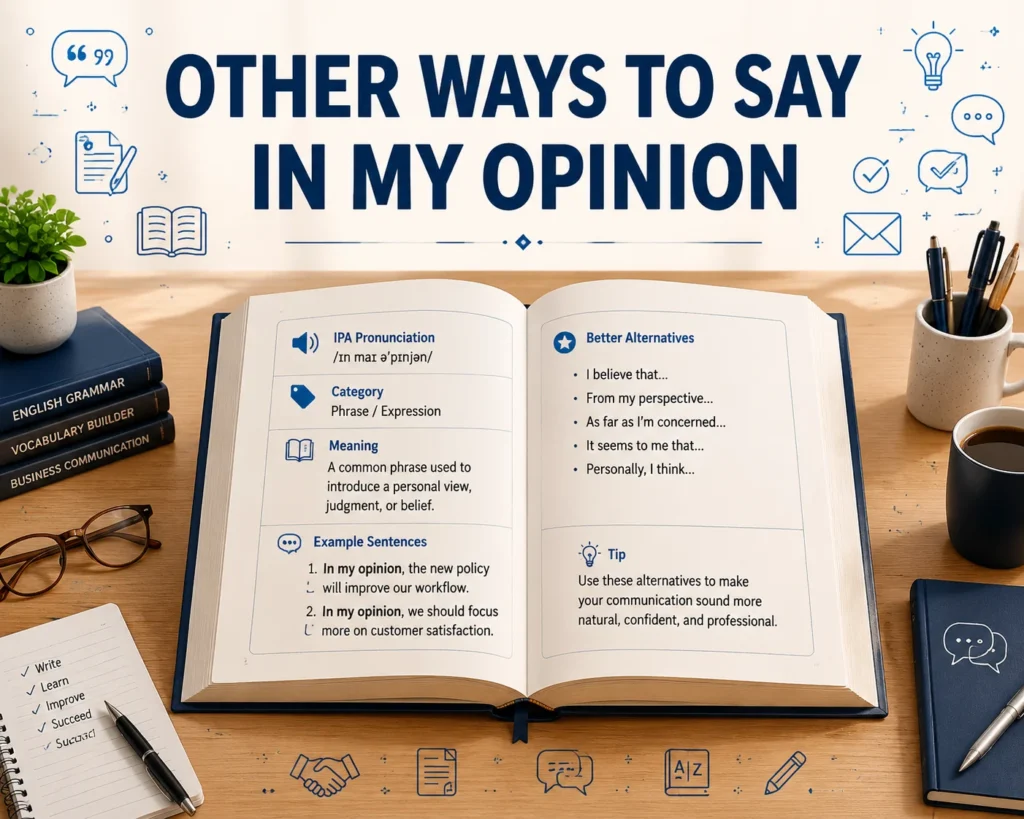
Looking for other ways to say in my opinion can help you sound more polished, confident, and natural in different situations. The phrase “in my opinion” is perfectly correct, but repeating it can make your writing sound predictable. In emails, workplace communication, academic writing, client conversations, and everyday discussions, a well-chosen alternative can make your message more effective.
You might want a professional way to say “in my opinion” when sharing a recommendation with a manager or client. You may need a formal alternative to “in my opinion” for a report or presentation. In a friendly conversation, you may prefer expressions such as “I think,” “I feel,” or “From my perspective.”
The key is not simply to replace the phrase with a synonym. The best expression depends on how confident you want to sound, how formal the situation is, and whether you want to present a personal view, professional judgment, or carefully considered recommendation.
What Does “In My Opinion” Mean?
Literal Meaning
“In my opinion” introduces a personal belief, judgment, view, or interpretation.
For example:
“In my opinion, this strategy offers the best value.”
The speaker makes it clear that the statement represents their own view rather than an established fact.
Tone
The phrase normally sounds:
- Neutral
- Polite
- Personal
- Clear
- Moderately formal
It does not usually sound rude or overly casual.
Purpose
People use “in my opinion” to:
- Express a personal view
- Give a recommendation
- Explain a judgment
- Disagree politely
- Add perspective to a discussion
- Separate opinion from fact
- Make a strong statement sound less absolute
For example:
“In my opinion, we should launch the campaign next month.”
This communicates a recommendation while showing that the decision remains open for discussion.
Emotional Context
The phrase can also soften disagreement.
Compare:
“Your proposal will not work.”
with:
“In my opinion, your proposal may need some changes before implementation.”
The second version sounds more diplomatic.
However, “in my opinion” does not automatically make criticism polite. The rest of the sentence still matters.
Why Use Alternatives to “In My Opinion”?
Although the phrase is useful, repeating it in every paragraph can weaken your writing.
Consider:
“In my opinion, the report is clear. In my opinion, the introduction is strong. In my opinion, the conclusion needs work.”
The repetition feels unnatural.
A stronger version might say:
“I believe the report is clear. The introduction is particularly strong, although the conclusion could use more detail.”
Using different sentence structures creates smoother professional communication.
Another reason to use alternatives is precision. “I think” sounds conversational, while “from my perspective” sounds more professional. “My assessment is that” sounds more analytical.
Professional Usage of “In My Opinion”
1. Emails
In business emails, you can use:
- I believe
- I think
- From my perspective
- In my view
- Based on my experience
- My assessment is that
- I would suggest
- I would recommend
- From what I can see
- My understanding is that
Example:
“Based on my experience, this approach should reduce the implementation time.”
This sounds more professional than repeatedly writing “in my opinion.”
2. Workplace Communication
When speaking with colleagues, managers, or team members, use language that communicates confidence without sounding arrogant.
For example:
“From my perspective, we should focus on customer retention before expanding the product range.”
This sounds constructive and invites discussion.
3. Clients
Client communication requires diplomacy.
Instead of:
“In my opinion, your current approach is wrong.”
Try:
“Based on what we have reviewed, I would recommend a different approach.”
This focuses on the recommendation rather than directly criticizing the client.
4. Networking
Networking conversations tend to be less formal.
You can naturally say:
“I think the biggest opportunity is improving customer experience.”
Or:
“From my perspective, the industry is moving toward more flexible solutions.”
5. Customer Service
Customer service representatives should avoid presenting personal opinions as company policy.
Instead of:
“In my opinion, you should choose the premium package.”
Use:
“Based on your requirements, I would recommend the premium package.”
This sounds helpful without pretending that a personal opinion represents the company.
Professional Alternatives
1. In my view
Meaning: This expresses your personal judgment.
Tone: Professional and neutral.
Best use: Business discussions, reports, emails.
Example:
“In my view, the proposal provides a strong foundation for the next phase.”
2. From my perspective
Meaning: This presents an issue from your personal or professional viewpoint.
Tone: Professional and thoughtful.
Best use: Meetings, workplace discussions, client conversations.
Example:
“From my perspective, improving communication should be our first priority.”
3. I believe
Meaning: This expresses a considered belief.
Tone: Professional and confident.
Best use: Emails, presentations, reports.
Example:
“I believe this approach will produce better long-term results.”
4. I think
Meaning: A simple way to express a personal view.
Tone: Friendly and neutral.
Best use: Everyday business communication.
Example:
“I think we should review the proposal once more.”
5. Based on my experience
Meaning: Your opinion comes from your previous knowledge or work.
Tone: Professional and credible.
Best use: Advice, recommendations, consulting.
Example:
“Based on my experience, customers respond better to simpler pricing.”
6. From what I can see
Meaning: You are giving a judgment based on available information.
Tone: Professional and cautious.
Best use: Analysis and meetings.
Example:
“From what I can see, the current process is working well.”
7. My assessment is that
Meaning: You have evaluated information and reached a conclusion.
Tone: Formal and analytical.
Best use: Reports, management communication.
Example:
“My assessment is that the project requires additional resources.”
8. My view is that
Meaning: A direct statement of your position.
Tone: Professional.
Best use: Business discussions and written communication.
Example:
“My view is that we should prioritize quality over speed.”
9. I would suggest
Meaning: You are offering an idea without presenting it as an absolute requirement.
Tone: Polite and diplomatic.
Best use: Emails and workplace discussions.
Example:
“I would suggest moving the meeting to Thursday.”
10. I would recommend
Meaning: You are giving a considered recommendation.
Tone: Professional and confident.
Best use: Client communication, consulting, business emails.
Example:
“I would recommend reviewing the contract before signing.”
11. I would argue that
Meaning: You are presenting a reasoned position.
Tone: Confident and analytical.
Best use: Reports, presentations, debates.
Example:
“I would argue that customer retention should receive greater attention.”
12. It seems to me that
Meaning: This signals a personal interpretation.
Tone: Polite and cautious.
Best use: Diplomatic discussions.
Example:
“It seems to me that the team needs clearer priorities.”
13. As I see it
Meaning: This means “from my point of view.”
Tone: Professional but conversational.
Best use: Meetings and discussions.
Example:
“As I see it, the main issue is communication.”
14. My perspective is that
Meaning: This introduces your particular viewpoint.
Tone: Professional.
Best use: Presentations and workplace discussions.
Example:
“My perspective is that we should invest more in training.”
15. From where I stand
Meaning: This presents your current position or viewpoint.
Tone: Conversational and professional.
Best use: Meetings and informal business discussions.
Example:
“From where I stand, the benefits outweigh the risks.”
Formal Alternatives
16. In my considered view
Meaning: Your opinion follows careful thought.
Tone: Formal.
Best use: Reports, formal correspondence, professional analysis.
Example:
“In my considered view, the proposed changes are reasonable.”
17. In my judgment
Meaning: Your conclusion comes from personal evaluation.
Tone: Formal and authoritative.
Best use: Formal writing and professional analysis.
Example:
“In my judgment, the proposal requires further review.”
18. In my estimation
Meaning: Your personal assessment of a situation.
Tone: Formal.
Best use: Business and analytical writing.
Example:
“In my estimation, the project can be completed within six months.”
19. It is my view that
Meaning: A formal way to introduce your position.
Tone: Very formal.
Best use: Reports, official communication.
Example:
“It is my view that the policy requires clarification.”
20. My considered opinion is that
Meaning: Your opinion follows deliberate consideration.
Tone: Formal and careful.
Best use: Formal reports and serious discussions.
Example:
“My considered opinion is that the proposal should be revised.”
21. I am of the view that
Meaning: A formal expression meaning “I believe.”
Tone: Formal.
Best use: Professional and official writing.
Example:
“I am of the view that additional evidence would strengthen the proposal.”
22. I take the view that
Meaning: This states your position on an issue.
Tone: Formal and analytical.
Best use: Reports, formal discussions.
Example:
“I take the view that the current process remains effective.”
23. My position is that
Meaning: This clearly states your stance.
Tone: Formal and firm.
Best use: Negotiations, meetings, formal writing.
Example:
“My position is that the agreement should remain unchanged.”
24. My assessment suggests that
Meaning: Your evaluation points toward a conclusion.
Tone: Formal and cautious.
Best use: Analytical reports.
Example:
“My assessment suggests that demand will increase next quarter.”
25. The evidence leads me to believe
Meaning: Your opinion comes from available evidence.
Tone: Formal and evidence-based.
Best use: Reports, research, presentations.
Example:
“The evidence leads me to believe that the revised strategy will perform better.”
Friendly Alternatives
26. I think
Tone: Friendly and natural.
“I think this is our best option.”
27. I feel
Tone: Personal and conversational.
“I feel we should give the team more time.”
28. Personally, I think
Tone: Friendly and personal.
“Personally, I think the first option is better.”
29. If you ask me
Tone: Casual and conversational.
“If you ask me, we should wait another week.”
30. As I see it
Tone: Friendly and natural.
“As I see it, we have two good options.”
31. The way I see it
Tone: Conversational.
“The way I see it, both proposals have strengths.”
32. For me
Tone: Casual.
“For me, reliability matters more than appearance.”
33. From my side
Tone: Informal.
“From my side, the plan looks good.”
Note: “From my side” can sound less natural in standard business English. “From my perspective” is usually better.
34. I’d say
Tone: Friendly and concise.
“I’d say the second option offers better value.”
35. I’d say that
Tone: Casual but clear.
“I’d say that we are ready to move forward.”
Email-Friendly Alternatives
These expressions work especially well in business emails.
36. I believe
“I believe the revised schedule is realistic.”
37. I would recommend
“I would recommend reviewing the figures before approval.”
38. I would suggest
“I would suggest scheduling a short follow-up call.”
39. From my perspective
“From my perspective, the proposal addresses the main concerns.”
40. Based on my experience
“Based on my experience, this process tends to take several weeks.”
41. Based on the information available
“Based on the information available, the current plan appears workable.”
42. My assessment is that
“My assessment is that we need additional data.”
43. My recommendation would be
“My recommendation would be to begin with a smaller rollout.”
44. I would be inclined to
Meaning: You lean toward a particular choice.
Tone: Polite and diplomatic.
“I would be inclined to postpone the launch until next month.”
45. I see it as
Meaning: You interpret something in a particular way.
Tone: Professional and natural.
“I see it as an opportunity to improve the customer experience.”
Workplace Alternatives
46. From my perspective
“From my perspective, the team needs clearer deadlines.”
47. In my view
“In my view, the current workflow is too complicated.”
48. I believe
“I believe we can resolve this issue quickly.”
49. I would recommend
“I would recommend assigning one person to coordinate the project.”
50. My view is that
“My view is that we should focus on the highest-priority tasks first.”
51. As I see it
“As I see it, the main challenge is the lack of communication.”
52. Based on what we know
“Based on what we know, the project remains on schedule.”
53. From my experience
“From my experience, regular feedback improves team performance.”
54. I would suggest
“I would suggest discussing this with the department head.”
55. My recommendation is
“My recommendation is to test the process before implementing it company-wide.”
Quick Comparison Table
| Alternative | Tone | Best Use |
| In my opinion | Neutral | General communication |
| In my view | Professional | Business writing |
| From my perspective | Professional | Meetings and emails |
| I believe | Confident | Business communication |
| I think | Friendly | Everyday conversation |
| I feel | Personal | Informal discussion |
| Based on my experience | Credible | Advice |
| My assessment is that | Analytical | Reports |
| I would recommend | Professional | Client advice |
| I would suggest | Diplomatic | Workplace requests |
| As I see it | Conversational | Meetings |
| From where I stand | Conversational | Discussions |
| In my judgment | Formal | Formal analysis |
| In my estimation | Formal | Business analysis |
| I am of the view that | Very formal | Official writing |
| I take the view that | Formal | Reports |
| My position is that | Firm | Negotiations |
| The way I see it | Casual | Friendly discussion |
| If you ask me | Casual | Informal conversation |
| I’d say | Friendly | Everyday business |
Email Examples
Client Email
Based on our review of the current requirements, I would recommend starting with the smaller package. This approach should give us enough flexibility to adjust the project later.
This sounds more useful than simply saying:
“In my opinion, the smaller package is better.”
Manager Email
From my perspective, the revised timeline is achievable, provided we receive the remaining information by Friday.
This communicates your judgment while clearly explaining the condition behind it.
Colleague Email
I think the second option may be easier for the team to implement. I would suggest discussing both options during tomorrow’s meeting.
The tone remains friendly without sounding too casual.
Customer Email
Based on the information you provided, I would recommend the standard package because it includes the features you mentioned.
This sounds like professional advice rather than an unsupported personal opinion.
Networking Email
From my perspective, the industry is moving toward more flexible service models. I would be interested to hear your thoughts on this trend.
This invites conversation rather than presenting your opinion as absolute fact.
Meeting Follow-Up
My assessment is that we have addressed the main concerns raised during today’s meeting. I would recommend confirming the revised timeline before moving forward.
This works well when summarizing a professional discussion.
Common Mistakes
1. Repeating “In My Opinion”
Using the same phrase repeatedly can make your writing sound mechanical.
Instead, vary your sentence structure:
“I believe…”
“From my perspective…”
“Based on my experience…”
“I would recommend…”
2. Using “I Feel” for Facts
“I feel” expresses a personal reaction or belief. It should not replace evidence.
Weak:
“I feel the sales increased by 20%.”
Better:
“The sales figures show a 20% increase.”
Then add your interpretation:
“I believe the new campaign contributed to this growth.”
3. Sounding Too Certain
Sometimes your opinion depends on incomplete information.
Instead of:
“This strategy will definitely work.”
Try:
“Based on the available information, I believe this strategy is likely to work.”
This creates a more credible tone.
4. Sounding Too Uncertain
The opposite problem can also weaken professional communication.
Too weak:
“I kind of think maybe we should consider changing it.”
Better:
“I would recommend changing the approach.”
5. Using Formal Language Everywhere
“I am of the view that” can sound unnatural in an ordinary email.
For most business communication, “I believe,” “in my view,” or “from my perspective” sounds more natural.
6. Using Casual Expressions With Clients
Phrases such as:
- “If you ask me”
- “For me”
- “The way I see it”
can sound too conversational in some client settings.
Choose:
“Based on our assessment…”
instead.
7. Presenting Opinions as Company Policy
Avoid:
“In my opinion, our company does not allow this.”
If you are communicating policy, verify the policy first.
Better:
“Our current policy does not permit this.”
Related Phrases
1. From my perspective
Means from your particular point of view.
“From my perspective, the plan is practical.”
2. In my view
A professional alternative to “in my opinion.”
“In my view, the proposal needs more detail.”
3. I believe
Expresses a considered belief.
“I believe we should proceed.”
4. I think
A common everyday expression of opinion.
“I think this option is better.”
5. I feel
Expresses a personal impression or feeling.
“I feel the team needs more support.”
6. Personally
Highlights an individual preference.
“Personally, I prefer the first option.”
7. As I see it
Introduces your interpretation.
“As I see it, the problem is timing.”
8. From my experience
Connects your opinion to past experience.
“From my experience, customers value simple processes.”
9. Based on my experience
A stronger professional version.
“Based on my experience, early planning reduces delays.”
10. My assessment is
Introduces an evaluation.
“My assessment is that the risk remains low.”
11. My recommendation is
Introduces a specific recommendation.
“My recommendation is to delay the launch.”
12. I would suggest
Offers an idea politely.
“I would suggest reviewing the figures.”
13. I would recommend
Offers a stronger professional recommendation.
“I would recommend conducting another test.”
14. It seems to me
Introduces a cautious interpretation.
“It seems to me that the issue is mainly procedural.”
15. My understanding is
Introduces your interpretation of information.
“My understanding is that the deadline remains unchanged.”
16. As far as I can tell
Signals that your conclusion depends on available information.
“As far as I can tell, everything is ready.”
17. Based on the available information
Makes your reasoning clear.
“Based on the available information, the proposal appears reasonable.”
18. From where I stand
Introduces your current position.
“From where I stand, the benefits outweigh the risks.”
Phrase Comparison
“In My Opinion” vs. “In My View”
These phrases have almost the same meaning.
In my opinion sounds neutral.
In my view often sounds slightly more polished in business writing.
“In My Opinion” vs. “I Think”
“I think” sounds more conversational.
“I think we should wait.”
“In my opinion” sounds slightly more deliberate.
“In my opinion, we should wait.”
Both are correct.
“In My Opinion” vs. “I Believe”
“I believe” can sound more confident and professional.
“I believe this approach will improve efficiency.”
Use it when you want to present a considered position.
“In My Opinion” vs. “From My Perspective”
“From my perspective” emphasizes your viewpoint rather than simply labeling something as an opinion.
“From my perspective, the issue requires better communication.”
It works particularly well in workplace discussions.
“In My Opinion” vs. “Based on My Experience”
“Based on my experience” adds a reason for your opinion.
Compare:
“In my opinion, the system needs improvement.”
with:
“Based on my experience, the system needs improvement.”
The second statement sounds more evidence-based.
“In My Opinion” vs. “I Would Recommend”
These phrases serve different purposes.
In my opinion introduces a view.
I would recommend introduces advice.
“In my opinion, the first option is stronger.”
“I would recommend choosing the first option.”
The second sounds more action-oriented.
Cultural Usage
US English
American business communication commonly uses:
- I think
- I believe
- In my view
- From my perspective
- I would recommend
- I would suggest
Direct but polite language often works well.
UK English
British professional English frequently uses polite and somewhat indirect expressions such as:
- I would suggest
- I would recommend
- In my view
- I would be inclined to
- It seems to me
However, these expressions are not exclusively British. Many work naturally in international English.
Corporate Communication
Corporate writing should balance confidence and openness.
Instead of:
“My opinion is that everyone is wrong.”
Use:
“From my perspective, there may be another way to approach this.”
This encourages discussion without weakening your position.
Customer Service
Customer service workers should distinguish between personal opinion and official guidance.
Instead of:
“In my opinion, you should buy this product.”
Use:
“Based on your requirements, I would recommend this option.”
Networking
Networking favors natural language.
Good choices include:
“I think…”
“From my perspective…”
“As I see it…”
Avoid overly formal expressions unless the setting requires them.
How to Sound More Professional Than “In My Opinion”
A useful trick is to connect your opinion to evidence, experience, or a recommendation.
Basic
“In my opinion, the project is ready.”
More professional
“Based on the current results, I believe the project is ready.”
More analytical
“My assessment is that the project is ready for the next phase.”
More action-oriented
“I would recommend moving the project to the next phase.”
The strongest version depends on your purpose.
Best Alternativ.es by Situation
For a business email
- I believe
- From my perspective
- In my view
- I would recommend
- I would suggest
For a formal report
- In my considered view
- In my judgment
- My assessment is that
- I take the view that
- The evidence leads me to believe
For a client
- Based on our assessment
- Based on the information available
- I would recommend
- I would suggest
- From our perspective
For a manager
- From my perspective
- I believe
- My assessment is that
- I would recommend
- In my view
For a colleague
- I think
- I believe
- As I see it
- From my perspective
- I would suggest
For casual conversation
- I think
- I feel
- Personally
- If you ask me
- The way I see it
Faqs
What are other ways to say “in my opinion”?
Common alternatives include in my view, from my perspective, I believe, I think, as I see it, based on my experience, and my assessment is that.
What is a professional way to say “in my opinion”?
“From my perspective,” “I believe,” “in my view,” and “based on my experience” are strong professional choices.
What is a formal alternative to “in my opinion”?
Try “in my considered view,” “in my judgment,” “I am of the view that,” or “I take the view that.”
What is the best synonym for “in my opinion”?
There is no single perfect synonym. “In my view” is probably the closest direct replacement.
Can I use “I think” instead of “in my opinion”?
Yes. “I think” is natural and grammatically correct, but it usually sounds more conversational.
Is “in my view” professional?
Yes. “In my view” works well in emails, meetings, reports, and professional discussions.
Is “from my perspective” formal?
It is moderately formal and works very well in business communication. It sounds professional without being overly stiff.
What is a polite way to give an opinion?
Try “I would suggest,” “I would recommend,” “from my perspective,” or “it seems to me that.”
How can I disagree politely?
Use phrases such as:
“I see it differently.”
“From my perspective, there may be another approach.”
“I would suggest considering another option.”
These expressions reduce the risk of sounding confrontational.
What is the best phrase for a business email?
“I believe” and “I would recommend” are excellent choices because they sound confident and professional.
What can I say instead of “in my opinion” in an essay?
Use “in my view,” “this suggests,” “the evidence indicates,” or “it can be argued that,” depending on whether you are expressing personal judgment or analyzing evidence.
Is “I feel” a professional alternative?
Yes, but use it carefully. “I feel” works for personal reactions or judgments. For evidence-based business writing, “I believe” or “my assessment is” may sound stronger.
How do I avoid repeating “in my opinion”?
Vary your sentence openings and use expressions such as I believe, from my perspective, in my view, based on my experience, and I would recommend.
What is a confident alternative to “in my opinion”?
“I believe” or “my assessment is that” can sound more confident, especially when you have evidence or experience to support your position.
What is the most natural alternative in everyday English?
“I think” is usually the most natural everyday alternative.
Final Summary
The best alternative to “in my opinion” depends on the tone and purpose of your message. For professional communication, choose “I believe,” “in my view,” “from my perspective,” or “I would recommend.” For formal writing, “in my considered view,” “in my judgment,” and “I take the view that” work well. For casual conversation, “I think,” “I feel,” “personally,” and “the way I see it” sound natural. In business emails, connect opinions with evidence, experience, or recommendations whenever possible. This approach makes your writing clearer, more credible, and more useful while avoiding repetitive phrasing.
Conclusion
“In my opinion” remains a correct and useful expression, but strong communicators know when to choose a better-fitting alternative. Use “I believe” for confident professional statements, “from my perspective” for workplace discussions, “I would recommend” for advice, and “in my considered view” for formal writing. Use “I think” in relaxed conversations. Most importantly, match your wording to your audience and purpose. A professional opinion should sound confident without sounding absolute. By varying your language and supporting your views with evidence or experience, you can make emails, reports, meetings, and everyday conversations more natural and persuasive.