
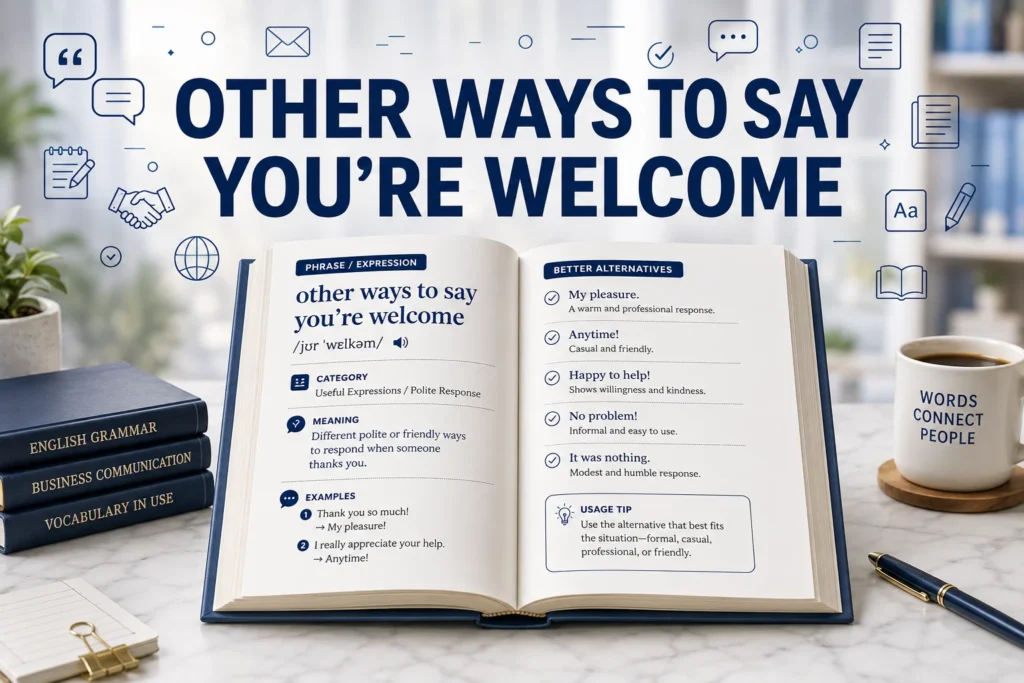
Whether you’re replying to a coworker, client, manager, friend, or customer, “you’re welcome” is one of the most common responses after someone says “thank you.” While it’s always polite, repeating the same phrase can sound repetitive, especially in professional communication.
Learning other ways to say you’re welcome helps you sound more natural, confident, and professional. The right response also helps build stronger relationships in emails, customer service, networking, and everyday conversations.
For example, replying to a client with “My pleasure” creates a warmer impression than simply saying “You’re welcome.” Likewise, telling a teammate “Happy to help” sounds more collaborative and friendly in the workplace.
In this guide, you’ll discover the meaning of “you’re welcome,” when to use it, and the best professional alternatives for emails, workplace communication, customer service, and everyday conversations. Each alternative includes its tone, best use case, and a practical example.
What Does “You’re Welcome” Mean?
“You’re welcome” is a polite expression used after someone thanks you. It acknowledges their gratitude while showing that helping them was no trouble.
Literal Meaning
The phrase means:
You are welcome to my help, kindness, or service.
It tells the other person that you’re glad you could assist them.
Tone
The tone is generally:
- Polite
- Respectful
- Friendly
- Professional
- Appreciative
Purpose
People use “you’re welcome” to:
- Respond to thanks politely
- Show kindness
- Build positive relationships
- End conversations on a pleasant note
- Maintain professional communication
Emotional Context
Depending on how it’s said, the phrase can feel:
- Warm
- Genuine
- Formal
- Casual
- Supportive
For this reason, choosing the right alternative can make your response sound more personal and natural.
Examples
Friend
Thanks for picking me up.
You’re welcome!
Thank you for your quick response.
You’re welcome. I’m glad I could help.
Customer
Thanks for solving my issue.
You’re very welcome. Please let us know if you need anything else.
Why Do People Look for Other Ways to Say “You’re Welcome”?
Many people search for alternatives because they want to:
- Avoid repeating the same phrase
- Sound more professional in emails
- Improve workplace communication
- Respond naturally to clients
- Write better business emails
- Sound warmer in customer service
- Build stronger networking relationships
Using different expressions also helps your communication match the situation. A formal email requires a different tone than a casual chat with a coworker.
When Is “You’re Welcome” Appropriate?
The phrase works well in almost every setting.
Emails
Suitable for professional replies after someone thanks you.
Example:
You’re welcome. I’m pleased I could assist with your request.
Workplace
Perfect for helping teammates or managers.
Example:
You’re welcome. Let me know if you need anything else.
Clients
Professional and respectful.
Example:
You’re welcome. It was a pleasure supporting your project.
Networking
Keeps conversations positive.
Example:
You’re welcome. I enjoyed meeting you as well.
Customer Service
Shows appreciation while remaining professional.
Example:
You’re welcome. We’re always happy to help.
Professional Ways to Say “You’re Welcome”
Below are some of the best professional alternatives you can use in emails, meetings, customer service, and workplace communication.
1. My Pleasure
Meaning: Helping you was enjoyable.
Tone: Warm, professional
Best Use: Clients, hospitality, customer service
Example
Thank you for your assistance.
My pleasure. Feel free to contact me anytime.
2. Happy to Help
Meaning: I was glad to assist.
Tone: Friendly, professional
Best Use: Workplace, coworkers, customers
Example
Happy to help. Let me know if you have more questions.
3. Glad I Could Help
Meaning: I’m pleased my assistance was useful.
Tone: Warm
Best Use: Emails, teamwork
Example
Glad I could help. Good luck with your presentation.
4. Don’t Mention It
Meaning: It wasn’t a big deal.
Tone: Casual but polite
Best Use: Friends, coworkers
Example
Don’t mention it. Anytime.
5. No Problem
Meaning: Helping caused no inconvenience.
Tone: Casual
Best Use: Everyday conversations
Example
No problem. I’m happy everything worked out.
6. Not a Problem
Meaning: It wasn’t difficult.
Tone: Neutral
Best Use: Workplace and customer support
Example
Not a problem. I’ll send the documents today.
7. Anytime
Meaning: I’m willing to help again.
Tone: Friendly
Best Use: Colleagues, friends
Example
Anytime. Just let me know whenever you need assistance.
8. You’re Most Welcome
Meaning: A more formal version of “You’re welcome.”
Tone: Formal
Best Use: Clients, senior professionals
Example
You’re most welcome. Thank you for choosing our services.
9. It Was Nothing
Meaning: The task required little effort.
Tone: Casual
Best Use: Friends and teammates
Example
It was nothing. I’m happy to help.
10. I’m Happy to Assist
Meaning: I enjoyed providing assistance.
Tone: Professional
Best Use: Business emails
Example
I’m happy to assist. Please reach out if additional support is needed.
11. Delighted to Help
Meaning: Helping was a pleasure.
Tone: Formal and warm
Best Use: Clients, executives
Example
Delighted to help. We appreciate your business.
12. It Was My Pleasure
Meaning: I truly enjoyed helping.
Tone: Polished and professional
Best Use: Customer service
Example
It was my pleasure assisting you today.
13. Always Happy to Help
Meaning: I’m consistently willing to help.
Tone: Friendly professional
Best Use: Workplace
Example
Always happy to help. Let me know if anything else comes up.
14. Absolutely
Meaning: Of course.
Tone: Confident
Best Use: Quick conversations
Example
Absolutely. Happy to help.
15. Of Course
Meaning: It was expected.
Tone: Friendly
Best Use: Team collaboration
Example
Of course. That’s what teammates are for.
16. It Was the Least I Could Do
Meaning: Helping was only fair.
Tone: Sincere
Best Use: Meaningful situations
Example
It was the least I could do after all your support.
17. I’m Here to Help
Meaning: You can rely on me.
Tone: Supportive
Best Use: Customer support and workplaces
Example
I’m here to help whenever you need assistance.
18. The Pleasure Is Mine
Meaning: I enjoyed helping you.
Tone: Formal
Best Use: Networking and business
Example
The pleasure is mine. I enjoyed working with you.
19. It Was a Pleasure
Meaning: Working with you was enjoyable.
Tone: Professional
Best Use: Meetings and projects
Example
It was a pleasure collaborating with your team.
20. I’m Always Here If You Need Me
Meaning: Future help is available.
Tone: Friendly, supportive
Best Use: Workplace relationships
Example
I’m always here if you need me. Don’t hesitate to ask.
Quick Comparison Table
| Alternative | Tone | Best Use |
| My Pleasure | Professional | Clients |
| Happy to Help | Friendly | Workplace |
| Glad I Could Help | Warm | Teams |
| You’re Most Welcome | Formal | Business |
| I’m Happy to Assist | Professional | Emails |
| Delighted to Help | Formal | Executives |
| The Pleasure Is Mine | Formal | Networking |
| I’m Here to Help | Supportive | Customer Service |
| Anytime | Casual | Friends & Colleagues |
| Of Course | Friendly | Everyday Workplace |
| No Problem | Casual | Informal Conversations |
| Not a Problem | Neutral | Customer Support |
| It Was My Pleasure | Professional | Hospitality |
| Always Happy to Help | Friendly | Office Communication |
| It Was a Pleasure | Professional | Projects |
| It Was the Least I Could Do | Sincere | Personal Support |
| Absolutely | Confident | Quick Replies |
| Don’t Mention It | Casual | Friends |
| It Was Nothing | Casual | Informal Chats |
| I’m Always Here If You Need Me | Warm | Long-Term Relationships |
In this section, you’ll discover more professional, friendly, workplace, and email alternatives to “you’re welcome.” Each phrase includes its meaning, tone, best use case, and an example so you can choose the right response for any situation.
Friendly Ways to Say “You’re Welcome”
These alternatives are perfect for conversations with friends, family, classmates, coworkers, or anyone you know well.
21. Sure Thing
Meaning: Of course, I was happy to help.
Tone: Casual and friendly
Best Use: Friends, coworkers
Example:
Sure thing! Let me know if you need anything else.
22. You Bet
Meaning: Absolutely.
Tone: Casual
Best Use: American English conversations
Example:
You bet! I’m glad everything worked out.
23. No Worries
Meaning: It wasn’t a problem.
Tone: Relaxed
Best Use: Friends, coworkers, Australian and UK English
Example:
No worries. Happy to help.
24. That’s What I’m Here For
Meaning: Helping is part of my role.
Tone: Friendly and supportive
Best Use: Workplace and customer service
Example:
That’s what I’m here for. Let me know anytime.
25. Any Time
Meaning: I’m always available to help.
Tone: Friendly
Best Use: Friends and colleagues
Example:
Any time! Just send me a message.
26. Happy Anytime
Meaning: I’ll gladly help again.
Tone: Warm
Best Use: Informal conversations
Example:
Happy anytime. Don’t hesitate to ask.
27. It Was Fun Helping
Meaning: I enjoyed assisting.
Tone: Cheerful
Best Use: Friends and team projects
Example:
It was fun helping. We should do it again sometime.
28. You’re Worth It
Meaning: Helping you was worthwhile.
Tone: Warm and personal
Best Use: Close friends and family
Example:
You’re worth it. I’m always happy to help.
29. Glad It Helped
Meaning: I’m pleased my help made a difference.
Tone: Friendly
Best Use: Workplace and casual conversations
Example:
Glad it helped. Good luck with the rest of your project.
30. I Got You
Meaning: You can count on me.
Tone: Very casual
Best Use: Friends
Example:
I got you. Anytime.
Email Alternatives to “You’re Welcome”
Professional emails often sound better with more polished responses.
31. It Was a Pleasure Assisting You
Meaning: Helping you was enjoyable.
Tone: Formal
Best Use: Client emails
Example:
It was a pleasure assisting you. Please reach out if you need further support.
32. Thank You for Your Kind Words
Meaning: Acknowledge appreciation instead of saying “You’re welcome.”
Tone: Professional
Best Use: Business emails
Example:
Thank you for your kind words. I’m glad I could assist.
33. I’m Glad We Could Help
Meaning: Shows teamwork.
Tone: Professional
Best Use: Company emails
Example:
I’m glad we could help. Let us know if there’s anything else you need.
34. It Was Great Working With You
Tone: Warm and professional
Best Use: Project completion
Example:
It was great working with you. We look forward to future collaborations.
35. Please Feel Free to Reach Out Anytime
Meaning: Invites future communication.
Tone: Professional
Best Use: Client support
Example:
Please feel free to reach out anytime if you need assistance.
36. I’m Pleased I Could Assist
Tone: Formal
Best Use: Executive communication
Example:
I’m pleased I could assist with your request.
37. It Was My Privilege
Tone: Respectful
Best Use: Formal occasions
Example:
It was my privilege to support your project.
38. We Appreciate Your Trust
Tone: Professional
Best Use: Customer service
Example:
We appreciate your trust in our team.
39. We’re Always Here to Help
Tone: Supportive
Best Use: Customer support
Example:
We’re always here to help whenever you need us.
40. Thank You for Choosing Us
Tone: Customer-focused
Best Use: Business and service emails
Example:
Thank you for choosing us. We truly appreciate your business.
Workplace Alternatives
These expressions fit meetings, office conversations, Slack messages, Microsoft Teams chats, and professional emails.
41. Happy to Support
Meaning: I’m glad to assist your work.
Example:
Happy to support the project.
42. Glad We Got It Sorted
Tone: Friendly
Example:
Glad we got it sorted.
43. I Appreciate Your Thanks
Tone: Professional
Example:
I appreciate your thanks. It was a team effort.
44. Teamwork Makes It Easy
Tone: Positive
Example:
Teamwork makes it easy. Happy to contribute.
45. That’s Why We’re a Team
Tone: Friendly
Example:
That’s why we’re a team.
46. Happy to Contribute
Tone: Professional
Example:
Happy to contribute to the project’s success.
47. It’s All Part of the Job
Tone: Neutral
Example:
It’s all part of the job.
48. I Appreciate the Opportunity
Tone: Professional
Example:
I appreciate the opportunity to help.
49. Thanks for Letting Me Help
Tone: Friendly
Example:
Thanks for letting me help.
50. Looking Forward to Working Together Again
Tone: Professional
Example:
Looking forward to working together again.
Ready-to-Use Email Examples
Client
Thank you for your kind feedback. It was a pleasure assisting you. Please let me know if there’s anything else I can do.
Manager
I’m glad I could help with the report. Please let me know if you’d like any additional revisions.
Colleague
Happy to help! Feel free to reach out anytime.
Customer
You’re most welcome. We appreciate your business and are always here to help.
Networking
It was a pleasure connecting with you. I hope we have the opportunity to collaborate again.
Meeting Follow-up
Thank you for today’s discussion. I’m happy to assist with any next steps if needed.
Common Mistakes When Saying “You’re Welcome”
1. Overusing the Same Phrase
Repeating “You’re welcome” in every email can make your communication sound repetitive.
Better: Rotate between:
- My pleasure
- Happy to help
- Glad I could assist
- It was a pleasure
2. Using Casual Phrases in Formal Emails
Avoid phrases like:
- No worries
- Yep
- Sure thing
- I got you
when writing to executives or clients.
3. Being Too Formal in Casual Conversations
Instead of saying:
It was my distinct privilege.
Simply say:
Happy to help!
4. Ending Business Emails Abruptly
Instead of replying with only:
You’re welcome.
Use:
You’re welcome. Please don’t hesitate to contact me if you need further assistance.
Business Email Etiquette Tips
- Match the other person’s tone.
- Keep your response genuine.
- Avoid robotic language.
- Be warm without being overly casual.
- Invite future communication when appropriate.
- Thank clients for their trust.
- End with a helpful offer whenever possible.
Following these simple practices makes your professional communication stronger and leaves a positive impression on clients, colleagues, and business partners.
Related Phrases to “You’re Welcome”
Besides saying “you’re welcome,” you can use many other expressions depending on the situation and the relationship you have with the other person.
| Phrase | Meaning | Example |
| My pleasure | I enjoyed helping. | My pleasure. Let me know if you need anything else. |
| Happy to help | I’m glad I could assist. | Happy to help with the project. |
| Glad I could help | I’m pleased my help was useful. | Glad I could help solve the issue. |
| No problem | It wasn’t difficult. | No problem at all! |
| Not a problem | Helping was easy. | Not a problem. I was available. |
| Anytime | I’m happy to help again. | Anytime! Just ask. |
| Of course | It was expected. | Of course. Happy to help. |
| Don’t mention it | No thanks are necessary. | Don’t mention it. |
| You’re most welcome | A formal response to thanks. | You’re most welcome. |
| It was my pleasure | I truly enjoyed helping. | It was my pleasure assisting you. |
| Delighted to help | I’m pleased to assist. | Delighted to help with your request. |
| The pleasure is mine | I also benefited from this interaction. | The pleasure is mine. |
| Always happy to help | I enjoy helping whenever needed. | Always happy to help. |
| I’m here to help | You can rely on me. | I’m here to help whenever needed. |
| Feel free to ask | You’re welcome to contact me again. | Feel free to ask anytime. |
Phrase Comparison
Choosing the right response depends on the situation, your relationship with the other person, and the level of formality.
| Phrase | Tone | Formality | Best Use |
| You’re Welcome | Neutral | Medium | Everyday conversations |
| My Pleasure | Warm | High | Clients, customer service |
| Happy to Help | Friendly | Medium | Workplace |
| Glad I Could Help | Warm | Medium | Teams and emails |
| You’re Most Welcome | Respectful | High | Formal business |
| No Problem | Casual | Low | Friends |
| Anytime | Friendly | Low | Colleagues |
| The Pleasure Is Mine | Elegant | High | Networking |
| I’m Here to Help | Supportive | Medium | Customer support |
| Of Course | Friendly | Low | Informal workplace |
Cultural Usage
US English
American English speakers often use:
- You’re welcome
- No problem
- Happy to help
- You bet
- Anytime
These phrases sound natural in both personal and professional conversations.
UK English
British English speakers commonly prefer:
- You’re welcome
- Not at all
- No worries
- My pleasure
- Don’t mention it
These expressions often sound slightly more reserved but remain polite.
Corporate Communication
In business settings, professionalism matters more than creativity.
Best choices include:
- My pleasure
- Happy to help
- It was a pleasure assisting you
- I’m pleased I could assist
- Please feel free to reach out anytime
These phrases create a positive impression while maintaining strong email etiquette.
Customer Service
Excellent customer service focuses on reassurance and future support.
Recommended responses include:
- We’re always here to help.
- My pleasure.
- It was a pleasure assisting you.
- Please let us know if you need anything else.
- Thank you for choosing us.
These responses make customers feel valued and encourage long-term loyalty.
Networking
Professional networking is about building relationships. Instead of ending conversations with a simple “you’re welcome,” choose expressions that invite future communication.
Examples:
- The pleasure is mine.
- It was great connecting with you.
- I look forward to working together again.
- Happy to stay in touch.
- Feel free to reach out anytime.
FAQs
What is the most professional way to say “you’re welcome”?
“My pleasure,” “I’m happy to assist,” and “It was a pleasure assisting you” are excellent professional alternatives.
What can I say instead of “you’re welcome” in an email?
Good options include:
- Happy to help
- My pleasure
- I’m glad I could assist
- Please feel free to reach out anytime
Is “no problem” professional?
It works in informal workplaces but may sound too casual in formal business communication.
Is “my pleasure” better than “you’re welcome”?
In many business situations, yes. It sounds warmer and more customer-focused.
What’s the best response to a client saying thank you?
Try:
My pleasure. Please let us know if we can assist further.
Is “you’re most welcome” formal?
Yes. It’s a respectful and polished alternative suitable for formal emails and customer service.
Can I say “happy to help” to my manager?
Absolutely. It sounds collaborative and professional.
Which phrase works best in customer service?
“My pleasure” and “We’re always here to help” are among the best choices.
Is “don’t mention it” appropriate in business?
Only in relaxed workplace conversations. It’s usually too informal for clients.
What’s the friendliest alternative?
“Happy to help,” “Anytime,” and “Of course” all sound warm and approachable.
Which expression is best for networking?
“The pleasure is mine” is an excellent choice because it shows mutual appreciation.
Should I always reply to “thank you”?
Yes. A polite response helps maintain positive and professional communication.
Is “you’re welcome” becoming outdated?
No. It’s still widely used, but mixing in alternatives makes your communication sound more natural.
What is the best formal alternative to “you’re welcome”?
“My pleasure,” “You’re most welcome,” and “I’m pleased I could assist” are strong formal options.
Why should I learn different ways to say “you’re welcome”?
Using a variety of expressions improves workplace communication, strengthens relationships, and helps your emails sound more engaging and professional.
Final Summary
Whether you’re responding to a client, manager, colleague, customer, or friend, using different ways to say “you’re welcome” helps your communication sound more natural and thoughtful.
For professional emails, phrases like “My pleasure,” “I’m happy to assist,” and “It was a pleasure assisting you” leave a positive impression. In workplace conversations, “Happy to help” and “Glad I could help” encourage teamwork. For casual situations, expressions such as “No problem,” “Anytime,” and “Of course” feel relaxed and friendly.
Choosing the right response based on the situation, tone, and audience improves professional communication, strengthens relationships, and demonstrates excellent email etiquette. Building a varied vocabulary allows you to communicate with confidence in every personal and professional setting.
Conclusion
Knowing other ways to say “you’re welcome” allows you to respond with confidence, professionalism, and warmth in every situation. Whether you’re writing business emails, helping a customer, supporting a coworker, or chatting with friends, choosing the right expression can leave a lasting positive impression. Professional alternatives such as “My pleasure,” “Happy to help,” and “I’m pleased I could assist” work well in formal settings, while casual phrases like “No problem” and “Anytime” are perfect for everyday conversations. By matching your response to the context, you’ll improve workplace communication, strengthen relationships, and become a more effective communicator.