
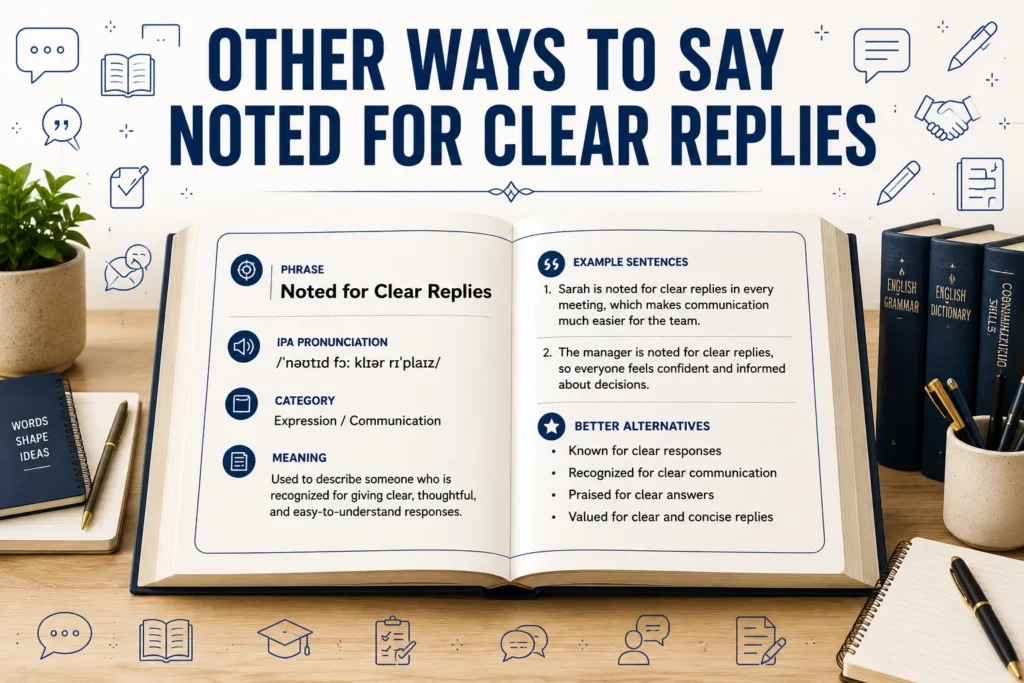
The phrase “noted” is short, useful, and common in professional communication. It tells someone that you have received, understood, or recorded the information they shared. However, using “noted” repeatedly can sometimes make your emails or messages sound too brief, cold, or mechanical.
That is why many people look for other ways to say noted for clear replies. A better alternative can make your response sound more professional, friendly, respectful, or specific depending on the situation.
For example, instead of simply writing “Noted,” you could say “Thank you for the update,” “I understand,” “I’ll keep that in mind,” or “Thanks for letting me know.” Each option communicates acknowledgment, but each creates a slightly different impression.
The best response depends on who you are speaking to and what you want to communicate. A client may need a polished business email phrase, while a colleague may prefer a simple and friendly response. A manager may expect a respectful acknowledgment, while a customer may appreciate a warmer reply.
This guide explains the meaning of “noted” and provides practical alternatives for email etiquette, workplace communication, professional communication, customer service, clients, networking, and everyday business conversations.
What Does “Noted” Mean?
“Noted” generally means that you have received, understood, remembered, or recorded information.
When someone sends you an instruction, update, request, reminder, or piece of information, replying “Noted” tells them that you have acknowledged it.
Example
Manager:
“Please submit the report by Friday.”
Reply:
“Noted.”
The response is clear, but it does not tell the manager much beyond the fact that you received the message.
A slightly more specific response could be:
“Understood. I’ll submit the report by Friday.”
This version confirms both acknowledgment and your intended action.
Literal Meaning
The word “noted” comes from the idea of making a note or recording information.
In modern business communication, however, it usually means:
- I received your message.
- I understand what you said.
- I have taken note of the information.
- I will remember this.
- I understand the instruction.
- I acknowledge your update.
The exact meaning depends on the context.
Tone of “Noted”
“Noted” can sound:
- Professional
- Brief
- Neutral
- Efficient
- Formal
- Sometimes cold or distant
The tone depends heavily on the situation and the relationship between the people communicating.
For example:
“Noted. Thank you.”
sounds warmer than:
“Noted.”
Similarly:
“Understood. I’ll take care of it.”
sounds more responsive than simply:
“Noted.”
Why Look for Other Ways to Say “Noted”?
There is nothing wrong with “noted,” but repetition can make your communication sound predictable.
A one-word reply can also leave the other person wondering whether you actually understood their message or plan to take action.
Consider these two responses:
Option 1:
“Noted.”
Option 2:
“Thanks for the update. I’ll make sure this is reflected in the report.”
The second response provides more context and shows engagement.
You may also need different expressions for different situations. A formal client email requires a different tone from a quick message to a coworker.
Finding the right synonym for noted can therefore help you make your communication clearer and more natural.
When Should You Use Alternatives to “Noted”?
You can use alternatives in many professional situations.
1. Emails
In business emails, a more complete response often sounds better than a one-word acknowledgment.
Instead of:
“Noted.”
Try:
“Thank you for the update. I’ll take this into consideration.”
2. Workplace Communication
When responding to a manager or coworker, choose an expression that shows whether you simply received the information or intend to act on it.
“Understood. I’ll complete the task today.”
is more useful than:
“Noted.”
3. Clients
Clients often appreciate acknowledgment combined with reassurance.
“Thank you for letting us know. We’ll take care of this.”
This sounds more attentive and customer-focused.
4. Networking
Networking messages usually benefit from a warm and conversational tone.
“Thanks for sharing that. I’ll keep it in mind.”
sounds more natural than a formal “Noted.”
5. Customer Service
Customer service replies should acknowledge the customer’s concern and, when appropriate, explain the next step.
“Thank you for bringing this to our attention. We’ll look into it right away.”
This provides reassurance rather than simply confirming receipt.
Professional Alternatives
1. Understood.
Meaning: You clearly understand the information or instruction.
Tone: Professional and direct.
Best use: Instructions, workplace communication, and business emails.
Example:
“Understood. I’ll update the document accordingly.”
2. Acknowledged.
Meaning: You confirm that you received and recognized the information.
Tone: Formal and professional.
Best use: Corporate communication, official messages, and work instructions.
Example:
“Acknowledged. We’ll proceed with the requested changes.”
3. Thank you for the update.
Meaning: You appreciate the information someone provided.
Tone: Polite and professional.
Best use: Emails, client communication, and workplace updates.
Example:
“Thank you for the update. I’ll review the changes.”
4. I understand.
Meaning: You have understood what the person explained.
Tone: Clear and respectful.
Best use: Instructions, explanations, and discussions.
Example:
“I understand. I’ll follow the revised procedure.”
5. I’ve taken note of this.
Meaning: You have recorded or remembered the information.
Tone: Professional and slightly formal.
Best use: Business emails and official communication.
Example:
“I’ve taken note of this and will keep it in mind going forward.”
6. I’ll keep that in mind.
Meaning: You will remember the information when making decisions or taking action.
Tone: Polite and natural.
Best use: Advice, preferences, suggestions, and feedback.
Example:
“Thanks for the feedback. I’ll keep that in mind.”
7. Thanks for letting me know.
Meaning: You acknowledge the information and appreciate being informed.
Tone: Friendly and professional.
Best use: Workplace messages and emails.
Example:
“Thanks for letting me know. I’ll adjust the schedule.”
8. I’ve received your message.
Meaning: You confirm receipt.
Tone: Professional and neutral.
Best use: Emails and formal correspondence.
Example:
“I’ve received your message and will review the details shortly.”
9. I’ll take care of it.
Meaning: You acknowledge the request and confirm that you will handle it.
Tone: Confident and professional.
Best use: Tasks, instructions, and workplace requests.
Example:
“I’ll take care of it and send you an update this afternoon.”
10. I’ll follow up accordingly.
Meaning: You will take the appropriate next step.
Tone: Professional and polished.
Best use: Business emails and client communication.
Example:
“Thank you for the information. I’ll follow up accordingly.”
11. I’ll proceed as discussed.
Meaning: You will act according to the previous conversation.
Tone: Professional.
Best use: Meetings, projects, and workplace instructions.
Example:
“I’ll proceed as discussed and share the results tomorrow.”
12. I’ve noted your request.
Meaning: You confirm that you have received someone’s request.
Tone: Professional.
Best use: Client service and business communication.
Example:
“I’ve noted your request and will forward it to the relevant team.”
13. Thanks for the clarification.
Meaning: You appreciate information that made something clearer.
Tone: Polite and professional.
Best use: Emails, meetings, and discussions.
Example:
“Thanks for the clarification. I now understand the requirements.”
14. I’ll make a note of that.
Meaning: You will remember or record the information.
Tone: Professional but conversational.
Best use: Meetings, workplace discussions, and networking.
Example:
“I’ll make a note of that for our next meeting.”
15. I’ll bear that in mind.
Meaning: You will remember the information when appropriate.
Tone: Polite and somewhat formal.
Best use: Professional discussions and UK-style business communication.
Example:
“Thank you for the suggestion. I’ll bear that in mind.”
Formal Alternatives
16. Duly noted.
Meaning: The information has been properly acknowledged.
Tone: Formal and official.
Best use: Formal correspondence and workplace communication.
Example:
“Duly noted. We will make the necessary adjustments.”
Although useful, “duly noted” can sometimes sound stiff. Use it when the context genuinely calls for a formal tone.
17. Your message has been duly noted.
Meaning: You confirm receipt in a formal manner.
Tone: Very formal.
Best use: Official or administrative communication.
Example:
“Your message has been duly noted, and the matter will be reviewed.”
18. We acknowledge receipt.
Meaning: You formally confirm that something has been received.
Tone: Highly formal.
Best use: Business correspondence, documents, applications, and official communication.
Example:
“We acknowledge receipt of your application.”
19. We have taken note of your comments.
Meaning: Your comments have been received and considered.
Tone: Formal.
Best use: Client communication and corporate correspondence.
Example:
“We have taken note of your comments and will discuss them with the team.”
20. Your feedback has been noted.
Meaning: You acknowledge someone’s feedback.
Tone: Formal and neutral.
Best use: Customer service, workplace feedback, and professional communication.
Example:
“Your feedback has been noted and will be considered during our review.”
21. I acknowledge your instructions.
Meaning: You confirm that you received and understood instructions.
Tone: Formal and respectful.
Best use: Managers, official tasks, and structured workplace environments.
Example:
“I acknowledge your instructions and will proceed accordingly.”
22. I have taken your request into consideration.
Meaning: You have considered someone’s request.
Tone: Formal and respectful.
Best use: Business emails and client requests.
Example:
“I have taken your request into consideration and will respond shortly.”
23. We have recorded your request.
Meaning: The request has been formally documented.
Tone: Formal and administrative.
Best use: Customer service and official records.
Example:
“We have recorded your request and assigned it to our support team.”
24. Your concerns have been acknowledged.
Meaning: You recognize that someone has raised concerns.
Tone: Formal and professional.
Best use: Complaints, customer service, and sensitive business communication.
Example:
“Your concerns have been acknowledged, and we are reviewing the matter.”
25. I acknowledge receipt of your email.
Meaning: You formally confirm receiving an email.
Tone: Highly professional.
Best use: Formal business correspondence.
Example:
“I acknowledge receipt of your email and will review the attached documents.”
Friendly Alternatives
26. Thanks for the heads-up.
Meaning: Thank you for warning or informing me about something.
Tone: Friendly and casual-professional.
Best use: Coworkers and informal workplace communication.
Example:
“Thanks for the heads-up. I’ll be ready for the change.”
27. Got it.
Meaning: I understand.
Tone: Casual and friendly.
Best use: Coworkers, chats, and informal messages.
Example:
“Got it. I’ll send the file this morning.”
28. Sounds good.
Meaning: You understand and agree with the suggestion or plan.
Tone: Friendly and positive.
Best use: Colleagues, teams, and casual business communication.
Example:
“Sounds good. Let’s move forward with that plan.”
29. Thanks, I understand.
Meaning: You acknowledge the information while expressing appreciation.
Tone: Warm and professional.
Best use: Workplace messages and emails.
Example:
“Thanks, I understand. I’ll make the changes.”
30. Thanks for the information.
Meaning: You appreciate someone sharing information.
Tone: Friendly and professional.
Best use: Emails, colleagues, and clients.
Example:
“Thanks for the information. That helps a lot.”
31. I appreciate the update.
Meaning: You value the information someone provided.
Tone: Warm and professional.
Best use: Clients, managers, and colleagues.
Example:
“I appreciate the update. I’ll adjust the schedule accordingly.”
32. Thanks for keeping me informed.
Meaning: You appreciate being updated.
Tone: Friendly and respectful.
Best use: Ongoing projects and business relationships.
Example:
“Thanks for keeping me informed. I’ll stay available if anything changes.”
33. That makes sense.
Meaning: You understand and accept the explanation.
Tone: Friendly and conversational.
Best use: Discussions and informal workplace communication.
Example:
“That makes sense. I’ll follow the new process.”
34. Absolutely, I understand.
Meaning: You strongly confirm understanding.
Tone: Warm and confident.
Best use: Customer service and workplace communication.
Example:
“Absolutely, I understand. We’ll make sure this is handled properly.”
35. Got it, thanks.
Meaning: You understand and appreciate the information.
Tone: Casual and friendly.
Best use: Team chats and informal messages.
Example:
“Got it, thanks. I’ll take care of the update.”
Email-Friendly Alternatives
36. Thank you for bringing this to my attention.
Meaning: You appreciate someone informing you about an issue or matter.
Tone: Polished and professional.
Best use: Client emails and problem-solving situations.
Example:
“Thank you for bringing this to my attention. I’ll look into the issue immediately.”
37. Thank you for the information.
Meaning: You acknowledge information politely.
Tone: Neutral and professional.
Best use: Almost any professional email.
Example:
“Thank you for the information. I’ll review it and get back to you.”
38. I appreciate you letting me know.
Meaning: You appreciate receiving the information.
Tone: Warm and professional.
Best use: Client and colleague emails.
Example:
“I appreciate you letting me know. We’ll take the necessary steps.”
39. I understand and will proceed accordingly.
Meaning: You understand the instruction and will act on it.
Tone: Formal and professional.
Best use: Managers, clients, and business emails.
Example:
“I understand and will proceed accordingly.”
40. I’ll review this and follow up.
Meaning: You will examine the information and respond later.
Tone: Professional and clear.
Best use: Emails involving documents, requests, or issues.
Example:
“Thank you for sending the details. I’ll review this and follow up shortly.”
41. I’ll keep this in mind moving forward.
Meaning: You will remember the information in future actions.
Tone: Professional and thoughtful.
Best use: Feedback and suggestions.
Example:
“Thank you for your feedback. I’ll keep this in mind moving forward.”
42. Thank you for the clarification. I understand.
Meaning: You confirm that additional information solved the confusion.
Tone: Polite and professional.
Best use: Business emails and project discussions.
Example:
“Thank you for the clarification. I understand the revised requirements.”
43. I’ve received the details and will review them.
Meaning: You confirm receipt and explain your next step.
Tone: Professional.
Best use: Client and business emails.
Example:
“I’ve received the details and will review them before our meeting.
44. Thank you. I’ll take the necessary action.
Meaning: You acknowledge the information and promise action.
Tone: Professional and responsible.
Best use: Workplace and customer communication.
Example:
“Thank you. I’ll take the necessary action today.”
45. Your email has been received and noted.
Meaning: You formally confirm receipt and acknowledgment.
Tone: Formal.
Best use: Official business emails.
Example:
“Your email has been received and noted. We’ll respond after reviewing the matter.”
Workplace Alternatives
46. Understood. I’ll handle it.
This works well when someone gives you a task.
“Understood. I’ll handle it before the end of the day.”
47. I’ll take care of this.
This communicates responsibility.
“Thanks for letting me know. I’ll take care of this.”
48. I’ll get on it.
This is casual but useful in team communication.
“Got it. I’ll get on it right away.”
49. I’ll make the necessary changes.
This works well when someone gives you feedback on a document or project.
“Understood. I’ll make the necessary changes before submitting the final version.”
50. I’ll proceed with the changes.
This clearly confirms your next action.
“Thanks for the feedback. I’ll proceed with the changes today.”
Quick Comparison Table
| Alternative | Tone | Best Use |
| Understood | Professional | Instructions |
| Acknowledged | Formal | Corporate communication |
| Thank you for the update | Polite | Emails |
| I understand | Professional | Explanations |
| I’ll keep that in mind | Friendly | Advice and feedback |
| Thanks for letting me know | Friendly | Workplace messages |
| I’ll take care of it | Confident | Tasks |
| Duly noted | Formal | Official communication |
| We acknowledge receipt | Very formal | Documents and applications |
| Got it | Casual | Coworkers |
| Sounds good | Friendly | Plans and suggestions |
| I appreciate the update | Warm | Clients and colleagues |
| I’ve noted your request | Professional | Customer service |
| I’ll follow up accordingly | Professional | Business emails |
| I’ll proceed as discussed | Professional | Meetings and projects |
| Thank you for the clarification | Polite | Discussions |
| Thanks for the heads-up | Casual | Workplace chats |
| I’ll review this and follow up | Professional | Emails |
| I’ll take the necessary action | Formal | Business requests |
| I’ll make the necessary changes | Professional | Feedback |
Email Examples
Example 1: Replying to a Client
Instead of:
“Noted.”
Try:
“Thank you for the update. I’ve taken note of your requirements and will make sure they are reflected in the next version.”
This sounds attentive and professional.
Example 2: Replying to a Manager
“Understood. I’ll complete the report by Friday and send it over for review.”
This is stronger than simply saying “Noted” because it confirms the task and deadline.
Example 3: Replying to a Colleague
“Got it, thanks. I’ll update the spreadsheet accordingly.”
This sounds natural in an internal team conversation.
Example 4: Replying to a Customer
“Thank you for bringing this to our attention. We’ve noted the issue and will investigate it promptly.”
This response acknowledges the concern while maintaining a professional customer-service tone.
Example 5: Networking Follow-Up
“Thanks for sharing that. I’ll keep it in mind, and I appreciate your advice.”
This sounds warmer than “Noted” and works well in relationship-building conversations.
Example 6: Meeting Follow-Up
“Thank you for the discussion today. I’ve noted the key points and will proceed with the agreed actions.”
This clearly connects acknowledgment with action.
Common Mistakes When Using “Noted”
1. Using “Noted” for Everything
Repeatedly replying “Noted” can make your messages feel automated or uninterested.
If someone gives you important feedback, consider acknowledging the specific point.
Instead of:
“Noted.”
Use:
“Thanks for the feedback. I’ll update the introduction accordingly.”
2. Choosing the Wrong Tone
“Got it” may work with a colleague but can sound too casual when replying to a senior executive or important client.
For a formal audience, use:
“Understood. I’ll proceed accordingly.”
3. Being Too Formal
The opposite problem can also occur.
A sentence such as:
“Your correspondence has been duly acknowledged and recorded.”
may sound unnecessarily bureaucratic in a simple workplace conversation.
A natural alternative would be:
“Thanks for the update. I understand.”
4. Failing to Confirm Action
Sometimes “noted” does not tell the recipient what you will do next.
If action is required, make it clear.
Instead of:
“Noted.”
Write:
“Understood. I’ll make the changes and send the revised document tomorrow.”
5. Using “Duly Noted” Too Often
“Duly noted” is valid, but frequent use can sound stiff or even sarcastic in some conversations.
Use it selectively when a formal acknowledgment is appropriate.
Related Business Email Phrases
Here are useful expressions related to “noted”:
1. Understood
Confirms comprehension.
“Understood. I’ll proceed.”
2. Acknowledged
Confirms receipt or recognition.
“Acknowledged. Thank you.”
3. Received
Confirms something arrived.
“The document has been received.”
4. I understand your point
Shows comprehension of an argument or concern.
“I understand your point and appreciate the explanation.”
5. Thanks for the update
Acknowledges new information.
“Thanks for the update. We’ll adjust the schedule.”
6. Thanks for clarifying
Shows that confusion has been resolved.
“Thanks for clarifying. That makes sense.”
7. I’ll keep that in mind
Shows that you will remember advice.
“I’ll keep that in mind for future projects.”
8. I’ll take care of it
Confirms responsibility.
“I’ll take care of it today.”
9. I’ll follow up
Promises another response or action.
“I’ll follow up once I have more information.”
10. I’ll review it
Shows that you will examine information.
“I’ll review it and get back to you.”
11. I’ll proceed accordingly
Confirms future action.
“I’ll proceed accordingly based on your instructions.”
12. I’ve taken note
Confirms that information has been remembered.
“I’ve taken note of your preference.”
13. I appreciate the information
Shows gratitude.
“I appreciate the information. It’s very helpful.”
14. Thanks for keeping me informed
Acknowledges an ongoing update.
“Thanks for keeping me informed about the project.”
15. We’ll take this into consideration
Shows that the information will influence future decisions.
“We’ll take this into consideration during our review.”
“Noted” vs. Other Alternatives
Different alternatives communicate different levels of meaning.
| Phrase | Formality | Warmth | Indicates Action? | Best Context |
| Noted | Medium | Low | No | Quick acknowledgment |
| Understood | Medium | Medium | Sometimes | Instructions |
| Acknowledged | High | Low | No | Formal business |
| Thanks for the update | Medium | High | No | Emails |
| I’ll keep that in mind | Medium | High | Future consideration | Feedback |
| I’ll take care of it | Medium | Medium | Yes | Tasks |
| Duly noted | High | Low | No | Formal situations |
| Got it | Low | High | Sometimes | Coworkers |
| I appreciate the update | Medium | High | No | Clients |
| I’ll proceed accordingly | High | Medium | Yes | Formal business |
| I’ll review this and follow up | Medium | Medium | Yes | Emails |
| Sounds good | Low | High | Usually | Informal plans |
The important point is that there is no single perfect replacement for “noted.” Choose the phrase based on what you actually want to communicate.
Cultural Usage of “Noted”
US English
In American workplace communication, “noted” is understood easily, but short email replies can sometimes benefit from a warmer expression.
For example:
“Thanks for the update. I’ll take care of it.”
often feels more conversational than:
“Noted.”
American business communication generally values clarity, directness, and a friendly professional tone.
UK English
“Noted,” “duly noted,” and “I’ll bear that in mind” can all appear in British professional communication.
“I’ll bear that in mind” has a particularly natural formal-professional feel in UK English.
Example:
“Thank you for the feedback. I’ll bear that in mind for future projects.”
Corporate Communication
Corporate environments often require concise but precise acknowledgments.
Good options include:
- “Acknowledged.”
- “Understood.”
- “I’ll proceed accordingly.”
- “I’ve taken note of this.”
- “Thank you for the update.”
The right choice depends on whether you need to confirm receipt, understanding, or action.
Customer Service
Customer service communication should usually sound more empathetic than a simple “Noted.”
Instead of:
“Noted.”
consider:
“Thank you for bringing this to our attention. We’ll look into it.”
This reassures the customer that their message matters.
Networking
Networking communication usually benefits from a warm and personal response.
Instead of:
“Noted.”
try:
“Thanks for sharing that. I really appreciate the advice.”
This keeps the conversation open and encourages a stronger professional relationship.
How to Choose the Right Alternative
Ask yourself what you want your reply to communicate.
If you only want to confirm receipt:
Use:
“Received.”
or:
“I’ve received your message.”
If you want to confirm understanding:
Use:
“Understood.”
or:
“I understand.”
If you want to show appreciation:
Use:
“Thank you for the update.”
or:
“I appreciate the information.”
If you need to confirm action:
Use:
“I’ll take care of it.”
or:
“I’ll proceed accordingly.”
If someone gave you advice:
Use:
“I’ll keep that in mind.”
If you are replying to a client:
Use:
“Thank you for bringing this to my attention.”
If you are replying to a coworker:
Use:
“Got it, thanks.”
If you are writing a formal letter:
Use:
“We acknowledge receipt.”
Best Professional Ways to Say “Noted”
If you need a quick list of the strongest professional options, these are excellent choices:
- Understood.
- Acknowledged.
- Thank you for the update.
- I understand.
- I’ve taken note of this.
- I’ll keep that in mind.
- Thanks for letting me know.
- I’ve noted your request.
- I’ll proceed accordingly.
- I’ll take care of it.
- I’ll follow up accordingly.
- I appreciate the update.
- I’ll make a note of that.
- Thank you for the clarification.
- I’ll proceed as discussed.
Best Formal Alternatives
For highly professional or official communication, consider:
- “Acknowledged.”
- “Duly noted.”
- “We acknowledge receipt.”
- “I acknowledge your instructions.”
- “Your feedback has been noted.”
- “Your concerns have been acknowledged.”
- “We have taken note of your comments.”
- “I acknowledge receipt of your email.”
- “We have recorded your request.”
- “I have taken your request into consideration.”
Best Friendly Alternatives
For colleagues and casual professional conversations:
- “Got it.”
- “Got it, thanks.”
- “Sounds good.”
- “Thanks for letting me know.”
- “Thanks for the heads-up.”
- “That makes sense.”
- “Thanks for the information.”
- “I appreciate the update.”
- “Thanks, I understand.”
- “I’ll keep that in mind.”
Best Email Alternatives
For polished business emails:
- “Thank you for the update.”
- “I appreciate the information.”
- “I’ve received your message.”
- “I’ve received the details and will review them.”
- “Thank you for the clarification.”
- “I’ll review this and follow up.”
- “I understand and will proceed accordingly.”
- “Thank you for bringing this to my attention.”
- “I’ll take the necessary action.”
- “I’ll keep this in mind moving forward.”
FAQs
What is a professional way to say “noted”?
“Understood,” “Acknowledged,” “Thank you for the update,” and “I’ve taken note of this” are professional alternatives.
What is a polite way to say “noted”?
“Thank you for letting me know” is a polite and natural option.
What is a formal alternative to “noted”?
“Duly noted” or “We acknowledge receipt” can work in formal situations.
Is “noted” professional in an email?
Yes. “Noted” is professional, but it can sound very brief. A slightly longer response can provide more warmth or clarity.
Is “duly noted” rude?
Not necessarily. It is grammatically correct and formal, but depending on context, it can sound stiff or sarcastic. Use it carefully.
What can I say instead of “noted” to my manager?
“Understood. I’ll take care of it” or “I understand and will proceed accordingly” are strong choices.
What can I say instead of “noted” to a client?
Try “Thank you for the update,” “I’ve noted your request,” or “Thank you for bringing this to my attention.”
What can I say instead of “noted” to a coworker?
“Got it,” “Thanks for letting me know,” or “Sounds good” work well.
How do I acknowledge an email professionally?
You can write, “Thank you for your email. I’ve received the information and will review it shortly.”
What is another way to say “I have noted this”?
You can say, “I’ve taken note of this,” “I’ll keep this in mind,” or “I’ve noted your request.”
How can I say “noted” without sounding rude?
Add context or appreciation. For example, use “Thanks for the update. I’ll take care of it” instead of simply “Noted.”
What is a good business email phrase for acknowledgment?
“Thank you for the update. I acknowledge receipt and will review the information” is a clear business email response.
Can I use “acknowledged” instead of “noted”?
Yes. “Acknowledged” is especially useful when you want to confirm that you received or recognized information.
What is the friendliest alternative to “noted”?
“Thanks for letting me know” or “Got it, thanks” are friendly options.
What is the best alternative to “noted”?
There is no universal best option. “Understood” works well for instructions, “Thank you for the update” works well for emails, and “I’ll take care of it” works best when you need to confirm action.
Final Summary
The word “noted” is useful, but you do not have to use it every time you acknowledge information. The best alternative depends on your audience, relationship, and purpose. For pr*fessional communication, “Understood,” “Thank you for the update,” “I’ve taken note of this,” and “I’ll proceed accordingly” are strong choices. For formal communication, “Acknowledged” and “We acknowledge receipt” work well. For friendly conversations, try “Got it,” “Thanks for letting me know,” or “S*unds good.” In business emails, always aim for clarity, respect, and the right level of detail rather than relying on the same one-word response.
Conclusion
Choosing the right alternative to “noted” can make a small but meaningful difference in professional communication. A simple “Noted” confirms receipt, but a more specific response can show understanding, appreciation, responsibility, or empathy. Use “Understood” for instructions, “Thank you for the update” for general business emails, “I’ll keep that in mind” for feedback, and “I’ll take care of it” when you want to confirm action. For formal situations, choose “Acknowledged” or “Duly noted.” The strongest business email phrases sound natural, match the situation, and tell the reader exactly what they need to know.