Introduction
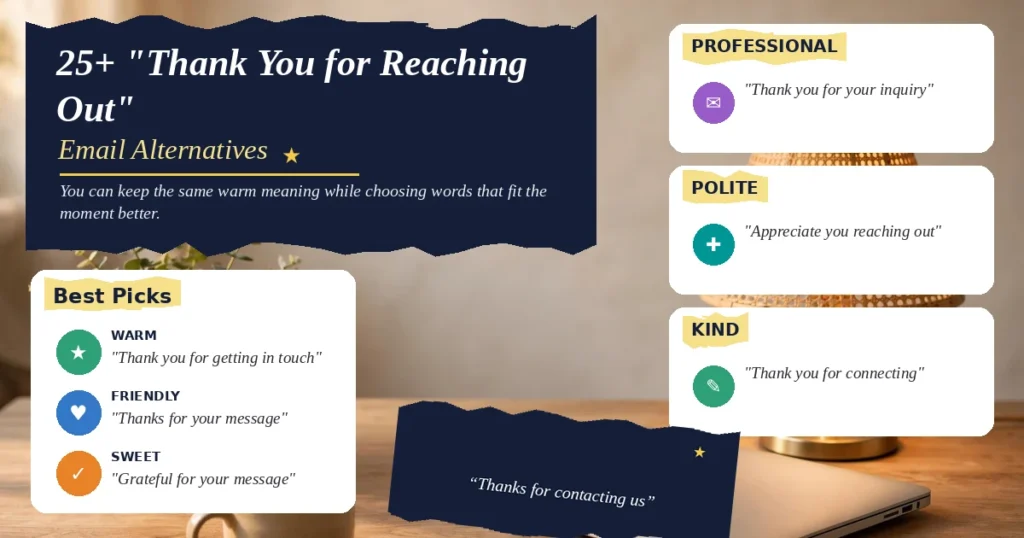
Looking for other ways to say thank you for reaching out to me? You are in the right place. The phrase “thank you for reaching out to me” works fine in most emails, but it can start to feel flat when you use it every day. Many professionals type it without thinking, and readers glide right past it. The good news is that you can keep the same warm meaning while choosing words that fit the moment better. This guide gives you more than 25 fresh alternatives, grouped by tone, so you always pick the right one. You will also find email examples, a quick comparison table, and answers to the questions people ask most about this phrase.
Why does this matter? A good thank-you line sets the tone for the whole reply. It tells the other person that their message matters and that you actually read it. A generic line can feel like a copy-paste job. A thoughtful line builds trust before you even answer their question. That small difference can change how a customer, recruiter, or partner sees you.
In this article, you will learn what the phrase really means, when to use it at work, and how to replace it with something sharper. You will see alternatives for professional emails, formal letters, friendly chats, customer support, and sales replies. Each one comes with a short example so you can copy the style right away. Let’s begin.
Meaning
“Thank you for reaching out to me” is a polite phrase that means you appreciate someone contacting you first. It usually opens a reply to an inquiry, complaint, application, or introduction, and it signals respect for the sender’s time and effort. People use it in emails, chats, and messages before they answer the question or share the information requested.
This phrase works as a social signal. It says three things at once: I saw your message, I value your effort, and I am happy to respond. That is why it feels natural at the top of a reply. The phrase sits in the family of gratitude expressions, similar to thank you for your message alternatives and general appreciation lines.
The “reaching out” part comes from the idea of extending a hand. It suggests the other person made the first move. So the full phrase honors that step. You do not need to use it every single time you reply, though. Once the conversation is going, you can drop it and move straight to your answer.
One more thing to note. The phrase is polite but not warm on its own. The warmth comes from what you say next. A flat “thank you for reaching out to me” followed by a helpful answer still works well. A flowery thank-you followed by an unhelpful answer will fall flat. The words matter, but the substance behind them matters more.
Professional usage
At work, this phrase shows up almost everywhere. Customer support teams use it to open replies to complaints. Recruiters use it to answer job applications. Salespeople use it to respond to leads. Freelancers use it when a new client sends a brief. It fits anywhere one person starts a conversation and the other wants to respond with respect.
Use it in the first two lines of your reply. That is where it feels most natural. Do not bury it in the third paragraph, and do not save it for the end. A thank-you opener works like a greeting: it prepares the reader for what comes next. For example, “Thank you for reaching out. I looked into your request this morning, and here is what I found.”
The phrase also buys you time. If you need to research an answer, you can write a short reply that says thanks for the message and promises a full answer soon. That is better than silence. People forgive a slow answer when they feel acknowledged. This is the same principle behind please bear with me responses in support work.
In formal settings, keep the full phrase or pick a more formal alternative from the list below. In casual internal chats, you can shorten it or drop it completely. Context decides. A reply to your CEO needs more polish than a reply to a teammate you talk to every day.
One rule to remember: do not overuse it with the same person. If you and a client exchange twenty emails in one week, you do not need to thank them for reaching out in each one. Use it once at the start of the thread, then skip it. Repeating it every time starts to look robotic, which defeats the purpose of showing genuine appreciation.
Alternatives
Here are 40 alternatives grouped by tone. Each one shows when it fits best and gives you a short example.
Professional alternatives
Thank you for getting in touch — Best use: safe default for almost any work email. Example: Thank you for getting in touch about the project timeline.
Thanks for your message — Best use: short and neutral, good for busy inboxes. Example: Thanks for your message; I have attached the updated report.
Appreciate you reaching out — Best use: warm but still professional. Example: Appreciate you reaching out with this feedback.
Thanks for contacting us — Best use: team or company replies, not personal ones. Example: Thanks for contacting us; a specialist will review your case today.
Thank you for your inquiry — Best use: formal replies to questions about services or products. Example: Thank you for your inquiry about our pricing plans.
Grateful for your message — Best use: adds weight when someone did you a favor. Example: Grateful for your message and the kind introduction.
Thank you for connecting — Best use: replies after networking or LinkedIn contact. Example: Thank you for connecting; I enjoyed your post on remote hiring.
Thanks for flagging this — Best use: when someone raised a problem or concern. Example: Thanks for flagging this; I have escalated it to the tech team.
Formal alternatives
I appreciate you taking the time to write — Best use: very formal, honors the sender’s effort. Example: I appreciate you taking the time to write; your letter raised important points.
Thank you for bringing this to my attention — Best use: formal replies to issues or complaints. Example: Thank you for bringing this to my attention; we will fix it this week.
Your message is greatly appreciated — Best use: formal and slightly distant, good for officials. Example: Your message is greatly appreciated, and I will respond in full by Friday.
I am grateful for your correspondence — Best use: legal or official letters. Example: I am grateful for your correspondence regarding the contract terms.
Thank you for your kind message — Best use: formal replies to compliments or condolences. Example: Thank you for your kind message; it meant a lot to the whole team.
I value your reaching out — Best use: formal but sincere. Example: I value your reaching out during such a busy quarter.
Many thanks for getting in contact — Best use: British-style formal politeness. Example: Many thanks for getting in contact about the partnership.
I am obliged to you for writing — Best use: old-fashioned formal, rare but elegant. Example: I am obliged to you for writing on such short notice.
Friendly alternatives
So glad you reached out — Best use: warm, personal, upbeat tone. Example: So glad you reached out; I was just thinking about this project.
Thanks for the note — Best use: casual and quick. Example: Thanks for the note; let’s catch up next week.
Great to hear from you — Best use: replies to people you know. Example: Great to hear from you; how did the launch go?
Appreciate the message — Best use: relaxed professional. Example: Appreciate the message; I will send the files tonight.
Love that you got in touch — Best use: very warm, for close contacts. Example: Love that you got in touch; we should grab coffee soon.
Thanks for thinking of me — Best use: when someone considered you for something. Example: Thanks for thinking of me for this role.
Happy you wrote in — Best use: cheerful, community-style replies. Example: Happy you wrote in; your question helps other readers too.
Good to hear from you — Best use: simple and friendly. Example: Good to hear from you; yes, the position is still open.
Email-ready alternatives
Thank you for your email — Best use: direct and clear for any inbox. Example: Thank you for your email; I have reviewed the draft.
Thanks for writing in — Best use: support desks and newsletters. Example: Thanks for writing in with your question about billing.
I appreciate your email — Best use: slightly more personal than the standard line. Example: I appreciate your email and the detail you included.
Thank you for following up — Best use: replies to a second message or reminder. Example: Thank you for following up; the invoice is now paid.
Thanks for the follow-up — Best use: short version for quick threads. Example: Thanks for the follow-up; we are on track.
Got your message, thanks — Best use: fast acknowledgment in casual threads. Example: Got your message, thanks; I will check with the team.
Thanks for sending this over — Best use: when the message included files or info. Example: Thanks for sending this over; the screenshots really help.
Appreciate the heads-up — Best use: when someone warned you about something. Example: Appreciate the heads-up about the schedule change.
Customer service alternatives
Thanks for contacting support — Best use: standard support opener. Example: Thanks for contacting support; I can help you with that refund.
We appreciate you getting in touch — Best use: warm company voice. Example: We appreciate you getting in touch; your feedback makes us better.
Thank you for sharing your concern — Best use: replies to complaints. Example: Thank you for sharing your concern; I understand how frustrating this is.
Your message means a lot to us — Best use: empathetic, human tone. Example: Your message means a lot to us; let me look into this right away.
Thanks for letting us know — Best use: reports of bugs or issues. Example: Thanks for letting us know; our team is fixing it now.
We are glad you reached out — Best use: friendly brand voice. Example: We are glad you reached out; here is a quick fix you can try.
Thank you for your patience in writing to us — Best use: when the reply took a while. Example: Thank you for your patience in writing to us; here is the full answer.
I am happy to help with this — Best use: pairs gratitude with action. Example: I am happy to help with this; let’s sort it out together.
Quick comparison
| Alternative | Tone | Best use |
|---|---|---|
| Thank you for getting in touch | Professional | Default for most work emails |
| Thanks for your message | Neutral | Short, busy inboxes |
| Appreciate you reaching out | Warm professional | Feedback and introductions |
| I appreciate you taking the time to write | Formal | Official or sensitive letters |
| Thank you for bringing this to my attention | Formal | Complaints and issues |
| So glad you reached out | Friendly | Warm personal replies |
| Great to hear from you | Friendly | People you already know |
| Thank you for your email | Direct | Any standard inbox |
| Thanks for following up | Direct | Second messages and reminders |
| Thanks for contacting support | Service | Customer support tickets |
| We appreciate you getting in touch | Warm brand | Company replies to customers |
| Appreciate the heads-up | Casual | Warnings and schedule changes |
Email examples
Customer support
Subject: Re: Delayed order #48291
Hi Sarah,
Thanks for contacting support. I checked your order, and it is on the truck for delivery tomorrow. I am sorry about the delay, and I have added a small credit to your account for the trouble.
If anything else comes up, just reply to this email.
Best,
Daniel
Job applicant
Subject: Re: Application for Content Writer role
Hi James,
Thank you for your email and for applying to the Content Writer role. I enjoyed reading your portfolio, especially the product guides. Our hiring manager is reviewing applications this week, and you will hear from us by Friday.
Warm regards,
Aisha
Networking
Subject: Great meeting you at the summit
Hi Priya,
Thank you for connecting after the summit. I really liked your point about email tone in support teams. I would love to continue the conversation over a short call next week if you have time.
Best,
Marcus
Vendor
Subject: Re: New pricing proposal
Hi Tom,
Thank you for your inquiry about our service plans. I have attached the updated proposal with the new rates. Please take a look, and let me know if you want to walk through the details on a call.
Regards,
Nina
Sales inquiry
Subject: Re: Demo request
Hi Chris,
Appreciate you reaching out about a demo. I would love to show you how the dashboard works. Are you free for 20 minutes on Thursday afternoon? I will send a calendar invite once you confirm.
Thanks,
Leo
Common mistakes
1. Using it in every single reply
Thanking someone for reaching out in all twenty emails of one thread sounds robotic. Use it once at the start, then drop it.
2. Pairing it with a cold or rude answer
“Thank you for reaching out. We cannot help you.” feels worse than no thanks at all. Keep your tone consistent from the first line to the last.
3. Making it too long and stiff
“I would like to take this opportunity to thank you for reaching out to me at this time” is a mouthful. Short and clear beats long and stiff every time.
4. Using it when you were the one who reached out first
If you started the conversation, thanking them for reaching out sounds confused. In that case, say thanks for their reply instead.
5. Forgetting to personalize it
A bare thank-you line followed by a generic answer feels like a template. Add one small detail from their message to show you actually read it.
6. Overusing exclamation marks
“Thank you so much for reaching out!!!” looks unprofessional in a work email. One exclamation mark is plenty, and in formal emails, use none.
7. Using slang versions with strangers
“Thanks for hitting me up” is fine with friends but wrong for a recruiter or a client. Match your words to the relationship, and when in doubt, stay professional.
Related phrases
These gratitude phrases often appear alongside thank-you openers, so keep them in your toolkit too. For replies that resolve a request, a line like thank you for taking care of this works as a warm follow-up closer.
Thanks for getting back to me — You reply to their answer. Example: Thanks for getting back to me so quickly.
I appreciate your time — You value the minutes they spent. Example: I appreciate your time on the call today.
Thanks for your patience — You thank them for waiting. Example: Thanks for your patience while we fixed the bug.
Thank you for your understanding — You thank them for accepting a problem. Example: Thank you for your understanding during the outage.
Grateful for your support — You thank them for help or loyalty. Example: Grateful for your support of our small business.
Thanks for your feedback — You thank them for opinions. Example: Thanks for your feedback on the new design.
Thank you for your interest — You thank them for curiosity about you. Example: Thank you for your interest in the position.
I appreciate the opportunity — You thank them for a chance. Example: I appreciate the opportunity to present our work.
Thanks for sharing — You thank them for information. Example: Thanks for sharing the article.
Thank you for your help — You thank them for assistance. Example: Thank you for your help with the move.
Much appreciated — Short and warm gratitude. Example: You sent the files already? Much appreciated.
Thanks a bunch — Casual and cheerful thanks. Example: Thanks a bunch for the recommendation.
I owe you one — Friendly thanks with a promise to return the favor. Example: You covered my shift? I owe you one.
Thank you for thinking of me — Thanks for being considered. Example: Thank you for thinking of me for the project.
Thanks for keeping me in the loop — Thanks for updates. Example: Thanks for keeping me in the loop on the launch.
I am thankful for your message — A softer version of the main phrase. Example: I am thankful for your message and kind words.
Phrase comparison
The main phrase, “thank you for reaching out to me,” is polite and safe, but it is also the most common choice, where it is also the most common choice, which makes it the easiest to ignore. “Thank you for getting in touch” carries the same meaning with a slightly fresher feel, and most readers will not even notice the swap. It works in nearly every situation where the original works.
“Appreciate you reaching out” feels warmer because “appreciate” sounds more personal than “thank you.” It suits replies where you want to build a connection, such as networking emails or answers to thoughtful feedback. “Thanks for your message” sits on the opposite side: shorter, cooler, and better for high-volume inboxes where speed matters more than warmth.
For formal writing, “I appreciate you taking the time to write” beats the original because it honors the effort, not just the contact. It tells the reader that you noticed they spent time on the message. “Thank you for bringing this to my attention” is narrower; it only fits complaints and problems, but in those moments it sounds more serious and responsible than a generic thanks.
In customer service, “we appreciate you getting in touch” sounds like a brand that cares, while “thanks for contacting support” sounds like a system. Both are fine, but the first one calms an upset customer faster. The key lesson is simple: match the warmth of your opener to the emotion of the message you received. A calm reader needs a calm opener; an upset reader needs a warmer one.
In customer service, “we appreciate you getting in touch” sounds like a brand that cares, while “thanks for contacting support” sounds like a system. Both are fine, but the first one calms an upset customer faster. The key lesson is simple: match the warmth of your opener to the emotion of the message you received. A calm reader needs a calm opener; an upset reader needs a warmer one.
Cultural usage
US English
American professionals use “thank you for reaching out” constantly, and it is fully natural in both emails and calls. Shorter forms like “thanks for reaching out” and “appreciate you reaching out” are common too, even in fairly formal business settings.
UK English
British writers often prefer “thank you for getting in touch” or “many thanks for your email.” The word “reaching out” can sound slightly American to some British ears, though most people understand it fine. When writing to a UK audience, the “getting in touch” versions blend in better.
Corporate communication
In large companies, the opener often depends on the department. HR and recruiting favor warm lines like “thank you for your interest.” Legal and finance favor precise lines like “thank you for your correspondence.” Marketing teams often pick friendlier openers that match the brand voice.
Customer service
Support teams around the world open with gratitude because it lowers tension. Phrases like “thanks for contacting us” and “we appreciate you getting in touch” are standard in help desks. The best teams follow the opener with a fast, clear answer, because a quick response matters more than perfect wording. Some teams also train agents to acknowledge frustration before solving the problem, which pairs well with a warm opener.
Frequently asked questions
Is “thank you for reaching out to me” grammatically correct?
Yes, it is completely correct. “Reaching out to me” works as a gerund phrase, and the sentence follows standard English grammar. Some style guides prefer “reaching out” without “to me,” but both versions are fine.
Is “thank you for reaching out” too informal for work?
No, it is fine for most work emails. It sits in the polite-professional zone. For very formal letters, you can switch to “thank you for your correspondence” or “I appreciate you taking the time to write.”
What is the shortest professional way to say it?
“Thanks for your message” is the shortest safe option at four words. “Appreciate the message” is even shorter and still professional enough for most inboxes.
Should I use it at the start or the end of an email?
Use it at the start. It works like a greeting and sets a positive tone before your main point. Saving thanks for the end is fine for closing lines, but the opener belongs up top.
Can I say “thank you for reaching out to me” on the phone?
Yes, it works in calls too. It sounds natural right after the greeting: “Hi, thank you for reaching out. How can I help?” Keep it brief so the call moves forward.
How do I reply when someone thanks me for reaching out?
Say “you’re welcome” or “happy to help,” then continue the conversation. In email, a simple “Happy to help! Here’s what I found…” keeps things moving without awkwardness.
What is a good alternative for customer support replies?
“Thanks for contacting support” is the standard choice. For a warmer tone, try “we appreciate you getting in touch” or “thank you for sharing your concern,” especially with upset customers.
What is a good alternative for job applications?
“Thank you for your interest in the role” works better than the generic phrase. It shows you noticed they applied for something specific, which candidates appreciate.
Is “thanks for reaching out” rude?
No, it is not rude. It is just casual. In formal emails, use the full “thank you” version. The meaning stays polite either way; only the tone changes.
Can I use this phrase with my boss?
Yes, but keep it professional. “Thank you for your message” or “I appreciate you taking the time to write” sound respectful without being stiff. Avoid slang versions with senior leaders.
What should I avoid saying instead?
Avoid “thanks for hitting me up,” “thx 4 reaching out,” and “noted.” These sound too casual or cold for professional email. Save them for texts with friends.
Does the phrase work in a cover letter?
It can, but stronger openers exist. In a cover letter, lead with your excitement about the role instead: “I was excited to see your opening for…” A cover letter should sell you, not just thank the reader.
How often can I use it with the same person?
Once per conversation thread is enough. After that, skip it and get to the point. Repeating it in every reply makes your emails look automated.
What is the difference between “reaching out” and “getting in touch”?
They mean the same thing, but “reaching out” sounds slightly more American and modern, while “getting in touch” sounds slightly more British and classic. Pick the one that fits your audience.
What is the most formal version?
“I am grateful for your correspondence” is the most formal option here. It suits legal letters, official complaints, and communication with senior officials. Most daily emails do not need this level of formality.
Conclusion
Best picks by tone: professional — “thank you for getting in touch” and “appreciate you reaching out”; formal — “I appreciate you taking the time to write”; friendly — “so glad you reached out” and “great to hear from you”; email-ready — “thank you for your email” and “thanks for following up”; customer service — “we appreciate you getting in touch” and “thank you for sharing your concern.”
Now you have more than 40 ways to open a reply with warmth and confidence. Pick the one that matches your reader, your relationship, and the mood of the message. Small word choices like these add up: over a year of emails, they shape how people feel about working with you. And when you are unsure about the exact meaning of a word you want to use, checking a trusted source helps — for example, the Cambridge definition of contact explains the noun and verb forms clearly. Start your next reply with one of these alternatives, and notice how much more human your inbox feels.