
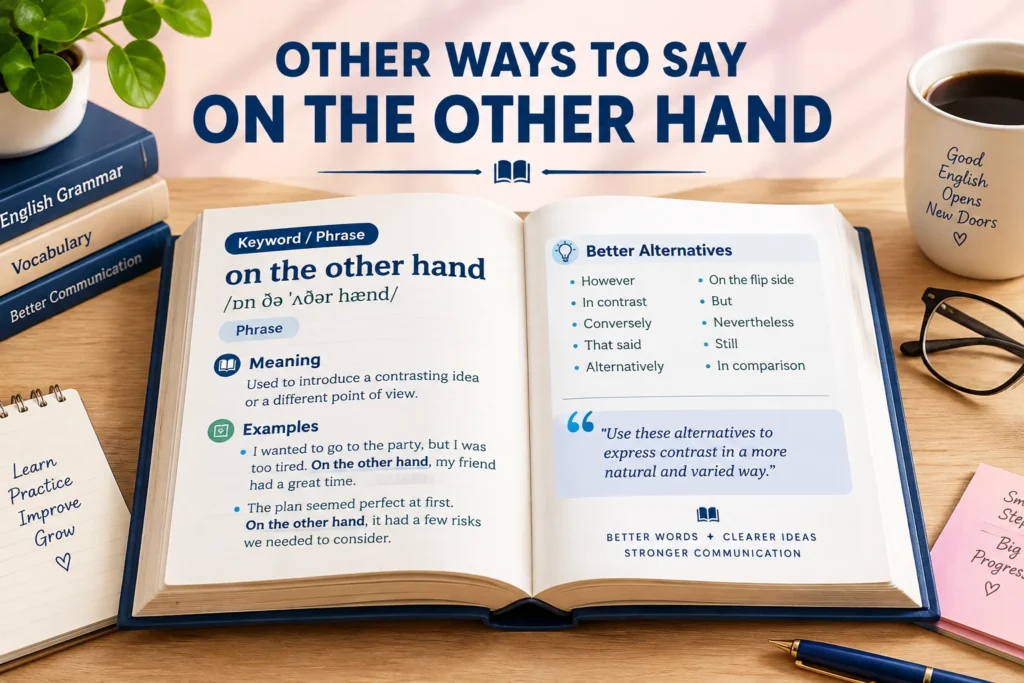
When you want to show a contrast between two ideas, “on the other hand” is one of the most useful English expressions. However, repeating the same phrase can make your writing sound predictable. This guide to other ways to say on the other hand gives you professional, formal, friendly, workplace, and email-ready alternatives.
You can use these expressions in business emails, reports, presentations, meetings, client communication, networking, and everyday conversations. The best alternative depends on how strong the contrast is and how formal you want your message to sound.
What Does “On the Other Hand” Mean?
“On the other hand” introduces a different point, fact, opinion, or perspective that contrasts with something mentioned earlier.
For example:
The project has a tight deadline. On the other hand, the team has enough experience to complete it successfully.
The first sentence presents a challenge. The second presents a contrasting positive point.
Literal Meaning
The expression does not usually refer to a physical hand. It means “from another point of view” or “considering the opposite side of the situation.”
Example:
The position offers a higher salary. On the other hand, it requires frequent travel.
Tone
“On the other hand” usually sounds:
- Neutral
- Natural
- Balanced
- Conversational
- Professional enough for most workplace situations
It does not sound strongly formal, but it works well in professional communication.
Purpose
You can use it to:
- Show contrast
- Present another perspective
- Compare advantages and disadvantages
- Balance an argument
- Introduce an opposing idea
- Explain a trade-off
- Make a discussion more objective
Emotional Context
The phrase often creates a balanced tone rather than an argumentative one.
Compare:
Your proposal has some limitations. However, it also offers several advantages.
This sounds more direct.
Your proposal has some limitations. On the other hand, it offers several advantages.
This sounds more balanced and conversational.
When Should You Use Alternatives to “On the Other Hand”?
Different situations call for different expressions. A casual conversation may need a simple phrase, while a business report may require a more formal transition.
In Emails
Use alternatives when you want your email to sound polished without becoming overly formal.
Example:
The current supplier offers competitive pricing. However, the delivery time is longer.
Instead of:
The current supplier offers competitive pricing. On the other hand, the delivery time is longer.
In the Workplace
Workplace communication often benefits from direct transitions.
Example:
The first option is cheaper. However, the second option offers better long-term value.
With Clients
Client communication should remain clear and diplomatic.
Example:
The standard package costs less. That said, the premium package includes additional support.
In Networking
Friendly alternatives work better when you want a natural conversational tone.
Example:
The role would involve more responsibility. At the same time, it would provide valuable experience.
In Customer Service
Customer-facing communication should sound polite and solution-focused.
Example:
The replacement may take three to five days. However, we can offer a refund immediately.
Other Ways to Say “On the Other Hand”
Below are 50 alternatives grouped by tone and purpose. Some are direct synonyms, while others express a similar contrast in a more specific way.
Professional Alternatives
1. However
Meaning: Introduces a contrasting fact or idea.
Tone: Professional and neutral.
Best use: Emails, reports, workplace communication.
Example:
The proposal looks promising. However, we need more financial data.
2. Nevertheless
Meaning: Shows that something remains true despite the previous point.
Tone: Professional and formal.
Best use: Reports and business writing.
Example:
The project faced several delays. Nevertheless, the team completed it successfully.
3. Nonetheless
Meaning: Similar to “nevertheless”; introduces a contrasting point.
Tone: Formal and polished.
Best use: Reports, presentations, professional correspondence.
Example:
The initial results were disappointing. Nonetheless, the research provided useful information.
4. That said
Meaning: Acknowledges the previous point before introducing another perspective.
Tone: Professional and natural.
Best use: Emails, meetings, business discussions.
Example:
The first option is more affordable. That said, the second option offers better quality.
5. Even so
Meaning: Shows contrast despite what was previously stated.
Tone: Neutral.
Best use: Workplace discussions and emails.
Example:
The schedule is demanding. Even so, we should be able to meet the deadline.
6. At the same time
Meaning: Presents another fact that exists alongside the first.
Tone: Neutral and professional.
Best use: Meetings, presentations, emails.
Example:
The change will increase costs. At the same time, it should improve efficiency.
7. By contrast
Meaning: Directly highlights a difference between two things.
Tone: Professional.
Best use: Reports, comparisons, presentations.
Example:
The first model is designed for small businesses. By contrast, the second targets large organizations.
8. In contrast
Meaning: Shows a clear difference between two ideas or situations.
Tone: Professional and academic.
Best use: Reports and formal writing.
Example:
Sales increased in Europe. In contrast, sales declined in Asia.
9. Conversely
Meaning: Introduces an opposite or reversed situation.
Tone: Formal.
Best use: Reports, analysis, academic and business writing.
Example:
Higher prices may reduce demand. Conversely, lower prices may increase sales.
10. Alternatively
Meaning: Introduces another possible option rather than necessarily an opposite idea.
Tone: Professional.
Best use: Proposals, planning, emails.
Example:
We could launch the product in June. Alternatively, we could wait until July.
11. From another perspective
Meaning: Introduces a different way of looking at an issue.
Tone: Professional and thoughtful.
Best use: Meetings, reports, discussions.
Example:
The change may increase expenses. From another perspective, it could improve productivity.
12. From another point of view
Meaning: Presents a different viewpoint.
Tone: Neutral and professional.
Best use: Discussions and presentations.
Example:
The policy may seem restrictive. From another point of view, it protects employees.
13. In another respect
Meaning: Introduces a contrast in a different area.
Tone: Formal.
Best use: Business reports and professional writing.
Example:
The product is affordable. In another respect, its maintenance costs are high.
14. On the contrary
Meaning: Directly rejects or contradicts a previous statement.
Tone: Strong and formal.
Best use: Correcting an incorrect assumption.
Example:
The campaign was not unsuccessful. On the contrary, it exceeded our expectations.
Important: Do not use “on the contrary” simply as a general synonym for every use of “on the other hand.”
15. Still
Meaning: Introduces a contrasting consideration.
Tone: Simple and natural.
Best use: Informal professional communication.
Example:
The process takes longer. Still, it produces better results.
Formal Alternatives
16. Notwithstanding This
Meaning: Despite the point just mentioned.
Tone: Very formal.
Best use: Legal, corporate, and formal writing.
Example:
The initial concerns remain. Notwithstanding this, the project can proceed.
17. Despite This
Meaning: Shows that the next point remains true despite the previous fact.
Tone: Formal and clear.
Best use: Reports and professional writing.
Example:
The market remains uncertain. Despite this, demand continues to grow.
18. In Spite of This
Meaning: Introduces a result or fact that contrasts with an earlier point.
Tone: Formal but natural.
Best use: Reports and business communication.
Example:
Costs increased significantly. In spite of this, the company maintained its profit margin.
19. Conversely
Meaning: Presents the opposite situation.
Tone: Formal.
Best use: Analytical writing.
Example:
Increased supply can lower prices. Conversely, limited supply can drive prices higher.
20. In Opposition
Meaning: Shows that something differs from or conflicts with another position.
Tone: Formal.
Best use: Academic or analytical contexts.
Example:
The first proposal supports expansion. In opposition, the second recommends consolidation.
21. In Comparison
Meaning: Introduces a point by comparing it with another.
Tone: Formal and neutral.
Best use: Reports and presentations.
Example:
The previous system was expensive. In comparison, the new system costs considerably less.
22. By Comparison
Meaning: Highlights differences or similarities between two things.
Tone: Formal.
Best use: Business reports.
Example:
The first supplier offers faster delivery. By comparison, the second supplier offers lower prices.
23. From a Different Perspective
Meaning: Presents another way to evaluate the issue.
Tone: Formal and thoughtful.
Best use: Strategy discussions and reports.
Example:
The investment carries some risk. From a different perspective, it could create significant long-term returns.
24. Viewed Differently
Meaning: Shows that another interpretation is possible.
Tone: Formal.
Best use: Analysis and presentations.
Example:
The decline may appear concerning. Viewed differently, it may reflect a temporary adjustment.
25. In a Different Context
Meaning: Shows how the situation changes when considered under different conditions.
Tone: Formal.
Best use: Professional analysis.
Example:
The strategy works well for large companies. In a different context, smaller firms may need a simpler approach.
Friendly and Conversational Alternatives
26. That Being Said
Meaning: Acknowledges the previous point before offering another thought.
Tone: Friendly and conversational.
Example:
I understand your concern. That being said, I think we should give the idea another chance.
27. Still
Meaning: Adds a contrasting thought.
Tone: Casual and natural.
Example:
It is a little expensive. Still, I think it is worth buying.
28. Even Then
Meaning: Shows that a point remains true despite another fact.
Tone: Conversational.
Example:
We may have limited time. Even then, we can complete the most important tasks.
29. At the Same Time
Meaning: Balances one point with another.
Tone: Friendly and professional.
Example:
I understand why you prefer the first option. At the same time, the second one gives us more flexibility.
30. Then Again
Meaning: Introduces another thought that may change the previous conclusion.
Tone: Casual.
Best use: Conversation and informal messages.
Example:
We could leave early. Then again, traffic might be lighter later.
31. On the Flip Side
Meaning: Introduces the opposite side of an issue.
Tone: Informal.
Best use: Casual conversation and friendly communication.
Example:
Working remotely saves travel time. On the flip side, it can feel isolating.
32. Looking at It Another Way
Meaning: Introduces another perspective.
Tone: Friendly.
Example:
The change creates more work. Looking at it another way, it gives us a chance to improve the process.
33. From Another Angle
Meaning: Presents another perspective.
Tone: Conversational but professional.
Example:
The plan is expensive. From another angle, it could save money over time.
34. On the Plus Side
Meaning: Introduces a positive point after discussing a negative one.
Tone: Friendly.
Example:
The office is farther away. On the plus side, the new location has better facilities.
35. The Downside Is
Meaning: Introduces a negative point after discussing benefits.
Tone: Conversational.
Example:
The software is easy to use. The downside is that the advanced features cost extra.
Email-Ready Alternatives
36. However
The proposed schedule is workable. However, we may need additional staff.
37. That Said
We can meet the current deadline. That said, an extension would give us more flexibility.
38. Nevertheless
The budget is limited. Nevertheless, we can complete the highest-priority tasks.
39. At the Same Time
We want to reduce expenses. At the same time, we need to maintain service quality.
40. By Contrast
Our current supplier offers lower prices. By contrast, the new supplier provides faster delivery.
41. In Contrast
The first package includes basic support. In contrast, the premium package includes dedicated assistance.
42. From Another Perspective
The investment requires significant funding. From another perspective, it could provide strong long-term returns.
43. That Being Said
I understand the concerns about the proposal. That being said, I believe it deserves further consideration.
44. Even So
The implementation may take several weeks. Even so, I recommend moving forward.
45. Despite This
We experienced several technical issues. Despite this, the project remains on schedule.
Workplace Alternatives
46. On the Other Side
This can work in limited contexts, especially when discussing two sides of an issue, but it is less natural than many alternatives.
The first team prefers speed. On the other side, the quality team wants more testing.
A better professional choice would often be:
The first team prefers speed. By contrast, the quality team wants more testing.
47. In Contrast
The marketing team wants to launch this month. In contrast, the sales team recommends waiting.
48. By Comparison
The first system requires more maintenance. By comparison, the new system is easier to manage.
49. At the Same Time
We need to control costs. At the same time, we cannot compromise on quality.
50. From Another Perspective
The new process may require training. From another perspective, it could reduce errors significantly.
Quick Comparison Table
| Alternative | Tone | Best Use |
| However | Professional | Emails and workplace |
| Nevertheless | Formal | Reports |
| Nonetheless | Formal | Business writing |
| That said | Professional | Emails and discussions |
| At the same time | Neutral | Workplace communication |
| By contrast | Professional | Comparisons |
| In contrast | Formal | Reports |
| Conversely | Formal | Analysis |
| Alternatively | Professional | Options |
| Even so | Neutral | Emails |
| Despite this | Formal | Reports |
| That being said | Conversational | Friendly emails |
| Still | Casual | Conversations |
| Then again | Casual | Informal discussion |
| On the flip side | Informal | Casual communication |
| From another perspective | Professional | Meetings and reports |
| From another point of view | Neutral | Discussions |
| On the contrary | Strong/formal | Direct contradiction |
| By comparison | Formal | Business analysis |
| On the plus side | Friendly | Informal communication |
How to Choose the Right Alternative
The best synonym for “on the other hand” depends on what you actually want to communicate.
If You Want Simple Contrast
Use:
However
The proposal is expensive. However, it offers excellent long-term value.
If You Want a Formal Tone
Use:
Nevertheless
The process is complex. Nevertheless, it remains manageable.
If You Want to Show Two Different Sides
Use:
By contrast
The first option focuses on speed. By contrast, the second prioritizes quality.
If You Want to Introduce Another Perspective
Use:
From another perspective
The investment requires more capital. From another perspective, it could generate greater returns.
If You Want a Natural Email Tone
Use:
That said
We can proceed with the current plan. That said, I recommend reviewing the timeline.
If You Want a Casual Tone
Use:
On the flip side
The apartment is affordable. On the flip side, it is far from the office.
Email Examples
1. Client Email
Subject: Project Timeline
We can complete the first phase within two weeks. However, the second phase may require additional time because it involves several rounds of testing.
This sounds direct, professional, and easy for a client to understand.
2. Email to a Manager
I believe the new process could improve efficiency. That said, the team may need some training before implementation.
This approach sounds respectful without being overly formal.
3. Email to a Colleague
The meeting time works for me. At the same time, an afternoon meeting might be easier for the rest of the team.
This keeps the discussion collaborative.
4. Customer Service Email
We can replace the damaged item at no additional cost. However, delivery may take three to five business days.
This gives the customer clear information while maintaining a polite tone.
5. Networking Email
Your approach to the project is very interesting. From another perspective, I think combining it with our current strategy could produce even better results.
This sounds thoughtful and professional.
6. Meeting Follow-Up
We agreed that the current plan is achievable. Nevertheless, we should review the budget before moving forward.
This works well in formal workplace communication.
Common Mistakes When Using “On the Other Hand”
1. Using It Too Often
Repeating “on the other hand” in every paragraph makes writing feel repetitive.
Instead, rotate between:
- However
- That said
- Nevertheless
- By contrast
- At the same time
- In contrast
2. Using “On the Contrary” Incorrectly
“On the contrary” usually contradicts a previous statement.
Incorrect:
The product is expensive. On the contrary, it has many useful features.
Better:
The product is expensive. On the other hand, it has many useful features.
Use “on the contrary” when you directly reject the previous idea:
I do not think the campaign failed. On the contrary, it exceeded our expectations.
3. Choosing an Expression That Is Too Casual
Avoid “on the flip side” in highly formal reports.
Use:
By contrast
instead.
4. Making Business Emails Too Formal
Expressions such as “notwithstanding this” may sound unnecessarily legal or stiff in a normal workplace email.
Instead, use:
That said
or
However
5. Confusing Contrast With Alternatives
“Alternatively” does not always mean the same thing as “on the other hand.”
“Alternatively” normally introduces another option:
We can meet on Monday. Alternatively, we can meet on Tuesday.
6. Creating Weak Contrast
Make sure the two ideas actually connect.
Weak:
The office has new chairs. However, the company hired ten employees.
The ideas do not create a meaningful contrast.
Better:
The office has new chairs. However, the meeting rooms still need renovation.
Related Phrases and Expressions
Here are related expressions that can help you create stronger workplace communication.
1. In contrast
Shows a clear difference.
Sales increased in Europe. In contrast, they declined in Asia.
2. By contrast
Highlights a difference.
The first plan is expensive. By contrast, the second is affordable.
3. However
Introduces a contrasting fact.
The deadline is tight. However, we can meet it.
4. Nevertheless
Shows that something remains true despite a difficulty.
The project faced delays. Nevertheless, we completed it.
5. Nonetheless
Similar to “nevertheless.”
The task was difficult. Nonetheless, the team succeeded.
6. That said
Acknowledges the previous point and introduces another.
The idea has risks. That said, it has strong potential.
7. At the same time
Shows two considerations that exist together.
We need to reduce costs. At the same time, quality must remain high.
8. Even so
Shows contrast despite the previous statement.
The process is demanding. Even so, it is worth completing.
9. Conversely
Introduces an opposite situation.
Higher supply can lower prices. Conversely, limited supply can increase them.
10. Alternatively
Introduces another option.
We could postpone the launch. Alternatively, we could reduce its scope.
11. On the contrary
Directly contradicts a previous claim.
The plan did not fail. On the contrary, it exceeded expectations.
12. Despite this
Shows contrast with the previous point.
Costs increased. Despite this, profits remained stable.
13. In spite of this
Similar to “despite this.”
The schedule changed. In spite of this, everyone attended.
14. From another perspective
Introduces a different viewpoint.
The cost is high. From another perspective, the investment could save money later.
15. On the flip side
Introduces the opposite side in casual language.
Remote work is convenient. On the flip side, communication can become harder.
16. Then again
Introduces another thought that changes or balances the previous one.
We could leave now. Then again, traffic may improve later.
17. On the plus side
Introduces a positive point.
The office is small. On the plus side, it is close to public transport.
18. The downside is
Introduces a disadvantage.
The software is powerful. The downside is that it takes time to learn.
“On the Other Hand” vs. Other Alternatives
| Phrase | Formality | Main Purpose | Example |
| On the other hand | Neutral | Balance two sides | The cost is high. On the other hand, quality is excellent. |
| However | Professional | Show contrast | The cost is high. However, quality is excellent. |
| Nevertheless | Formal | Contrast despite difficulty | The cost is high. Nevertheless, demand remains strong. |
| That said | Professional | Acknowledge and shift | The cost is high. That said, the quality is excellent. |
| By contrast | Formal | Compare differences | Option A is cheap. By contrast, Option B is premium. |
| In contrast | Formal | Show difference | Sales rose here. In contrast, they fell elsewhere. |
| Conversely | Formal | Show opposite relationship | Prices rise with demand. Conversely, prices fall when demand drops. |
| At the same time | Neutral | Balance considerations | We need speed. At the same time, accuracy matters. |
| On the contrary | Formal/strong | Direct contradiction | The plan did not fail. On the contrary, it succeeded. |
| On the flip side | Casual | Informal contrast | It is cheap. On the flip side, it is basic. |
Cultural Usage: US and UK English
US English
American business communication commonly uses:
- However
- That said
- On the other hand
- At the same time
- By contrast
- Nevertheless
For everyday professional emails, “however” and “that said” are especially natural.
Example:
The proposal is strong. However, we need to revise the budget.
UK English
British English also uses “on the other hand,” “however,” “nevertheless,” and “that said.”
Formal British writing may use slightly more traditional expressions such as:
- Nevertheless
- Nonetheless
- Conversely
- By contrast
- Despite this
The differences are usually about style rather than meaning.
Corporate Communication
Corporate communication generally favors clear transitions over complicated vocabulary.
Instead of:
Notwithstanding the aforementioned circumstances…
Use:
However…
Clear language usually communicates the message more effectively.
Customer Service
Customer service teams should choose polite, solution-focused transitions.
Good choices include:
- However
- That said
- At the same time
- Even so
- Despite this
Example:
We understand your concern. However, our policy requires the original receipt for a refund.
Networking
Networking communication often benefits from a friendly professional tone.
Good choices include:
- That said
- At the same time
- From another perspective
- On the other hand
- Even so
Example:
Your approach is different from ours. At the same time, I think there may be an opportunity for collaboration.
Professional Way to Say “On the Other Hand”
If you need one simple professional way to say “on the other hand,” use “however.”
Example:
The proposal offers significant benefits. However, it also requires additional funding.
For a more conversational professional tone, use “that said.”
The proposal offers significant benefits. That said, it also requires additional funding.
For a formal report, use “nevertheless,” “nonetheless,” “in contrast,” or “by contrast,” depending on the meaning.
Formal Alternative to “On the Other Hand”
The best formal alternative depends on your sentence.
For general contrast:
However
For contrast despite a difficulty:
Nevertheless
For a clear difference:
In contrast
For comparing two things:
By contrast
For an opposite relationship:
Conversely
For another viewpoint:
From another perspective
Synonym for “On the Other Hand”
There is no single perfect synonym for “on the other hand” in every sentence.
Common alternatives include:
- However
- Nevertheless
- Nonetheless
- That said
- At the same time
- In contrast
- By contrast
- Conversely
- Even so
- From another perspective
- From another point of view
- That being said
- Despite this
- In spite of this
- Still
Choose the expression based on the relationship between your two ideas.
Business Email Phrases for Showing Contrast
When writing business emails, these phrases can make your transitions clearer:
- However, …
- That said, …
- At the same time, …
- Nevertheless, …
- Even so, …
- By contrast, …
- In contrast, …
- From another perspective, …
- Despite this, …
- That being said, …
Example:
We can proceed with the current timeline. However, we may need additional resources.
Or:
The current timeline is achievable. That said, additional resources would help us avoid delays.
Frequently Asked Questions
What is another way to say “on the other hand”?
Common alternatives include however, nevertheless, nonetheless, that said, in contrast, by contrast, at the same time, and from another perspective.
What is the most professional alternative to “on the other hand”?
“However” is usually the safest professional alternative because it is clear, concise, and widely accepted in workplace communication.
What is a formal alternative to “on the other hand”?
Good formal options include nevertheless, nonetheless, in contrast, by contrast, and conversely.
Can I use “however” instead of “on the other hand”?
Yes. “However” often works as a direct replacement when you want to introduce a contrasting idea.
The offer is attractive. However, it has some limitations.
Is “on the contrary” the same as “on the other hand”?
No. “On the contrary” usually directly contradicts a previous statement. “On the other hand” normally presents another side or perspective.
Is “that said” professional?
Yes. “That said” is professional and natural in many emails, meetings, and workplace discussions. It sounds less formal than “nevertheless.”
What is the best alternative for a business email?
However and that said are excellent choices. Use “however” for direct contrast and “that said” when you want to acknowledge the previous point before adding another perspective.
What can I say instead of “on the other hand” in an essay?
Try however, nevertheless, in contrast, by contrast, conversely, or from another perspective, depending on the relationship between your ideas.
What is a casual way to say “on the other hand”?
You can use still, then again, on the flip side, or looking at it another way.
Should I use “on the other hand” in professional communication?
Yes. “On the other hand” is completely acceptable in professional communication. However, varying your transitions can make your writing more polished and precise.
Final Summary
The best alternative to “on the other hand” depends on your tone and purpose. For everyday professional communication, “however” is the safest choice. For a polished conversational tone, choose “that said” or “at the same time.” For formal reports, use “nevertheless,” “nonetheless,” “in contrast,” or “by contrast.” For casual conversations, “still” or “on the flip side” can work well. Always match the transition to the relationship between your ideas rather than replacing the phrase automatically. Strong workplace communication uses clear, natural transitions that make contrasting points easy to understand.




