
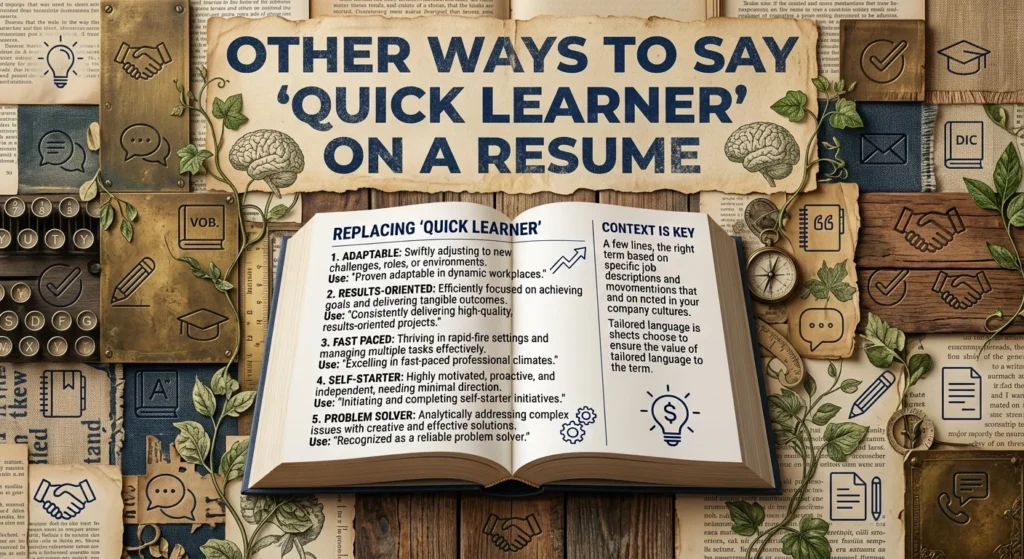
If you are looking for other ways to say quick learner on a resume, you have several professional options that can make your resume sound more specific and impressive. While “quick learner” is positive, it is also common and sometimes too general.
Instead of simply writing “I am a quick learner,” you can describe your ability to adapt, develop new skills, learn new systems, understand new processes, and apply new knowledge quickly.
For example:
Basic:
“I am a quick learner.”
More professional:
“Adaptable professional with a proven ability to quickly learn new systems and processes.”
Using the right phrase can help your resume communicate your strengths more clearly. The best choice depends on your experience, industry, job description, and the specific skill you want to highlight.
In this guide, you will find professional, formal, friendly, workplace, and email-ready alternatives to “quick learner,” along with practical examples.
What Does “Quick Learner” Mean?
“Quick learner” describes someone who can understand new information, develop new skills, or become familiar with new systems in a short amount of time.
On a resume, this phrase usually suggests that you can:
- Learn new skills quickly
- Understand instructions easily
- Adapt to new environments
- Master new software
- Follow new procedures
- Accept feedback
- Solve unfamiliar problems
- Work with limited supervision
- Adjust to changing responsibilities
- Apply new knowledge effectively
Literal Meaning of Quick Learner
The literal meaning is simple: a person who learns something quickly.
For example:
“Ali is a quick learner who mastered the new accounting software within a few weeks.”
However, on a resume, simply calling yourself a quick learner does not provide much evidence.
Tone of “Quick Learner”
The phrase has a positive, confident, and approachable tone.
It is suitable for:
- Resumes
- Interviews
- Cover letters
- Workplace conversations
- Networking
- Professional emails
However, it can sound generic because many candidates use it.
Purpose of Using “Quick Learner” on a Resume
The main purpose is to show employers that you can learn new responsibilities without needing excessive training or supervision.
A stronger version would be:
“Quick to master new software and business processes with minimal supervision.”
This statement gives the employer more information than simply saying “quick learner.”
Why Use an Alternative to “Quick Learner” on a Resume?
“Quick learner” is not incorrect, but it does not explain what you learned, how you learned it, or what result you achieved.
Compare these two examples:
Weak:
“Quick learner and hardworking employee.”
Stronger:
“Adaptable professional who quickly mastered new customer service software and independently handled customer inquiries.”
The second example connects learning ability with an actual workplace skill.
Professional Alternatives to “Quick Learner”
Below are useful alternatives divided into different categories.
Professional Alternatives
1. Adaptable Professional
Meaning: Someone who adjusts effectively to new situations and responsibilities.
Best use: Resume, cover letter, LinkedIn profile.
Example:
“Adaptable professional with experience learning new systems and processes in fast-paced environments.”
2. Fast Learner
Meaning: Someone who develops new skills quickly.
Best use: Resume and interview.
Example:
“Fast learner with a strong ability to understand new technical concepts.”
3. Rapid Learner
Meaning: Someone who acquires knowledge or skills quickly.
Best use: Professional resume.
Example:
“Rapid learner who quickly adapts to new software and workplace procedures.”
4. Highly Adaptable
Meaning: Someone who can adjust easily when situations or responsibilities change.
Best use: Resume and cover letter.
Example:
“Highly adaptable professional who performs effectively in changing work environments.”
5. Learning-Oriented Professional
Meaning: A professional who actively develops new knowledge and skills.
Best use: Resume and LinkedIn.
Example:
“Learning-oriented professional committed to continuous skill development.”
6. Quick to Master New Skills
Meaning: Someone who can develop new abilities efficiently.
Example:
“Quick to master new skills and apply them to practical business challenges.”
7. Strong Learning Agility
Meaning: The ability to learn, adapt, and apply new knowledge effectively.
Example:
“Demonstrated strong learning agility when transitioning to new reporting systems.”
8. Highly Trainable
Meaning: Someone who understands and applies training effectively.
Best use: Entry-level positions.
Example:
“Highly trainable team member with strong customer service and communication skills.”
9. Adaptable Learner
Meaning: Someone who learns effectively while adjusting to new circumstances.
Example:
“Adaptable learner who quickly adjusts to new procedures and team requirements.”
10. Self-Directed Learner
Meaning: Someone who takes responsibility for learning independently.
Example:
“Self-directed learner who independently developed proficiency in Excel and data analysis.”
11. Proactive Learner
Meaning: Someone who actively looks for opportunities to develop new skills.
Example:
“Proactive learner who consistently develops new skills to improve team performance.”
12. Continuous Learner
Meaning: Someone committed to ongoing professional development.
Example:
“Continuous learner with a strong interest in emerging technologies.”
13. Quick to Acquire New Skills
Meaning: Able to develop new skills efficiently.
Example:
“Quick to acquire new technical skills and apply them to workplace challenges.”
14. Adaptable and Resourceful
Meaning: Someone who adjusts to change and finds practical solutions.
Example:
“Adaptable and resourceful professional capable of learning new systems with minimal supervision.”
15. Fast to Adapt
Meaning: Someone who adjusts quickly to new systems and responsibilities.
Example:
“Fast to adapt to new technologies, workflows, and organizational priorities.”
Formal Alternatives
16. Demonstrated Learning Agility
“Demonstrated learning agility across multiple software platforms and operational processes.”
17. Demonstrated Ability to Learn Quickly
“Demonstrated ability to learn quickly and apply new procedures accurately.”
18. Proven Ability to Adapt
“Proven ability to adapt to new technologies and changing business requirements.”
19. Capable of Rapid Skill Development
“Capable of rapid skill development in complex software environments.”
20. Strong Capacity for Learning
“Strong capacity for learning new analytical methods and applying them to business problems.”
21. Efficiently Acquires New Knowledge
“Efficiently acquires new knowledge and translates it into practical solutions.”
22. Demonstrated Capacity for Adaptation
“Demonstrated capacity for adaptation during technological and organizational changes.”
23. Skilled at Learning New Processes
“Skilled at learning new processes and implementing them accurately.”
24. Proficient in Rapid Skill Acquisition
“Proficient in rapid skill acquisition across digital tools and reporting systems.”
25. Strong Ability to Assimilate New Information
“Strong ability to assimilate new information and apply it to complex projects.”
Friendly Alternatives
26. Eager to Learn
“Eager to learn new technologies and contribute to a collaborative team.”
27. Always Ready to Learn
“Always ready to learn new approaches that can improve my work.”
28. Open to New Ideas
“Open to new ideas and comfortable adapting to changing priorities.”
29. Curious and Adaptable
“Curious and adaptable professional with a strong interest in learning new digital tools.”
30. Always Looking to Improve
“Always looking to improve skills, processes, and customer experiences.”
31. Open to Learning
“Open to learning new systems and taking on additional responsibilities.”
32. Willing to Learn
“Willing to learn new tools and contribute wherever needed.”
33. Growth-Minded
“Growth-minded professional who actively seeks opportunities to develop new skills.”
34. Curious by Nature
“Curious by nature and motivated to understand new technologies.”
35. Enthusiastic About Learning
“Enthusiastic about learning new systems and supporting continuous improvement.”
Email and Workplace Alternatives
36. Quick to Pick Up New Skills
“I’m quick to pick up new skills and can become familiar with the new platform quickly.”
37. I Adapt Quickly to New Systems
“I adapt quickly to new systems and would be happy to learn the updated platform.”
38. I Learn New Processes Quickly
“I learn new processes quickly and can begin supporting the team after initial training.”
39. Comfortable Learning New Tools
“I’m comfortable learning new tools and can quickly become familiar with the reporting system.”
40. Quick to Pick Up New Concepts
“I pick up new concepts quickly and would be happy to review the proposed workflow.”
41. Adapt Well to Change
“I adapt well to change and can adjust quickly as project requirements develop.”
42. Always Willing to Learn
“I’m always willing to learn and develop new professional skills.”
43. Able to Become Productive Quickly
“Based on my previous experience, I can become productive quickly with new systems.”
44. Strong Ability to Learn New Processes
“I have a strong ability to learn new processes and apply them accurately.”
45. Comfortable Taking on New Responsibilities
“I’m comfortable taking on new responsibilities and learning the processes required for the role.”
Workplace-Specific Alternatives
46. Quick to Understand New Processes
“Quick to understand new processes and consistently applies them accurately.”
47. Adaptable Team Member
“Adaptable team member who adjusts quickly to changing project requirements.”
48. Fast to Learn New Systems
“Fast to learn new systems and able to work independently after training.”
49. Able to Work Independently After Training
“Able to work independently after training and manage daily responsibilities with minimal supervision.”
50. Learns and Applies New Skills Quickly
“Learns and applies new skills quickly while maintaining high standards of accuracy.”
How to Use “Quick Learner” on a Resume
Simply adding “quick learner” to your resume may not be enough.
Try to connect the phrase with a specific skill or achievement.
Weak Example
“Quick learner and hardworking employee.”
Better Example
“Adaptable professional who quickly masters new software and operational procedures.”
Strong Example
“Adaptable operations professional who mastered a new inventory system within three weeks and reduced manual reporting time.”
The final example is stronger because it provides evidence.
Best Alternatives for Different Resume Sections
Resume Summary
Use:
“Adaptable professional with a proven ability to quickly learn new systems and processes.”
Skills Section
Use:
- Learning agility
- Adaptability
- Rapid skill development
- Self-directed learning
- Technical adaptability
Work Experience Section
Use:
“Quickly learned the company’s CRM system and independently managed customer records within the first month.”
Cover Letter
Use:
“I am confident in my ability to learn new processes quickly and apply them effectively.”
How to Choose the Right Alternative
If You Want to Show Adaptability
Use:
Highly adaptable
Example:
“Highly adaptable professional with experience working in changing environments.”
If You Want to Show Independent Learning
Use:
Self-directed learner
Example:
“Self-directed learner who developed advanced Excel skills independently.”
If You Want to Show Enthusiasm
Use:
Eager to learn
Example:
“Eager to learn new technologies and develop additional professional skills.”
If You Want to Sound Corporate
Use:
Strong learning agility
Example:
“Professional with strong learning agility and a proven record of adapting to new systems.”
If You Want to Highlight Technology
Use:
Quick to master new systems
Example:
“Quick to master new software, digital tools, and technical platforms.”
Quick Comparison Table
| Alternative | Tone | Best Use |
| Adaptable professional | Professional | Resume |
| Fast learner | Direct | Resume |
| Rapid learner | Formal | Resume |
| Highly adaptable | Professional | Resume |
| Strong learning agility | Corporate | Resume |
| Self-directed learner | Professional | Resume |
| Proactive learner | Positive | Resume |
| Continuous learner | Growth-focused | |
| Eager to learn | Friendly | Entry-level resume |
| Highly trainable | Practical | Entry-level jobs |
| Growth-minded | Modern | Resume/LinkedIn |
| Quick to master new skills | Results-focused | Resume |
| Proven ability to adapt | Formal | Resume |
| Quick to learn new systems | Technical | Resume |
| Adaptable team member | Workplace | Performance review |
Resume Examples by Job Type
Entry-Level Resume
“Eager to learn new systems, develop professional skills, and contribute effectively to a collaborative team.”
Customer Service Resume
“Highly adaptable customer service professional who quickly learns new systems and service procedures.”
Administrative Resume
“Adaptable administrative professional with the ability to quickly learn office systems and workflows.”
Sales Resume
“Proactive learner who quickly adapts to CRM systems, sales processes, and customer needs.”
Marketing Resume
“Curious and adaptable marketing professional with a strong ability to learn new digital platforms.”
IT Resume
“Rapid learner with demonstrated ability to master new software, technical tools, and development environments.”
Management Resume
“Adaptable leader with strong learning agility and experience managing changing priorities.”
Common Mistakes to Avoid
1. Using “Quick Learner” Without Evidence
Avoid:
“Quick learner with excellent skills.”
Instead:
“Quickly mastered a new customer management system and independently managed customer records.”
2. Using Too Many Similar Phrases
Do not write:
“Quick learner, fast learner, rapid learner, adaptable learner, eager learner.”
Choose one strong phrase instead.
3. Using an Informal Expression
Avoid:
“I pick things up super fast.”
Use:
“Demonstrated ability to quickly learn and apply new processes.”
4. Using Too Much Corporate Jargon
Avoid unnecessarily complicated phrases such as:
“Accelerated knowledge assimilation capabilities.”
Use simple language:
“Quickly learns and applies new information.”
5. Ignoring the Job Description
Always match your wording to the position.
For a technology job, emphasize learning software.
For customer service, emphasize learning procedures.
For management, emphasize adaptability.
For an entry-level position, emphasize willingness to learn.
Related Phrases for “Quick Learner”
Adaptable
Able to adjust effectively to change.
Example:
“Adaptable professional comfortable with changing priorities.”
Flexible
Able to handle different situations effectively.
Example:
“Flexible team member who adjusts to changing schedules.”
Resourceful
Able to find practical solutions.
Example:
“Resourceful employee who solves unfamiliar problems independently.”
Self-Motivated
Able to work toward goals without constant supervision.
Example:
“Self-motivated professional committed to continuous development.”
Coachable
Open to feedback and improvement.
Example:
“Coachable team member who responds positively to constructive feedback.”
Tech-Savvy
Comfortable using and learning technology.
Example:
“Tech-savvy professional experienced with digital workplace tools.”
Versatile
Able to handle different responsibilities.
Example:
“Versatile employee capable of supporting multiple departments.”
Proactive
Takes action without waiting for instructions.
Example:
“Proactive professional who identifies opportunities for improvement.”
Curious
Interested in understanding new ideas.
Example:
“Curious professional with a strong interest in emerging technology.”
Open-Minded
Willing to consider different approaches.
Example:
“Open-minded team member who works well with different perspectives.”
Quick Learner vs. Professional Alternatives
Quick Learner vs. Adaptable
“Quick learner” focuses mainly on learning speed.
“Adaptable” focuses on your ability to adjust to change.
Quick Learner vs. Self-Directed Learner
“Quick learner” emphasizes speed.
“Self-directed learner” emphasizes independence.
Quick Learner vs. Eager to Learn
“Quick learner” describes ability.
“Eager to learn” describes attitude and willingness.
Quick Learner vs. Learning Agility
“Learning agility” sounds more corporate and emphasizes the ability to learn, adapt, and apply knowledge.
Quick Learner vs. Highly Trainable
“Highly trainable” suggests that you respond well to instruction and training.
Professional Communication Tips
When using an alternative to “quick learner,” remember these principles:
- Keep your language simple.
- Use active voice.
- Match the phrase to the job.
- Avoid exaggerated claims.
- Provide evidence whenever possible.
- Use measurable achievements when available.
- Avoid repeating the same idea.
- Keep your resume concise.
- Match your wording to the employer’s requirements.
Good workplace communication focuses on what you can actually demonstrate.
Frequently Asked Questions
What is a professional way to say “quick learner” on a resume?
Use phrases such as “highly adaptable,” “strong learning agility,” “self-directed learner,” or “demonstrated ability to quickly learn new skills.”
What is a formal alternative to “quick learner”?
Good formal alternatives include “demonstrated learning agility,” “proven ability to adapt,” and “capable of rapid skill development.”
What is another word for a quick learner?
Depending on the context, you can use “adaptable,” “rapid learner,” “fast learner,” “self-directed learner,” or “highly trainable.”
Should I put “quick learner” on my resume?
You can, but a specific statement often works better. Explain what you learned and how you applied it.
How do I prove that I am a quick learner?
Give an example of a skill, system, or process you learned quickly and explain the result.
What is the best alternative for an entry-level resume?
“Eager to learn,” “highly trainable,” “adaptable,” and “open to learning” are useful choices.
Is “fast learner” professional?
Yes. However, it can sound general. A phrase such as “quick to master new systems” provides more specific information.
How do I say “quick learner” in an interview?
You can say:
“I adapt quickly to new systems and usually become comfortable with new processes after initial training.”
Then provide a real example.
What is the best synonym for “quick learner”?
There is no single synonym that works best for every situation. “Adaptable,” “rapid learner,” “learning agility,” and “self-directed learner” each communicate a slightly different quality.
How can I make “quick learner” stronger on my resume?
Connect it to an achievement:
“Quickly mastered a new CRM system and independently managed customer records within one month.”
Final Summary
The phrase “quick learner” is useful, but a more specific alternative can make your resume stronger. Use “highly adaptable” when you want to emphasize flexibility, “strong learning agility” for a corporate tone, “self-directed learner” to highlight independence, and “quick to master new skills” to emphasize learning speed. For entry-level positions, “eager to learn” and “highly trainable” are practical choices. The strongest approach is to support your claim with a real skill, achievement, or measurable result.
Conclusion
“Quick learner” is a positive phrase, but it can sound generic when used alone on a resume. Stronger alternatives such as “highly adaptable,” “strong learning agility,” “self-directed learner,” and “quick to master new skills” help explain your ability more clearly. For entry-level roles, “eager to learn” and “highly trainable” can show potential and motivation. The most effective resume statements also include evidence. Instead of only claiming that you learn quickly, show what you learned, how you applied it, and what result you achieved. This approach makes your resume clearer, more professional, and more credible.




