
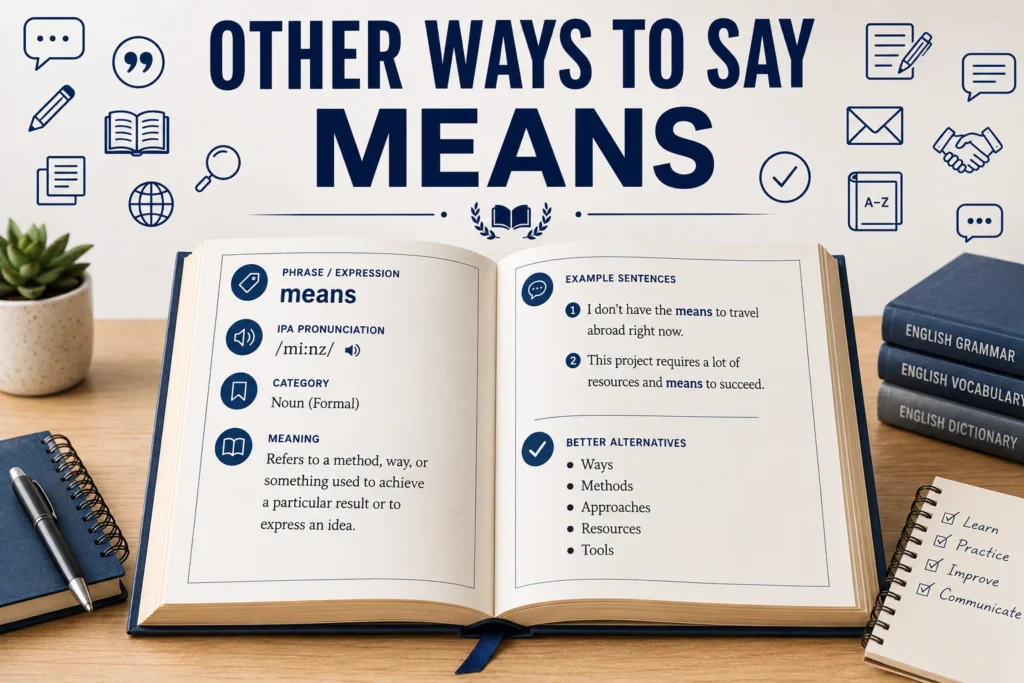
If you’re searching for other ways to say “means,” you’re probably looking to make your writing sound clearer, more professional, or less repetitive. The word “means” appears frequently in business emails, workplace conversations, academic writing, presentations, and everyday communication. While it’s a useful word, using it too often can make your sentences feel repetitive and less engaging.
Choosing the right alternative helps you communicate more effectively. Some words are better suited for formal reports and client emails, while others work naturally in casual conversations or team discussions. The best choice depends on your audience, your purpose, and the tone you want to create.
In this guide, you’ll learn the best professional, formal, and friendly alternatives to “means,” along with their meanings, tone, best use cases, and practical examples. Whether you’re writing a business email, explaining an idea to a colleague, or preparing a report, these alternatives will strengthen your professional communication, improve email etiquette, and make your writing more natural.
What Does “Means” Mean?
The word “means” generally refers to the meaning of something, a method of doing something, or a way to achieve a result, depending on the context.
Simple Definition
Means = Indicates the meaning of something or refers to a method or way of doing it.
Tone
- Neutral
- Professional
- Clear
- Suitable for both formal and informal communication
Purpose
People use “means” to:
- Explain the meaning of a word or phrase.
- Describe a method or process.
- Clarify instructions.
- Simplify complex information.
- Improve understanding during conversations.
Examples
- Success means working consistently toward your goals.
- This symbol means the file has been shared.
- Teamwork means supporting each other.
- Digital marketing means promoting products through online channels.
Why Use an Alternative to “Means”?
Although “means” is simple and correct, repeating it throughout an email, article, or presentation can make your writing feel repetitive. Using different expressions improves readability and allows you to match the tone of your audience.
Benefits
- Makes writing more engaging.
- Avoids unnecessary repetition.
- Improves professional communication.
- Creates smoother business emails.
- Helps explain ideas more clearly.
- Matches formal and informal situations.
Professional Usage of “Means”
Emails
In professional emails, “means” is often used to explain policies, instructions, or decisions. Replacing it with suitable alternatives can make your message sound more polished.
Example:
Completing the form indicates that you agree to our terms and conditions.
Workplace Communication
Managers and employees use “means” when explaining procedures, project goals, or company expectations. Clear alternatives help reduce confusion and improve communication.
Example:
Meeting this deadline requires close collaboration between all team members.
Client Communication
Clients appreciate clear explanations. Instead of repeating “means,” use more precise wording that sounds confident and professional.
Example:
Premium support includes 24/7 technical assistance and priority response times.
Networking
During networking events or professional conversations, explaining ideas clearly builds credibility and trust.
Example:
Leadership involves listening carefully and making informed decisions.
Customer Service
Customer support teams often explain processes, account information, or product features. Using varied language keeps responses professional and easy to understand.
Example:
Your confirmation email indicates that your payment was received successfully.
Professional Alternatives to “Means”
These alternatives work well in business emails, reports, presentations, and workplace communication.
1. Indicates
Meaning: Shows or points to something.
Tone: Professional
Best Use: Reports, emails, and data analysis.
Example:
A green status indicates that the project is on schedule.
2. Refers To
Meaning: Points to or mentions a particular subject.
Tone: Professional
Best Use: Business writing and explanations.
Example:
The policy refers to all full-time employees.
3. Signifies
Meaning: Expresses or represents a meaning.
Tone: Formal
Best Use: Reports and presentations.
Example:
A gold badge signifies outstanding performance.
4. Represents
Meaning: Stands for or symbolizes something.
Tone: Professional
Best Use: Business reports and presentations.
Example:
This figure represents our annual sales growth.
5. Suggests
Meaning: Implies an idea without stating it directly.
Tone: Professional
Best Use: Research and workplace discussions.
Example:
The survey suggests that customers prefer online support.
6. Implies
Meaning: Indicates something indirectly.
Tone: Formal
Best Use: Business communication.
Example:
Your response implies that additional training is needed.
7. Denotes
Meaning: Officially indicates or means.
Tone: Formal
Best Use: Academic or technical writing.
Example:
The red symbol denotes an urgent task.
8. Expresses
Meaning: Communicates an idea or feeling.
Tone: Professional
Best Use: Communication and presentations.
Example:
The message expresses our appreciation for your partnership.
9. Describes
Meaning: Explains or gives details.
Tone: Neutral
Best Use: Everyday communication.
Example:
The guide describes each step of the process.
10. Explains
Meaning: Makes something easier to understand.
Tone: Professional
Best Use: Emails and training materials.
Example:
The document explains how to submit expense reports.
11. Defines
Meaning: Gives the exact meaning.
Tone: Professional
Best Use: Policies and educational content.
Example:
The handbook defines employee responsibilities.
12. Clarifies
Meaning: Makes something clearer.
Tone: Professional
Best Use: Client communication and meetings.
Example:
This update clarifies the new company policy.
13. Conveys
Meaning: Communicates a message or idea.
Tone: Professional
Best Use: Business presentations.
Example:
The presentation conveys our long-term vision.
14. Reflects
Meaning: Shows or demonstrates something.
Tone: Professional
Best Use: Performance reviews and reports.
Example:
The results reflect the team’s hard work.
15. Illustrates
Meaning: Explains by giving an example.
Tone: Professional
Best Use: Reports and presentations.
Example:
This chart illustrates the company’s yearly growth.
Formal Alternatives to “Means”
These alternatives are ideal for official documents, reports, contracts, and formal business communication.
1. Constitutes
Tone: Very Formal
Example:
Missing the deadline constitutes a breach of the agreement.
2. Corresponds To
Tone: Formal
Example:
Each code corresponds to a specific department.
3. Is Defined As
Tone: Formal
Example:
Confidential information is defined as any non-public business data.
4. Is Interpreted As
Tone: Formal
Example:
Late submission is interpreted as non-compliance.
5. Is Understood As
Tone: Formal
Example:
Professional conduct is understood as respectful workplace behavior.
6. Is Considered
Tone: Professional
Example:
Attendance below 80% is considered unsatisfactory.
7. Represents the Idea Of
Tone: Formal
Example:
This symbol represents the idea of innovation.
8. Is Associated With
Tone: Professional
Example:
Blue is associated with trust and reliability.
9. Communicates
Tone: Professional
Example:
The announcement communicates our new company goals.
10. Identifies
Tone: Professional
Example:
The report identifies the key challenges facing the team.
Quick Comparison Table
| Alternative | Tone | Best Use |
| Indicates | Professional | Business emails |
| Refers to | Professional | General writing |
| Signifies | Formal | Reports |
| Represents | Professional | Presentations |
| Suggests | Neutral | Discussions |
| Implies | Formal | Professional communication |
| Denotes | Formal | Academic writing |
| Explains | Professional | Emails |
| Clarifies | Professional | Client communication |
| Defines | Professional | Policies |
| Conveys | Professional | Presentations |
| Reflects | Professional | Performance reviews |
| Illustrates | Professional | Reports |
| Constitutes | Very Formal | Legal documents |
| Corresponds to | Formal | Official reports |
These alternatives sound more natural in everyday conversations, casual emails, and team discussions. They help explain ideas without sounding overly formal.
1. Stands For
Meaning: Represents or has a particular meaning.
Tone: Friendly
Best Use: Explaining abbreviations, symbols, or concepts.
Example:
SEO stands for Search Engine Optimization.
2. Is About
Meaning: Describes the main idea or topic.
Tone: Casual
Best Use: Conversations and simple explanations.
Example:
Good leadership is about helping others succeed.
3. Shows
Meaning: Indicates or demonstrates something.
Tone: Friendly
Best Use: Everyday communication.
Example:
This report shows that customer satisfaction has improved.
4. Tells Us
Meaning: Gives information or explains something.
Tone: Casual
Best Use: Training and conversations.
Example:
The data tells us that sales increased last month.
5. Points To
Meaning: Suggests or indicates.
Tone: Friendly
Best Use: Discussions and presentations.
Example:
The survey points to a growing demand for online services.
6. Reveals
Meaning: Makes information known.
Tone: Neutral
Best Use: Reports and research.
Example:
The analysis reveals several areas for improvement.
7. Highlights
Meaning: Draws attention to something important.
Tone: Professional and friendly
Best Use: Meetings and presentations.
Example:
The report highlights the importance of teamwork.
8. Demonstrates
Meaning: Clearly proves or explains.
Tone: Professional
Best Use: Business reports.
Example:
This case study demonstrates the value of customer feedback.
9. Gives the Idea Of
Meaning: Suggests a general meaning.
Tone: Casual
Best Use: Informal explanations.
Example:
The company’s mission gives the idea of long-term growth.
10. Helps Explain
Meaning: Makes something easier to understand.
Tone: Friendly
Best Use: Teaching and workplace training.
Example:
This example helps explain the new policy.
Email Alternatives
These alternatives work well in business emails where you need to explain information clearly.
1. Indicates
2. Explains
3. Clarifies
4. Refers To
5. Outlines
6. Describes
7. Demonstrates
8. Confirms
9. Identifies
10. Highlights
Example:
The attached document outlines the next steps for the project and clarifies each team member’s responsibilities.
Workplace Alternatives
These expressions are useful during meetings, presentations, project discussions, and internal communication.
1. Reflects
2. Represents
3. Indicates
4. Defines
5. Suggests
6. Conveys
7. Illustrates
8. Identifies
9. Demonstrates
10. Explains
Example:
The quarterly report reflects strong business growth and illustrates how customer satisfaction has improved over the past year.
Email Examples
Client
The attached proposal explains our recommended solution and outlines the project timeline.
Manager
The latest report indicates that we’ve achieved all of this month’s targets.
Colleague
The updated document clarifies everyone’s responsibilities before the meeting.
Customer
Your order confirmation confirms that your payment was received successfully.
Networking
Your presentation clearly demonstrated the importance of building strong professional relationships.
Meeting Follow-up
As discussed today, the meeting notes outline the agreed action items and next steps.
Common Mistakes
1. Repeating “Means” Too Often
Using “means” in every sentence makes your writing repetitive.
❌ Success means hard work. Leadership means responsibility. Growth means learning.
✔ Use alternatives like represents, indicates, shows, or illustrates.
2. Choosing the Wrong Tone
Some alternatives are too formal for casual conversations, while others are too informal for client emails.
✔ Match the phrase to your audience and purpose.
3. Using Vague Words
Words like thing or stuff make explanations unclear.
✔ Use specific alternatives such as defines, clarifies, or explains instead.
4. Ignoring Email Etiquette
Business emails should be concise and easy to understand.
✔ Choose clear alternatives that improve readability without making sentences unnecessarily complicated.
Related Phrases
| Phrase | Meaning | Example |
| Refers to | Points to | The policy refers to all employees. |
| Indicates | Shows | The graph indicates steady growth. |
| Represents | Stands for | Blue represents trust. |
| Signifies | Symbolizes | The badge signifies excellence. |
| Explains | Makes clear | The guide explains the process. |
| Defines | Gives meaning | The handbook defines company values. |
| Clarifies | Removes confusion | The update clarifies the policy. |
| Conveys | Communicates | The message conveys appreciation. |
| Reflects | Shows | The results reflect improvement. |
| Illustrates | Gives an example | The chart illustrates the trend. |
| Demonstrates | Proves | The report demonstrates progress. |
| Highlights | Emphasizes | The presentation highlights key findings. |
| Identifies | Points out | The report identifies risks. |
| Shows | Displays | The dashboard shows today’s performance. |
| Stands for | Represents | KPI stands for Key Performance Indicator. |
Phrase Comparison
| Phrase | Tone | Best Use |
| Means | Neutral | General communication |
| Indicates | Professional | Business emails |
| Refers to | Professional | Reports |
| Represents | Professional | Presentations |
| Explains | Neutral | Everyday writing |
| Clarifies | Professional | Client communication |
| Signifies | Formal | Official writing |
| Shows | Friendly | Daily conversations |
| Demonstrates | Professional | Reports |
| Illustrates | Professional | Training and presentations |
Cultural Usage
US English
In American English, words like shows, indicates, explains, and stands for are commonly used in both business and everyday communication because they sound direct and natural.
UK English
British English often prefers refers to, represents, signifies, and clarifies, especially in formal writing and corporate communication.
Corporate Communication
Companies usually choose precise alternatives such as indicates, defines, clarifies, and represents to avoid confusion in reports, policies, and official emails.
Customer Service
Customer support teams often use explains, clarifies, shows, and confirms to make responses clear, professional, and easy for customers to understand.
Networking
During networking events or professional discussions, alternatives like represents, reflects, and demonstrates help explain ideas confidently and leave a professional impression.
FAQs
What is another way to say “means”?
Common alternatives include indicates, refers to, represents, signifies, explains, and defines.
What is the best professional synonym for “means”?
Indicates and represents are excellent choices for business communication.
Can I replace “means” with “indicates”?
Yes, when you want to show that something points to or suggests a particular result.
Which alternative is best for formal writing?
Signifies, denotes, constitutes, and defines work well in formal documents.
Is “stands for” a good alternative?
Yes. It’s commonly used when explaining abbreviations, symbols, or meanings.
Which word should I use in business emails?
Indicates, explains, clarifies, and refers to are clear and professional.
What’s the difference between “means” and “represents”?
Means explains the definition of something, while represents shows what something symbolizes or stands for.
How can I avoid repeating “means”?
Use a variety of alternatives based on the context, such as shows, identifies, illustrates, or demonstrates.
Is “denotes” too formal?
It can sound formal, so it’s best suited for academic, technical, or legal writing.
Why should I use different alternatives?
Using different expressions improves readability, strengthens professional communication, and makes your writing more engaging.
Conclusion
Using different ways to say “means” helps your writing become clearer, more engaging, and more professional. While “means” is a useful everyday word, relying on it too often can make emails, reports, and conversations feel repetitive. Alternatives such as indicates, represents, clarifies, explains, and defines allow you to match your tone to different situations. Whether you’re communicating with clients, colleagues, managers, or customers, choosing the right expression improves clarity, supports effective workplace communication, and helps you deliver your message with greater confidence and professionalism.