
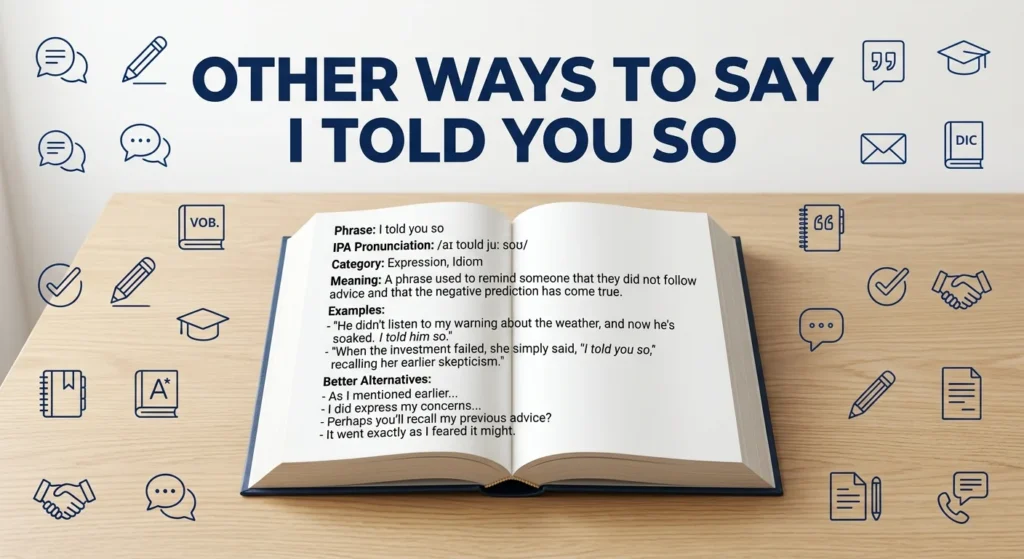
“I told you so” is a common phrase used when someone wants to point out that their earlier warning, advice, opinion, or prediction turned out to be correct. While the phrase is easy to understand, it can sound smug, sarcastic, or confrontational.
That is why many people search for other ways to say I told you so, especially when they need to communicate professionally. In emails, workplace conversations, client discussions, networking, and customer service, you often need to make the same point without making the other person feel embarrassed.
A better approach is to focus on the situation rather than the person. Instead of saying, “I told you so,” you can say, “As we discussed earlier,” “This is what I was concerned about,” or “It looks like the issue we discussed has occurred.”
The right alternative depends on your relationship, tone, and purpose. Some expressions work well in formal emails, while others suit friendly conversations with colleagues or close friends.
This guide explains the meaning of “I told you so,” when it can sound inappropriate, and 50 professional, formal, friendly, and email-ready alternatives with practical examples.
What Does “I Told You So” Mean?
Literal Meaning
“I told you so” means that you previously warned, advised, informed, or predicted something, and the current situation proves that your earlier statement was correct.
For example:
“I told you so. We should have checked the report before sending it.”
The speaker is saying that they had already warned the other person about the possible problem.
Tone of “I Told You So”
The phrase can have several tones:
- Playful: Used between close friends or family members.
- Teasing: Used when someone makes a prediction that comes true.
- Sarcastic: Used to highlight another person’s mistake.
- Confrontational: Used to prove that you were right.
- Professional: Usually avoided because it can sound blaming or self-satisfied.
In professional communication, the last thing you want is to make someone defensive. A neutral alternative usually works better.
Purpose of the Phrase
People generally use “I told you so” to:
- Remind someone about previous advice.
- Point out that a warning was accurate.
- Confirm an earlier prediction.
- Highlight a missed recommendation.
- Explain that an issue was foreseeable.
The same purpose can be achieved with more respectful language.
Emotional Context
“I told you so” often carries an emotional message beyond its literal meaning. It can suggest:
- “I was right.”
- “You should have listened.”
- “I warned you.”
- “This happened exactly as I predicted.”
- “You should have followed my advice.”
That emotional layer explains why the phrase can create tension.
Example
Instead of:
“I told you so. The deadline was too tight.”
A professional version would be:
“This is the scheduling concern we discussed earlier.”
The second sentence communicates the same basic idea without sounding like a personal victory.
Why Use Alternatives to “I Told You So”?
There are several reasons to choose a different expression.
To Sound Professional
In business communication, your goal should be solving the problem rather than proving that you were right.
Instead of:
“I told you so.”
Try:
“This is the issue we anticipated earlier.”
To Avoid Blame
A direct “I told you so” can make another person feel criticized.
A neutral statement keeps the conversation focused on the situation.
To Protect Workplace Relationships
Good workplace communication depends on trust. Even when your prediction was correct, reminding someone of their mistake too strongly can damage a working relationship.
To Improve Email Etiquette
Written communication does not always show your intended tone. A phrase that sounds playful when spoken can look harsh in an email.
To Communicate With Clients
Clients may not respond well to language that suggests they ignored your advice. A respectful alternative protects both the relationship and the business conversation.
When Is “I Told You So” Appropriate?
“I told you so” is not always wrong.
It can work in casual situations with people who understand your humor.
For example:
“I told you so! That restaurant really was closed on Mondays.”
Between close friends, this can sound playful rather than rude.
However, the phrase is usually less suitable in:
- Business emails
- Client communication
- Customer service
- Formal meetings
- Workplace disagreements
- Professional networking
- Performance discussions
- Sensitive conversations
When the relationship matters, choose a neutral alternative.
Other Ways to Say “I Told You So”
Professional Alternatives
These expressions work well when you need to refer to previous advice or concerns without sounding arrogant.
1. As We Discussed Earlier
Meaning: Refers to something you previously discussed.
Tone: Professional and neutral.
Best use: Emails, meetings, and workplace communication.
Example:
“As we discussed earlier, the current timeline may create scheduling issues.”
2. As I Mentioned Earlier
Meaning: Reminds someone that you previously raised the point.
Tone: Polite and professional.
Best use: Business emails and meetings.
Example:
“As I mentioned earlier, we may need additional time to complete the testing.”
3. As We Anticipated
Meaning: Indicates that the current result was expected.
Tone: Professional and collaborative.
Best use: Project discussions and reports.
Example:
“As we anticipated, the additional testing identified a few issues.”
4. This Is What I Was Concerned About
Meaning: Points back to a concern you previously expressed.
Tone: Calm and professional.
Best use: Workplace discussions and project updates.
Example:
“This is what I was concerned about when we reviewed the timeline last week.”
5. This Is the Issue We Discussed
Meaning: Connects the current problem with an earlier discussion.
Tone: Neutral.
Best use: Meetings, emails, and project management.
Example:
“This is the issue we discussed during Monday’s meeting.”
6. This Confirms Our Earlier Concern
Meaning: Says that a previous concern has now been supported by events.
Tone: Professional and measured.
Best use: Reports and business emails.
Example:
“The latest figures confirm our earlier concern about rising costs.”
7. This Is Consistent With What We Expected
Meaning: Explains that the result matches an earlier expectation.
Tone: Professional.
Best use: Business analysis and workplace communication.
Example:
“The current response is consistent with what we expected from the initial testing.”
8. This Is What We Were Trying to Avoid
Meaning: Indicates that the current problem was previously identified as a risk.
Tone: Professional but direct.
Best use: Project management.
Example:
“This delay is what we were trying to avoid when we recommended an earlier launch.”
9. The Outcome Supports Our Earlier Assessment
Meaning: Says that the result supports your previous judgment.
Tone: Formal and objective.
Best use: Reports, analysis, and management communication.
Example:
“The latest results support our earlier assessment of the market.”
10. The Results Confirm Our Earlier Prediction
Meaning: States that a previous prediction proved accurate.
Tone: Professional and factual.
Best use: Data, research, sales, and business reports.
Example:
“The latest sales figures confirm our earlier prediction.”
11. As Previously Noted
Meaning: Refers to information already mentioned.
Tone: Formal.
Best use: Reports, emails, and documentation.
Example:
“As previously noted, the contract requires written approval before implementation.”
12. As Previously Discussed
Meaning: Refers to an earlier conversation.
Tone: Professional and polite.
Best use: Emails and workplace communication.
Example:
“As previously discussed, we will review the proposal on Friday.”
13. As I Pointed Out Earlier
Meaning: Reminds someone that you previously identified the issue.
Tone: Direct but professional.
Best use: Meetings and detailed discussions.
Example:
“As I pointed out earlier, the current system has limited capacity.”
14. This Was One of the Risks We Identified
Meaning: Connects the current issue to a previously identified risk.
Tone: Objective.
Best use: Project management and business analysis.
Example:
“This was one of the risks we identified during the planning stage.”
15. This Aligns With My Earlier Recommendation
Meaning: Indicates that the current outcome supports your earlier advice.
Tone: Professional and confident.
Best use: Consulting, management, and client communication.
Example:
“The outcome aligns with my earlier recommendation to delay the launch.”
Formal Alternatives
These are useful when you need a more polished or diplomatic way to communicate the idea.
16. The Current Outcome Confirms My Earlier Assessment
Meaning: Says the current result supports your previous evaluation.
Tone: Formal and objective.
Best use: Reports, executive communication, and formal emails.
Example:
“The current outcome confirms my earlier assessment of the risks involved.”
17. The Results Validate the Earlier Recommendation
Meaning: Indicates that later results support an earlier recommendation.
Tone: Formal.
Best use: Business reports and professional analysis.
Example:
“The results validate the earlier recommendation to conduct additional testing.”
18. The Evidence Supports Our Earlier View
Meaning: Says that available evidence now supports a previous opinion.
Tone: Formal and analytical.
Best use: Research, business analysis, and management discussions.
Example:
“The new data supports our earlier view regarding customer demand.”
19. This Confirms What We Had Anticipated
Meaning: Says that an expected result has occurred.
Tone: Formal and diplomatic.
Best use: Reports and professional meetings.
Example:
“This confirms what we had anticipated during the planning phase.”
20. The Outcome Was Consistent With Our Earlier Expectations
Meaning: States that the actual result matched the previous expectation.
Tone: Formal.
Best use: Business reports and project reviews.
Example:
“The outcome was consistent with our earlier expectations.”
21. This Reflects the Concern Raised Earlier
Meaning: Connects a current issue to an earlier concern.
Tone: Formal and neutral.
Best use: Workplace emails and reports.
Example:
“This reflects the concern raised earlier regarding delivery times.”
22. The Situation Developed as Anticipated
Meaning: Says that events happened in the expected way.
Tone: Formal and concise.
Best use: Business updates.
Example:
“The situation developed as anticipated following the policy change.”
23. This Reinforces the Earlier Recommendation
Meaning: Says that new information makes an earlier recommendation more convincing.
Tone: Formal.
Best use: Management communication.
Example:
“The customer feedback reinforces the earlier recommendation.”
24. This Supports the Point Raised Earlier
Meaning: Connects new evidence to an earlier statement.
Tone: Formal and neutral.
Best use: Meetings, reports, and emails.
Example:
“The latest figures support the point raised earlier about staffing.”
25. The Outcome Was Foreseeable Based on the Earlier Information
Meaning: Says the result could have been expected from information already available.
Tone: Formal and analytical.
Best use: Reports and post-project reviews.
Example:
“The delay was foreseeable based on the earlier delivery estimates.”
Friendly Alternatives
These phrases work better with colleagues, friends, or people you know well.
26. Looks Like I Was Right About That
Meaning: Lightly points out that your earlier opinion was correct.
Tone: Friendly and slightly playful.
Best use: Casual workplace or personal conversations.
Example:
“Looks like I was right about that deadline after all.”
27. Seems Like We Saw This Coming
Meaning: Suggests that the situation was expected.
Tone: Friendly and collaborative.
Best use: Conversations with colleagues.
Example:
“Seems like we saw this coming when we reviewed the schedule.”
28. That’s What I Was Worried About
Meaning: Reminds someone of an earlier concern.
Tone: Friendly but direct.
Best use: Informal workplace conversations.
Example:
“That’s what I was worried about when we changed the supplier.”
29. That’s Exactly What We Discussed
Meaning: Points out that the current issue matches an earlier discussion.
Tone: Friendly and neutral.
Best use: Colleague conversations.
Example:
“That’s exactly what we discussed during yesterday’s meeting.”
30. This Is What I Had in Mind
Meaning: Indicates that the current result matches your earlier expectation.
Tone: Friendly.
Best use: Informal conversations.
Example:
“This is what I had in mind when I suggested waiting another week.”
31. Looks Like Our Earlier Concern Was Valid
Meaning: Says that a previous concern turned out to be reasonable.
Tone: Friendly and professional.
Best use: Workplace discussions.
Example:
“Looks like our earlier concern about the supplier was valid.”
32. We Had a Feeling This Might Happen
Meaning: Says that the outcome had been expected.
Tone: Casual and friendly.
Best use: Colleagues and informal discussions.
Example:
“We had a feeling this might happen after the first test.”
33. This Is What We Were Talking About
Meaning: Connects the current event to an earlier conversation.
Tone: Casual and neutral.
Best use: Workplace and personal conversations.
Example:
“This is what we were talking about when we discussed the new system.”
34. Seems Like the Prediction Came True
Meaning: Says that an earlier prediction was accurate.
Tone: Light and friendly.
Best use: Informal conversations.
Example:
“Seems like the prediction came true after all.”
35. I Guess We Called It
Meaning: Informally says that your earlier prediction was correct.
Tone: Casual and playful.
Best use: Friends or close colleagues.
Example:
“I guess we called it. The event sold out quickly.”
Email-Ready Alternatives
These expressions are especially useful when you need a professional way to say I told you so without sounding confrontational.
36. As Discussed Earlier
Meaning: Refers to a previous conversation.
Tone: Neutral and professional.
Best use: Business emails.
Example:
“As discussed earlier, the current timeline may affect the delivery date.”
37. As Mentioned Previously
Meaning: Refers to information you already provided.
Tone: Formal and polite.
Best use: Emails and documentation.
Example:
“As mentioned previously, the revised quotation will remain valid until Friday.”
38. As We Discussed
Meaning: Reminds the recipient about a shared discussion.
Tone: Collaborative.
Best use: Client and colleague emails.
Example:
“As we discussed, we will complete the remaining work next week.”
39. I Wanted to Revisit the Concern I Raised Earlier
Meaning: Politely brings an earlier concern back into the conversation.
Tone: Diplomatic.
Best use: Sensitive business emails.
Example:
“I wanted to revisit the concern I raised earlier regarding the project timeline.”
40. I’d Like to Revisit My Earlier Recommendation
Meaning: Brings previous advice back into consideration.
Tone: Professional and respectful.
Best use: Client or management communication.
Example:
“I’d like to revisit my earlier recommendation to conduct another quality check.”
41. The Latest Results Support Our Earlier Discussion
Meaning: Says that new information supports what was previously discussed.
Tone: Professional and collaborative.
Best use: Reports and emails.
Example:
“The latest results support our earlier discussion about expanding the service.”
42. The Current Situation Reflects the Risk We Discussed
Meaning: Connects the current situation to an earlier warning.
Tone: Diplomatic.
Best use: Client and workplace emails.
Example:
“The current situation reflects the delivery risk we discussed last week.”
43. This Is Consistent With the Concern I Previously Raised
Meaning: Politely explains that a previous concern has now appeared.
Tone: Professional.
Best use: Business emails.
Example:
“This is consistent with the concern I previously raised about the supplier’s capacity.”
44. I Believe the Earlier Recommendation Is Worth Revisiting
Meaning: Suggests reconsidering previous advice without blaming anyone.
Tone: Very diplomatic.
Best use: Managers, clients, and senior colleagues.
Example:
“Given the latest developments, I believe the earlier recommendation is worth revisiting.”
45. The Latest Development Confirms Our Earlier Assessment
Meaning: States that new information supports the earlier assessment.
Tone: Formal and professional.
Best use: Client emails, reports, and management updates.
Example:
“The latest development confirms our earlier assessment of the market conditions.”
Workplace Alternatives
These expressions help you communicate the idea naturally at work.
46. This Is the Risk We Identified Earlier
Meaning: Reminds the team about an earlier risk.
Tone: Neutral and professional.
Best use: Meetings and project discussions.
Example:
“This is the risk we identified earlier during the planning session.”
47. This Is What We Flagged Previously
Meaning: Refers to an issue that the team previously identified.
Tone: Professional.
Best use: Project meetings and team updates.
Example:
“This is what we flagged previously when reviewing the supplier agreement.”
48. We Discussed This Possibility Earlier
Meaning: Reminds colleagues that the possibility was previously considered.
Tone: Neutral.
Best use: Meetings and workplace communication.
Example:
“We discussed this possibility earlier, so we should review the backup plan.”
49. This Matches the Scenario We Discussed
Meaning: Says that the current situation matches an earlier scenario.
Tone: Professional and collaborative.
Best use: Team meetings and project reviews.
Example:
“This matches the scenario we discussed during the risk assessment.”
50. Our Earlier Discussion Prepared Us for This
Meaning: Shows that the earlier conversation was useful for dealing with the current situation.
Tone: Positive and collaborative.
Best use: Workplace communication.
Example:
“Our earlier discussion prepared us for this possibility, so we can move forward with the backup plan.”
Quick Comparison Table
| Alternative | Tone | Best Use |
| As we discussed earlier | Professional | Emails and meetings |
| As I mentioned earlier | Polite | Business emails |
| As we anticipated | Professional | Reports and projects |
| This is what I was concerned about | Direct | Workplace discussions |
| This confirms our earlier concern | Neutral | Business communication |
| This is the issue we discussed | Professional | Meetings |
| The results confirm our earlier prediction | Formal | Reports |
| As previously noted | Formal | Documentation |
| As previously discussed | Professional | Emails |
| This was one of the risks we identified | Objective | Project management |
| This aligns with my earlier recommendation | Professional | Consulting |
| The current outcome confirms my earlier assessment | Formal | Reports |
| The evidence supports our earlier view | Formal | Analysis |
| This reinforces the earlier recommendation | Formal | Management |
| The situation developed as anticipated | Formal | Business updates |
| Looks like I was right about that | Friendly | Casual conversations |
| Seems like we saw this coming | Friendly | Colleagues |
| That’s what I was worried about | Friendly | Informal discussions |
| We had a feeling this might happen | Casual | Colleagues |
| I guess we called it | Casual | Friends and close colleagues |
| As discussed earlier | Email-ready | Business emails |
| As mentioned previously | Formal | Emails |
| I wanted to revisit the concern I raised earlier | Diplomatic | Sensitive emails |
| I’d like to revisit my earlier recommendation | Professional | Clients/managers |
| The latest results support our earlier discussion | Professional | Reports/emails |
| This reflects the risk we discussed | Diplomatic | Client communication |
| The latest development confirms our earlier assessment | Formal | Business updates |
| This is the risk we identified earlier | Professional | Meetings |
| We discussed this possibility earlier | Neutral | Workplace |
| Our earlier discussion prepared us for this | Positive | Team communication |
Email Examples
Example for a Client
Instead of:
“I told you so. This is why I recommended delaying the launch.”
Write:
“As discussed earlier, the current results suggest that delaying the launch may help us address the remaining issues before release.”
This approach protects the client relationship while still referring to your earlier recommendation.
Example for a Manager
Instead of:
“I told you this deadline was unrealistic.”
Write:
“I wanted to revisit the timeline concern I raised earlier. Based on the current progress, we may need additional time to complete the remaining tasks.”
This sounds constructive rather than confrontational.
Example for a Colleague
Instead of:
“See? I told you so.”
Write:
“Looks like our earlier concern was valid. Let’s see what we can do to address it.”
This keeps the conversation friendly.
Example for a Customer
Instead of:
“I told you that the delivery might be delayed.”
Write:
“As mentioned previously, the delivery timeline was subject to potential delays. We now have an updated delivery date.”
This is more appropriate for customer service.
Example for Networking
Instead of:
“I told you that strategy would work.”
Write:
“It’s great to see that the strategy we discussed is producing positive results.”
This gives credit to the shared effort.
Example for a Meeting Follow-Up
Instead of:
“I told you this would happen.”
Write:
“As discussed during the meeting, this was one of the potential risks we identified. The latest update confirms that we should address it now.”
This keeps the follow-up professional and solution-focused.
How to Say “I Told You So” Without Sounding Rude
The key is to replace personal victory with shared facts.
Focus on the Situation
Instead of:
“I told you so.”
Say:
“This is the issue we discussed earlier.”
Focus on Evidence
Instead of:
“I was right.”
Say:
“The latest results support our earlier assessment.”
Focus on the Future
Instead of:
“You should have listened to me.”
Say:
“We can use this information to improve the next step.”
Focus on Collaboration
Instead of:
“I warned you.”
Say:
“We identified this as a potential risk during planning.”
These changes make your communication more constructive.
Common Mistakes When Replacing “I Told You So”
1. Choosing an Alternative That Still Sounds Blaming
Changing the exact words does not always change the tone.
For example:
“As I warned you, this happened.”
Although technically professional, “as I warned you” can still sound accusatory.
A better choice is:
“This is the risk we discussed earlier.”
2. Overusing “As I Mentioned Earlier”
This phrase is useful, but repeating it in every email can sound impatient.
Instead, vary your language:
- As discussed earlier
- As previously noted
- As we anticipated
- This is consistent with our earlier discussion
- The latest results support our earlier assessment
3. Trying Too Hard to Sound Formal
Not every conversation requires formal language.
For a colleague, this may sound unnecessarily stiff:
“The current outcome validates my previous assessment.”
A natural alternative could be:
“Looks like our earlier concern was valid.”
4. Using Casual Language With Clients
Expressions such as:
“See? I was right.”
or
“I guess I called it.”
may work with friends but can sound unprofessional with clients.
5. Making the Conversation About Yourself
The purpose of professional communication should be solving the problem.
Instead of focusing on who was right, focus on:
- What happened?
- Why did it happen?
- What can we learn?
- What should happen next?
6. Ignoring Email Tone
Written communication can sound harsher than intended.
For example:
“As I said before, this was going to happen.”
A softer version is:
“As discussed earlier, this was one of the potential outcomes we considered.”
Related Phrases and Expressions
Here are related expressions that can help you discuss previous advice, predictions, warnings, and expectations.
1. As Discussed
Refers to a previous conversation.
Example: “As discussed, we will proceed with the revised schedule.”
2. As Mentioned Earlier
Refers to information already provided.
Example: “As mentioned earlier, the offer expires Friday.”
3. As Previously Noted
Points to information already documented.
Example: “As previously noted, approval is required before implementation.”
4. As Anticipated
Means something happened as expected.
Example: “As anticipated, demand increased after the campaign.”
5. As Expected
Shows that an outcome was not surprising.
Example: “As expected, the additional testing revealed several issues.”
6. As Predicted
Means an earlier prediction proved accurate.
Example: “As predicted, the market responded positively.”
7. As We Suspected
Suggests that an earlier suspicion was correct.
Example: “As we suspected, the delay was caused by the supplier.”
8. As We Expected
Connects the result to an earlier expectation.
Example: “As we expected, the new process reduced processing time.”
9. This Confirms Our Concern
Shows that a concern was supported by later information.
Example: “This confirms our concern about the delivery schedule.”
10. This Validates the Recommendation
Indicates that the outcome supports earlier advice.
Example: “The results validate the recommendation to test the product first.”
11. This Supports Our Earlier View
Says that new evidence supports an earlier opinion.
Example: “The survey results support our earlier view.”
12. We Identified This Risk Earlier
Reminds the team about a previously identified problem.
Example: “We identified this risk earlier, so we should activate the backup plan.”
13. This Was One of the Possibilities We Considered
Shows that the current event was previously considered.
Example: “This was one of the possibilities we considered during planning.”
14. The Outcome Was Foreseeable
Means the result could reasonably have been expected.
Example: “The delay was foreseeable given the limited delivery window.”
15. The Results Speak for Themselves
Means the evidence clearly communicates the situation.
Example: “The latest figures speak for themselves.”
16. It Turned Out as Expected
Means the final result matched the expectation.
Example: “The project turned out as expected after the additional testing.”
17. That Was the Concern
Points back to an earlier concern.
Example: “That was the concern we raised during the initial review.”
18. This Is What We Planned For
Shows that the team had already considered the situation.
Example: “This is what we planned for when creating the backup process.”
“I Told You So” vs. Professional Alternatives
| Phrase | Tone | Formality | Best Use |
| I told you so | Blunt/playful | Low | Close friends |
| I warned you | Direct | Medium | Sensitive workplace situations |
| As I mentioned earlier | Neutral | Medium | Emails |
| As we discussed earlier | Collaborative | Medium | Workplace |
| As we anticipated | Professional | High | Business reports |
| This confirms our earlier concern | Objective | High | Professional communication |
| This supports our earlier assessment | Formal | High | Reports and analysis |
| This is the risk we identified earlier | Neutral | High | Project management |
| Looks like I was right about that | Friendly | Low | Casual conversations |
| We had a feeling this might happen | Friendly | Low | Colleagues |
| I’d like to revisit my earlier recommendation | Diplomatic | High | Clients and managers |
| The latest results support our earlier discussion | Professional | High | Emails and reports |
The main difference is that “I told you so” focuses on being right, while professional alternatives focus on the evidence, previous discussion, or next action.
Cultural and Professional Usage
US English
In American English, “I told you so” is common in casual conversation and often carries a playful or teasing tone.
However, professional American communication usually favors direct but diplomatic wording.
For example:
“The results confirm our earlier assessment.”
sounds more professional than:
“I told you so.”
UK English
British English also uses “I told you so” in informal situations. Depending on context, it can sound humorous, teasing, or slightly smug.
In professional settings, phrases such as:
“As previously discussed”
or
“This is consistent with our earlier assessment”
are safer choices.
Corporate Communication
Corporate communication usually rewards neutral language.
Instead of proving that someone made a mistake, focus on:
- Previous discussions
- Evidence
- Risks
- Results
- Recommendations
- Next steps
This makes workplace communication more productive.
Customer Service
Customer service requires extra care because customers may already feel frustrated.
Avoid:
“I told you this could happen.”
Prefer:
“As mentioned previously, this was a potential issue with the delivery timeline.”
Then move toward a solution.
Networking
Networking conversations should maintain positive relationships.
If an idea you recommended succeeds, avoid making the conversation about being right.
Instead of:
“I told you that strategy would work.”
Say:
“It’s great to see the strategy producing the results we discussed.”
This sounds confident while giving the conversation a positive direction.
How to Choose the Right Alternative
The best alternative depends on your audience.
For a Formal Email
Use:
- As previously noted
- As previously discussed
- The current outcome confirms our earlier assessment
- The results support our earlier recommendation
For a Client
Use:
- As we discussed
- I’d like to revisit my earlier recommendation
- This reflects the risk we discussed
- The latest results support our earlier discussion
For a Manager
Use:
- I wanted to revisit the concern I raised earlier
- This is consistent with our earlier expectations
- The current results support our earlier assessment
For a Colleague
Use:
- Looks like our earlier concern was valid
- Seems like we saw this coming
- That’s exactly what we discussed
For a Friend
Use:
- Looks like I was right about that
- I guess we called it
- Seems like the prediction came true
The more sensitive the situation, the more neutral your wording should become.
FAQs
What is a professional way to say “I told you so”?
A professional way to say it is “As we discussed earlier,” “This confirms our earlier concern,” or “The latest results support our earlier assessment.” These expressions communicate the point without sounding smug or blaming.
What is a polite alternative to “I told you so”?
A polite alternative is “This is the issue we discussed earlier.” You can also say, “As previously discussed, this was one of the risks we identified.”
What is a formal alternative to “I told you so”?
A formal alternative is “The current outcome confirms my earlier assessment.” Another option is “The results support our earlier recommendation.”
How do you say “I told you so” in an email?
Instead of using the phrase directly, write something like:
“As discussed earlier, the current results reflect the concern we identified during the planning stage.”
This sounds professional and keeps the focus on the situation.
Is “I told you so” rude?
It can be. The phrase often suggests that the speaker wants credit for being right or wants to highlight another person’s mistake. It may sound playful with friends but confrontational in professional settings.
Can I use “I told you so” at work?
You can use it with close colleagues in a clearly playful situation, but it is generally safer to avoid it in formal workplace communication. Use neutral language when discussing mistakes, risks, or previous advice.
What is another way to say “I warned you”?
You can say “This is the concern we discussed earlier,” “This was one of the risks we identified,” or “This reflects the issue we previously discussed.”
What is a professional way to remind someone of previous advice?
Try “I’d like to revisit my earlier recommendation” or “As discussed earlier, this was one of the potential risks.” These phrases remind the person without directly blaming them.
What is a synonym for “I told you so”?
There is no perfect one-word synonym because “I told you so” combines several ideas: previous advice, being correct, and reminding someone about it. Useful alternatives include “As anticipated,” “As discussed,” “As predicted,” and “This confirms our earlier assessment.”
How can I say “I was right” professionally?
You can say “The latest results support our earlier assessment” or “The outcome is consistent with our earlier expectations.” These phrases communicate the same idea in a more objective way.
How do you say “I told you so” without sounding arrogant?
Focus on evidence rather than yourself. Instead of saying “I was right,” say “The results confirm the concern we discussed earlier.” This keeps the conversation factual.
What should I say instead of “See, I told you”?
Try “This is what we discussed earlier,” “Looks like our earlier concern was valid,” or “The results support what we discussed.” Choose based on how formal the conversation is.
What is the best phrase for a business email?
“As discussed earlier” is one of the safest choices because it sounds professional, neutral, and collaborative.
What is the best alternative when speaking to a client?
Use a diplomatic phrase such as “I’d like to revisit the recommendation we discussed earlier” or “The current situation reflects the risk we discussed.”
What is the best casual alternative to “I told you so”?
For friends or close colleagues, you can say “Looks like I was right about that” or “I guess we called it.” These options retain the playful feeling without being as blunt.
Final Summary
“I told you so” is easy to understand, but it can sound smug, blaming, or confrontational, especially in professional communication. The best alternative depends on your audience and purpose.
For professional communication, use phrases such as “As we discussed earlier,” “This confirms our earlier concern,” and “This is consistent with what we expected.”
For formal communication, choose “The current outcome confirms my earlier assessment” or “The results support our earlier recommendation.”
For casual conversations, “Looks like I was right about that” and “I guess we called it” can work well.
For business emails, “As previously discussed,” “I’d like to revisit my earlier recommendation,” and “The latest results support our earlier discussion” are strong choices.
The key is to focus on the facts, evidence, and next steps rather than making the conversation about who was right. That approach creates clearer, more respectful, and more effective professional communication.
Conclusion
Finding other ways to say “I told you so” helps you communicate confidence without sounding arrogant or confrontational. In professional settings, the strongest alternatives focus on previous discussions, evidence, risks, and results rather than personal victory. Phrases such as “As we discussed earlier,” “This confirms our earlier concern,” and “The results support our earlier assessment” work well in emails, meetings, client conversations, and workplace communication. For casual situations, friendlier expressions such as “Looks like I was right about that” can keep the tone light. Choose your wording based on the relationship, context, and level of formality to make your message clear, respectful, and effective.




