
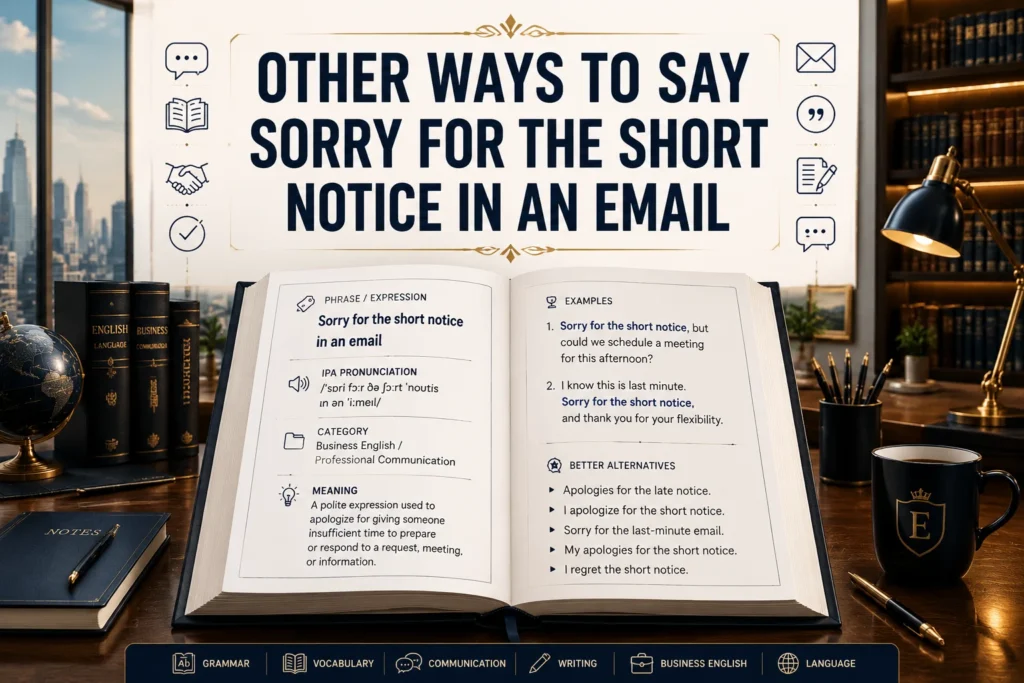
If you’ve ever had to send a last-minute request, meeting invitation, or schedule change, you’ve probably written “sorry for the short notice.” While this phrase is polite and common, using it repeatedly can make your emails sound repetitive. That’s why many professionals search for other ways to say sorry for the short notice in an email that sound more polished, sincere, and appropriate for different situations.
Whether you’re emailing a client, manager, colleague, customer, or networking contact, choosing the right wording helps maintain professionalism and shows respect for the recipient’s time. A thoughtful alternative can also improve your professional communication, strengthen workplace communication, and reflect good email etiquette.
In this guide, you’ll discover professional, formal, friendly, email-friendly, and workplace alternatives, along with practical examples to help you communicate confidently in any business setting.
What Does “Sorry for the Short Notice” Mean?
Literal Meaning
“Sorry for the short notice” is an apology used when you’re informing someone about something with little advance warning. It acknowledges that the recipient has limited time to prepare, respond, or make arrangements.
Tone
The phrase is generally:
- Polite
- Respectful
- Professional
- Considerate
- Sincere
Purpose
People use it to:
- Apologize for a last-minute request
- Show respect for someone’s schedule
- Reduce inconvenience
- Maintain positive professional relationships
- Encourage understanding
Emotional Context
Using this phrase shows empathy. It recognizes that the recipient may need to adjust their plans because of your late request. A sincere apology often makes the request feel more respectful and thoughtful.
Examples
- Sorry for the short notice, but could we reschedule today’s meeting?
- I apologize for the short notice regarding tomorrow’s presentation.
- Sorry for the short notice, but we need your approval by this afternoon.
When Is It Appropriate to Use This Phrase?
Emails
Use it when sending:
- Last-minute meeting invitations
- Urgent requests
- Deadline changes
- Schedule updates
- Unexpected announcements
Example:
Sorry for the short notice, but we’ve moved tomorrow’s meeting to 10:00 a.m.
Workplace
It’s appropriate when unexpected situations require immediate communication with coworkers or team members.
Example:
Sorry for the short notice. Could everyone join a quick meeting at 3 p.m.?
Clients
When contacting clients at the last minute, a polite apology helps maintain trust and professionalism.
Example:
I apologize for the short notice, but we’d like to discuss a project update this afternoon.
Networking
If you’re arranging a meeting or requesting a quick call, acknowledging the limited notice shows courtesy.
Example:
Sorry for the short notice. Would you be available for a brief call today?
Customer Service
Customer service teams often use similar wording when informing customers about unexpected service interruptions or schedule changes.
Example:
We apologize for the short notice regarding today’s maintenance update.
50 Other Ways to Say “Sorry for the Short Notice”
Professional Alternatives
1. I apologize for the late notice
Meaning: A direct and professional apology for notifying someone late.
Tone: Professional
Best Use: Business emails
Example: I apologize for the late notice, but the meeting has been rescheduled.
2. Thank you for your flexibility
Meaning: Shows appreciation instead of focusing on the apology.
Tone: Positive
Best Use: Workplace communication
Example: Thank you for your flexibility with this last-minute change.
3. I appreciate your understanding
Meaning: Acknowledges the recipient’s patience.
Tone: Respectful
Best Use: Client emails
Example: I appreciate your understanding as we adjust the timeline.
4. Thank you for accommodating this request
Meaning: Expresses gratitude for cooperation.
Tone: Professional
Best Use: Scheduling
Example: Thank you for accommodating this request on short notice.
5. I appreciate your patience
Meaning: Thanks the reader for being patient.
Tone: Warm
Best Use: Delays and updates
Example: I appreciate your patience while we finalize the details.
6. I regret the limited notice
Meaning: A formal way to apologize.
Tone: Formal
Best Use: Executive communication
Example: I regret the limited notice regarding tomorrow’s meeting.
7. Please accept my apologies for the late request
Meaning: Offers a sincere apology.
Tone: Formal
Best Use: Important requests
Example: Please accept my apologies for the late request.
8. I realize this is last minute
Meaning: Acknowledges the timing.
Tone: Friendly Professional
Best Use: Team communication
Example: I realize this is last minute, but your feedback would be appreciated.
9. Thank you for your prompt attention
Meaning: Appreciates a quick response.
Tone: Professional
Best Use: Urgent emails
Example: Thank you for your prompt attention to this matter.
10. I understand this is short notice
Meaning: Shows empathy.
Tone: Respectful
Best Use: Client communication
Example: I understand this is short notice, and I appreciate your help.
11. Thank you for your cooperation
Meaning: Appreciates support.
Tone: Professional
Best Use: Workplace
Example: Thank you for your cooperation during this schedule change.
12. I appreciate your willingness to help
Meaning: Recognizes assistance.
Tone: Warm
Best Use: Team emails
Example: I appreciate your willingness to help despite the limited notice.
13. Thank you for making time
Meaning: Appreciates availability.
Tone: Friendly Professional
Best Use: Meetings
Example: Thank you for making time on such short notice.
14. Your flexibility is greatly appreciated
Meaning: Expresses sincere gratitude.
Tone: Professional
Best Use: Clients
Example: Your flexibility is greatly appreciated.
15. Thank you for your quick response
Meaning: Appreciates timely action.
Tone: Professional
Best Use: Urgent requests
Example: Thank you for your quick response despite the short notice.
Formal Alternatives
16. Please accept my sincere apologies.
Meaning: A respectful apology.
Tone: Very Formal
Best Use: Senior management or clients
Example: Please accept my sincere apologies for the late notification.
17. I regret any inconvenience this may cause.
Meaning: Recognizes possible disruption.
Tone: Formal
Best Use: Official correspondence
Example: I regret any inconvenience this schedule change may cause.
18. I apologize for the inconvenience.
Meaning: A common professional apology.
Tone: Formal
Best Use: Business emails
Example: I apologize for the inconvenience caused by this late request.
19. Kindly excuse the short notice.
Meaning: Politely asks for understanding.
Tone: Formal
Best Use: Executive emails
Example: Kindly excuse the short notice regarding today’s meeting.
20. I appreciate your consideration.
Meaning: Thanks the recipient in advance.
Tone: Formal
Best Use: Requests
Example: I appreciate your consideration despite the limited notice.
21. My apologies for the late communication.
Meaning: Admits delayed communication.
Tone: Formal
Best Use: Business correspondence
Example: My apologies for the late communication regarding the project update.
22. I regret the timing of this request.
Meaning: Acknowledges unfortunate timing.
Tone: Formal
Best Use: Client emails
Example: I regret the timing of this request and appreciate your understanding.
23. Thank you for your understanding and cooperation.
Meaning: Combines gratitude and professionalism.
Tone: Formal
Best Use: Corporate communication
Example: Thank you for your understanding and cooperation.
24. I recognize the inconvenience.
Meaning: Shows empathy.
Tone: Formal
Best Use: Service updates
Example: I recognize the inconvenience and appreciate your patience.
25. I sincerely appreciate your flexibility.
Meaning: Expresses genuine appreciation.
Tone: Formal
Best Use: Professional emails
Example: I sincerely appreciate your flexibility with this last-minute request.
Friendly Alternatives
These alternatives work well when emailing coworkers, teammates, friends, or people you know well. They sound warm and conversational while remaining respectful.
26. Thanks for understanding
Meaning: Shows appreciation for the recipient’s patience.
Tone: Friendly
Best Use: Team emails
Example: Thanks for understanding about the last-minute schedule change.
27. I know this is last minute
Meaning: Acknowledges the late timing.
Tone: Friendly Professional
Best Use: Colleagues
Example: I know this is last minute, but could you review the document today?
28. Thanks for being flexible
Meaning: Appreciates someone’s willingness to adapt.
Tone: Friendly
Best Use: Workplace
Example: Thanks for being flexible with today’s meeting.
29. I hope this isn’t too inconvenient
Meaning: Politely recognizes possible inconvenience.
Tone: Warm
Best Use: Clients and coworkers
Example: I hope this isn’t too inconvenient, but we’ve had to move the meeting.
30. I appreciate you making time
Meaning: Thanks someone for adjusting their schedule.
Tone: Friendly Professional
Best Use: Meetings
Example: I appreciate you making time on such short notice.
31. Thank you for fitting this into your schedule
Meaning: Expresses gratitude for accommodating a request.
Tone: Friendly
Best Use: Busy professionals
Example: Thank you for fitting this into your schedule.
32. I know your schedule is busy
Meaning: Shows empathy.
Tone: Respectful
Best Use: Managers
Example: I know your schedule is busy, so I appreciate your help.
33. Thanks for your patience
Meaning: Appreciates waiting.
Tone: Warm
Best Use: Delays
Example: Thanks for your patience while we finalize the details.
34. I appreciate your quick help
Meaning: Thanks someone for responding quickly.
Tone: Friendly
Best Use: Workplace
Example: I appreciate your quick help with this request.
35. Many thanks for your understanding
Meaning: A slightly warmer version of “Thank you.”
Tone: Friendly Professional
Best Use: Client communication
Example: Many thanks for your understanding.
Email Alternatives
These phrases are ideal for professional business emails.
36. Thank you for reviewing this promptly
Meaning: Appreciates a quick review.
Tone: Professional
Best Use: Reports
Example: Thank you for reviewing this promptly.
37. Your prompt attention is appreciated
Meaning: Thanks the reader in advance.
Tone: Professional
Best Use: Urgent emails
Example: Your prompt attention is appreciated.
38. I’d appreciate a quick review
Meaning: Requests fast feedback.
Tone: Professional
Best Use: Documents
Example: I’d appreciate a quick review before tomorrow.
39. Thank you for your prompt assistance
Meaning: Appreciates immediate help.
Tone: Professional
Best Use: Requests
Example: Thank you for your prompt assistance.
40. I appreciate your prompt response
Meaning: Thanks the recipient.
Tone: Professional
Best Use: Client communication
Example: I appreciate your prompt response.
41. Thank you for accommodating the revised schedule
Meaning: Appreciates flexibility.
Tone: Professional
Best Use: Meetings
Example: Thank you for accommodating the revised schedule.
42. I appreciate your immediate attention
Meaning: Suitable for urgent matters.
Tone: Formal Professional
Best Use: Business emails
Example: I appreciate your immediate attention to this matter.
43. Thank you for your continued support
Meaning: Appreciates ongoing cooperation.
Tone: Professional
Best Use: Clients
Example: Thank you for your continued support.
44. I appreciate your cooperation
Meaning: Recognizes collaboration.
Tone: Professional
Best Use: Workplace
Example: I appreciate your cooperation during this change.
45. Thank you for your understanding during this change
Meaning: Expresses appreciation during unexpected situations.
Tone: Professional
Best Use: Project updates
Example: Thank you for your understanding during this change.
Workplace Alternatives
These phrases are perfect for internal communication.
46. Could you help on short notice?
Meaning: Politely requests assistance.
Tone: Friendly Professional
Best Use: Team communication
Example: Could you help on short notice?
47. I appreciate everyone’s flexibility
Meaning: Thanks the entire team.
Tone: Professional
Best Use: Group emails
Example: I appreciate everyone’s flexibility today.
48. Thanks for adapting so quickly
Meaning: Appreciates quick adjustments.
Tone: Friendly
Best Use: Team meetings
Example: Thanks for adapting so quickly.
49. Your support is appreciated
Meaning: Expresses gratitude.
Tone: Professional
Best Use: Workplace announcements
Example: Your support is appreciated during this transition.
50. Thank you for adjusting your schedule
Meaning: Appreciates schedule changes.
Tone: Professional
Best Use: Meetings
Example: Thank you for adjusting your schedule for today’s discussion.
Quick Comparison Table
| Alternative | Tone | Best Use |
| Thank you for your flexibility | Professional | Clients |
| Thanks for understanding | Friendly | Coworkers |
| I apologize for the late notice | Formal | Business emails |
| I know this is last minute | Friendly Professional | Team communication |
| Your prompt attention is appreciated | Formal | Urgent requests |
| Thank you for making time | Warm | Meetings |
| I appreciate your cooperation | Professional | Workplace |
| Kindly excuse the short notice | Formal | Executive emails |
| Thanks for being flexible | Friendly | Internal communication |
| Thank you for adjusting your schedule | Professional | Meetings |
Email Examples
Client
Subject: Meeting Time Change
Dear Sarah,
I apologize for the late notice, but we’d like to move tomorrow’s meeting to 2:00 p.m. Thank you for your flexibility, and I appreciate your understanding.
Kind regards,
Manager
Hello David,
I know this is last minute, but could we review the proposal this afternoon? Thank you for making time.
Best,
Colleague
Hi Emma,
Sorry for the late request. Could you take a quick look at the presentation before lunch? Thanks for being flexible!
Customer
Dear Customer,
Thank you for your patience. Due to an unexpected issue, today’s appointment has been rescheduled. We appreciate your understanding.
Networking
Hello James,
I hope you’re doing well. I realize this is short notice, but would you be available for a brief call tomorrow? I appreciate your flexibility.
Best regards,
Meeting Follow-Up
Hello Team,
Thank you for adjusting your schedules for today’s meeting. I appreciate everyone’s flexibility and participation.
Have a great day!
Common Mistakes
1. Apologizing Too Much
Repeating “sorry” throughout an email can make your message sound uncertain. Apologize once, then focus on the solution.
2. Using Casual Language with Clients
Avoid phrases like “My bad” or “Oops, sorry!” in professional communication.
3. Forgetting to Thank the Reader
A message that includes appreciation often sounds more positive than one filled with apologies.
4. Not Explaining the Situation
Briefly explain why the notice is short, especially if the change affects meetings or deadlines.
5. Making Last-Minute Requests a Habit
Frequent short-notice emails may reduce trust. Whenever possible, provide advance notice.
Related Phrases
| Phrase | Meaning | Example |
| Thank you for your flexibility | Appreciates adaptability | Thank you for your flexibility today. |
| I appreciate your understanding | Shows gratitude | I appreciate your understanding. |
| Thank you for your patience | Thanks for waiting | Thank you for your patience during the delay. |
| I apologize for the inconvenience | Formal apology | I apologize for the inconvenience. |
| Thank you for accommodating this request | Appreciates cooperation | Thank you for accommodating this request. |
| I realize this is last minute | Acknowledges timing | I realize this is last minute. |
| Your cooperation is appreciated | Appreciates support | Your cooperation is appreciated. |
| Please excuse the late notice | Formal apology | Please excuse the late notice. |
| Thank you for making time | Appreciates availability | Thank you for making time today. |
| I appreciate your prompt attention | Thanks for urgency | I appreciate your prompt attention. |
| Thanks for fitting this in | Friendly appreciation | Thanks for fitting this into your schedule. |
| I regret the inconvenience | Formal apology | I regret the inconvenience caused. |
| Thank you for your quick response | Appreciates speed | Thank you for your quick response. |
| I value your flexibility | Appreciates adaptability | I value your flexibility. |
| Thanks for your cooperation | Appreciates teamwork | Thanks for your cooperation throughout the project. |
Phrase Comparison
| Phrase | Tone | Formality | Best Use |
| Sorry for the short notice | Neutral | Medium | General emails |
| I apologize for the late notice | Professional | High | Business communication |
| Thank you for your flexibility | Positive | Medium | Workplace |
| I appreciate your understanding | Professional | High | Clients |
| I know this is last minute | Friendly | Low | Coworkers |
| Kindly excuse the short notice | Formal | Very High | Executive emails |
| Thanks for understanding | Casual | Low | Friends and teammates |
| Thank you for making time | Warm | Medium | Meetings |
Cultural Usage
The phrase “sorry for the short notice” is widely understood in English-speaking countries. However, slight differences in tone and preference exist depending on the region and professional setting.
US English
In the United States, professionals often prefer positive language that balances an apology with appreciation. Instead of repeatedly saying “sorry,” many people choose gratitude-focused alternatives.
Common examples include:
- Thank you for your flexibility.
- I appreciate your understanding.
- Thank you for making time.
- I appreciate your prompt attention.
These phrases sound confident while still acknowledging the inconvenience.
UK English
British English tends to use slightly more formal and reserved language, especially in business communication.
Common alternatives include:
- I apologize for the late notice.
- Please accept my apologies.
- Kindly excuse the short notice.
- I regret any inconvenience this may cause.
These expressions are especially common in corporate emails and official correspondence.
Corporate Communication
In professional workplaces, clarity matters just as much as politeness. Rather than over-apologizing, explain the situation briefly and thank the recipient for their cooperation.
Example:
Thank you for your flexibility. Due to an unexpected scheduling conflict, we’ve moved tomorrow’s meeting to 2:00 p.m.
This approach sounds confident, respectful, and solution-oriented.
Customer Service
Customer service emails should reassure customers while maintaining empathy.
Good alternatives include:
- We appreciate your patience.
- Thank you for your understanding.
- We apologize for any inconvenience.
- Thank you for your continued support.
These phrases help maintain a positive customer experience, even when unexpected changes occur.
Networking
When contacting someone you’ve recently met or requesting a last-minute conversation, keep your message warm and respectful.
Examples:
- I realize this is last minute, but I’d appreciate the opportunity to speak with you.
- Thank you for considering my request.
- I appreciate your flexibility.
These expressions feel polite without sounding overly formal.
FAQs
1. Is “sorry for the short notice” appropriate in business emails?
Yes. It’s a professional and widely accepted phrase when you need to apologize for giving someone little advance notice.
What is the most professional alternative?
Some of the strongest professional alternatives include:
- I apologize for the late notice.
- Thank you for your flexibility.
- I appreciate your understanding.
- Thank you for accommodating this request.
Should I apologize or express gratitude instead?
Whenever appropriate, gratitude is often more effective than repeated apologies. For example, “Thank you for your flexibility” sounds more positive than “Sorry for the short notice.”
Can I use these phrases with clients?
Absolutely. Professional alternatives such as “I appreciate your understanding” and “I apologize for the late notice” work well with clients, customers, and business partners.
Which alternative sounds the most formal?
The most formal options include:
- Please accept my sincere apologies.
- Kindly excuse the short notice.
- I regret any inconvenience this may cause.
What’s the best option for coworkers?
For colleagues and teammates, conversational alternatives work well, such as:
- Thanks for understanding.
- I know this is last minute.
- Thanks for being flexible.
Is “thank you for your flexibility” better than saying sorry?
In many professional situations, yes. It focuses on appreciation instead of the mistake, creating a more positive tone while still showing respect.
How can I avoid overusing apologies in emails?
Use an apology once if needed, briefly explain the reason, then shift to appreciation and the next steps. This keeps your message confident and professional.
What is a good synonym for “sorry for the short notice in an email”?
Some excellent alternatives are:
- I apologize for the late notice.
- Thank you for your understanding.
- I appreciate your flexibility.
- Thank you for making time.
- I regret the limited notice.
What is the best phrase for urgent workplace communication?
For urgent workplace emails, phrases like “Thank you for your prompt attention,” “I appreciate your cooperation,” and “Thank you for your flexibility” are professional, respectful, and effective.
Final Summary
Choosing the right alternative to “sorry for the short notice in an email” helps you communicate with confidence while respecting the recipient’s time. In most business situations, appreciation-focused phrases create a more positive impression than repeated apologies.
Best Professional Options
- I apologize for the late notice.
- I appreciate your understanding.
- Thank you for your flexibility.
- Thank you for accommodating this request.
- I appreciate your cooperation.
Best Formal Options
- Please accept my sincere apologies.
- Kindly excuse the short notice.
- I regret any inconvenience this may cause.
- I regret the timing of this request.
- My apologies for the late communication.
Best Casual Options
- Thanks for understanding.
- I know this is last minute.
- Thanks for being flexible.
- I appreciate you making time.
- I hope this isn’t too inconvenient.
Best Email Options
- Thank you for your prompt attention.
- I’d appreciate a quick review.
- Thank you for reviewing this promptly.
- I appreciate your prompt response.
- Thank you for your continued support.
Conclusion
Using alternatives to “sorry for the short notice in an email” allows you to communicate more professionally, thoughtfully, and effectively. While apologizing is appropriate when circumstances require it, balancing your message with appreciation often leaves a stronger impression. Whether you’re writing to a client, manager, colleague, customer, or networking contact, selecting the right phrase helps maintain positive relationships and demonstrates excellent email etiquette. By matching your wording to the situation and audience, you can write clearer, more confident emails that encourage cooperation while showing respect for the recipient’s time and schedule.