
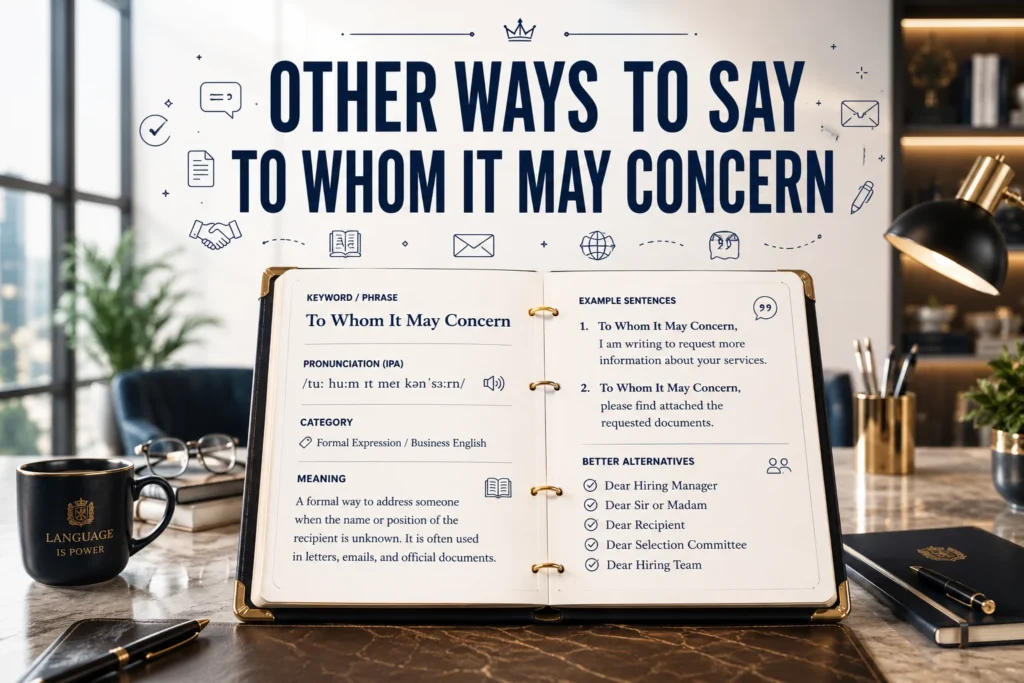
“To Whom It May Concern” is a traditional formal greeting used when you do not know the name, position, or identity of the person receiving your message. While this phrase remains correct, many professionals now search for other ways to say to whom it may concern because modern communication values personalization, clarity, and stronger connections.
In business emails, workplace communication, client messages, customer service, and networking, a personalized greeting often creates a better first impression. Using the right alternative can make your email sound more professional, friendly, and relevant.
For example, instead of starting an email with “To Whom It May Concern,” you might write “Dear Hiring Manager,” “Hello Customer Support Team,” or “Dear Recruitment Team,” depending on your situation.
Choosing the right greeting shows attention to detail and improves your professional communication skills. This guide covers the best alternatives, when to use them, and real examples for different business situations.
Meaning of “To Whom It May Concern”
Literal Meaning
The phrase “To Whom It May Concern” literally means:
“This message is intended for anyone who is responsible, interested, or involved in this matter.”
The writer does not know the exact recipient, so they use a general greeting.
Example:
To Whom It May Concern,
I am writing to confirm that John Smith worked at our company from 2022 to 2025.
Here, the writer does not know who will read the letter, but they know the information may be reviewed by an appropriate person.
Tone of the Phrase
“To Whom It May Concern” has a:
- Formal tone
- Professional tone
- Neutral emotional feeling
- Slightly traditional style
It sounds official but can sometimes feel distant because it does not address a specific person.
Example:
Traditional:
To Whom It May Concern,
Please accept this letter as confirmation of employment.
Modern:
Dear Human Resources Team,
Please accept this letter as confirmation of employment.
The second option feels more direct and personal.
Purpose of Using the Phrase
People traditionally use “To Whom It May Concern” for:
- Reference letters
- Employment verification letters
- Complaint letters
- Recommendation letters
- Legal documents
- Official applications
- General business correspondence
However, modern email etiquette encourages writers to find a more specific greeting whenever possible.
Professional Usage of “To Whom It May Concern”
1. In Emails
In emails, this phrase is acceptable when you truly do not know the recipient.
However, most professional emails now allow you to find a better option.
Less Personal:
To Whom It May Concern,
I would like to ask about your services.
Better:
Dear Customer Service Team,
I would like to ask about your services.
The second greeting immediately tells the reader that the message is intended for them.
2. Workplace Communication
Employees often use “To Whom It May Concern” for official documents rather than everyday workplace messages.
It works well for:
- HR letters
- Internal verification documents
- Company statements
It is less suitable for:
- Team emails
- Manager communication
- Daily conversations
Better workplace alternatives:
- Dear HR Team
- Dear Hiring Team
- Hello Management Team
- Dear Operations Department
3. Client Communication
When writing to clients, avoiding “To Whom It May Concern” usually creates a warmer experience.
Clients prefer messages that feel personal.
Example:
Instead of:
To Whom It May Concern,
We are contacting you regarding your account.
Use:
Dear Client Services Team,
We are contacting you regarding your account.
4. Networking Messages
Networking requires a personal connection. A generic greeting may reduce engagement.
Instead of:
To Whom It May Concern,
Use:
- Hello Marketing Team
- Dear Business Development Team
- Hello [Company Name] Team
A specific greeting feels more professional and approachable.
5. Customer Service Communication
Customer service messages often need clear department references.
Better choices include:
- Dear Support Team
- Hello Customer Care Team
- Dear Service Department
These greetings show that you understand the organization structure.
Professional Alternatives
These alternatives work best for business emails, workplace communication, and professional communication.
1. Dear Hiring Manager
Meaning: A greeting for the person responsible for hiring decisions.
Tone: Professional and respectful.
Best use case:
- Job applications
- Cover letters
- Recruitment emails
Example:
Dear Hiring Manager,
I am excited to apply for the Marketing Coordinator position at your company.
2. Dear Recruitment Team
Meaning: A message directed toward the people managing recruitment.
Tone: Professional and modern.
Best use case:
- Job applications
- Career inquiries
- Internship requests
Example:
Dear Recruitment Team,
I would like to express my interest in the available position.
3. Dear HR Team
Meaning: A greeting for the Human Resources department.
Tone: Professional and direct.
Best use case:
- Employment documents
- Workplace requests
- Employee matters
Example:
Dear HR Team,
I am requesting a copy of my employment records.
4. Dear Human Resources Department
Meaning: A formal reference to the HR department.
Tone: Formal and official.
Best use case:
- Verification letters
- Company documents
Example:
Dear Human Resources Department,
Please find attached the required employment information.
5. Dear Customer Service Team
Meaning: A greeting for customer support representatives.
Tone: Professional and helpful.
Best use case:
- Complaints
- Service questions
- Product inquiries
Example:
Dear Customer Service Team,
I need assistance with my recent order.
6. Dear Support Team
Meaning: A general greeting for technical or customer support.
Tone: Friendly and professional.
Best use case:
- Software issues
- Account problems
- Technical questions
Example:
Dear Support Team,
I am experiencing an issue with my account login.
7. Dear Sales Team
Meaning: A greeting for employees handling sales.
Tone: Professional.
Best use case:
- Product inquiries
- Business proposals
- Partnership requests
Example:
Dear Sales Team,
I would like more information about your pricing plans.
8. Dear Management Team
Meaning: A message directed toward company leaders.
Tone: Respectful and formal.
Best use case:
- Business proposals
- Company feedback
- Official requests
Example:
Dear Management Team,
I would like to share a suggestion regarding company improvements.
9. Dear Department Head
Meaning: A greeting for the leader of a specific department.
Tone: Formal and respectful.
Best use case:
- Internal communication
- Professional requests
Example:
Dear Department Head,
I would appreciate your guidance regarding this matter.
10. Hello Team
Meaning: A simple greeting for a group of people.
Tone: Professional but approachable.
Best use case:
- Business emails
- Team communication
Example:
Hello Team,
I am sharing the updated project schedule.
11. Dear Team Members
Meaning: A greeting for members of a group.
Tone: Polite and professional.
Best use case:
- Workplace announcements
- Collaboration emails
Example:
Dear Team Members,
Thank you for your support during this project.
12. Dear Professional Team
Meaning: A respectful general greeting for an unknown professional group.
Tone: Formal.
Best use case:
- Business inquiries
- Organizations
Example:
Dear Professional Team,
I am interested in learning more about your services.
13. Dear Sir or Madam
Meaning: A traditional greeting when gender and identity are unknown.
Tone: Formal and old-fashioned.
Best use case:
- Official letters
- Government communication
Example:
Dear Sir or Madam,
I am writing regarding my application status.
14. Greetings
Meaning: A neutral opening without naming the recipient.
Tone: Professional and simple.
Best use case:
- Formal emails
- International communication
Example:
Greetings,
I would like to discuss a possible partnership opportunity.
15. Hello [Company Name] Team
Meaning: A greeting that addresses an entire organization.
Tone: Modern and professional.
Best use case:
- Networking
- Business inquiries
- Partnerships
Example:
Hello ABC Solutions Team,
I am interested in discussing a potential collaboration.
Formal Alternatives
These options are suitable when you need a highly respectful and official tone.
16. Dear Sir/Madam
Meaning: A formal greeting when the recipient is unknown.
Tone: Very formal.
Best use case:
- Official applications
- Legal communication
Example:
Dear Sir/Madam,
I am submitting my request for your review.
17. Dear Admissions Committee
Meaning: A greeting for an academic selection group.
Tone: Formal and respectful.
Best use case:
- University applications
- Scholarship requests
Example:
Dear Admissions Committee,
I am pleased to submit my application for consideration.
18. Dear Selection Committee
Meaning: A greeting for people reviewing candidates.
Tone: Formal.
Best use case:
- Awards
- Hiring processes
- Competitions
Example:
Dear Selection Committee,
Thank you for considering my application.
19. Dear Review Committee
Meaning: A greeting for a group evaluating documents.
Tone: Official.
Best use case:
- Reports
- Applications
- Professional reviews
Example:
Dear Review Committee,
Please find my proposal attached for evaluation.
20. Dear Board Members
Meaning: A greeting for organizational leaders.
Tone: Highly professional.
Best use case:
- Corporate communication
- Official presentations
Example:
Dear Board Members,
I appreciate your consideration of this proposal.
Friendly Alternatives
Friendly alternatives work well when you want to sound professional but more approachable. They are useful for modern business communication, networking, and customer interactions where a warm tone creates a better connection.
21. Hello There
Meaning: A simple greeting when you do not know the recipient.
Tone: Friendly and casual-professional.
Best use case:
- General inquiries
- First contact emails
- Informal business communication
Example:
Hello There,
I would like to learn more about your services and available options.
22. Hello Team
Meaning: A greeting that addresses a group of employees.
Tone: Friendly and professional.
Best use case:
- Company communication
- Support requests
- Collaboration emails
Example:
Hello Team,
I hope you are doing well. I wanted to ask about your upcoming project schedule.
23. Hi Everyone
Meaning: A casual greeting for a group.
Tone: Warm and relaxed.
Best use case:
- Internal workplace emails
- Team updates
Example:
Hi Everyone,
Thank you for your hard work on this project.
24. Hello [Department Name]
Meaning: A personalized greeting for a specific department.
Tone: Professional and friendly.
Best use case:
- Customer service
- Business inquiries
- Company communication
Example:
Hello Marketing Team,
I would like to discuss a possible partnership opportunity.
25. Hi Support Team
Meaning: A friendly greeting for customer or technical support.
Tone: Helpful and polite.
Best use case:
- Technical issues
- Service questions
Example:
Hi Support Team,
I need assistance with updating my account information.
26. Hello Customer Care Team
Meaning: A greeting for customer service representatives.
Tone: Warm and respectful.
Best use case:
- Complaints
- Customer questions
- Service requests
Example:
Hello Customer Care Team,
I appreciate your help with resolving my recent issue.
27. Hello [Company Name]
Meaning: A direct greeting toward a business.
Tone: Modern and simple.
Best use case:
- Brand inquiries
- Partnership emails
Example:
Hello Bright Solutions,
I am interested in discussing a possible collaboration.
28. Greetings Team
Meaning: A polite group greeting.
Tone: Friendly but professional.
Best use case:
- International communication
- Business emails
Example:
Greetings Team,
I hope everything is going well. I am reaching out regarding your services.
29. Good Morning Team
Meaning: A time-based professional greeting.
Tone: Positive and approachable.
Best use case:
- Workplace messages
- Team updates
Example:
Good Morning Team,
Please review the attached document before today’s meeting.
30. Hello Colleagues
Meaning: A greeting for coworkers or professional peers.
Tone: Friendly and respectful.
Best use case:
- Internal communication
- Professional groups
Example:
Hello Colleagues,
I would like to share an update about our upcoming deadline.
Email Alternatives
These alternatives are especially useful for professional emails where “To Whom It May Concern” feels too distant.
31. Dear [Name]
Meaning: A direct greeting using the recipient’s name.
Tone: Personal and professional.
Best use case:
- Client emails
- Business communication
- Follow-ups
Example:
Dear Sarah,
Thank you for your quick response regarding the proposal.
32. Dear [Job Title]
Meaning: A greeting based on the recipient’s professional role.
Tone: Formal and respectful.
Best use case:
- When the person’s name is unknown
Examples:
- Dear Marketing Director
- Dear Project Manager
- Dear Finance Manager
Example:
Dear Marketing Director,
I am contacting you regarding a potential partnership.
33. Dear Hiring Team
Meaning: A greeting for people involved in recruitment.
Tone: Professional and modern.
Best use case:
- Job applications
- Career emails
Example:
Dear Hiring Team,
I would like to apply for the available position.
34. Dear Recruitment Manager
Meaning: A greeting for the person managing recruitment.
Tone: Professional.
Best use case:
- Employment inquiries
Example:
Dear Recruitment Manager,
I am interested in learning about current opportunities.
35. Dear Project Team
Meaning: A greeting for people working on a project.
Tone: Professional and collaborative.
Best use case:
- Workplace communication
- Project updates
Example:
Dear Project Team,
Please find the updated timeline attached.
36. Dear Account Manager
Meaning: A greeting for someone managing business accounts.
Tone: Professional.
Best use case:
- Client communication
- Business services
Example:
Dear Account Manager,
I would like to discuss changes to our account.
37. Dear Business Team
Meaning: A general greeting for business departments.
Tone: Professional.
Best use case:
- Corporate emails
- Partnership discussions
Example:
Dear Business Team,
I am reaching out to explore a possible collaboration.
38. Dear Service Team
Meaning: A greeting for service-related departments.
Tone: Polite and neutral.
Best use case:
- Customer inquiries
- Service requests
Example:
Dear Service Team,
I would appreciate your assistance with this matter.
39. Dear Client Relations Team
Meaning: A greeting for teams managing customer relationships.
Tone: Professional and customer-focused.
Best use case:
- Customer communication
- Account concerns
Example:
Dear Client Relations Team,
I am contacting you regarding my recent experience.
40. Dear Operations Team
Meaning: A greeting for operational departments.
Tone: Professional.
Best use case:
- Business processes
- Workplace communication
Example:
Dear Operations Team,
I would like to request an update on the current process.
Workplace Alternatives
These alternatives fit modern workplace communication better than traditional phrases.
41. Hi Team
Meaning: A short greeting for coworkers.
Tone: Friendly and professional.
Best use case:
- Daily workplace emails
- Team discussions
Example:
Hi Team,
Please review the attached report before Friday.
42. Hello Everyone
Meaning: A greeting for a group of people.
Tone: Open and friendly.
Best use case:
- Announcements
- Team messages
Example:
Hello Everyone,
I wanted to share an important update.
43. Dear All
Meaning: A formal group greeting.
Tone: Professional.
Best use case:
- Workplace announcements
- Company-wide emails
Example:
Dear All,
Please be informed about the updated company policy.
44. Dear Team Members
Meaning: A respectful greeting for colleagues.
Tone: Professional and polite.
Best use case:
- Internal communication
- Group updates
Example:
Dear Team Members,
Thank you for your dedication and support.
45. Hello Management
Meaning: A greeting for company leaders.
Tone: Respectful.
Best use case:
- Workplace proposals
- Formal requests
Example:
Hello Management,
I would like to present a suggestion for improving workflow.
46. Dear Leadership Team
Meaning: A greeting for senior company leaders.
Tone: Formal and respectful.
Best use case:
- Executive communication
- Company matters
Example:
Dear Leadership Team,
I appreciate your guidance on this initiative.
47. Hello Project Members
Meaning: A greeting for people involved in a project.
Tone: Collaborative.
Best use case:
- Project discussions
- Team coordination
Example:
Hello Project Members,
Let’s discuss the next steps for completing this task.
48. Dear Department Team
Meaning: A greeting for a specific workplace group.
Tone: Professional.
Best use case:
- Internal messages
- Department updates
Example:
Dear Finance Team,
Please review the attached budget document.
49. Hello Partners
Meaning: A greeting for business partners.
Tone: Professional and respectful.
Best use case:
- Partnership communication
- Business relationships
Example:
Hello Partners,
We appreciate your continued cooperation.
50. Dear Stakeholders
Meaning: A greeting for people affected by a business decision.
Tone: Formal and corporate.
Best use case:
- Reports
- Business updates
- Corporate announcements
Example:
Dear Stakeholders,
We would like to share an update about our company progress.
Quick Comparison Table
| Alternative | Tone | Best Use |
| Dear Hiring Manager | Professional | Job applications |
| Dear HR Team | Formal | Employee matters |
| Dear Customer Service Team | Helpful | Support emails |
| Dear Sir/Madam | Very formal | Official letters |
| Hello Team | Friendly | Workplace emails |
| Dear All | Professional | Group announcements |
| Dear Stakeholders | Corporate | Business updates |
| Dear Client Relations Team | Professional | Client communication |
| Dear Recruitment Team | Modern | Hiring emails |
| Hello [Company Name] Team | Friendly-professional | Networking |
| Dear Account Manager | Professional | Client accounts |
| Greetings | Neutral | General emails |
Email Examples Using Alternatives
1. Client Email Example
Subject: Request for Service Information
Dear Client Relations Team,
I hope you are doing well. I am contacting you to learn more about your available services and pricing options.
I would appreciate any information you can provide.
Thank you for your assistance.
Best regards,
[Your Name]
2. Manager Email Example
Subject: Project Update Request
Dear Project Manager,
I hope you are having a great day. I would like to request an update regarding the current project timeline.
Please let me know if any additional information is required.
Thank you.
Best regards,
[Your Name]
3. Colleague Email Example
Subject: Meeting Documents
Hi Team,
I have attached the documents we discussed during our meeting. Please review them before our next discussion.
Thank you for your cooperation.
Best,
[Your Name]
4. Customer Email Example
Subject: Support Request
Dear Support Team,
I am experiencing an issue with my account and would appreciate your help in resolving it.
Thank you for your support.
Kind regards,
[Your Name]
5. Networking Email Example
Subject: Partnership Opportunity
Hello Business Team,
I am reaching out to explore a possible opportunity for collaboration between our organizations.
I would appreciate the chance to discuss this further.
Regards,
[Your Name]
6. Meeting Follow-Up Email Example
Subject: Follow-Up After Our Meeting
Dear Team Members,
Thank you for your time during today’s meeting. I appreciate your valuable feedback and suggestions.
I look forward to our next steps.
Best regards,
[Your Name]
Common Mistakes When Using “To Whom It May Concern”
Although “To Whom It May Concern” is grammatically correct, many people use it incorrectly in professional communication. Choosing the wrong greeting can make your email feel impersonal or outdated.
1. Using It When the Recipient’s Name Is Available
One of the biggest mistakes is using a generic greeting when you already know the person’s name.
Incorrect:
To Whom It May Concern,
I am contacting you regarding our partnership.
Better:
Dear Mr. Johnson,
I am contacting you regarding our partnership.
Using a person’s name shows effort and improves professional communication.
2. Overusing the Phrase
“To Whom It May Concern” should not be your default greeting for every formal message.
Many modern businesses prefer personalized emails because they build stronger relationships.
Use specific greetings whenever possible:
- Dear Hiring Manager
- Dear Customer Support Team
- Dear Marketing Director
- Hello [Company Name] Team
3. Choosing the Wrong Tone
The phrase sounds highly formal. It may feel too distant for casual workplace communication.
Too formal:
To Whom It May Concern,
Can you please send me the file?
Better:
Hi Sarah,
Could you please send me the file?
Match your greeting with the relationship and purpose.
4. Using It for Internal Workplace Emails
Most internal emails do not need extremely formal language.
Avoid:
To Whom It May Concern,
I have completed the task.
Better:
Hi Team,
I have completed the task.
5. Ignoring Email Etiquette
A professional email needs more than the right greeting.
Good email etiquette includes:
- Clear subject lines
- Polite openings
- Short paragraphs
- Professional closing
- Respectful language
A strong greeting creates a positive first impression
Related Phrases and Expressions
1. Dear Hiring Manager
Meaning: A greeting for someone responsible for recruitment.
Example:
Dear Hiring Manager,
I would like to apply for the available position.
2. Dear Recruitment Team
Meaning: A greeting for the hiring department.
Example:
Dear Recruitment Team,
Thank you for reviewing my application.
3. Dear Sir or Madam
Meaning: A traditional formal greeting when identity is unknown.
Example:
Dear Sir or Madam,
I am writing to request further information.
4. Dear Customer Service Team
Meaning: A greeting for customer support representatives.
Example:
Dear Customer Service Team,
I need assistance with my order.
5. Hello Support Team
Meaning: A friendly professional greeting for technical help.
Example:
Hello Support Team,
I am having trouble accessing my account.
6. Dear Team
Meaning: A simple professional greeting for groups.
Example:
Dear Team,
Please review the attached document.
7. Greetings
Meaning: A neutral opening for unknown recipients.
Example:
Greetings,
I would like to discuss a business opportunity.
8. Hello Everyone
Meaning: A friendly greeting for multiple people.
Example:
Hello Everyone,
Thank you for attending today’s meeting.
9. Dear Colleagues
Meaning: A greeting for professional coworkers.
Example:
Dear Colleagues,
I appreciate your support on this project.
10. Dear Partners
Meaning: A greeting for business partners.
Example:
Dear Partners,
We value our continued cooperation.
11. Dear Stakeholders
Meaning: A corporate greeting for people involved in business decisions.
Example:
Dear Stakeholders,
We are pleased to share our quarterly update.
12. Hello [Company Name] Team
Meaning: A personalized greeting for an organization.
Example:
Hello ABC Team,
I am interested in learning more about your services.
13. Dear Department Head
Meaning: A greeting for a department leader.
Example:
Dear Department Head,
I would appreciate your guidance on this matter.
14. Dear Manager
Meaning: A professional greeting for a supervisor or leader.
Example:
Dear Manager,
I would like to discuss my current responsibilities.
15. Dear Representative
Meaning: A greeting for an official company representative.
Example:
Dear Representative,
I am contacting you regarding my account.
Phrase Comparison: “To Whom It May Concern” vs Alternatives
| Phrase | Tone | Formality | Best Use |
| To Whom It May Concern | Very formal, distant | High | Official letters |
| Dear Hiring Manager | Professional | High | Job applications |
| Dear HR Team | Professional | Medium-high | Workplace matters |
| Dear Sir/Madam | Traditional formal | High | Government/legal letters |
| Hello Team | Friendly | Medium | Internal emails |
| Dear Customer Service Team | Helpful | Medium | Support requests |
| Dear Client Relations Team | Professional | Medium-high | Client communication |
| Hello [Company Name] Team | Modern | Medium | Networking |
| Dear Stakeholders | Corporate | High | Business updates |
| Dear [Name] | Personal | Medium | Direct communication |
Cultural Usage of “To Whom It May Concern”
US English Usage
In American business communication, “To Whom It May Concern” is still accepted, especially for:
- Reference letters
- Employment verification
- Official documents
However, many American companies prefer direct greetings because they value personal communication.
Common US alternatives:
- Dear Hiring Manager
- Dear Team
- Hello [Department Name]
UK English Usage
British English traditionally uses formal greetings more often.
“To Whom It May Concern” appears in:
- Formal letters
- Legal documents
- Academic references
Modern UK workplaces increasingly prefer:
- Dear Recruitment Team
- Dear Sir or Madam
- Dear Customer Service Team
Corporate Communication
Large organizations often avoid generic greetings because emails may represent the company brand.
Professional corporate alternatives include:
- Dear Leadership Team
- Dear Management Team
- Dear Stakeholders
- Dear Business Team
These options sound more targeted and professional.
Customer Service Communication
Customer service teams receive thousands of messages daily. A clear department greeting helps your email reach the right person faster.
Better options:
- Dear Support Team
- Dear Customer Care Team
- Hello Service Team
These greetings show that you understand the organization structure.
Networking Communication
Networking depends on creating relationships. A cold, generic greeting can reduce engagement.
Better options:
- Hello [Company Name] Team
- Dear Business Development Team
- Hello Marketing Team
These greetings feel more intentional and professional.
FAQs
What is the best professional way to say “To Whom It May Concern”?
The best professional alternatives are:
- Dear Hiring Manager
- Dear HR Team
- Dear Customer Service Team
- Dear [Department Name]
The best choice depends on your situation.
Is “To Whom It May Concern” still professional?
Yes, it is still professional, but it can sound traditional. Modern business communication usually prefers a more specific greeting.
What can I use instead of “To Whom It May Concern” in an email?
You can use:
- Dear Team
- Hello Support Team
- Dear Hiring Manager
- Hello [Company Name] Team
What is a formal alternative to “To Whom It May Concern”?
Formal alternatives include:
- Dear Sir or Madam
- Dear Selection Committee
- Dear Review Committee
- Dear Department Head
Can I use “Dear Sir/Madam” instead of “To Whom It May Concern”?
Yes. Both are formal, but “Dear Sir/Madam” directly addresses the recipient while “To Whom It May Concern” focuses on the subject.
What should I write if I do not know the recipient’s name?
Use the person’s role or department.
Examples:
- Dear Hiring Manager
- Dear Sales Team
- Dear Customer Service Team
Is “To Whom It May Concern” rude?
No. It is not rude. However, some readers may find it impersonal because it does not address a specific person.
What is the best greeting for a business email?
The best greeting depends on your audience:
- Client: Dear [Name]
- Company: Hello [Company Name] Team
- Department: Dear Marketing Team
- Unknown person: Dear Hiring Manager
Should I capitalize “To Whom It May Concern”?
Yes. The standard format is:
To Whom It May Concern,
Each main word is capitalized.
Is “To whom it may concern” outdated?
It is not outdated, but many professionals consider it less personal. Specific greetings are usually preferred.
What is a good replacement for a cover letter?
Use:
Dear Hiring Manager,
It is one of the most common professional alternatives.
What greeting should I use for customer support?
Use:
- Dear Customer Service Team
- Hello Support Team
- Dear Client Relations Team
What is the best alternative for networking emails?
Good choices include:
- Hello [Company Name] Team
- Dear Business Development Team
- Hello Marketing Team
Can I use “Hello Team” in a professional email?
Yes. “Hello Team” works well for workplace communication and internal business emails.
What is the most modern replacement for “To Whom It May Concern”?
Modern replacements include:
- Dear [Name]
- Hello [Department Name]
- Hello [Company Name] Team
These options sound more natural and personalized.
Final Summary
The phrase “To Whom It May Concern” remains correct, but modern professional communication often requires a more personal approach. The best alternatives depend on your purpose.
For formal situations, use Dear Hiring Manager, Dear Sir/Madam, or Dear Selection Committee.
For workplace communication, choose Hello Team, Dear Colleagues, or Dear Department Team.
For clients and customers, use Dear Customer Service Team, Dear Client Relations Team, or Dear Account Manager.
For networking, personalized greetings like Hello [Company Name] Team create stronger connections.
Choosing the right greeting improves email etiquette, workplace communication, and overall professional communication.