Introduction
We all say “just to let you know” at work. It is a useful phrase. It tells the reader that news is coming. But if you are searching for other ways to say just to let you know, you want fresh options. You want words that sound polite, clear, and professional.
The problem is that people use this phrase too much. It starts to sound weak. It can also sound unsure. A stronger phrase can change the whole tone of your email. It shows that you respect the reader’s time. It also shows that you know your message well.
In this guide, you will find 35 alternatives to “just to let you know.” We grouped them by tone. You will see professional, formal, friendly, email, and workplace options. Each one comes with a short note on the best use. Each one also has an example sentence. You will also learn common mistakes, cultural tips, and answers to common questions.
By the end, you will never struggle with this phrase again. You will pick the right words when you are reaching out with an update. Your emails will sound sharper, warmer, and more confident.
Meaning
“Just to let you know” means “I want to give you this information.” It is a soft way to start a message. It prepares the reader for news. The news can be good, bad, or neutral.
People use it to sound polite. It shows that you do not want to sound rude or pushy. For example, “Just to let you know, the meeting starts at 9” is gentler than “The meeting starts at 9.” The meaning is the same, but the tone is softer.
The phrase works in emails, chats, and short notes. It fits both work and personal messages. It does not carry blame. It simply passes on information. That is why it is so popular in offices around the world.
But the phrase has a small weakness. It can sound a little timid. Some readers may think you are unsure of yourself. If you compare it with other ways to say just to clarify, you will see how small word changes shift the tone. A phrase like “Please note” sounds more sure. A phrase like “FYI” sounds more casual. Your choice tells the reader how to feel about the news.
The meaning stays the same across all 35 options in this guide. The difference is tone. Pick the tone that fits your reader and your goal, and your message will land better.
Professional usage
At work, tone matters more than the words themselves. A manager reads tone fast. A client reads tone even faster. “Just to let you know” is safe, but it is also bland. In professional settings, you often need more weight.
Use a formal option when the news is official. For example, “Please be advised” fits a policy change. It tells the reader to take the message seriously. Use a softer option when the news is small. “A quick update for you” fits a minor change in plans.
Context decides everything. A message to your boss needs more care than a chat with a teammate. A message to a new client needs more polish than a note to a colleague you know well. Think about who reads the message before you pick the phrase.
Also think about the channel. Email allows longer, more formal phrases. Chat apps favor short ones like “Quick heads-up.” Pick the phrase that fits the screen and the reader.
Small words build trust. When you pair your update with gratitude, for example by showing that you appreciate their patience, the message feels warmer. Timing matters too. Share news early. A late update can upset people even if your words are polite. The right phrase plus the right timing builds a strong work reputation.
Alternatives
Here are 35 polished ways to replace “just to let you know.” They are grouped by tone so you can pick the one that fits your situation. Each entry shows the phrase, when to use it, and a short example.
Professional tone alternatives
These seven options sound confident and clear. Use them in business emails, reports, and meetings.
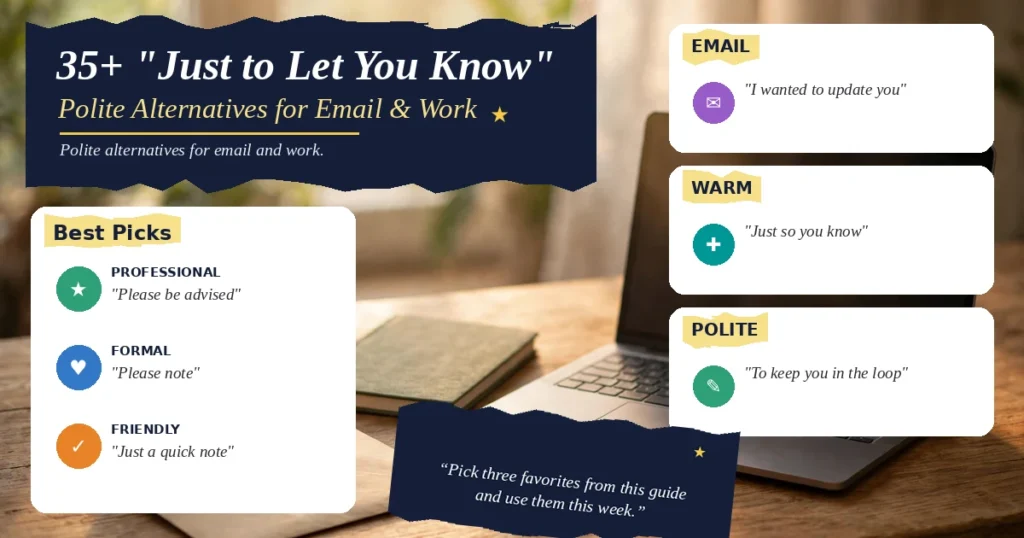
- Please be advised: Formal and direct. Best for official notices that people must read. Example: Please be advised that the office will close early on Friday.
- For your information: Clean and neutral. Best for memos and project reports. Example: For your information, the client approved the final design.
- Please note: Short and clear. Best for key details that must not be missed. Example: Please note that the deadline has moved to Monday.
- I wanted to inform you: Polite and personal. Best for one-on-one updates. Example: I wanted to inform you that your request has been approved.
- I wanted to update you: Warm and current. Best for news about ongoing projects. Example: I wanted to update you on the status of the shipment.
- As a heads-up: Relaxed yet professional. Best for advance warnings. Example: As a heads-up, the server will restart at midnight.
- I wanted to make you aware: Careful and respectful. Best for sensitive or serious news. Example: I wanted to make you aware of the change in policy.
Formal tone alternatives
These seven options are best for official letters, legal notes, and messages to senior leaders.
- Kindly be informed: Very formal and courteous. Best for official company letters. Example: Kindly be informed that the meeting venue has changed.
- This is to inform you: Official and structured. Best for HR or legal notices. Example: This is to inform you that your contract has been renewed.
- I am writing to notify you: Serious and formal. Best for announcements that carry weight. Example: I am writing to notify you of the upcoming audit.
- Allow me to inform you: Courteous and old-fashioned. Best for respectful correspondence. Example: Allow me to inform you that the payment has been processed.
- It is my responsibility to inform you: Grave and honest. Best for difficult news that you must deliver. Example: It is my responsibility to inform you that the project is delayed.
- I wish to bring to your attention: Formal and polite. Best for formal requests or concerns. Example: I wish to bring to your attention the error in the invoice.
- Please be informed: Firm and institutional. Best for messages from a company or department. Example: Please be informed that new parking rules start next week.
Friendly tone alternatives
These seven options keep things warm. Use them with teammates and people you know well.
- Just a quick note: Warm and brief. Best for casual everyday updates. Example: Just a quick note to say the meeting moved to 3 p.m.
- Quick heads-up: Light and helpful. Best for small warnings or tips. Example: Quick heads-up, the printer on level two is out of paper.
- Just so you know: Relaxed and open. Best for sharing simple facts. Example: Just so you know, Sarah is back from leave.
- In case you missed it: Helpful and gentle. Best for information you shared before. Example: In case you missed it, the report is now in the shared folder.
- Just wanted to share: Positive and open. Best for good news and wins. Example: Just wanted to share that we won the client award.
- A friendly heads-up: Kind and clear. Best for polite warnings. Example: A friendly heads-up that your free trial ends tomorrow.
- FYI: Short and casual. Best for quick team chats and instant messages. Example: FYI, the boss moved our one-on-one to Thursday.
Email tone alternatives
These seven options are built for the inbox. They start emails in a natural way.
- I wanted to touch base: Warm and conversational. Best for follow-up emails. Example: I wanted to touch base about the proposal we sent last week.
- Just circling back: Polite and persistent. Best for emails that got no reply. Example: Just circling back to see if you reviewed the contract.
- I wanted to flag this: Direct and useful. Best for important issues in a thread. Example: I wanted to flag this budget item before we finalize it.
- As discussed: Efficient and clear. Best for confirming past decisions. Example: As discussed, I have booked the conference room.
- Following up on this: Professional and steady. Best for status checks. Example: Following up on this to confirm the delivery date.
- Per my last email: Firm but polite. Best for gentle reminders. Example: Per my last email, the invoice is due on the 30th.
- I wanted to share an update: Positive and clear. Best for progress news. Example: I wanted to share an update on the new hiring plan.
Workplace tone alternatives
These seven options fit daily office life. They sound natural in standups, Slack, and team notes.
- For your awareness: Professional and neutral. Best for team briefings. Example: For your awareness, the schedule for next week has changed.
- To keep you in the loop: Collaborative and open. Best for team updates. Example: To keep you in the loop, we are hiring two new designers.
- Bringing this to your attention: Serious and direct. Best for urgent matters. Example: Bringing this to your attention, the server error is back.
- A quick update for you: Brief and helpful. Best for short messages. Example: A quick update for you, the package arrived this morning.
- I wanted to keep you posted: Caring and steady. Best for ongoing situations. Example: I wanted to keep you posted on the client’s feedback.
- So we’re on the same page: Collaborative and clear. Best for making sure everyone agrees. Example: So we’re on the same page, the launch is on the 15th.
- Updating you on this: Simple and direct. Best for daily standups and chat threads. Example: Updating you on this, the test results look good.
Quick comparison
This table gives you a fast view of the most useful options. Scan it when you are short on time.
| Phrase | Tone | Best for |
|---|---|---|
| Please be advised | Formal | Official notices and policy changes |
| For your information | Neutral | Memos, reports, and project updates |
| Please note | Direct | Details that must not be missed |
| I wanted to update you | Warm | Ongoing projects and one-on-one news |
| As a heads-up | Relaxed | Advance warnings in chat or email |
| Just so you know | Friendly | Casual facts for teammates |
| FYI | Casual | Quick notes in team chat |
| I wanted to flag this | Alert | Important issues in email threads |
Pick from the left column based on the middle column. The right column tells you the exact situation. When in doubt, choose a warmer option for people and a formal option for records.
Email examples
Seeing the phrases in real emails helps you use them with confidence. Here are six short examples.
Example 1: project delay
Subject: Update on the launch date
Hi Maria,
I wanted to update you that the launch date has moved to the 22nd. The vendor needs two more days for testing. I will send the new timeline by Friday.
Thanks,
Dan
Example 2: meeting change
Subject: New time for our review call
Hello James,
As a heads-up, our review call will now start at 2 p.m. instead of 1 p.m. I know your day is full, so I wanted you to hear it from me first.
Best,
Priya
Example 3: gentle reminder
Subject: Quick reminder about the invoice
Hi Leo,
Per my last email, the invoice for March is due on the 30th. Let me know if you need the file again. I am looking forward to your call tomorrow to close this out.
Thanks,
Nina
Example 4: sharing good news
Subject: Great news from the client
Hi team,
Just wanted to share that the client loved our proposal. They signed off on the full budget this morning. Great work by everyone involved.
Cheers,
Sam
Example 5: flagging an issue
Subject: Something to check in the report
Hi Alex,
I wanted to flag this number on page three of the report. It does not match the data from last week. I know this is frustrating, and I understand your frustration. Can we review it together at 11?
Thanks,
Rita
Example 6: formal notice
Subject: Change in office hours
Dear staff,
Please be advised that the office will open at 10 a.m. on Monday due to building work. Security will be at the main entrance to guide you.
Regards,
The Admin Team
Common mistakes
Many people use these phrases in the wrong way. Avoid these six mistakes.
Using “FYI” with senior leaders
“FYI” is too casual for a CEO or a new client. It can sound lazy in a formal email. Use “For your information” or “Please be advised” instead. Save “FYI” for teammates and chat apps.
Starting every email with the same phrase
If each email opens with “Just to let you know,” you sound like a robot. Vary your openings. Rotate through three or four options from this guide. Readers notice variety, and it keeps your emails fresh.
Hiding bad news behind soft words
Soft phrases cannot fix bad news. Do not write “Just so you know, we lost the client” and hope it feels fine. Be direct and kind instead. Say “I wanted to make you aware that we lost the client” and then explain the next steps. Honesty builds trust.
Forgetting the main point
Some people write the phrase and then add three paragraphs of background. The reader gets lost. State the news in the first two sentences. Then add only the details that matter. If you need to thank someone for the clarification first, do it in one line and move on.
Mixing tones in one message
Do not write “Kindly be informed” and “FYI” in the same email. Mixed tones confuse the reader. Pick one tone for the whole message. Match the tone to the reader and the news.
Using these phrases for questions
These phrases share information. They do not ask for it. Do not write “Just to let you know, can you send the file?” That mixes two goals. Ask the question directly: “Could you please send the file?” Save these phrases for updates and news.
Related phrases
“Just to let you know” belongs to a large family of phrases. Knowing the cousins helps you pick the best one for each moment.
- As a reminder: Use it when the reader already heard the news once. It nudges without blame.
- Please be aware: Use it when the news needs care. It sounds a bit more serious than “just to let you know.”
- In case you were wondering: Use it for curious or optional details. It sounds friendly and light.
- By the way: Use it for small side notes. It is the most casual option in this family.
- Heads up: Use it for warnings and quick alerts. It is short, punchy, and common in chat.
- I thought you should know: Use it when the news feels personal or important. It shows care.
Each of these shifts the tone a little. If you want even more choices for a close cousin of this phrase, see these other ways to say I will let you know. Learning related phrases in groups is the fastest way to grow your workplace vocabulary.
Phrase comparison
Not all options carry the same weight. This table compares the original phrase with three common replacements.
| Feature | Just to let you know | FYI | Please note | Kindly be informed |
|---|---|---|---|---|
| Formality | Low to medium | Low | Medium | High |
| Best channel | Email and chat | Chat | Formal letters | |
| Warmth | Medium | Low | Low | Low |
| Authority | Low | Low | Medium | High |
| Good for bad news | Weak | Poor | Okay | Strong |
“Just to let you know” sits in the middle. It is polite but soft. “FYI” is the fastest option, but it can feel cold. “Please note” adds authority without sounding stiff. “Kindly be informed” is the most formal, so use it for official records.
Choose based on two things: the reader and the news. A teammate getting a small update needs warmth. A department getting a new rule needs authority. When you match the phrase to the moment, your writing sounds natural and professional.
Cultural usage
English is used around the world, and tone rules change by culture. In the United States, direct phrases are normal. “Quick heads-up” and “FYI” are common in American offices. People value speed and clarity.
In the United Kingdom, polite softeners are more common. “Just to let you know” itself is very British. UK readers also like “I wanted to make you aware” and “I wish to bring to your attention.” These sound respectful without being stiff.
In South Asia, the Middle East, and parts of Africa, formal respect matters a lot. “Kindly be informed” and “Please be advised” are widely used in offices there. They show respect for hierarchy. Casual options like “FYI” can feel rude in these settings, so use them with care.
In global teams, keep it simple. Avoid slang and jokes. Pick a neutral phrase like “For your information” or “Please note.” These travel well across cultures. When you work with people from many countries, clear and polite beats clever. A short note like a warm thank you for the clarification also crosses cultures well, since gratitude is understood everywhere.
Frequently asked questions
Is “just to let you know” rude?
No, it is not rude. It is a polite phrase that most people use at work. But it can sound weak if you use it too often. Some readers may feel you lack confidence. A stronger phrase can make the same message sound better.
Is “just to let you know” too informal for work emails?
It depends on the email. For teammates and everyday updates, it is fine. For senior leaders or formal notices, it is too casual. In those cases, use “Please be advised” or “For your information.” Match the phrase to the reader.
What is the most professional alternative?
“Please be advised” is the most professional option for official news. It sounds serious and clear. Use it for policy changes, legal notes, and formal announcements. For less formal news, “I wanted to update you” is a warm professional choice.
Can I use “FYI” in a work email?
You can, but be careful. “FYI” is fine for teammates in quick notes. It is too casual for clients, bosses, or formal messages. When in doubt, write “For your information” instead. It says the same thing with more polish.
What is the difference between “just to let you know” and “just so you know”?
The two phrases mean almost the same thing. “Just so you know” sounds a bit more casual and spoken. “Just to let you know” sounds a bit more written and planned. In most cases, you can swap them freely. Pick the one that fits your tone.
How do I share bad news politely at work?
Be direct, kind, and clear. Use a phrase like “I wanted to make you aware” or “It is my responsibility to inform you.” Then state the facts in simple words. End with the next steps or a solution. Soft words alone cannot fix bad news, but honesty plus a plan can.
Should I use these phrases at the start or in the middle of an email?
The start works best for most messages. It tells the reader why you are writing. You can also use them in the middle when you move to a new point. Avoid using the same phrase twice in one email. One clear use is enough.
What is a good alternative for Slack or Teams messages?
Short options work best in chat. Try “Quick heads-up,” “FYI,” or “A quick update for you.” These fit small screens and fast reading. Keep the message under three lines when you can. Long formal phrases feel heavy in chat apps.
How many alternatives should I learn?
Start with five or six. Pick two formal, two neutral, and two casual options from this guide. Practice them for two weeks until they feel natural. Then add more. Learning in small groups is easier than learning all 35 at once.
Can I use “just to let you know” with clients?
Yes, for small and friendly updates it works well. For example, “Just to let you know, your order has shipped” is perfectly fine. For serious client news, choose a stronger phrase. “Please note” or “I wanted to inform you” shows more care.
What tone should I use with my boss?
Use a respectful and confident tone. Options like “I wanted to update you” and “For your awareness” work well. Avoid “FYI” and “Just so you know” with senior leaders. Keep the message short and put the key point first. Busy managers value clarity.
Is “kindly be informed” too old-fashioned?
It can sound old-fashioned in American offices, but it is still common in formal business English around the world. In South Asia, the Middle East, and Africa, it is a normal and respected phrase. Know your audience. When the setting is formal, it is a safe choice.
How do I stop overusing the same phrase?
Notice your habit first. Search your sent emails for “just to let you know” and count how often it appears. Then pick three replacements and write them on a sticky note. Use them on purpose for one week. New habits form fast with a little practice.
What is the best alternative for a reminder email?
“Per my last email” is strong for reminders. It points back to your earlier message without sounding angry. “Just circling back” is a softer option for the first reminder. If the matter is urgent, “I wanted to flag this” adds the right weight.
Do these phrases work in job applications and cover letters?
Some do, but choose carefully. “I am writing to notify you” is too stiff for a cover letter. “I wanted to share” and “I wanted to update you” fit better in follow-up emails to recruiters. Keep cover letters confident and direct. Save these phrases for updates, not for selling yourself.
Conclusion
You now have 35 strong ways to replace “just to let you know.” Each one carries the same basic meaning but a different tone. The professional options add weight. The formal options add respect. The friendly ones add warmth. The email and workplace options fit daily office life.
The secret is simple. Think about your reader first. Then think about your news. Then pick the phrase that fits both. A teammate needs warmth. A policy change needs authority. A quick chat needs speed. When the phrase matches the moment, your message feels natural.
Start small. Pick three favorites from this guide and use them this week. Notice how people respond. Over time, you will build a set of go-to phrases for every situation. Good communication is a skill, and every email is practice.
To keep learning, look up how dictionaries explain these words. Cambridge defines inform as giving someone facts or news, which is exactly what these phrases do. The more words you know, the clearer your writing becomes. Keep practicing, and your emails will stand out for all the right reasons.