
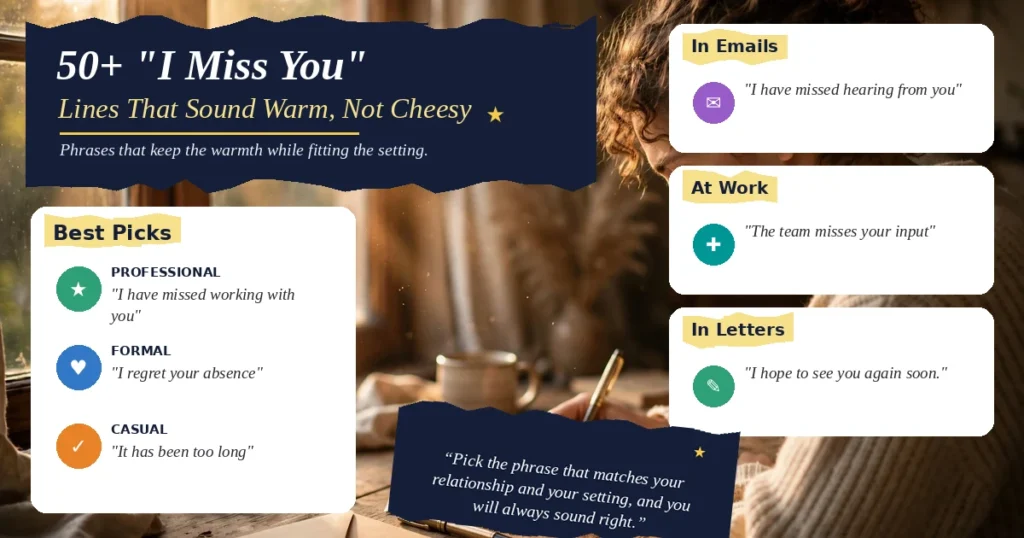
Saying “I miss you” feels natural with family and close friends, but it can sound too personal at work or in a formal letter. That is why so many people search for other ways to say I miss you — phrases that keep the warmth while fitting the setting. Whether you are writing an email to a former colleague, reconnecting with a client, or sending a polite note to a distant relative, the right words protect your tone and your relationships.
This guide gives you 50 professional, formal, friendly, and email-ready alternatives with real examples for each one. You will learn what the phrase really means, when it is safe to use it at work, and which version fits clients, managers, and networking contacts. By the end, you will pick the right phrase in seconds and never worry about sounding too casual or too stiff again.
Meaning of “I miss you”
“I miss you” means you feel the absence of someone and wish they were near. People say it to express affection, loneliness, or fond memories of time spent together. The tone is personal and emotional, so it fits close relationships far better than professional or formal settings.
Literal meaning: you notice that someone is gone, and their absence makes you feel sad or wistful.
Tone: personal, warm, and emotional. It signals closeness and affection between the speaker and the other person.
Purpose: to comfort someone, to reopen contact after time apart, or to show that the person matters to you.
Emotional context: people use it during separations, after a move, when they feel nostalgic, or when distance has grown between friends or family members.
Here are a few natural examples:
- “I miss you, Mom. The house feels empty without you.”
- “I miss you, buddy. We should plan that road trip soon.”
- “I miss you and the whole team since I moved to the new office.”
Professional usage of “I miss you”
In business communication, the plain phrase “I miss you” is almost always too intimate. The professional way to say it is to name the working relationship instead of the personal feeling. Here is how that rule plays out in each setting.
Emails
In a professional email, replace the personal phrase with one tied to work. “I have missed working with you” or “I miss our collaboration” shows warmth without crossing a boundary. Save “I miss you” for personal email only.
Workplace
At work, speak about the working relationship, not the person. “The team misses your input” sounds professional and kind. “I miss you” sounds personal and can make colleagues uncomfortable, especially across levels of seniority.
Clients
With clients, keep every phrase focused on the business relationship. “I have missed our regular check-ins” works well and feels attentive. Never write “I miss you” to a client, because it blurs the line between friendly service and personal intimacy.
Networking
When you reconnect with a contact, show that you remember them and value the connection. “It has been too long since we last spoke” opens the door politely. Follow it with a clear reason for reaching out so the message feels purposeful, not random.
Customer service
A service representative can say “We have missed serving you” to a returning customer. It feels warm and keeps the focus on the service relationship. Avoid “I miss you” here, since the customer expects professional care, not personal emotion.
50 other ways to say “I miss you”
These 50 alternatives are grouped by tone so you can pick the right one fast. Each entry shows the tone, the best situation for it, and a real example you can copy or adapt.
Professional alternatives
I have missed working with you. Warm and professional; best for a respected former colleague. Example: “I have missed working with you, Sarah. Let us catch up over coffee next week.”
It has been wonderful collaborating with you. Appreciative; best when you want to reopen a partnership. Example: “It has been wonderful collaborating with you, and I would love to do it again.”
I value our past collaboration. Respectful; best for formal reconnecting emails. Example: “I value our past collaboration and hope our paths cross again soon.”
Your presence on the team is missed. Professional and team-focused; best for a departed teammate. Example: “Your presence on the team is missed, especially during planning sessions.”
We miss your contributions. Inclusive; best for group messages to a former member. Example: “We miss your contributions to the project and hope you are doing well.”
Your input has been missed. Polite; best when a key voice left a project. Example: “Your input has been missed in our recent design reviews.”
I miss our productive conversations. Warm; best for a mentor or sharp colleague. Example: “I miss our productive conversations about market strategy.”
The team misses your expertise. Professional; best for someone with rare skills. Example: “The team misses your expertise on the new platform.”
I have missed our working relationship. Sincere; best for long-term business partners. Example: “I have missed our working relationship since the merger.”
Your perspective is missed here. Respectful; best when a thoughtful voice is gone. Example: “Your perspective is missed here during budget talks.”
I miss the energy you brought to the team. Warm; best for an enthusiastic former colleague. Example: “I miss the energy you brought to the team every Monday morning.”
Our meetings have not been the same without you. Friendly and professional; best for a regular meeting partner. Example: “Our meetings have not been the same without you, David.”
I have missed your insight on this project. Specific; best when reconnecting about shared work. Example: “I have missed your insight on this project and would value your view.”
You are missed around the office. Casual and professional; best for a friendly office note. Example: “You are missed around the office. The break room is too quiet.”
I miss partnering with you on this. Collaborative; best for a co-lead or joint owner. Example: “I miss partnering with you on this launch.”
Formal alternatives
I regret your absence. Formal and restrained; best for official correspondence. Example: “I regret your absence at yesterday’s ceremony.”
Your absence is sincerely felt. Dignified; best for formal gatherings or speeches. Example: “Your absence is sincerely felt by everyone present today.”
I look forward to our next meeting. Polite; best for closing a formal letter. Example: “I look forward to our next meeting in the spring.”
Your presence would be most welcome. Courteous; best for formal invitations. Example: “Your presence would be most welcome at the annual dinner.”
I hope to see you again soon. Classic and formal; best for letters to respected elders. Example: “I hope to see you again soon, Professor.”
You have been missed at our gatherings. Formal yet warm; best for clubs or societies. Example: “You have been missed at our gatherings this season.”
I eagerly await your return. Formal; best for someone on extended leave. Example: “I eagerly await your return from your sabbatical.”
Your company is greatly missed. Traditional; best for formal social notes. Example: “Your company is greatly missed at our Sunday dinners.”
I wish you were here with us. Gentle and formal; best for family events. Example: “I wish you were here with us to celebrate.”
May we meet again soon. Gracious; best for closing a farewell note. Example: “May we meet again soon. Travel safely.”
Friendly alternatives
I have been thinking of you. Warm; best for old friends. Example: “I have been thinking of you since I heard your favorite band play.”
It has been too long. Casual; best for reconnecting after a gap. Example: “It has been too long. We need to fix that this month.”
I miss catching up with you. Friendly; best for a chatty friend. Example: “I miss catching up with you over long phone calls.”
You have been on my mind. Caring; best when someone faces a hard time. Example: “You have been on my mind since your move.”
I miss our chats. Simple; best for a close friend. Example: “I miss our chats about everything and nothing.”
Life has not been the same without you. Heartfelt; best for a best friend. Example: “Life has not been the same without you in this city.”
I miss hanging out with you. Relaxed; best for casual friends. Example: “I miss hanging out with you on weekends.”
We need to get together soon. Upbeat; best for restarting a friendship. Example: “We need to get together soon. Dinner next Friday?”
I have missed your laugh. Sweet; best for someone cheerful. Example: “I have missed your laugh around the house.”
I miss the good times we shared. Nostalgic; best for old classmates. Example: “I miss the good times we shared in college.”
Email alternatives
I have missed hearing from you. Polite; best for opening a follow-up email. Example: “I hope you are well. I have missed hearing from you.”
It has been a while since we last spoke. Neutral; best for general follow-up emails. Example: “It has been a while since we last spoke. How is the new role?”
I have missed our exchanges. Professional; best for regular email correspondents. Example: “I have missed our exchanges on industry trends.”
I miss hearing your thoughts on this. Engaging; best when you want input by email. Example: “I miss hearing your thoughts on this, so I wanted your take.”
I have been meaning to reach out. Warm; best for overdue replies. Example: “I have been meaning to reach out for weeks now.”
Your updates have been missed. Polite; best for newsletter-style contacts. Example: “Your updates have been missed. Please keep them coming.”
I miss our correspondence. Slightly formal; best for long-time partners or pen pals. Example: “I miss our correspondence and hope all is well.”
I look forward to reconnecting. Forward-looking; best for closing an email. Example: “I look forward to reconnecting at the conference.”
Workplace alternatives
The team misses you. Simple; best for a team card or group message. Example: “The team misses you, Priya. Get well soon.”
We miss your leadership. Respectful; best for a manager on leave. Example: “We miss your leadership during this busy quarter.”
I miss brainstorming with you. Collaborative; best for a creative partner. Example: “I miss brainstorming with you on campaign ideas.”
Your desk feels empty without you. Light; best for a close office friend. Example: “Your desk feels empty without you. Hurry back.”
I miss our lunch breaks. Casual; best for a work friend. Example: “I miss our lunch breaks at the corner cafe.”
The office is quieter without you. Playful; best for a lively colleague. Example: “The office is quieter without you. Almost too quiet.”
We miss having you on the project. Professional; best for a reassigned teammate. Example: “We miss having you on the project. The client asks about you.”
Quick comparison table
Use this table to pick the right phrase at a glance. These are the ten most useful picks from the full list above.
| Alternative | Tone | Best use |
|---|---|---|
| I have missed working with you | Professional | Former colleagues and partners |
| I regret your absence | Formal | Official letters and ceremonies |
| It has been too long | Friendly | Reconnecting with old friends |
| I have missed hearing from you | Polite | Email openers and follow-ups |
| The team misses you | Workplace | Team cards and group messages |
| I value our past collaboration | Professional | Reconnecting emails |
| I look forward to our next meeting | Formal | Closing formal letters |
| I have been thinking of you | Friendly | Old friends and relatives |
| We miss your contributions | Professional | Departed team members |
| I look forward to reconnecting | Polite | Closing emails warmly |
Email examples using “I miss you” alternatives
Copy these short email examples and adjust the names and details. Each one uses a professional alternative to “I miss you” in a realistic setting.
For a client
Subject: Catching up
Hi James,
I hope business is going well on your side. I have missed our regular check-ins and wanted to see how the new rollout is performing. Would you have 20 minutes next week for a quick call? I would love to hear your thoughts.
Best regards,
Anna
For a manager
Subject: Hope you are recovering well
Hi Ms. Carter,
I heard about your surgery and hope you are resting well. We miss your leadership during this busy quarter, but please take all the time you need. The team has everything covered until you return.
Warm regards,
Tom
For a colleague
Subject: Long time!
Hi Rachel,
It has been a while since we last spoke. I have missed working with you since you moved to the Chicago office. How is the new role treating you? Let us schedule a video call soon and catch up properly.
Cheers,
Mike
For a customer
Subject: We have missed you
Hi there,
We have missed serving you and noticed it has been a while since your last visit. As a thank-you for your loyalty, here is 15% off your next order. We hope to see you again soon.
Warmly,
The Green Grocer Team
For networking
Subject: Reconnecting after the summit
Hi Daniel,
It was great meeting you at last year’s summit. I have missed our exchanges on industry trends and would love to hear what you are working on now. Are you attending this year’s event? It would be great to reconnect in person.
Best,
Lisa
For a meeting follow-up
Subject: Great seeing you yesterday
Hi Karen,
Thank you for your time yesterday. I have missed our productive conversations and really enjoyed picking your brain again. I will send over the proposal we discussed by Friday. I look forward to reconnecting soon.
Kind regards,
Steve
Common mistakes to avoid
These small errors can make a warm message feel awkward or unprofessional. Watch out for each one.
1. Saying “I miss you” to a client
It sounds personal and can confuse a business relationship. Use “I have missed our check-ins” instead.
2. Using it in a first email
You cannot miss someone you just met. Open with interest in their work, not with false familiarity.
3. Mixing formal and casual tones
Do not pair a stiff greeting like “Dear Sir” with a casual line like “miss ya.” Keep one tone from start to finish.
4. Overusing it in every message
Repeating the phrase in each email drains its meaning. Say it once, then move on to your real point.
5. Adding it to a group email
A personal line in a message to ten people feels strange. Save it for one-to-one emails or direct messages.
6. Forgetting the reason for writing
A warm line is an opener, not the whole email. Always follow it with a clear purpose, question, or next step.
Related phrases
These expressions carry a similar feeling and work well alongside the alternatives above.
Thinking of you. Means someone is in your thoughts. Example: “Just thinking of you on your big day.”
Long time no see. A casual greeting after a long gap. Example: “Long time no see! How have you been?”
It has been ages. Means a very long time has passed. Example: “It has been ages since we last met.”
You have been missed. Says others noticed the absence too. Example: “You have been missed at the club meetings.”
I wish you were here. Expresses a wish for someone’s presence. Example: “I wish you were here to see this sunset.”
I look forward to seeing you. Shows excitement about a future meeting. Example: “I look forward to seeing you at the wedding.”
Let us not be strangers. Asks to stay in touch. Example: “Now that you moved away, let us not be strangers.”
I hope we meet again soon. A polite wish for a future meeting. Example: “Safe travels. I hope we meet again soon.”
You are in my thoughts. A caring line for hard times. Example: “You are in my thoughts during this difficult week.”
I miss your company. A gentle, slightly formal phrase. Example: “I miss your company at our Friday dinners.”
It is good to hear from you. A warm reply to a message. Example: “It is good to hear from you after so long.”
I have missed this. Refers to an activity, not a person. Example: “I have missed this view from your balcony.”
I miss old times. Nostalgia for the past. Example: “I miss old times when we all lived nearby.”
Until we meet again. A warm farewell. Example: “Until we meet again, take care of yourself.”
You crossed my mind today. Means you thought of someone suddenly. Example: “You crossed my mind today when I passed our old school.”
Phrase comparison: “I miss you” vs top alternatives
“I miss you” is the most direct option, but also the most personal. It carries real emotion, which is its strength with family and close friends and its weakness everywhere else. In a work email it can read as overly familiar, and with a client it can blur a boundary you want to keep sharp.
“I have missed working with you” keeps the warmth but aims it at the working relationship. The tone is professional and respectful, and it fits former colleagues, partners, and mentors. It says you valued the person without saying you feel lonely, which makes it safe for almost any business setting.
“I regret your absence” sits at the formal end. It expresses the same idea with distance and dignity, which suits official letters, ceremonies, and messages to respected elders. It never risks sounding casual, but it can feel cold between friends, so keep it for formal contexts.
“It has been too long” is the friendly middle ground. It is casual, upbeat, and free of heavy emotion, which makes it perfect for reconnecting with old friends or distant relatives. It opens a conversation without demanding one, and it works in texts, calls, and casual emails alike.
“I have missed hearing from you” is the email specialist of the group. It fits naturally as an opener, sounds polite rather than needy, and works for clients, contacts, and colleagues. When in doubt in an email, this is the safest pick.
Cultural usage
How people express missing someone changes with culture and setting. These notes help you pick a phrase that lands well with your reader.
US English
Americans use warm, direct language even at work. “I have missed working with you” and “It has been too long” feel natural. Casual phrases like “miss ya” appear in texts but never in business email.
UK English
British speakers often soften the feeling with understatement. “You have been missed” and “I hope to see you again soon” are common. A very direct “I miss you” can feel unusually emotional in British professional settings.
Corporate communication
In corporate settings, always tie the phrase to work. “We miss your contributions” and “Your input has been missed” are standard. Personal wording stays out of memos, reports, and company-wide emails.
Customer service
Service teams use warm but professional lines like “We have missed serving you” in win-back emails. The plural “we” keeps it about the brand, not one person’s feelings, which customers find more comfortable.
Networking
In networking, the phrase should open a door, not ask for comfort. “I have missed our exchanges” followed by a clear reason for writing works best. Always give the reader something to respond to.
Frequently asked questions
What is a professional way to say “I miss you”?
The most professional way to say “I miss you” is “I have missed working with you.” It keeps the warmth but aims it at the working relationship, which makes it safe for colleagues, partners, and mentors. Other strong options include “We miss your contributions” and “Your input has been missed.”
How do you say “I miss you” in a formal email?
In a formal email, use “I have missed hearing from you” as an opener or “I look forward to reconnecting” as a closer. Both sound polite and professional without feeling personal. Avoid the plain phrase “I miss you” in any formal business email.
Is it appropriate to say “I miss you” at work?
The plain phrase is usually too personal for work, especially with clients or senior leaders. Instead, name the working relationship: “The team misses your input” or “I miss our productive conversations.” These carry the same warmth with proper workplace communication boundaries.
What is a polite alternative to “I miss you” for a client?
For a client, try “I have missed our regular check-ins.” It shows attentiveness and keeps the focus on the business relationship. Good email etiquette means never blurring the line between friendly service and personal emotion.
How do you tell a colleague you miss working with them?
Say “I have missed working with you” in an email or message, then suggest a catch-up. You can also write “I miss our productive conversations” if you shared a strong working bond. Keep it brief and follow it with a clear reason for reaching out.
What is a formal synonym for “I miss you”?
The best formal synonym for “I miss you” is “I regret your absence.” Other formal options include “Your absence is sincerely felt” and “I hope to see you again soon.” These suit official letters, ceremonies, and messages to respected elders.
How do you say “I miss you” without sounding romantic?
Aim the phrase at shared activities or work, not at the person alone. “I miss our chats” or “I miss hanging out with you” sounds friendly without romance. In professional settings, “I have missed working with you” removes all romantic reading.
What should I write instead of “I miss you” in a business letter?
Use “I value our past collaboration” or “I look forward to our next meeting.” Both are standard business email phrases that express the same sentiment with proper formality. Close the letter warmly and keep the body focused on business.
Is “I miss you” too personal for the workplace?
Yes, in most cases it is too personal for the workplace. Colleagues may read it as overly familiar, and it can feel awkward across levels of seniority. Choose a workplace-safe version like “We miss having you on the project” instead.
How do you express missing someone in a professional email?
Open with “I have missed hearing from you” or “It has been a while since we last spoke.” Then state your reason for writing right away. This pattern shows warmth, respects professional communication norms, and gives the reader something clear to answer.
What is a friendly way to say “I miss you” to a friend?
Try “It has been too long” or “I have been thinking of you.” Both feel warm and natural without heavy emotion. Follow with a plan, like “We need to get together soon,” so the message opens a conversation.
Can I say “I miss you” to my boss?
It is better not to. Even with a friendly boss, the phrase can sound too personal. Use “We miss your leadership” if your boss is on leave, or “I have missed working with you” if you are writing to a former manager.
How do British people say “I miss you” politely?
British speakers often soften it with understatement, such as “You have been missed” or “I hope to see you again soon.” A very direct “I miss you” can feel unusually emotional in British professional settings, so the gentler versions land better.
What is the best way to reconnect with someone after a long time?
Start with “It has been too long” or “I have been meaning to reach out,” then give a clear reason for writing. Mention something specific you remember about them. A short, warm, purposeful message beats a long, vague one every time.
How do you end an email when you miss working with someone?
Close with “I look forward to reconnecting” or “I hope our paths cross again soon.” Both are warm, professional, and forward-looking. Add a concrete next step, like a call or meeting, when you can.
Conclusion
Quick picks — Professional: “I have missed working with you” and “Your input has been missed.” Formal: “I regret your absence” and “Your absence is sincerely felt.” Friendly-casual: “It has been too long” and “I miss catching up with you.” Email: “I have missed hearing from you” and “It has been a while since we last spoke.”
Missing someone is universal, but the words you choose decide how your message lands. Match your line to the relationship and the setting, then keep one steady tone from greeting to sign-off. A short, sincere note will always beat a long, awkward one — so say it simply, and suggest a time to talk.
Related Articles
- 55 Professional Ways to Say “Take Care” (Polite & Better Alternatives With Examples)
- Other Ways to Say Congratulations (50 Alternatives & Idioms)
- Congratulations on Your Achievement: 30 Other Ways to Say It
- Funny Ways to Say Happy Mother’s Day: 50+ Ideas
- Other Ways to Say Have a Great Rest of Your Week
- Other Ways to Say Thank You: Professional & Polite Alternatives in 2026
- 55+ “I Appreciate It” Alternatives That Sound Sincere




