
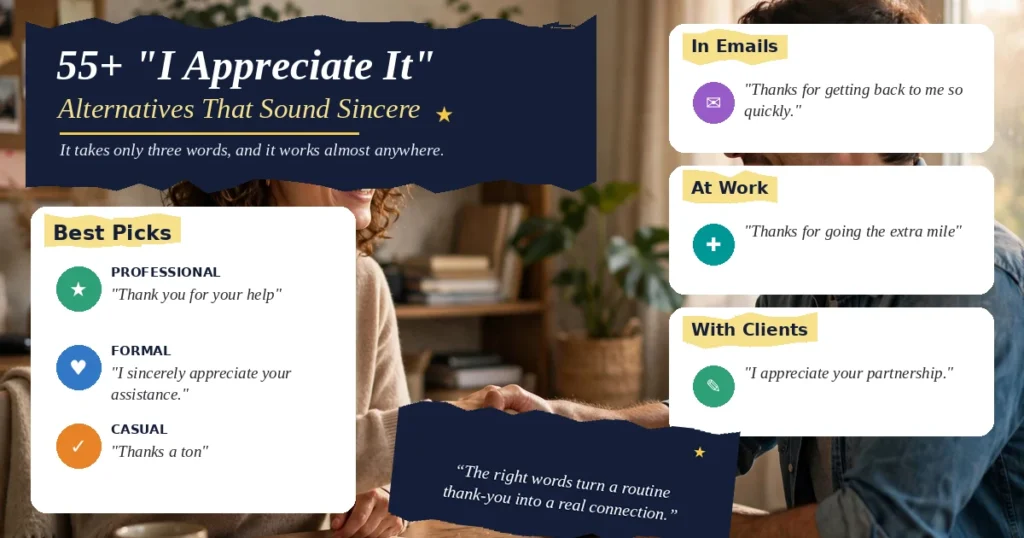
“I appreciate it” is a short, warm way to thank someone. People say it when a coworker helps with a task, a client answers a question, or a friend does them a small favor. It takes only three words, and it works almost anywhere.
But repeat it too often and it starts to sound flat. That is why professionals search for other ways to say I appreciate it — they want a professional way to say I appreciate it in emails, a formal alternative to I appreciate it for clients, and friendly options for everyday workplace communication. Fresh wording keeps your thanks sincere instead of automatic.
This guide gives you 55 alternatives grouped by tone: professional, formal, friendly, email-ready, and workplace. Each one comes with a short explanation and a real example so you can pick the right line in seconds. You will also find email samples, common mistakes, cultural notes, and quick answers to the questions people ask most.
What does “I appreciate it” mean?
“I appreciate it” means “I am thankful for what you just did.” It expresses gratitude for a favor, a piece of help, or a kind gesture. The tone is warm but neutral, so it fits both casual chats and professional emails without sounding too stiff or too loose.
The literal meaning is simple: you recognize the value of something someone did and you feel thankful. The purpose is to acknowledge effort. A manager says it after a team member stays late. A client says it after you send a revised proposal. A friend says it after you give them a ride.
The emotional context matters. “I appreciate it” feels genuine when the help is real and specific. It feels hollow when it arrives as an automatic reply to everything. If you thanked someone three times this week with the same line, your words carry less weight each time. That is the main reason to learn a good synonym for I appreciate it — variety keeps gratitude honest.
Tone-wise, the phrase sits in the middle. It is warmer than a plain “noted” and softer than “I am deeply grateful.” You can use it with your boss, your team, or your barista. The sections below show when it fits best and which alternatives raise or lower the formality to match the moment.
When to use “I appreciate it” professionally
The phrase works in most professional settings, but the best alternative depends on the context. Here is how to judge it across the five situations you will meet most.
Emails
Use it in the closing of routine emails. “Thanks for the update — I appreciate it” reads as polite and efficient. For high-stakes messages, like a proposal to a new client, choose a stronger line such as “I sincerely appreciate your time and consideration.” The extra weight matches the importance of the message.
Workplace
Say it to coworkers for everyday help: covering a shift, fixing a file, or answering a quick question. It builds goodwill without making a small favor sound like a big deal. When someone goes far beyond their job, upgrade to “Thanks for going the extra mile” so the praise matches the effort.
Clients
Clients expect polished language. “I appreciate it” is safe but plain. Better picks include “Thank you for your trust” or “I appreciate your partnership.” These lines thank the client for the relationship, not just the last email, and they strengthen long-term professional communication.
Networking
After a coffee chat or an introduction, “I appreciate it” can feel too thin. Try “Thanks for making time for me” or “I really value your advice.” Specific thanks show you listened, and they make the other person more likely to help again.
Customer service
Support teams use “I appreciate it” to soften requests: “I appreciate your patience while we fix this.” It calms frustrated customers. Pair it with a clear action — “Here is what I will do next” — so the thanks feel backed by effort, not empty words.
55 other ways to say “I appreciate it”
Browse by tone and pick the line that fits your situation. Every entry shows the tone, the best use, and a short example.
Professional alternatives
These lines suit emails, meetings, and everyday workplace communication. They sound polished without feeling stiff.
- Thank you for your help. Warm and direct; works for everyday workplace thanks. Example: “Thank you for your help with the report — I submitted it on time.”
- I’m grateful for your support. Slightly deeper than a quick thanks; fits ongoing help. Example: “I’m grateful for your support during the product launch.”
- Thanks for your time. Short and respectful; best after meetings or calls. Example: “Thanks for your time today — the feedback was really useful.”
- I appreciate your effort. Praises the work behind the result. Example: “I appreciate your effort on the client presentation.”
- Thank you for your guidance. Perfect when a senior colleague advises you. Example: “Thank you for your guidance on the pricing strategy.”
- I’m thankful for your input. Acknowledges someone’s ideas, not just their labor. Example: “I’m thankful for your input — it changed my approach.”
- Your help means a lot. Personal but still professional; shows real feeling. Example: “Your help means a lot — I couldn’t have hit the deadline alone.”
- Thanks for going the extra mile. Rewards effort beyond the job description. Example: “Thanks for going the extra mile to fix the bug before launch.”
- I value your contribution. Formal enough for reviews and team meetings. Example: “I value your contribution to this quarter’s results.”
- Thank you for your quick response. Ideal for fast email replies. Example: “Thank you for your quick response — that clears everything up.”
- I’m grateful for your attention to this. Polite nudge; thanks someone for prioritizing your request. Example: “I’m grateful for your attention to this invoice.”
- Thanks for making time for me. Great after meetings or advice sessions. Example: “Thanks for making time for me this morning.”
- Your support made a real difference. Strong praise for meaningful help. Example: “Your support made a real difference in the final demo.”
- I appreciate your partnership. Best for clients and long-term collaborators. Example: “I appreciate your partnership on this project.”
- Thank you for your patience. Use when someone waited or dealt with delays. Example: “Thank you for your patience while we resolved the issue.”
Formal alternatives
These lines fit clients, executives, official letters, and ceremonies. They carry the most weight.
- I sincerely appreciate your assistance. The classic formal alternative to I appreciate it; suits official emails. Example: “I sincerely appreciate your assistance with the audit.”
- Thank you kindly. Brief, old-fashioned, and very polite. Example: “Thank you kindly for your prompt reply.”
- I’m deeply grateful for your help. Expresses strong emotion in formal language. Example: “I’m deeply grateful for your help during a difficult quarter.”
- Please accept my sincere thanks. Ceremonial tone; fits award speeches and formal letters. Example: “Please accept my sincere thanks for this recognition.”
- I’m indebted to you for your support. Strong; save for truly significant help. Example: “I’m indebted to you for your support of our charity drive.”
- Your generosity is greatly appreciated. Best when someone gives time, money, or resources. Example: “Your generosity is greatly appreciated by the whole team.”
- I wish to express my gratitude. Very formal; suits written letters and speeches. Example: “I wish to express my gratitude for your mentorship.”
- Many thanks for your consideration. Standard in proposals and applications. Example: “Many thanks for your consideration of our bid.”
- I appreciate your prompt attention to this matter. Formal request language for official correspondence. Example: “I appreciate your prompt attention to this matter.”
- Thank you for your continued support. Perfect for long-term clients and donors. Example: “Thank you for your continued support of our program.”
Friendly alternatives
Casual, warm, and natural. Use these with coworkers you know well, friends, and relaxed teams.
- Thanks a ton. Cheerful and casual; everyday use. Example: “Thanks a ton for covering my shift.”
- You’re the best. Playful praise for friends and close colleagues. Example: “You’re the best — that fix saved my morning.”
- That means a lot to me. Warm and honest; shows real feeling. Example: “That means a lot to me — thank you.”
- You’re a lifesaver. Fun exaggeration for timely help. Example: “You’re a lifesaver — I forgot my laptop charger.”
- Thanks a million. Enthusiastic casual thanks. Example: “Thanks a million for the ride to the airport.”
- I’m so thankful for you. Personal; best for people, not just tasks. Example: “I’m so thankful for you and your advice.”
- You really came through. Praises reliability in a pinch. Example: “You really came through with those slides.”
- Big thanks for that. Relaxed and upbeat. Example: “Big thanks for that intro — the call went great.”
- You’re amazing — thank you. High energy; suits creative teams. Example: “You’re amazing — thank you for the design tweaks.”
- I owe you one. Casual promise to return the favor. Example: “I owe you one for handling the client call.”
Email alternatives
Ready-made lines for business email phrases. Drop them into openings or closings to sound polished.
- Thanks for getting back to me so quickly. Rewards fast replies. Example: “Thanks for getting back to me so quickly — that answers my question.”
- I really appreciate you taking the time. Shows you value their schedule. Example: “I really appreciate you taking the time to review the draft.”
- Thank you for your thoughtful response. Praises quality, not just speed. Example: “Thank you for your thoughtful response to my proposal.”
- Grateful for your help on this. Short subject-line-friendly thanks. Example: “Grateful for your help on this — the file is fixed.”
- Thanks for keeping me in the loop. Perfect for updates and cc’d threads. Example: “Thanks for keeping me in the loop on the timeline.”
- I appreciate your prompt reply. Slightly formal; fits client emails. Example: “I appreciate your prompt reply regarding the contract.”
- Thank you for sharing your expertise. Great after advice or training. Example: “Thank you for sharing your expertise in today’s session.”
- Thanks for the detailed update. Acknowledges thorough reporting. Example: “Thanks for the detailed update — the numbers look strong.”
- Much appreciated — thanks for your help. Compact; works in short emails. Example: “Much appreciated — thanks for your help with the setup.”
- Thank you for your understanding. Softens bad news or delays. Example: “Thank you for your understanding while we reschedule.”
Workplace alternatives
Lines built for teams, managers, and office life. They fit standups, reviews, and Slack messages.
- Thanks for covering for me. The go-to line for shift and task cover. Example: “Thanks for covering for me while I was at the dentist.”
- I appreciate you jumping in. Praises proactive help. Example: “I appreciate you jumping in on the support tickets.”
- Thanks for your hard work on this. Acknowledges sustained effort. Example: “Thanks for your hard work on this release.”
- Your effort hasn’t gone unnoticed. Manager-to-team praise with weight. Example: “Your effort hasn’t gone unnoticed — great quarter, everyone.”
- I appreciate your flexibility. Best when plans change suddenly. Example: “I appreciate your flexibility with the new deadline.”
- Thanks for picking up the slack. Casual; thanks someone who filled a gap. Example: “Thanks for picking up the slack during the hiring freeze.”
- I appreciate your dedication. Strong praise for commitment. Example: “I appreciate your dedication to the quality checks.”
- Thanks for your teamwork. Celebrates collaboration. Example: “Thanks for your teamwork on the launch — we did it together.”
- I appreciate your honesty. Use after tough but truthful feedback. Example: “I appreciate your honesty about the timeline risks.”
- Thanks for always delivering. Rewards consistent reliability. Example: “Thanks for always delivering clean code on schedule.”
Quick comparison table
Short on time? These ten picks cover almost every situation. Match the tone to the person and the moment.
| Alternative | Tone | Best use |
|---|---|---|
| Thank you for your help | Professional | Everyday workplace thanks |
| I sincerely appreciate your assistance | Formal | Client emails and official letters |
| Thanks a ton | Friendly | Coworkers and casual teams |
| Thanks for getting back to me so quickly | Professional | Fast email replies |
| I’m grateful for your support | Professional | Ongoing help and projects |
| Please accept my sincere thanks | Very formal | Speeches and ceremonies |
| That means a lot to me | Friendly | Heartfelt personal thanks |
| Thank you for your understanding | Professional | Delays and rescheduling |
| Thanks for going the extra mile | Professional | Effort beyond expectations |
| Much appreciated | Neutral | Short emails and messages |
Email examples
Good email etiquette means matching your thanks to the reader. These short samples show each alternative in a real message.
To a client
Subject: Re: Q3 proposal
Hi Sarah,
Thank you for your thoughtful response. Your notes on the pricing section were spot on, and I have updated the draft. I appreciate your partnership on this project.
Best,
James
To a manager
Subject: Thanks for the feedback
Hi Ms. Rivera,
Thank you for your guidance on the campaign plan. Your advice on the timeline saved us from a last-minute rush. I’m grateful for your support.
Best regards,
Daniel
To a colleague
Subject: Re: Data file
Hi Priya,
Thanks for getting back to me so quickly. The updated file works perfectly. I owe you one for the fast turnaround.
Thanks,
Alex
To a customer
Subject: Your refund is processed
Hi Tom,
Thank you for your patience while we resolved the billing error. Your refund is now complete. We value your business and hope to serve you better next time.
Warm regards,
The Support Team
Networking follow-up
Subject: Great meeting you
Hi Lisa,
Thanks for making time for me yesterday. Your advice on breaking into product marketing was exactly what I needed. I really value your insight.
Best,
Nina
Meeting follow-up
Subject: Thanks — today’s sync
Hi team,
Thanks for your time today. The decisions we made will keep the project on track. I appreciate your prompt attention to the action items.
Best,
Marcus
Common mistakes to avoid
Even polite words fail in the wrong setting. Watch out for these errors.
1. Repeating the same line all week
Copy-paste thanks sound robotic. Rotate two or three alternatives so each message feels personal.
2. Using casual lines with executives
“Thanks a ton” to a CEO can seem careless. Match the formality of the reader, not your mood.
3. Sounding formal with close teammates
“Please accept my sincere thanks” in a Slack chat feels stiff. Save ceremony for ceremonies.
4. Thanking without specifics
A bare “I appreciate it” names nothing. Add one detail — the file, the call, the favor — so the thanks feel real.
5. Over-thanking small favors
“I’m deeply grateful” for a forwarded link sounds dramatic. Scale the praise to the size of the help.
6. Forgetting the email subject
A thank-you email with a blank or vague subject gets ignored. Write “Thanks for the Q3 data” so the reader knows why you wrote.
7. Mixing thanks with new requests
“Thanks so much! Also, can you send the other file?” buries the gratitude. Thank first, ask later — or in a separate message.
Related phrases
These expressions carry a similar meaning with a slightly different shade. Each one includes a quick definition and an example.
- Thank you so much — stronger than “thank you”; shows real warmth. Example: “Thank you so much for the detailed notes.”
- I’m so grateful — emotional and sincere; fits meaningful help. Example: “I’m so grateful you stayed late to help.”
- Many thanks — brief and slightly formal; common in British emails. Example: “Many thanks for sending the contract.”
- Thanks a bunch — casual and cheerful. Example: “Thanks a bunch for the coffee run.”
- I’m much obliged — old-fashioned and formal. Example: “I’m much obliged for your assistance.”
- You have my thanks — dignified; suits written notes. Example: “You have my thanks for the warm welcome.”
- I’m thankful — simple and heartfelt. Example: “I’m thankful for your honest feedback.”
- Thanks ever so much — warm British phrasing. Example: “Thanks ever so much for your time.”
- I can’t thank you enough — for big favors; shows deep gratitude. Example: “I can’t thank you enough for the referral.”
- You’ve been a great help — praises the person directly. Example: “You’ve been a great help with the move.”
- I’m in your debt — playful formal; implies you will return the favor. Example: “I’m in your debt for covering my presentation.”
- Thanks for everything — broad thanks for multiple kindnesses. Example: “Thanks for everything during my first month.”
- I owe you big time — casual; promises a future favor. Example: “I owe you big time for the airport pickup.”
- My sincere thanks — compact formal sign-off line. Example: “My sincere thanks for your consideration.”
- I’m truly thankful — “truly” adds weight and honesty. Example: “I’m truly thankful for your mentorship.”
- Cheers for that — very casual British thanks. Example: “Cheers for that — the file worked.”
“I appreciate it” vs top alternatives
“I appreciate it” is the safe middle ground: polite, quick, and neutral. It never offends, but it rarely impresses. Compare it with the strongest alternatives to see when to upgrade.
“Thank you for your help” beats it for clarity because it names the action. The reader knows exactly what you value. Use it when you want the thanks to land with precision, such as after a coworker fixes your spreadsheet.
“I sincerely appreciate your assistance” outranks it in formality. The word “sincerely” adds weight, which matters in client emails and official letters. Use it when the relationship or the stakes demand polish that a three-word line cannot deliver.
“Thanks a ton” wins on warmth in casual teams. It sounds like a real person talking, not a template. Use it in chat messages and quick hallway thanks where “I appreciate it” would feel oddly stiff.
“I’m grateful for your support” carries more emotion for long-term help. It thanks someone for a pattern of kindness, not a single favor. Use it at the end of projects, in performance reviews, or in farewell messages.
The rule is simple: keep “I appreciate it” for routine, low-stakes thanks, and switch to a sharper alternative whenever the moment matters more than the habit.
Cultural usage notes
Gratitude sounds different across regions and industries. These notes help you adapt.
US English
Americans thank often and casually. “I appreciate it” and “Thanks so much” flow freely in offices, stores, and emails. Short, upbeat thanks feel normal, and nobody finds frequent gratitude strange.
UK English
British speakers favor “Many thanks,” “Cheers,” and “Much obliged.” “I appreciate it” works but sounds slightly American. In formal British business writing, “I am most grateful” carries the right weight.
Corporate communication
Large companies expect polished, consistent language. Stick to the professional and formal lists in this guide. Avoid slang like “You rock” in company-wide emails, and keep thanks brief in threads with many readers.
Customer service
Support agents thank customers to build trust: “Thank you for your patience” and “We appreciate your business.” Train teams to pair thanks with action so customers hear solutions, not just politeness.
Networking
After events, specific thanks beat generic ones. “Thanks for the intro to Maya” works better than “I appreciate it.” Name the help, mention the next step, and keep the tone warm but professional.
Frequently asked questions
What does “I appreciate it” mean?
It means “I am thankful for what you did.” People use it to acknowledge help, favors, or kind gestures. The tone is warm and neutral, so it fits both casual and professional settings.
Is “I appreciate it” professional?
Yes, it is professional enough for most workplace situations. It works in emails, meetings, and chats. For very formal messages, choose a stronger line like “I sincerely appreciate your assistance.”
What is a more formal way to say “I appreciate it”?
“I sincerely appreciate your assistance” is the standard formal upgrade. Other strong options include “Please accept my sincere thanks” and “I wish to express my gratitude.” Use these with clients, executives, and in official letters.
Can I say “I appreciate it” in an email?
Yes. It works well in the body or closing of routine emails. For important emails, pair it with a specific detail: “I appreciate it — the updated numbers look great.” Specifics make it feel genuine.
What can I say instead of “I appreciate it” at work?
Try “Thank you for your help,” “Thanks for your time,” or “I appreciate your effort.” Each one names what you value. For big contributions, use “Thanks for going the extra mile.”
Is “Thanks a lot” the same as “I appreciate it”?
They are close, but “Thanks a lot” sounds slightly more casual. Both work in everyday conversation. In formal writing, neither is ideal — choose “Many thanks” or “I sincerely appreciate it” instead.
How do you say “I appreciate it” to a client?
Use polished lines like “Thank you for your partnership” or “I appreciate your trust.” These thank the client for the relationship, not just one email. Avoid slang and keep the tone respectful.
What is the difference between “I appreciate it” and “Thank you”?
“Thank you” is the standard, direct expression of gratitude. “I appreciate it” adds a personal touch — it says you recognize the value of what someone did. In practice, they are interchangeable in most situations.
Is “Much appreciated” professional?
Yes, “Much appreciated” is professional and common in business emails. It is short and slightly informal, so it fits routine messages well. For formal letters, use the full “I sincerely appreciate your assistance.”
How do I respond to “I appreciate it”?
Reply with “You’re welcome,” “Happy to help,” or “Anytime.” In professional settings, “My pleasure” or “Glad I could help” also work. Keep your reply short and warm.
Can I use “I appreciate it” with senior management?
Yes, but choose the formal version: “I sincerely appreciate your guidance.” Senior leaders expect polished language. A casual “Thanks a ton” can seem too relaxed in that setting.
What is a casual alternative to “I appreciate it”?
“Thanks a ton,” “You’re the best,” and “I owe you one” all work with friends and close coworkers. They sound natural in chat messages and relaxed offices. Save them for people you know well.
Is “I appreciate it” too informal for a cover letter?
It is a little casual for a cover letter. Use “Thank you for your time and consideration” or “I sincerely appreciate your consideration” instead. Cover letters call for the most polished language you have.
How do you say “I appreciate it” in British English?
British speakers often say “Many thanks,” “Cheers,” or “Much obliged.” “I appreciate it” is understood but sounds American. In formal British business writing, “I am most grateful” is the classic choice.
Should I use “I appreciate it” or “I appreciate that”?
Both are correct. “I appreciate it” is more common and slightly warmer. “I appreciate that” points to a specific thing: “I appreciate that you called.” Use “that” when you want to highlight a particular action.
Conclusion
Quick picks — Professional: “Thank you for your help” and “I’m grateful for your support.” Formal: “I sincerely appreciate your assistance” and “Thank you kindly.” Friendly-casual: “Thanks a ton” and “You’re the best.” Email: “Thanks for getting back to me so quickly” and “I really appreciate you taking the time.”
Gratitude lands hardest when it names the act, not just the feeling. Swap the autopilot phrase for one sharp line, and scale the warmth to the reader. A specific thank-you takes five seconds longer and works ten times harder. Make every thanks sound like it was written for one person.
Related Articles
- Other Ways to Say Thank You: Professional & Polite Alternatives in 2026
- 55+ “We Value Your Feedback” Lines People Believe
- Other Ways to Say “Sorry for the Inconvenience”
- Other Ways to Say Please Advise: Professional & Polite Alternatives in 2026
- Other Ways to Say “Take Care”: Professional & Polite Alternatives in 2026
- 55+ “I Am Honored” Alternatives for Big Moments
- 50+ “Thank You for the Clarification” Alternatives




