
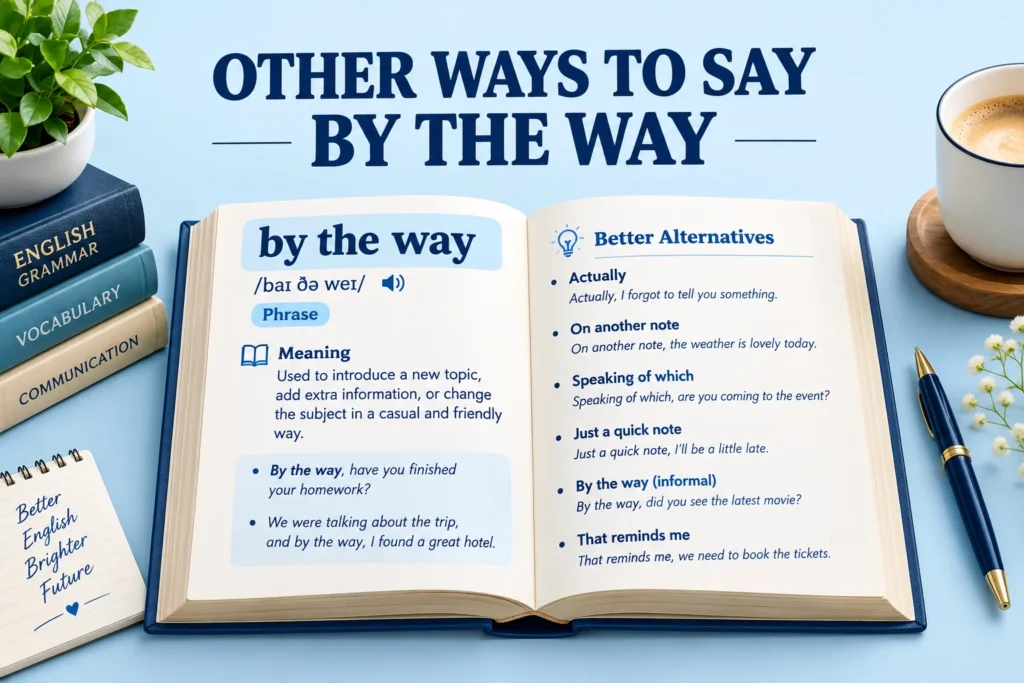
“By the way” is a common phrase that people use when they want to introduce an additional point, change the subject slightly, add a reminder, or mention something related to the current conversation. It sounds natural in everyday English, but it may not always fit a formal email or professional message. That is why many people search for other w*ys to s*y by the way.
The best alternative depends on the situation. In a casual conversation, you can say “just so you know,” “speaking of which,” or “oh, and.” In professional communication, phrases such as “I’d also like to mention,” “on a related note,” and “I should also point out” can sound clearer and more polished.
Choosing the right expression matters because workplace communication needs to balance clarity, politeness, and natural tone. A phrase that sounds friendly in a text message may sound too casual in a client email.
This guide explains 50 alternatives to “by the way,” including professional, formal, friendly, email-ready, and workplace expressions. Each alternative includes its meaning, tone, best use case, and an example.
What Does “By the Way” Mean?
“By the way” introduces information that is not the main subject of a conversation but is still relevant or worth mentioning.
For example:
“By the way, did you receive the updated report?”
Here, the speaker adds a new question to the conversation.
Another example:
“By the way, the meeting has been moved to Friday.”
The speaker adds an important piece of information without making it the main topic.
Literal Meaning
“By the way” does not usually refer to a physical road or path in modern conversation. Instead, it works as a conversational expression that signals an additional thought or change of topic.
It can introduce:
- An extra detail
- A reminder
- A related point
- A new question
- A small change of subject
- Additional information
- Something the speaker almost forgot to mention
Tone of “By the Way”
The phrase usually sounds:
- Casual
- Conversational
- Natural
- Friendly
- Informal
It can appear in professional communication, but repeated use may make a formal message sound conversational.
Purpose of “By the Way”
People commonly use “by the way” to:
- Add another point
- Introduce a related subject
- Give a reminder
- Mention something important
- Change the topic slightly
- Add information after discussing the main point
Emotional Context
“By the way” usually has little emotional meaning on its own. Its effect depends on the information that follows it.
For example:
“By the way, congratulations on your promotion.”
This sounds friendly.
“By the way, you still need to submit the report.”
This may sound like a reminder.
“By the way, we need to discuss the budget.”
This sounds more business-focused.
When to Use “By the Way” Professionally
“By the way” is not wrong in professional communication. However, you should consider your audience, relationship, and message purpose.
In Emails
You can use “by the way” in informal workplace emails, especially when writing to someone you know well.
Example:
“By the way, I’ve attached the revised presentation.”
For a more polished business email, consider:
“I’d also like to mention that I’ve attached the revised presentation.”
In the Workplace
“By the way” sounds natural in conversations with colleagues.
Example:
“By the way, are you joining the team meeting tomorrow?”
For a more formal workplace message:
“On a related note, are you available for tomorrow’s meeting?”
With Clients
When communicating with clients, a more direct expression often sounds professional.
Instead of:
“By the way, we have changed the delivery date.”
Use:
“I’d also like to let you know that we have changed the delivery date.”
This approach makes the additional information sound intentional rather than like an afterthought.
In Networking
Networking conversations often allow a conversational tone.
Example:
“By the way, I’d love to stay in touch.”
A slightly more professional option is:
“On a related note, I’d be happy to stay in touch.”
In Customer Service
Customer service messages should make important information easy to notice.
Instead of:
“By the way, your order will arrive tomorrow.”
Use:
“I’d also like to let you know that your order will arrive tomorrow.”
This makes the information sound more deliberate and professional.
Other W*ys to Say “By the W*y”
Professional Alternatives to “By the Way”
1. On a Related Note
Meaning: Introduces information connected to the current topic.
Tone: Professional and natural.
Best use: Business emails, meetings, workplace communication, and client messages.
Example:
“On a related note, we should review the delivery schedule before Friday.”
2. I’d Also Like to Mention
Meaning: Signals that you want to add another point.
Tone: Professional and polite.
Best use: Emails, reports, client communication, and presentations.
Example:
“I’d also like to mention that the revised document is now available.”
3. I’d Also Like to Add
Meaning: Introduces an additional idea or piece of information.
Tone: Professional.
Best use: Meetings, emails, discussions, and reports.
Example:
“I’d also like to add that the team completed the work ahead of schedule.”
4. It’s Also Worth Mentioning
Meaning: Highlights another point that may be useful or important.
Tone: Professional and polished.
Best use: Reports, emails, presentations, and business discussions.
Example:
“It’s also worth mentioning that the new process will reduce processing time.”
5. I Should Also Mention
Meaning: Introduces information that the speaker wants to add.
Tone: Professional and conversational.
Best use: Emails and workplace communication.
Example:
“I should also mention that the client approved the revised proposal.”
6. I’d Like to Point Out
Meaning: Directs attention to an additional fact or detail.
Tone: Professional and clear.
Best use: Meetings, reports, business discussions, and presentations.
Example:
“I’d like to point out that the final deadline has not changed.”
7. I’d Like to Add
Meaning: Adds another thought to an existing discussion.
Tone: Professional.
Best use: Meetings, emails, and formal discussions.
Example:
“I’d like to add that we have already contacted the supplier.”
8. Another Point to Consider Is
Meaning: Introduces another factor or idea.
Tone: Professional and thoughtful.
Best use: Business discussions, reports, proposals, and meetings.
Example:
“Another point to consider is the impact on our delivery schedule.”
9. Another Thing to Keep in Mind Is
Meaning: Introduces an additional factor that someone should remember.
Tone: Professional and helpful.
Best use: Workplace communication and advice.
Example:
“Another thing to keep in mind is the client’s preferred delivery time.”
10. On a Separate Note
Meaning: Introduces a different subject.
Tone: Professional and natural.
Best use: Emails and workplace messages.
Example:
“On a separate note, could you send me the updated contact list?”
11. As an Additional Point
Meaning: Introduces another relevant point.
Tone: Formal-professional.
Best use: Reports, presentations, and business correspondence.
Example:
“As an additional point, we should review the contract before signing.”
12. I’d Like to Highlight
Meaning: Draws attention to a particular detail.
Tone: Professional.
Best use: Reports, presentations, meetings, and emails.
Example:
“I’d like to highlight one important change in the proposal.”
13. It May Also Be Helpful to Know
Meaning: Introduces information that may benefit the reader.
Tone: Polite and professional.
Best use: Client emails, customer service, and guidance.
Example:
“It may also be helpful to know that the support team is available 24 hours a day.”
14. I’d Also Like to Clarify
Meaning: Adds information that removes possible confusion.
Tone: Professional and direct.
Best use: Business emails, client communication, and workplace discussions.
Example:
“I’d also like to clarify that the quoted price includes delivery.”
15. I’d Also Like to Let You Know
Meaning: Introduces additional information directly.
Tone: Polite and professional.
Best use: Client emails, customer service, and workplace communication.
Example:
“I’d also like to let you know that your order has been shipped.”
Formal Alternatives to “By the Way”
16. Furthermore
Meaning: Adds another related point.
Tone: Formal.
Best use: Reports, formal writing, proposals, and official correspondence.
Example:
“Furthermore, the revised policy will apply to all departments.”
17. In Addition
Meaning: Introduces another point or fact.
Tone: Formal and professional.
Best use: Business writing, reports, proposals, and formal emails.
Example:
“In addition, the company will provide training for all employees.”
18. Additionally
Meaning: Adds another piece of information.
Tone: Formal and concise.
Best use: Reports, professional documents, and formal communication.
Example:
“Additionally, all employees must complete the training by Friday.”
19. Moreover
Meaning: Adds information that strengthens or develops the previous point.
Tone: Formal.
Best use: Formal writing, reports, proposals, and presentations.
Example:
“Moreover, the new system will improve customer response times.”
20. It Is Also Important to Note
Meaning: Signals that an additional detail deserves attention.
Tone: Formal and professional.
Best use: Reports, official communication, and important business emails.
Example:
“It is also important to note that the deadline cannot be extended.”
21. I Would Also Like to Note
Meaning: Introduces another point that the writer considers important.
Tone: Formal and respectful.
Best use: Formal emails, reports, and business correspondence.
Example:
“I would also like to note that all documents have been reviewed.”
22. I Would Like to Add
Meaning: Adds another point to a discussion or message.
Tone: Formal-professional.
Best use: Meetings, business letters, and formal emails.
Example:
“I would like to add that we remain committed to completing the project on time.”
23. It Is Worth Noting
Meaning: Draws attention to a useful or important fact.
Tone: Formal and polished.
Best use: Reports, presentations, and professional writing.
Example:
“It is worth noting that customer satisfaction increased this quarter.”
24. As a Further Point
Meaning: Introduces another point connected to the discussion.
Tone: Formal.
Best use: Formal correspondence, reports, and presentations.
Example:
“As a further point, we should consider the long-term cost.”
25. I Would Also Like to Emphasize
Meaning: Gives additional importance to a particular point.
Tone: Formal and professional.
Best use: Official communication, reports, and business discussions.
Example:
“I would also like to emphasize the importance of meeting the deadline.”
Friendly Alternatives to “By the Way”
26. Just So You Know
Meaning: Gives someone additional information or a reminder.
Tone: Friendly and conversational.
Best use: Colleagues, friends, and informal messages.
Example:
“Just so you know, the meeting starts at 10 a.m.”
27. Speaking of Which
Meaning: Connects the current topic to a related subject.
Tone: Friendly and conversational.
Best use: Conversations, casual workplace chats, and networking.
Example:
“We were talking about the new project. Speaking of which, have you met the new manager?”
28. Oh, and
Meaning: Adds another thought that the speaker remembers.
Tone: Very casual and friendly.
Best use: Text messages, informal conversations, and close colleagues.
Example:
“Oh, and please remember to bring the documents tomorrow.”
29. One More Thing
Meaning: Signals one additional point.
Tone: Friendly and conversational.
Best use: Conversations, chats, and informal workplace messages.
Example:
“One more thing: could you send me the final version?”
30. While I’m Thinking of It
Meaning: Introduces something that the speaker remembers.
Tone: Friendly and conversational.
Best use: Informal conversations and workplace chats.
Example:
“While I’m thinking of it, could you check the meeting room booking?”
31. Just a Quick Note
Meaning: Introduces a short additional message.
Tone: Friendly and polite.
Best use: Emails, chats, and workplace communication.
Example:
“Just a quick note to let you know that the schedule has changed.”
32. Just a Heads-Up
Meaning: Gives advance information or a warning.
Tone: Friendly and informal.
Best use: Colleagues, team chats, and informal workplace communication.
Example:
“Just a heads-up, the office will close early tomorrow.”
33. Before I Forget
Meaning: Introduces something the speaker wants to remember to say.
Tone: Casual and friendly.
Best use: Conversations and informal messages.
Example:
“Before I forget, can you send me the invoice?”
34. That Reminds Me
Meaning: Connects a new thought to something just mentioned.
Tone: Friendly and natural.
Best use: Conversations and informal workplace communication.
Example:
“That reminds me, did you speak with Sarah about the meeting?”
35. While We’re on the Subject
Meaning: Introduces another point connected to the current topic.
Tone: Conversational and friendly.
Best use: Meetings, discussions, and informal professional communication.
Example:
“While we’re on the subject, should we also review the budget?”
Email-Ready Alternatives to “By the Way”
36. I’d Also Like to Let You Know
Meaning: Provides additional information in a clear way.
Tone: Professional and polite.
Best use: Business emails and client communication.
Example:
“I’d also like to let you know that the order has been shipped.”
37. I’d Also Like to Mention
Meaning: Adds another piece of information.
Tone: Professional.
Best use: Business email phrases and client communication.
Example:
“I’d also like to mention that the revised contract is attached.”
38. On a Related Note
Meaning: Introduces information connected to the main topic.
Tone: Professional and polished.
Best use: Email communication and workplace messages.
Example:
“On a related note, could you confirm the delivery address?”
39. On a Separate Note
Meaning: Signals a change to a different subject.
Tone: Professional and natural.
Best use: Emails and workplace communication.
Example:
“On a separate note, I wanted to ask about next week’s meeting.”
40. I’d Like to Add One More Thing
Meaning: Introduces an additional point.
Tone: Polite and professional.
Best use: Emails, meeting follow-ups, and business messages.
Example:
“I’d like to add one more thing: please include the updated figures in the report.”
41. I Should Also Mention That
Meaning: Adds information that the writer considers relevant.
Tone: Professional and conversational.
Best use: Emails and workplace communication.
Example:
“I should also mention that the client has approved the changes.”
42. It’s Also Worth Mentioning That
Meaning: Highlights another useful detail.
Tone: Professional and polished.
Best use: Business emails, reports, and client communication.
Example:
“It’s also worth mentioning that the new schedule begins next Monday.”
43. I’d Like to Draw Your Attention to
Meaning: Directs the reader toward an important detail.
Tone: Formal and professional.
Best use: Documents, reports, proposals, and formal emails.
Example:
“I’d like to draw your attention to the changes on page three.”
44. Please Also Note That
Meaning: Tells the reader to pay attention to additional information.
Tone: Professional and direct.
Best use: Business emails, instructions, and customer communication.
Example:
“Please also note that the office will remain closed on Monday.”
45. I Also Wanted to Mention
Meaning: Adds a point in a natural but professional way.
Tone: Friendly-professional.
Best use: Emails, follow-ups, and workplace messages.
Example:
“I also wanted to mention that I really appreciate your help with the project.”
Workplace Alternatives to “By the Way”
46. One Other Point
Meaning: Introduces one additional idea or detail.
Tone: Professional and concise.
Best use: Meetings and workplace discussions.
Example:
“One other point: we need to confirm the supplier before Friday.”
47. Another Point
Meaning: Introduces an additional topic.
Tone: Professional.
Best use: Meetings, reports, and workplace communication.
Example:
“Another point we should discuss is the revised budget.”
48. One More Item
Meaning: Introduces another task or issue.
Tone: Professional and practical.
Best use: Meetings, agendas, and workplace communication.
Example:
“One more item before we finish: please review the updated schedule.”
49. Before We Move On
Meaning: Introduces a final point before changing subjects.
Tone: Professional.
Best use: Meetings, presentations, and discussions.
Example:
“Before we move on, I’d like to clarify the delivery deadline.”
50. Before We Finish
Meaning: Introduces an additional point near the end of a discussion.
Tone: Professional and natural.
Best use: Meetings, presentations, and workplace conversations.
Example:
“Before we finish, I’d like to mention one important update.”
Quick Comparison Table
| Alternative | Tone | Best Use |
| On a related note | Professional | Business emails |
| I’d also like to mention | Professional | Emails and meetings |
| I’d also like to add | Professional | Discussions |
| It’s also worth mentioning | Professional | Reports and emails |
| I should also mention | Professional | Workplace communication |
| On a separate note | Professional | Changing topics |
| Furthermore | Formal | Reports and formal writing |
| In addition | Formal | Business documents |
| Additionally | Formal | Professional writing |
| Moreover | Formal | Formal communication |
| It is also important to note | Formal | Reports |
| I would also like to note | Formal | Business correspondence |
| Just so you know | Friendly | Informal workplace messages |
| Speaking of which | Friendly | Conversations |
| Oh, and | Casual | Texts and chats |
| One more thing | Friendly | Informal conversations |
| Just a quick note | Friendly-professional | Emails |
| Just a heads-up | Casual | Team chats |
| Before I forget | Casual | Informal messages |
| That reminds me | Friendly | Conversations |
| I’d also like to let you know | Professional | Client emails |
| Please also note that | Professional | Instructions |
| I also wanted to mention | Friendly-professional | Emails |
| One other point | Professional | Meetings |
| Before we move on | Professional | Meetings |
Email Examples Using Alternatives to “By the Way”
Client Email
Subject: Project Update
Thank you for reviewing the latest proposal. I’ve included the requested changes in the attached document.
I’d also like to let you know that the revised timeline is now available. Please let me know if you have any questions.
Manager Email
Subject: Project Update
Thank you for your feedback on the report. I’ve made the requested changes.
I should also mention that the client has approved the revised figures.
Colleague Email
Subject: Meeting Details
The meeting is scheduled for Thursday at 10 a.m. and will take place in Conference Room B.
On a related note, could you please bring the latest sales figures?
Thanks.
Customer Email
Subject: Your Order Update
Thank you for your patience while we processed your order.
I’d also like to let you know that your package has now been shipped and should arrive within three business days.
Networking Email
Subject: Great Meeting You
It was a pleasure speaking with you at the conference. I enjoyed learning more about your work.
On a related note, I’d be happy to stay in touch and continue our conversation.
Meeting Follow-Up Email
Subject: Follow-Up From Today’s Meeting
Thank you for your time during today’s meeting. We covered the main project requirements and agreed on the next steps.
One other point: please send your updated figures by Friday afternoon.
Common Mistakes When Replacing “By the Way”
Overusing “By the Way”
Using “by the way” several times in the same email can make your message feel unstructured.
Weak:
“By the way, I attached the report. By the way, the meeting moved. By the way, please call me.”
Better:
“I’ve attached the report. I’d also like to let you know that the meeting has moved to Thursday. Please call me when you have a moment.”
Choosing the Wrong Tone
A casual phrase may not fit a formal business situation.
Too casual:
“Oh, and your contract is ready.”
Better:
“I’d also like to let you know that your contract is ready.”
Making a Formal Message Sound Too Stiff
Formal alternatives do not always improve professional communication.
For example:
“Furthermore, I would like to emphasize that…”
This may sound unnecessarily formal in a short email.
A simpler alternative:
“I’d also like to mention that…”
Using “By the Way” for Important Information
If information is important, do not make it sound like an afterthought.
Instead of:
“By the way, the deadline has changed.”
Write:
“Please note that the deadline has changed.”
This gives the information the attention it deserves.
Changing the Subject Without a Clear Connection
“By the way” can introduce a different topic, but professional emails benefit from clear transitions.
Instead of suddenly changing subjects, use:
“On a separate note…”
or
“Regarding another matter…”
Using Too Many Transition Phrases
You do not need a transition phrase before every new sentence.
Too many:
“On a related note…”
“Additionally…”
“Furthermore…”
“On a separate note…”
A clear email can simply organize information into short paragraphs.
Related Phrases and Expressions
Just So You Know
Meaning: Provides useful information or a reminder.
Example:
“Just so you know, the office will close at 4 p.m.”
Speaking of Which
Meaning: Connects a new point to something already mentioned.
Example:
“We discussed the conference. Speaking of which, have you booked your ticket?”
On a Related Note
Meaning: Introduces a connected subject.
Example:
“On a related note, we should review the marketing plan.”
On a Separate Note
Meaning: Introduces a different subject.
Example:
“On a separate note, I wanted to discuss next month’s schedule.”
I’d Also Like to Mention
Meaning: Adds another relevant detail.
Example:
“I’d also like to mention that the documents are ready.”
It’s Also Worth Mentioning
Meaning: Highlights useful additional information.
Example:
“It’s also worth mentioning that the service is available on weekends.”
Just a Quick Note
Meaning: Introduces a short message or reminder.
Example:
“Just a quick note to confirm tomorrow’s meeting.”
Just a Heads-Up
Meaning: Gives advance information.
Example:
“Just a heads-up, the system will be offline tonight.”
One More Thing
Meaning: Introduces one final additional point.
Example:
“One more thing: please bring your ID to the meeting.”
Before I Forget
Meaning: Introduces something the speaker remembers.
Example:
“Before I forget, could you send me the invoice?”
That Reminds Me
Meaning: Connects a new thought to something previously mentioned.
Example:
“That reminds me, we need to confirm the venue.”
In Addition
Meaning: Adds another point.
Example:
“In addition, we need to update the client records.”
Additionally
Meaning: Adds more information.
Example:
“Additionally, the company will provide technical support.”
Furthermore
Meaning: Adds a related point in formal writing.
Example:
“Furthermore, the policy applies to all employees.”
Please Also Note
Meaning: Directs attention to additional information.
Example:
“Please also note that the deadline has been extended.”
Another Point to Consider
Meaning: Introduces another factor or idea.
Example:
“Another point to consider is the cost of maintenance.”
I Should Also Mention
Meaning: Adds another relevant detail.
Example:
“I should also mention that the client requested a revised quote.”
“By the Way” vs. Other Alternatives
“By the Way” vs. “On a Related Note”
“By the way” sounds more conversational. “On a related note” sounds more deliberate and professional.
Use “by the way” with:
- Friends
- Familiar colleagues
- Informal conversations
Use “on a related note” with:
- Clients
- Business contacts
- Professional emails
- Meetings
“By the Way” vs. “On a Separate Note”
“On a separate note” works better when you want to clearly change subjects.
Example:
“On a separate note, I wanted to ask about next week’s meeting.”
This creates a clear transition between topics.
“By the Way” vs. “I’d Also Like to Mention”
“I’d also like to mention” works well when the additional information matters.
Example:
“I’d also like to mention that the deadline remains unchanged.”
This sounds more intentional than:
“By the way, the deadline remains unchanged.”
“By the Way” vs. “Furthermore”
These phrases serve different purposes.
“By the way” introduces an additional thought or topic.
“Furthermore” adds a related point that supports or develops the previous point.
Example:
“The new system will reduce costs. Furthermore, it will improve processing speed.”
You would not normally replace “furthermore” with “by the way” in this example.
“By the Way” vs. “Just So You Know”
“Just so you know” sounds friendly and conversational.
Example:
“Just so you know, the meeting starts at 9 a.m.”
It works well with colleagues but may sound too casual for some client emails.
“By the Way” vs. “Please Also Note”
“Please also note” sounds more direct and professional.
Example:
“Please also note that payments must be received by Friday.”
This works particularly well when the information requires the reader’s attention.
Cultural and Professional Usage
US English
In American English, “by the way” is extremely common in everyday conversation and informal professional communication.
People often use it to introduce a side comment or change the subject.
Example:
“By the way, did you send the invoice?”
In formal business writing, professionals often choose clearer transitions such as “in addition,” “on a related note,” or “I’d also like to mention.”
UK English
British English also uses “by the way” naturally in everyday conversation.
In professional writing, “many thanks,” “on a separate note,” “in addition,” and similar expressions may appear depending on the context and level of formality.
Corporate Communication
Corporate communication should prioritize clarity over conversational filler.
Instead of:
“By the way, we changed the deadline.”
Use:
“Please note that the deadline has changed.”
Or:
“I’d also like to let you know that the deadline has changed.”
The second versions make the purpose of the sentence clearer.
Customer Service
Customer service messages should make important information easy to find.
Instead of:
“By the way, your refund has been processed.”
Use:
“I’d also like to let you know that your refund has been processed.”
Or:
“Please note that your refund has now been processed.”
Networking
Networking communication can be slightly more conversational.
For example:
“By the way, I’d love to stay in touch.”
However, a polished alternative is:
“On a related note, I’d be happy to stay in touch.”
The best choice depends on how formal the relationship is.
How to Choose the Right Alternative
Think about three things before choosing an alternative: your audience, your purpose, and your level of formality.
For a Formal Business Email
Use:
“I would also like to note…”
“It is also important to note…”
“In addition…”
For a Professional but Natural Email
Use:
“I’d also like to mention…”
“On a related note…”
“I also wanted to mention…”
For a Client
Use:
“I’d also like to let you know…”
“Please also note…”
“On a related note…”
For a Colleague
Use:
“Just so you know…”
“One more thing…”
“Just a quick note…”
For a Meeting
Use:
“One other point…”
“Before we move on…”
“I’d also like to add…”
For Customer Service
Use:
“I’d also like to let you know…”
“Please also note…”
“It may also be helpful to know…”
For a Casual Conversation
Use:
“Oh, and…”
“Speaking of which…”
“That reminds me…”
“Before I forget…”
Frequently Asked Questions
What is a professional way to say “by the way”?
Professional alternatives include “on a related note,” “I’d also like to mention,” “I’d also like to add,” and “it’s also worth mentioning.” These expressions work well in workplace communication and business emails.
What is a formal alternative to “by the way”?
Formal alternatives include “in addition,” “additionally,” “furthermore,” “moreover,” and “it is also important to note.” Choose the phrase based on how closely the new information relates to the previous point.
What is a synonym for “by the way”?
Common synonyms and related expressions include “on a related note,” “speaking of which,” “just so you know,” “on a separate note,” “I’d also like to mention,” and “in addition.”
Is “by the way” professional?
“By the way” can work in informal professional communication, especially with familiar colleagues. However, a more specific transition often works better in formal business emails.
Can I use “by the way” in a business email?
Yes, but use it carefully. It can sound natural in casual workplace emails, but client-facing or formal messages often benefit from alternatives such as “on a related note” or “I’d also like to mention.”
What is the best way to say “by the way” in an email?
There is no single best option. “I’d also like to mention” works well for adding information, while “on a separate note” works better when changing the subject.
How can I say “by the way” politely?
You can say “I’d also like to mention,” “I’d also like to let you know,” “on a related note,” or “it may also be helpful to know.”
What can I say instead of “by the way” to a client?
Use professional phrases such as “I’d also like to let you know,” “on a related note,” “please also note,” or “it may also be helpful to know.”
What can I say instead of “by the way” to my manager?
“I’d also like to mention,” “I should also mention,” and “I’d also like to add” work well when writing to a manager.
What can I say instead of “by the way” to a colleague?
For a familiar colleague, you can say “just so you know,” “one more thing,” “just a quick note,” or “I also wanted to mention.”
Is “on a separate note” the same as “by the way”?
They can serve a similar purpose, but they are not identical. “On a separate note” clearly signals a change of subject, while “by the way” can introduce either a related point or a new subject.
Is “speaking of which” formal?
“Speaking of which” is mainly conversational. It works well in friendly discussions and informal workplace communication but may sound too casual in a highly formal business email.
Is “furthermore” a good replacement for “by the way”?
Not always. “Furthermore” adds a supporting or related point to an existing argument. “By the way” often introduces a side comment or additional topic. Use “furthermore” when the new point directly develops the previous idea.
How do I avoid using “by the way” too much?
Choose a transition based on your purpose. Use “on a related note” for related information, “on a separate note” for a topic change, “please also note” for important information, and “I’d also like to mention” for an additional point.
What is a good business email phrase instead of “by the way”?
Conclusion
“I’d also like to mention” is a versatile choice for business email phrases. Other useful options include “on a related note,” “I’d also like to let you know,” and “please also note.”
Conclusion
“By the way” is a useful and friendly phrase for introducing a new topic, adding information, or changing the subject naturally. Depending on the context, expressions such as “Actually,” “On another note,” “Speaking of which,” “Just a quick note,” and “That reminds me” can make your English sound more natural and varied. Choosing the right alternative helps you communicate clearly and confidently in both casual and professional conversations.
Final Summary
“By the way” is natural and useful, but professional communication often benefits from more specific alternatives. For professional emails, use “I’d also like to mention,” “on a related note,” or “I’d also like to let you know.” For formal writing, choose “in addition,” “additionally,” or “it is also important to note.” For friendly workplace conversations, “just so you know,” “one more thing,” and “speaking of which” work well. When changing subjects, “on a separate note” provides a clear transition. The best alternative depends on your audience, purpose, and level of formality. Choosing the right phrase makes your workplace communication clearer, more natural, and more professional.




