
Introduction
If you have ever typed “requester vs requestor” into a search box, you are not alone. Both spellings show up in emails, forms, legal documents, and company policies — and they look so similar that most people pause before picking one. Is there a real difference, or is one of them simply wrong?
The short version: requester is the standard, widely accepted spelling. Requestor is a rare variant that appears mostly in legal and technical writing. In almost every situation — business emails, workplace messages, forms, and everyday conversation — “requester” is the safe choice.
This guide breaks down exactly what each word means, when (if ever) to use “requestor,” and how to avoid the most common mistakes. You will find clear definitions, real example sentences from business and legal contexts, related confusing word pairs, and answers to the questions people ask most about this spelling puzzle.
Requester vs requestor: the short answer
Requester (with an -er ending) is the standard spelling of the noun meaning “a person who makes a request.” It is the form used in dictionaries, business writing, and everyday English. Requestor (with an -or ending) is a much rarer variant with the same meaning, found mainly in legal documents and some technical contexts. Unless you are following a specific legal style guide, always use requester.
What each word means
Requester
“Requester” is a noun formed from the verb “request” plus the agent suffix “-er,” which means “one who does the action.” A requester is simply a person who asks for something — information, permission, a service, or an action.
- Part of speech: noun (countable)
- Pronunciation: ri-KWES-ter
- Example: “The requester asked for the report by Friday.”
This is the spelling you will find in the Oxford English Dictionary, Merriam-Webster, and Cambridge Dictionary. Style guides for business and journalism — including the AP Stylebook tradition and most corporate writing standards — all default to “requester.” When in doubt, this is the word.
Requestor
“Requestor” uses the alternative agent suffix “-or” instead of “-er.” It means exactly the same thing as “requester”: a person who makes a request. It is not a different word with a different meaning — it is just a less common spelling of the same noun.
- Part of speech: noun (countable)
- Pronunciation: ri-KWES-ter (identical to “requester”)
- Example: “The requestor shall submit all claims in writing.”
You will encounter “requestor” most often in contracts, court filings, insurance paperwork, and older technical manuals. Some legal style guides have historically preferred “-or” endings for Latin-derived agent nouns (think “grantor,” “donor,” “vendor”). But even in legal writing, “requester” is gaining ground, and many modern legal editors now recommend it for consistency.
Which one to use
In business emails
Always use requester. Business emails should follow standard spelling, and “requester” is what your readers expect. Writing “requestor” in an email to a client or colleague can look like a typo, even when it is technically acceptable. For instance, when you are reaching out to offer help on a ticket, write “the requester will receive an update” — not “the requestor.”
In formal and legal writing
Use requester unless your organization’s style guide or a specific legal document requires “requestor.” Some law firms and government agencies still use “requestor” in templates out of habit. If you are editing an existing legal document, match the spelling already in use for consistency — but for new documents, “requester” is the modern recommendation.
In everyday conversation and forms
Use requester. On web forms, support tickets, and internal tools, “requester” is the familiar label. Most users have seen “requester” in software interfaces (help-desk systems commonly label the person filing a ticket as the “requester”), so it causes the least confusion.
In job titles and official names
Check the official title first. A few organizations use “Requestor” in formal role names or system fields as a legacy choice. If the official name uses “-or,” keep it; otherwise, default to “-er.”
Example sentences
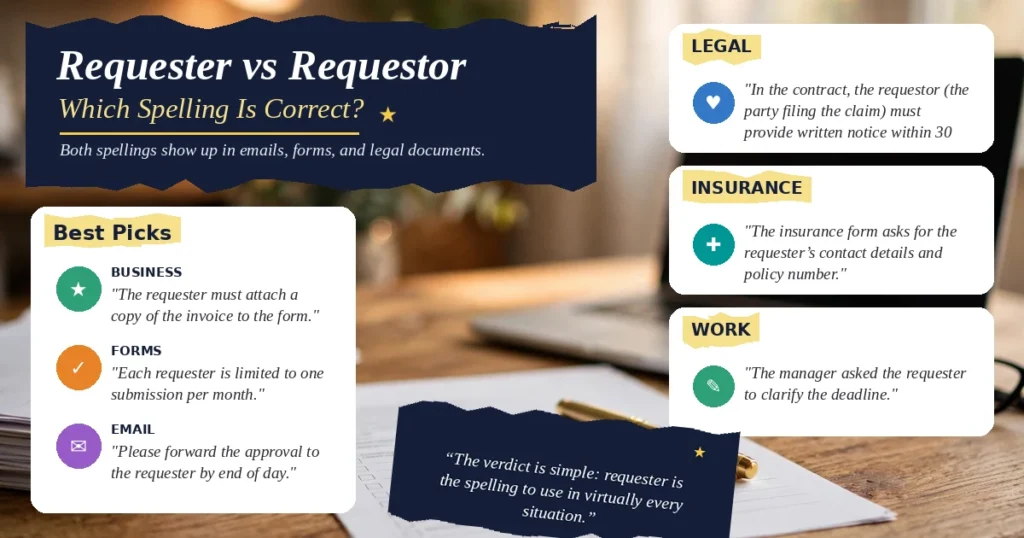
- The requester must attach a copy of the invoice to the form.
- Please forward the approval to the requester by end of day.
- Our system notifies the requester automatically when the status changes.
- Each requester is limited to one submission per month.
- The manager asked the requester to clarify the deadline.
- In the contract, the requestor (the party filing the claim) must provide written notice within 30 days.
- Legal counsel advised that the requestor sign every page of the agreement.
- The insurance form asks for the requester’s contact details and policy number.
- As the requester, you will receive a confirmation email within an hour.
- The committee reviews every case from the requester’s perspective before deciding.
Notice how sentences 6 and 7 — the only ones using “requestor” — both come from legal contexts. Everywhere else, “requester” is the natural choice. When you need to thank someone for the clarification they provided on a request, the standard phrasing stays the same regardless of spelling: “Thank you for the clarification, the requester has been notified.”
Common mistakes
1. Using “requestor” in everyday business writing
The most common mistake is treating the two spellings as interchangeable in normal contexts. They are not interchangeable in practice: “requestor” looks wrong to most readers outside legal circles. In emails, reports, and presentations, stick with “requester.”
2. Assuming “requestor” is the American spelling and “requester” is British (or vice versa)
This is a myth. Both the US and the UK prefer “requester.” The “-or” variant is not a regional spelling — it is simply a rarer form that survives in legal and technical niches on both sides of the Atlantic.
3. Mixing both spellings in the same document
Nothing undermines a document’s polish faster than spelling the same word two ways. Pick one spelling and use it consistently throughout. If you inherit a legal template that says “requestor,” either keep it everywhere or change it everywhere — never mix.
4. Correcting “requestor” to “requester” in quoted legal text
When you quote a contract, statute, or court document, reproduce the original spelling exactly — even if it says “requestor.” Altering quoted text, even to fix spelling, is a serious error in legal and academic writing. Add “[sic]” only if your style guide requires it.
5. Overthinking it in casual contexts
In chats, quick messages, and informal notes, “requester” is always fine. Do not waste time debating the variant when the standard spelling works everywhere. Save your energy for getting the tone right — for example, making sure you show you understand the other person’s situation before discussing their request.
Related word pairs
English is full of “-er” vs “-or” spelling puzzles. Here are the most common ones, each with a quick note on which form to prefer:
- Adviser vs advisor — Both are correct and widely used; “advisor” is more common in American business titles, “adviser” in British English and journalism. Example: “She hired a financial advisor.”
- Acknowledgment vs acknowledgement — “Acknowledgment” (no e) is standard in American English; “acknowledgement” is the British variant. Example: “Please send an acknowledgment of receipt.”
- Judgment vs judgement — “Judgment” is preferred in American English (and in legal writing everywhere); “judgement” appears in British non-legal writing. Example: “The court issued its judgment on Monday.”
- Conveyor vs conveyer — “Conveyor” is standard (as in “conveyor belt”); “conveyer” is rare. Example: “The luggage moved along the conveyor.”
- Grantor vs granter — “Grantor” is the legal term for one who grants (property, rights); “granter” is almost never used. Example: “The grantor signed the deed.”
- Donor vs doner — “Donor” is correct for one who donates; “doner” refers to the rotating meat dish (doner kebab). Example: “The blood donor waited fifteen minutes.”
- Vendor vs vender — “Vendor” is the standard spelling; “vender” is a rare variant. Example: “We approved three new vendors.”
- Licensor vs licenser — “Licensor” is standard in legal contexts (one who grants a license); “licenser” is uncommon. Example: “The licensor retains all ownership rights.”
- Debtor vs debter — “Debtor” is correct; “debter” is simply wrong. Example: “The debtor agreed to a payment plan.”
The pattern is clear: when an “-er”/”-or” pair exists, the common everyday spelling almost always wins outside of legal writing. “Requester” follows the same rule. And just as good spelling builds trust, good manners do too — when a request is finally resolved, it never hurts to tell the other person you are happy to help with anything else.
Frequently asked questions
Is “requestor” a real word?
Yes. “Requestor” is a real but rare variant spelling of “requester,” recognized by some dictionaries and used mainly in legal and technical writing. It is not a typo in those contexts, but it is far less common than “requester” and looks like an error to most readers.
Which is correct: requester or requestor?
“Requester” is the correct standard spelling for general use. “Requestor” is an acceptable variant in legal and technical contexts. For business emails, everyday writing, and anything public-facing, use “requester.”
Why do legal documents use “requestor”?
Legal English has a long tradition of “-or” agent nouns borrowed from Latin (grantor, donor, vendor, licensor). “Requestor” followed that pattern in some legal drafting traditions. However, even legal style guides are shifting toward “requester” for consistency with modern usage.
Is “requestor” more formal than “requester”?
Not really. The two spellings carry the same level of formality — “requestor” only looks more formal because people associate it with legal documents. True formality comes from your sentence structure and word choice, not from swapping “-er” for “-or.”
What is the plural of requester?
“Requesters.” The plural of the variant is “requestors.” Both follow the regular rule of adding “-s.”
Can I use “requestor” in a job application?
You can, but you should not. Hiring managers and recruiters expect standard spelling, and “requestor” may read as a mistake. Use “requester” in resumes, cover letters, and application forms.
Does Microsoft Word flag “requestor” as a spelling error?
It depends on your dictionary settings. Many spell-checkers flag “requestor” because “requester” is the primary dictionary entry. If your spell-checker underlines “requestor,” take the hint and switch to “requester” unless you are drafting a legal document.
What is a synonym for requester?
Common synonyms include “applicant” (for formal applications), “petitioner” (legal), “claimant” (insurance/legal), and “asker” (informal). Choose based on context: an insurance form wants “claimant,” a help desk wants “requester.”
Is “requester” used in software and IT?
Yes — it is the standard term. Help-desk and ticketing systems (like Jira Service Management and ServiceNow) label the person who files a ticket as the “requester.” You will almost never see “requestor” in software interfaces.
How do you pronounce requester and requestor?
Both are pronounced identically: ri-KWES-ter. The spelling difference does not change the sound, which is one reason the confusion persists — people hear the same word and guess at the spelling.
Conclusion
The verdict is simple: requester is the spelling to use in virtually every situation — business emails, forms, software, and everyday writing. Reserve requestor for legal documents that already use it, and even there, check whether your style guide has moved on.
Spelling is a small detail, but small details build credibility. Getting “requester” right — and keeping it consistent — is one of the easiest wins in professional writing. And once the wording is settled, the harder part begins: handling the request itself with clarity and care. A little patience goes a long way there too — when timelines slip, knowing how to ask someone to be patient gracefully matters just as much as spelling the words correctly. When the work is done well, do not forget the human touch either: a simple note that you appreciate their patience turns a routine transaction into a relationship.
For the full dictionary definition, see Merriam-Webster’s entry on “requester”.




