Introduction
If you are searching for other ways to say see you tomorrow, you are in the right place. “See you tomorrow” is a friendly and simple goodbye, but it can start to feel flat when you use it every single day with the same people. A little variety keeps your goodbyes warm and shows people that you care about the moment, not just the routine.
In this guide, you will find 35 warm alternatives to “see you tomorrow,” organized into five tone groups: Professional, Formal, Friendly, Email, and Workplace. Each phrase comes with a tone note and a short example so you know exactly when to use it. You will also get email samples, a quick comparison table, common mistakes to avoid, and cultural tips, so your sign-offs always land the right way.
Meaning
“See you tomorrow” is a farewell phrase that means you expect to meet or talk to the person again on the next day. It carries a promise of continuity, which is why it feels so comforting at the end of a conversation. You are not just leaving; you are confirming that the connection continues.
The phrase sits comfortably in the middle of the formality scale. It works with a close friend, a coworker, a client, and even a teacher, though the warmest tone comes from the relationship behind it. It also implies that you actually plan to reconnect, so it feels slightly more personal than a plain “goodbye” or “good night.”
In daily use, people often shorten it to “see you tomorrow” in person, “talk tomorrow” in messages, or simply “tomorrow” with a wave. The alternatives below keep the same warm promise but change the tone, so you can match the moment: serious, playful, polite, or professional.
Professional usage
In a professional setting, “see you tomorrow” is perfectly acceptable, but the alternatives give you more control over how you sound. When you end a meeting with “I’ll see you in the morning,” you sound prepared and focused. When you close an email with “I’ll touch base tomorrow,” you sound organized and responsible. Small wording choices shape how colleagues remember you.
Use these alternatives at the end of meetings, video calls, shift handovers, and work messages. Match the formality of your workplace: a law office leans formal, a startup leans casual, and most offices sit somewhere in between. If you manage a team, a warmer sign-off like “we’ll regroup tomorrow” can lift tired spirits after a long day.
One more tip: pair your goodbye with a small act of care. If a meeting ran long and everyone is drained, a warm sign-off softens the moment. When you understand their frustration, your words carry more weight, and the promise of tomorrow feels like a fresh start rather than another obligation.
Alternatives
Here are 35 warm alternatives to “see you tomorrow,” grouped by tone. Pick the group that fits your setting, then choose the phrase that fits your mood.
Professional
- I’ll see you in the morning : crisp and confident tone, works best for next-day meetings. Example: “Great, I’ll see you in the morning, and I’ll bring the updated slides.”
- Until tomorrow, then : polite and assured tone, ideal for ending a phone call smoothly. Example: “Until tomorrow, then, and I’ll have the numbers ready.”
- See you bright and early : upbeat professional tone, great for teams with an early start. Example: “See you bright and early at the site visit.”
- Catch you tomorrow : relaxed professional tone, suited to friendly coworkers. Example: “Catch you tomorrow, and enjoy the rest of your evening.”
- I’ll reconnect with you tomorrow : polished tone, made for clients and senior contacts. Example: “I’ll reconnect with you tomorrow after the review.”
- Tomorrow it is : short and decisive, perfect for confirming plans. Example: “Tomorrow it is; we can finalize the agenda then.”
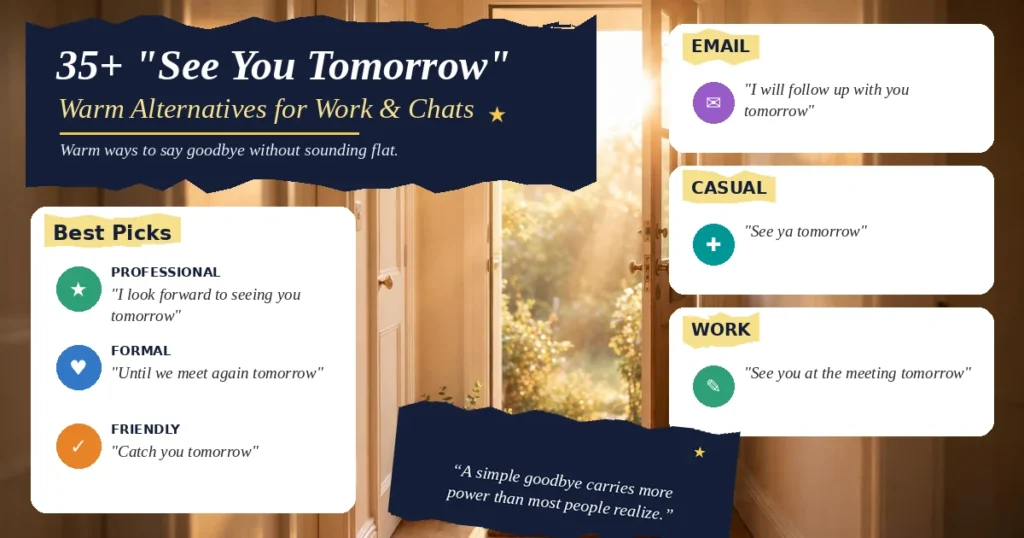
- I’ll follow up with you tomorrow : responsible tone, ideal for open tasks. Example: “I’ll follow up with you tomorrow about the contract.”
Formal
- I look forward to seeing you tomorrow : warm formal tone, perfect for invitations and events. Example: “I look forward to seeing you tomorrow at the ceremony.”
- We shall meet again tomorrow : classic formal tone, works well in official correspondence. Example: “We shall meet again tomorrow, I wish you a pleasant evening.”
- Until we meet again tomorrow : gracious tone, suited to formal farewells. Example: “Until we meet again tomorrow, I wish you a pleasant evening.”
- I await our meeting tomorrow : respectful tone, ideal for senior contacts and dignitaries. Example: “I await our meeting tomorrow with great interest.”
- Tomorrow we shall continue : measured tone, great for formal agendas. Example: “Tomorrow we shall continue the discussion at nine.”
- I remain until tomorrow, then : old-fashioned formal tone, made for traditional letters. Example: “I remain until tomorrow, then, at your convenience.”
- May we meet again tomorrow : courteous tone, lovely for hospitality and hosting. Example: “May we meet again tomorrow for the tour.”
Friendly
- Talk to you tomorrow : easy-going tone, perfect for friends and family. Example: “Talk to you tomorrow, and tell me how the interview went.”
- See you in the a.m. : playful tone, best for close friends. Example: “See you in the a.m., don’t forget the snacks.”
- See ya tomorrow : relaxed tone, great for casual chats. Example: “See ya tomorrow, and drive safe.”
- Till tomorrow, friend : warm tone, lovely for long-time friends. Example: “Till tomorrow, friend, and drive safe.”
- See you on the flip side : playful tone, made for fun-loving friends. Example: “See you on the flip side, and bring the good playlist.”
- I’ll holler at you tomorrow : casual tone, suited to very informal friendships. Example: “I’ll holler at you tomorrow about the tickets.”
- Same time tomorrow : easy tone, perfect for daily routines. Example: “Same time tomorrow, same coffee spot.”
- I’ll touch base tomorrow : business-email tone, ideal for routine check-ins. Example: “I’ll touch base tomorrow once the shipment clears.”
- Let’s pick this up tomorrow : collaborative tone, great for unfinished threads. Example: “Let’s pick this up tomorrow when everyone is back.”
- I’ll circle back tomorrow : tidy business tone, perfect for open action items. Example: “I’ll circle back tomorrow with the final figures.”
- Speak tomorrow : concise sign-off tone, ideal for quick email exchanges. Example: “Speak tomorrow, and please send the draft tonight.”
- I’ll have an update for you tomorrow : informative tone, great for status emails. Example: “I’ll have an update for you tomorrow by noon.”
- More on this tomorrow : brief tone, suited to newsletters and daily updates. Example: “More on this tomorrow in the product briefing.”
- Until tomorrow’s update : structured tone, perfect for recurring reports. Example: “Until tomorrow’s update, the schedule stands as planned.”
Workplace
- See you at the morning standup : team-focused tone, ideal for daily scrums. Example: “See you at the morning standup, and have your blockers listed.”
- Catch you at the office tomorrow : casual workplace tone, great for hybrid teams. Example: “Catch you at the office tomorrow for the workshop.”
- I’ll see you on shift tomorrow : practical tone, made for shift and hourly workers. Example: “I’ll see you on shift tomorrow; the swap ends at six.”
- Tomorrow’s briefing then : focused tone, suited to managers and team leads. Example: “Tomorrow’s briefing then, and come prepared with questions.”
- Back at it tomorrow : motivating tone, lovely after a tiring day. Example: “Back at it tomorrow, team, and rest up tonight.”
- See you at the meeting tomorrow : clear tone, perfect for scheduled calls. Example: “See you at the meeting tomorrow; the link is in the invite.”
- We’ll regroup tomorrow : steady tone, great after a difficult day. Example: “We’ll regroup tomorrow with fresh eyes on the problem.”
Quick comparison
Not sure which group fits your situation? This table gives you a fast overview of the five tone groups so you can pick with confidence.
| Tone group | Best setting | Vibe | Example phrase |
|---|---|---|---|
| Professional | Meetings and calls | Confident and crisp | I’ll see you in the morning |
| Formal | Events and senior contacts | Polite and graceful | I look forward to seeing you tomorrow |
| Formal | Clients and events | Slightly formal | Until tomorrow |
| Friendly | Friends and family | Warm and playful | Talk to you tomorrow |
| Work emails and updates | Clear and organized | I’ll touch base tomorrow | |
| Workplace | Teams and shifts | Motivating and practical | We’ll regroup tomorrow |
Email examples
Email sign-offs are where “see you tomorrow” alternatives shine, because the tone stays on the record. Here are four ready-to-use examples you can copy and adapt.
Example 1: project update to a manager
Subject: Homepage redesign, day one summary
Hi Sarah,
We finished the wireframes and the design team approved the layout. Thank you for the clarification on the header copy; it saved us a full round of revisions. I’ll have the first mockups ready by ten, and I’ll touch base tomorrow with the preview link.
Best,
Ali
Example 2: rescheduling a client call
Subject: Moving today’s call
Hi Daniel,
I need to move our 3 p.m. call because a vendor meeting ran long. Are you free at the same time tomorrow? I look forward to seeing you tomorrow, and I’ll send a fresh calendar invite tonight.
Thanks,
Priya
Example 3: team message after a long day
Subject: Standup moved to 10 a.m.
Hi Daniel,
I need to move our 3 p.m. call because a vendor meeting ran long. Are you free at the same time tomorrow? I look forward to seeing you tomorrow, and I’ll send a fresh calendar invite tonight.
Thanks,
Priya
Example 4: friendly follow-up with a colleague
Subject: Lunch plans
Hi Maya,
Lunch was great today; we should do this more often. Catch you at the office tomorrow for the workshop, and I will bring the notes from the design review.
Cheers,
Jordan
Common mistakes
Even a simple goodbye can go wrong. Watch out for these five mistakes so your sign-off always feels right.
- Promising tomorrow when you mean “someday.” If you say “see you tomorrow” but have no real plan to meet, people notice. Only use tomorrow phrases when you genuinely expect to connect the next day.
- Using a casual phrase with a formal audience. “See ya tomorrow” charms a friend but can sound careless to a client or a senior executive. Match the tone group to the relationship.
- Stacking too many goodbyes. Saying “bye, see you tomorrow, talk soon, good night” in one breath dilutes every phrase. Pick one sign-off and say it once with warmth.
- Forgetting the time zone in messages. “I’ll holler at you tomorrow” means little if your teammate is ten hours ahead. In global teams, name the actual time, like “I’ll see you at the 9 a.m. standup tomorrow.”
- Copying a phrase without checking its tone. “Back at it tomorrow” motivates a team but sounds pushy to a tired friend. Read the tone notes above and choose the tone group that fits the mood.
Related phrases
These phrases share the same goodbye family as “see you tomorrow.” They are useful when you want variety without changing the meaning.
- Talk to you later : for phone calls and messages with no fixed time.
- See you soon : for meetings expected within days, not necessarily tomorrow.
- Until next time : for planned but unscheduled future meetings.
- Good night : for late-evening goodbyes, works with or without a tomorrow plan.
- Take care : for warm farewells where the next meeting is uncertain.
- Cheers : for British and Australian contexts as a friendly sign-off.
- Peace out : for playful, slang-heavy friendships.
- Adios : for a light Spanish flavor among friends who enjoy it.
When a situation needs extra warmth, you can add a sentence of care before your goodbye. A simple “I appreciate it so much” turns a routine sign-off into a kind one.
Phrase comparison
Some goodbye phrases look alike but carry different promises. This table helps you choose the exact shade of meaning you want.
| Phrase | Time promise | Tone | Best use |
|---|---|---|---|
| See you tomorrow | Next day | Neutral warm | Daily routines |
| Talk to you tomorrow | Next day, voice or text | Friendly | Friends and colleagues |
| Until tomorrow | Next day | Slightly formal | Clients and events |
| See you soon | Soon, no date | Warm and flexible | Uncertain schedules |
| I’ll be in touch tomorrow | Next day, on your side | Professional | Work follow-ups |
Cultural usage
In American English, “see you tomorrow” is a daily workhorse. Coworkers say it while leaving the office, parents say it at school pickup, and friends say it after dinner. Shorter forms like “see ya tomorrow” and “talk tomorrow” are common and friendly, never rude.
In British English, the same phrase works, but people also soften it with “lovely to see you, see you tomorrow” or “right then, tomorrow it is.” In emails, British writers often close with “speak tomorrow,” which sounds natural and slightly more formal than its American use.
In Australian English, goodbyes trend casual: “catch ya tomorrow” and “see ya in the morning” are normal even in some workplaces. For extra playfulness, you might hear funny ways to say goodbye folded into the farewell.
Across all three cultures, one rule stays the same: warmth beats formality. If you are unsure which phrase fits a new culture, pick the friendlier option in the right tone group, smile or use a warm emoji in messages, and you will land well.
Frequently asked questions
Is “see you tomorrow” too casual for work?
No, it is perfectly fine in most workplaces, especially with colleagues you meet daily. If you are writing to a client or a senior executive, a slightly warmer formal option like “I look forward to seeing you tomorrow” works better. The key is to match the tone to the relationship.
Can I use these phrases in text messages?
Yes, most of them work beautifully in texts. The Friendly group (“talk to you tomorrow,” “see you in the a.m.”) was made for messaging. Just keep the Email and Formal groups for written emails and events, since they can feel stiff in a quick text.
What is a professional way to say “see you tomorrow” in an email?
“I’ll touch base tomorrow” and “I’ll have an update for you tomorrow” are both professional and clear. They tell the reader what to expect, which is exactly what a good email sign-off should do. Pair one with other ways to say I will let you know when the exact timing is still open.
How do I say “see you tomorrow” without sounding boring?
Rotate through the alternatives instead of using the same phrase daily. “See you bright and early,” “back at it tomorrow,” and “same time tomorrow” all carry the same meaning with fresh energy. A little variety shows personality without losing clarity.
Is it okay to say “see ya tomorrow” to my boss?
It depends on your workplace culture and your relationship. In a relaxed startup with a friendly boss, it is usually fine. In a formal office, switch to “I’ll see you in the morning” or “until tomorrow, then” to stay safe.
What should I say if I might not actually see them tomorrow?
Don’t promise what you cannot deliver. Use “see you soon” or “I’ll be in touch” instead, which keep things warm without a false date. Honesty in small phrases builds trust in big things.
Can I combine these phrases with “good night”?
Yes, combining them is common and natural. Try “Good night, talk to you tomorrow” or “Good night, see you bright and early.” The combination feels complete because it covers both the evening farewell and the next-day promise.
Which phrase works best for a job interview follow-up?
“I look forward to seeing you tomorrow” fits perfectly when a second round is scheduled. It sounds respectful and enthusiastic without being pushy. For an email instead of a meeting, try “I’ll have an update for you tomorrow.”
How do friends say “see you tomorrow” in slang?
Friends use “see ya tomorrow,” “catch ya later,” and “see you on the flip side” in relaxed settings. These belong to the same casual family as what up style greetings, so use them only with people who enjoy that vibe. Never use slang with clients or in formal writing.
Is “until tomorrow” more formal than “see you tomorrow”?
Yes, slightly. “Until tomorrow” sounds a touch more polished and intentional, which is why it fits client calls and formal events. “See you tomorrow” is warmer and more everyday. Both promise the same thing, so choose based on the mood you want.
Can I use these alternatives on social media?
Absolutely. “Back at it tomorrow” and “same time tomorrow” work well in captions and comments. They feel personal and invite engagement. For live streams or daily content, a recurring sign-off like “speak tomorrow” builds a lovely routine with your audience.
What is a warm way to end a phone call?
End with a line that promises connection, like “talk to you tomorrow” or “I’ll reconnect with you tomorrow.” A phrase such as looking forward to your call adds even more warmth before you hang up. Smile as you say it; people can hear warmth in your voice.
Should I use different phrases for different time zones?
Yes, naming the actual time avoids confusion in global teams. “I’ll see you at the 9 a.m. standup tomorrow” beats “see you tomorrow” when half the team is asleep in your morning. It also shows respect for their schedule, which always builds goodwill.
How many alternatives should I memorize?
You don’t need all 35. Pick three to five favorites, one from each tone group you use most, and practice them for a week. Once they feel natural, add a few more. Quality beats quantity, because a confident “we’ll regroup tomorrow” beats a memorized list you stumble through.
Can “see you tomorrow” ever sound rude?
Rarely, but context matters. Said with a flat tone while walking away mid-sentence, it can feel dismissive. Said with eye contact and a smile, it is one of the warmest things you can say. Tone always matters more than the words, so deliver your goodbye with genuine warmth.
Conclusion
A simple goodbye carries more power than most people realize. “See you tomorrow” promises that the connection continues, and the 35 alternatives in this guide let you keep that promise in a voice that fits every setting, from boardrooms to group chats. Pick the tone group that matches your moment, say it with warmth, and let tomorrow arrive on a good note.
Words like these do quiet work in our daily lives, and their meanings shift gently over time, so it helps to check a trusted source now and then. For the precise definition and usage notes of the core word behind all these phrases, see the Cambridge Dictionary entry for tomorrow. Then choose your favorite alternative above, and use it tonight.