If you’re looking for other ways to say “I understand,” you’re not alone. This simple phrase is used every day in business emails, workplace conversations, customer service, meetings, and personal communication. While “I understand” is polite and respectful, using it repeatedly can make your writing and speech sound repetitive.
Learning different ways to express understanding helps you communicate more naturally and professionally. Some alternatives sound more formal and are perfect for emails or client communication, while others are warmer and better suited for conversations with colleagues or friends.
In this guide, you’ll discover the best professional, formal, and friendly alternatives to “I understand,” complete with meanings, tone, best use cases, and practical examples. Whether you’re responding to a client, acknowledging feedback from your manager, or replying to a customer, these alternatives will help you improve your professional communication, email etiquette, and workplace communication skills.
What Does “I Understand” Mean?
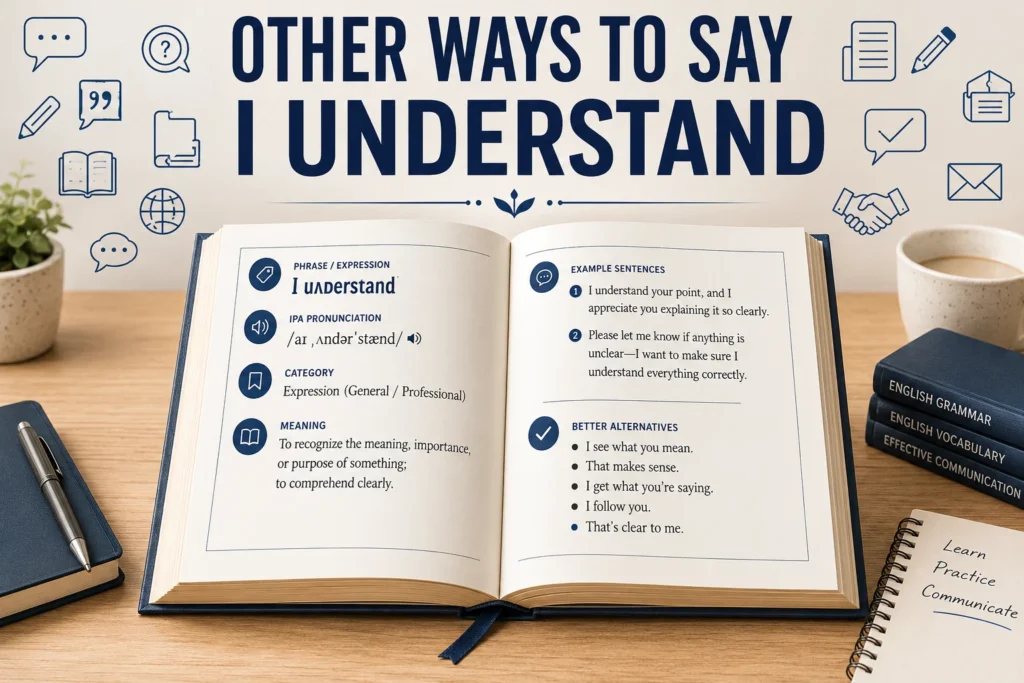
The phrase “I understand” means that you have successfully understood what another person has said, explained, or requested. It shows that you are listening, paying attention, and acknowledging their message.
Simple Definition
I understand = I know what you mean or I clearly understand your point.
Tone
- Professional
- Polite
- Respectful
- Supportive
- Neutral
Purpose
People use “I understand” to:
- Show they are listening.
- Confirm they understand instructions.
- Acknowledge someone’s feelings.
- Respond professionally in emails.
- Build trust during conversations.
Examples
- I understand your concern.
- I understand the deadline has changed.
- I understand what you’re saying.
- I understand why this issue is important.
Why Use an Alternative to “I Understand”?
Although “I understand” is correct, saying it repeatedly can make your communication feel repetitive or generic. Using different expressions helps you sound more confident, empathetic, and professional.
Benefits
- Avoids repetition
- Improves professional communication
- Makes emails sound more natural
- Shows empathy and active listening
- Matches different levels of formality
- Creates stronger client relationships
Professional Usage of “I Understand”
Emails
Business emails often require acknowledging information politely.
Example:
I understand your request and will provide an update by tomorrow.
Workplace Communication
Managers and employees frequently use the phrase during meetings and project discussions.
Example:
I understand the new priorities and will adjust my schedule accordingly.
Client Communication
Clients appreciate responses that show their concerns have been heard.
Example:
I understand your concerns regarding the project timeline.
Networking
Showing understanding helps build positive professional relationships.
Example:
I understand your goals and believe we can work together successfully.
Customer Service
Support teams often reassure customers by acknowledging their concerns.
Example:
I understand how frustrating this situation must be, and I’ll do my best to help.
Professional Alternatives to “I Understand”
These alternatives work well in business emails, meetings, presentations, and workplace communication.
1. I Understand Your Point
Meaning: You recognize the person’s opinion.
Tone: Professional
Best Use: Meetings
Example:
I understand your point, and I agree with your recommendation.
2. I See What You Mean
Meaning: You understand another person’s explanation.
Tone: Professional and friendly
Best Use: Discussions
Example:
I see what you mean about the budget limitations.
3. I Appreciate Your Explanation
Meaning: You value the clarification.
Tone: Professional
Best Use: Client communication
Example:
I appreciate your explanation and will review the details.
4. That Makes Sense
Meaning: The explanation is logical.
Tone: Friendly professional
Best Use: Workplace conversations
Example:
That makes sense. Let’s move forward with your suggestion.
5. I Follow
Meaning: You understand the discussion.
Tone: Neutral
Best Use: Meetings
Example:
I follow your reasoning completely.
6. I Acknowledge Your Concern
Meaning: You recognize someone’s issue.
Tone: Professional
Best Use: Customer service
Example:
I acknowledge your concern and will investigate immediately.
7. I Hear What You’re Saying
Meaning: You are actively listening.
Tone: Professional and empathetic
Best Use: Difficult conversations
Example:
I hear what you’re saying, and your feedback is valuable.
8. I Recognize the Situation
Meaning: You understand the circumstances.
Tone: Formal
Best Use: Business communication
Example:
I recognize the situation and appreciate your patience.
9. I Completely Understand
Meaning: You fully understand.
Tone: Professional
Best Use: Client emails
Example:
I completely understand your concerns.
10. I Understand Completely
Meaning: Full understanding.
Tone: Professional
Best Use: Formal replies
Example:
I understand completely and will address the issue today.
11. I Understand Your Perspective
Meaning: You appreciate someone’s viewpoint.
Tone: Professional
Best Use: Workplace discussions
Example:
I understand your perspective, even though we have different ideas.
12. I Appreciate Your Point of View
Meaning: You value someone’s opinion.
Tone: Professional
Best Use: Meetings
Example:
I appreciate your point of view and will consider it carefully.
13. Your Point Is Clear
Meaning: The message has been understood.
Tone: Professional
Best Use: Formal discussions
Example:
Your point is clear, and we’ll include it in our planning.
14. I Have a Clear Understanding
Meaning: You fully understand the information.
Tone: Formal
Best Use: Reports and meetings
Example:
I have a clear understanding of the project’s requirements.
15. I Appreciate the Clarification
Meaning: Thank you for explaining.
Tone: Professional
Best Use: Emails
Example:
I appreciate the clarification and will update the document.
Formal Alternatives to “I Understand”
These expressions are best for official emails, reports, proposals, and client communication.
1. I Acknowledge Your Statement
Tone: Formal
Example:
I acknowledge your statement and will review the information carefully.
2. I Comprehend the Situation
Tone: Very Formal
Example:
I comprehend the situation and appreciate your detailed explanation.
3. I Recognize Your Concerns
Tone: Formal
Example:
I recognize your concerns and will work toward a solution.
4. I Appreciate Your Feedback
Tone: Professional
Example:
I appreciate your feedback and value your suggestions.
5. I Have Taken Note
Tone: Formal
Example:
I have taken note of your comments.
6. Your Message Is Understood
Tone: Formal
Example:
Your message is understood, and we’ll proceed accordingly.
7. I Have Noted Your Concerns
Tone: Professional
Example:
I have noted your concerns and will discuss them with the team.
8. I Accept Your Explanation
Tone: Formal
Example:
I accept your explanation and appreciate your honesty.
9. I Am Aware
Tone: Professional
Example:
I am aware of the recent policy changes.
10. I Have Reviewed the Information
Tone: Professional
Example:
I have reviewed the information and understand the next steps.
Quick Comparison Table
| Alternative | Tone | Best Use |
| I see what you mean | Friendly Professional | Meetings |
| I understand your point | Professional | Discussions |
| I appreciate your explanation | Professional | Client emails |
| That makes sense | Friendly | Conversations |
| I hear what you’re saying | Empathetic | Conflict resolution |
| I acknowledge your concern | Professional | Customer service |
| I appreciate your feedback | Professional | Workplace |
| I have taken note | Formal | Official emails |
| I recognize your concerns | Formal | Client communication |
| I have reviewed the information | Professional | Business emails |
| I understand your perspective | Professional | Team meetings |
| I appreciate the clarification | Professional | Email replies |
| I follow | Neutral | Presentations |
| Your point is clear | Professional | Formal discussions |
| I have a clear understanding | Formal | Reports |
Friendly Alternatives to “I Understand”
These alternatives are perfect for casual conversations, team chats, and friendly workplace communication.
1. I Get It
Meaning: I understand what you’re saying.
Tone: Casual
Best Use: Conversations with colleagues or friends
Example: I get it. The new schedule is much easier to follow.
2. I See
Meaning: I understand the information.
Tone: Neutral
Best Use: Everyday conversations
Example: I see. Thanks for explaining that.
3. Got It
Meaning: I understand and will remember.
Tone: Friendly
Best Use: Quick replies
Example: Got it! I’ll finish the report this afternoon.
4. That Makes Perfect Sense
Meaning: The explanation is completely clear.
Tone: Friendly
Best Use: Team discussions
Example: That makes perfect sense. Let’s move forward with your idea.
5. I Can See Why
Meaning: You understand someone’s reason or feelings.
Tone: Empathetic
Best Use: Customer support or personal conversations
Example: I can see why you’re concerned about the delay.
6. I’m With You
Meaning: I understand and agree.
Tone: Friendly
Best Use: Team meetings
Example: I’m with you on improving customer service.
7. I Understand Where You’re Coming From
Meaning: You understand someone’s perspective.
Tone: Warm and empathetic
Best Use: Sensitive conversations
Example: I understand where you’re coming from, and I appreciate your honesty.
8. Fair Enough
Meaning: Your point is reasonable.
Tone: Casual
Best Use: Friendly discussions
Example: Fair enough. Let’s try your approach first.
9. I Know What You Mean
Meaning: You share the same understanding.
Tone: Friendly
Best Use: Everyday communication
Example: I know what you mean. That deadline is challenging.
10. Absolutely
Meaning: Complete understanding or agreement.
Tone: Positive
Best Use: Quick conversations
Example: Absolutely. I’ll take care of it today.
Email Alternatives
These phrases help your emails sound more professional and polished.
1. I Appreciate the Update
Example: I appreciate the update and will review the information.
2. Thank You for the Clarification
Example: Thank you for the clarification. Everything is clear now.
3. I Have Taken Note
Example: I have taken note of your request.
4. I Have Reviewed Your Message
Example: I have reviewed your message and understand the next steps.
5. I Appreciate Your Patience
Example: I appreciate your patience while we resolve the issue.
6. Thank You for Letting Me Know
Example: Thank you for letting me know about the schedule change.
7. I Will Keep That in Mind
Example: I’ll keep that in mind for future updates.
8. Your Instructions Are Clear
Example: Your instructions are clear, and I’ll begin immediately.
9. I Will Proceed Accordingly
Example: I understand the requirements and will proceed accordingly.
10. Thank You for Sharing
Example: Thank you for sharing your feedback with us.
Workplace Alternatives
These alternatives are suitable for meetings, presentations, project discussions, and professional communication.
1. I Understand the Requirements
2. I Have Reviewed the Details
3. I Acknowledge the Situation
4. I Appreciate the Feedback
5. I Understand the Objective
6. I Recognize the Challenge
7. I Understand the Priority
8. I Understand the Expectations
9. I See the Bigger Picture
10. I Agree with Your Assessment
Example:
I understand the expectations and will complete the project before Friday.
Email Examples
Client
I appreciate your explanation and understand your concerns. We’ll provide an update within 24 hours.
Manager
I understand the revised deadline and will adjust my schedule accordingly.
Colleague
Got it. I’ll complete my part before tomorrow’s meeting.
Customer
I understand your frustration, and I’m committed to resolving this issue as quickly as possible.
Networking
I appreciate your insights and understand your goals. I look forward to staying connected.
Meeting Follow-up
Thank you for today’s meeting. I understand the agreed action items and will begin working on them immediately.
Common Mistakes
1. Repeating “I Understand”
Using the same phrase several times in one conversation or email sounds repetitive.
❌ I understand… I understand… I understand…
✔ Mix alternatives such as I see what you mean, I appreciate the clarification, and That makes sense.
2. Using Casual Phrases in Formal Emails
Expressions like Got it or I get it are friendly but may not suit important client emails.
3. Sounding Robotic
Simply replying with I understand without adding context can feel impersonal.
✔ Better:
I understand your concern, and I’ll work on a solution immediately.
4. Ignoring Empathy
When someone shares a problem, acknowledge both the information and their feelings.
✔ I understand how frustrating this must be.
Related Phrases
| Phrase | Meaning | Example |
| I see what you mean | I understand your point | I see what you mean about the deadline. |
| I get it | I understand | I get it. Thanks for explaining. |
| Got it | Message received | Got it! I’ll handle it. |
| I follow | I understand the discussion | I follow your explanation. |
| That makes sense | It’s logical | That makes sense to me. |
| I hear you | I understand your feelings | I hear you, and I appreciate your honesty. |
| I acknowledge your concern | I recognize the issue | I acknowledge your concern and will help. |
| I appreciate the clarification | Thanks for explaining | I appreciate the clarification. |
| I recognize your point | I understand your opinion | I recognize your point completely. |
| I understand your perspective | I understand your viewpoint | I understand your perspective. |
| I have taken note | I recorded the information | I have taken note of your comments. |
| I appreciate your feedback | Thanks for your opinion | I appreciate your feedback. |
| I’m with you | I agree and understand | I’m with you on this idea. |
| Fair enough | That’s reasonable | Fair enough. Let’s do that. |
| Absolutely | Complete agreement | Absolutely. I understand. |
Phrase Comparison
| Phrase | Tone | Best Use |
| I understand | Neutral | General communication |
| I see what you mean | Friendly Professional | Meetings |
| I appreciate your explanation | Professional | Client emails |
| I hear you | Empathetic | Customer service |
| Got it | Casual | Team chats |
| That makes sense | Friendly | Conversations |
| I acknowledge your concern | Formal | Customer support |
| I have taken note | Formal | Business emails |
| I understand your perspective | Professional | Workplace discussions |
| I follow | Neutral | Presentations |
Cultural Usage
US English
American professionals commonly use I see what you mean, Got it, and That makes sense in workplace conversations. Formal emails often use I understand or I appreciate the clarification.
UK English
British English tends to prefer polite expressions such as I understand your position, I appreciate your explanation, and I see your point.
Corporate Communication
In business settings, phrases like I acknowledge your concern, I appreciate your feedback, and I understand the requirements create a professional and respectful tone.
Customer Service
Customer support representatives often use empathetic alternatives such as I understand your frustration, I hear your concern, and I appreciate your patience to reassure customers.
Networking
During networking conversations, phrases like I understand your goals, I appreciate your insights, and I see your perspective help build trust and strengthen professional relationships.
FAQs
What is another way to say “I understand” professionally?
Good professional alternatives include I see what you mean, I appreciate your explanation, I acknowledge your concern, and I understand your perspective.
Is “I understand” appropriate in business emails?
Yes. It is polite, professional, and commonly used in workplace communication.
What is the best formal alternative?
I acknowledge your concern and I have taken note are excellent formal choices.
Can I say “Got it” in an email?
Yes, but only in casual emails or internal team communication.
Which phrase sounds more empathetic?
I understand how you feel and I hear what you’re saying show empathy.
How can I avoid repeating “I understand”?
Use alternatives like That makes sense, I see your point, or I appreciate the clarification.
Which alternative is best for customer service?
I understand your concern and I appreciate your patience work very well.
Is “I get it” professional?
It is acceptable in informal workplace conversations but not ideal for formal business emails.
What’s the difference between “I understand” and “I see what you mean”?
I understand confirms comprehension, while I see what you mean sounds more conversational and acknowledges the speaker’s perspective.
10. Why should I use different alternatives?
Using a variety of expressions improves professional communication, avoids repetition, and helps you match the tone to your audience.
Conclusion
Using different ways to say “I understand” makes your communication clearer, warmer, and more professional. While the original phrase is always appropriate, choosing alternatives such as I see what you mean, I appreciate your explanation, I acknowledge your concern, or That makes sense allows you to match your tone to the situation. Whether you’re writing business emails, speaking with clients, supporting customers, or collaborating with colleagues, the right expression shows active listening and respect. Expanding your vocabulary will improve your workplace communication, strengthen relationships, and help you communicate with greater confidence and professionalism.