
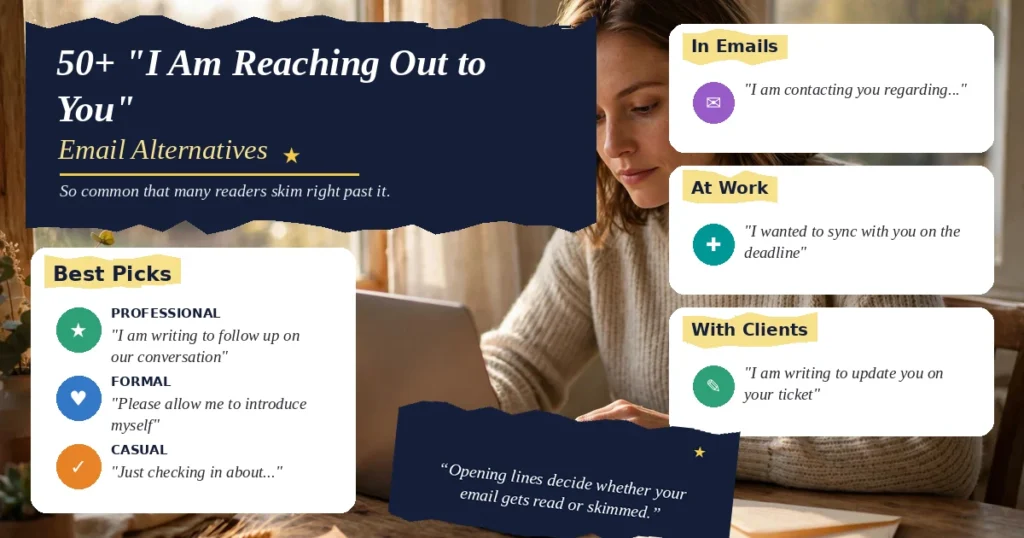
Finding the right other ways to say I am reaching out to you can make your emails sound sharper and more human. The phrase “I am reaching out to you” has become so common that many readers skim right past it. Worse, some hiring managers and executives see it as filler. This guide gives you 50 professional and polite alternatives with real examples for emails, meetings, and networking. You will learn what the phrase really means, when it works, when it hurts your message, and what to write instead. Whether you contact a client, a recruiter, or a colleague, you will find the right opening line here.
Most people look for a fresh way to say I am reaching out to you because their emails all start the same way. They worry the line sounds pushy, vague, or overused. Others need a warmer version for networking or a more formal one for official letters. This article covers all of it: the meaning of the phrase, email-ready templates, common mistakes, cultural differences, and answers to the questions people ask most. By the end, your opening lines will never sound copy-pasted again.
Meaning of I am reaching out to you
“I am reaching out to you” is a common business expression that means “I am contacting you.” People use it to start emails, calls, and messages when they want something: information, help, a meeting, or a connection. The tone is friendly and professional, though many readers now see it as a cliché. A simple example: “I am reaching out to you about the marketing role on your careers page.” The sentence tells the reader that contact is happening, but it does not say much else. Stronger alternatives state the purpose right away, which respects the reader’s time.
Emotionally, the phrase tries to sound warm and personal. It suggests effort, as if the writer stretched across a distance to connect. In practice, it often does the opposite: because everyone uses it, it feels impersonal. Use it sparingly, or replace it with a line that names your reason in the first sentence. A clear purpose beats a warm cliché every time.
Professional usage of I am reaching out to you
The phrase appears in many professional settings. Below are the most common ones, with guidance on stronger choices for each.
Business emails
Cold emails and follow-ups open with this line most often. Replace it with your purpose: “I am writing to follow up on our conversation” tells the reader more in the same space.
Workplace communication
Colleagues use it in chat messages and emails to request help. A direct line like “I wanted to sync with you on the deadline” works better because it names the topic.
Client outreach
Sales and account teams use it to start conversations with clients. Clients respond faster to specific openings like “I am contacting you regarding your renewal” than to a generic reach-out.
Networking
Job seekers and professionals use it on LinkedIn and in intro emails. A personal touch works best here: “I wanted to connect with you about your work in fintech” shows real interest.
Customer service
Support teams sometimes use it in proactive messages. Clearer options like “I am writing to update you on your ticket” tell the customer exactly why you wrote.
50 alternatives to I am reaching out to you
These 50 options cover every tone you might need. Pick the group that matches your audience, then choose the line that states your purpose most clearly.
Professional alternatives
- I am writing to you today about… Clear and direct. Best for first-contact emails. Example: “I am writing to you today about the partnership opportunity we discussed.”
- I am contacting you regarding… Professional and specific. Best for formal requests. Example: “I am contacting you regarding invoice #4521.”
- I wanted to connect with you about… Warm and professional. Best for networking. Example: “I wanted to connect with you about your recent article on SEO.”
- I am getting in touch to discuss… Natural business tone. Best for scheduling conversations. Example: “I am getting in touch to discuss the Q4 campaign.”
- I am writing to introduce myself. Classic and polite. Best for first introductions. Example: “I am writing to introduce myself. I am the new account manager for your region.”
- I am contacting you on behalf of… Shows you represent someone. Best for referrals and agencies. Example: “I am contacting you on behalf of Dr. Lee, who suggested we speak.”
- I wanted to reach out regarding… A softer version of the original. Best when you want a gentle tone. Example: “I wanted to reach out regarding the feedback you shared.”
- I am writing with regard to… Formal and precise. Best for official matters. Example: “I am writing with regard to your application dated March 3.”
- I am touching base about… Light and conversational. Best for ongoing relationships. Example: “I am touching base about the delivery schedule.”
- I wanted to follow up on… Perfect for second messages. Best for follow-up emails. Example: “I wanted to follow up on the proposal I sent last week.”
- I am writing to explore an opportunity with you. Honest and direct. Best for sales and partnerships. Example: “I am writing to explore an opportunity with you in the healthcare space.”
- I am contacting you with a question about… States the need upfront. Best for information requests. Example: “I am contacting you with a question about the new pricing plan.”
Formal alternatives
- I am writing to bring this to your attention. Serious and formal. Best for complaints and escalations. Example: “I am writing to bring this to your attention before the audit.”
- Please allow me to introduce myself. Very polite. Best for first letters to senior people. Example: “Please allow me to introduce myself. I lead the research team at DataCorp.”
- I am writing in connection with… Traditional formal style. Best for legal and HR letters. Example: “I am writing in connection with the position of office manager.”
- I take this opportunity to write to you. Ceremonial. Best for official announcements. Example: “I take this opportunity to write to you about the upcoming merger.”
- I am addressing this message to you regarding… Precise and official. Best for formal notices. Example: “I am addressing this message to you regarding the contract renewal.”
- I wish to bring to your notice… Formal, common in South Asian business English. Best for official memos. Example: “I wish to bring to your notice the delay in shipment.”
- I am writing to formally request… Leaves no doubt about intent. Best for official requests. Example: “I am writing to formally request a meeting with the board.”
- Allow me to introduce myself and my purpose. Combines greeting and reason. Best for cold outreach to executives. Example: “Allow me to introduce myself and my purpose: I help teams cut reporting time in half.”
- I am writing pursuant to… Legal-style formal. Best for compliance and contracts. Example: “I am writing pursuant to clause 7 of our agreement.”
- I respectfully write to inform you… Courteous and serious. Best for sensitive news. Example: “I respectfully write to inform you of the change in leadership.”
Friendly alternatives
- Just wanted to say hello and connect. Warm opener. Best for LinkedIn messages. Example: “Just wanted to say hello and connect. I enjoyed your talk at the summit.”
- Thought I would drop you a line about… Casual and charming. Best for light business notes. Example: “Thought I would drop you a line about the webinar next month.”
- Just checking in about… Relaxed follow-up. Best for gentle nudges. Example: “Just checking in about the draft. No rush at all.”
- Wanted to chat with you about… Conversational. Best for informal workplaces. Example: “Wanted to chat with you about the new rota. Do you have five minutes?”
- Quick note to say hi — I wanted to talk about… Friendly and honest. Best for first messages with warmth. Example: “Quick note to say hi — I wanted to talk about the volunteer project.”
- Hope you are well — I wanted to connect on… Polite and personal. Best for reconnecting. Example: “Hope you are well — I wanted to connect on the alumni event.”
- Just dropping by to ask about… Very casual. Best for chat apps. Example: “Just dropping by to ask about the login issue.”
- Wanted to pop in and say hello. Light and brief. Best for social-style messages. Example: “Wanted to pop in and say hello. Loved your latest post.”
- Just a quick hello from me. Simple and human. Best for informal introductions. Example: “Just a quick hello from me. I am new to the marketing team.”
Email alternatives
- I am writing to follow up on our conversation. References shared history. Best for post-meeting emails. Example: “I am writing to follow up on our conversation about the rebrand.”
- I am circling back on… Modern business phrase. Best for reminders. Example: “I am circling back on the budget approval. Any updates?”
- I am writing to share some information with you. Clear purpose. Best for FYI emails. Example: “I am writing to share some information with you about the new policy.”
- I am following up regarding… Direct and professional. Best for pending items. Example: “I am following up regarding the signed contract.”
- I am writing to let you know about… Good for announcements. Best for updates. Example: “I am writing to let you know about the office move in June.”
- I am writing to check whether… Polite question opener. Best for confirmations. Example: “I am writing to check whether you received my last email.”
- I am sending this email to… Simple and transparent. Best for action requests. Example: “I am sending this email to request your approval on the design.”
- I am writing to confirm… Short and purposeful. Best for confirmations. Example: “I am writing to confirm our call on Thursday at 2 p.m.”
- I am writing to request your feedback on… Shows respect for opinion. Best for reviews. Example: “I am writing to request your feedback on the draft proposal.”
- I am writing to schedule… Action-oriented. Best for booking meetings. Example: “I am writing to schedule a demo of our new tool.”
Workplace alternatives
- I wanted to loop you in on… Team-friendly. Best for group updates. Example: “I wanted to loop you in on the client feedback from today.”
- I am connecting with you to align on… Shows teamwork. Best for cross-team work. Example: “I am connecting with you to align on the launch dates.”
- I wanted to bring you into the conversation about… Inclusive. Best for inviting input. Example: “I wanted to bring you into the conversation about the new hire.”
- I wanted to get your thoughts on… Flattering and direct. Best for asking opinions. Example: “I wanted to get your thoughts on the homepage redesign.”
- I am pinging you about… Casual and quick. Best for chat messages. Example: “I am pinging you about the server restart tonight.”
- I wanted to sync with you on… Modern workplace phrase. Best for coordination. Example: “I wanted to sync with you on the sprint goals.”
- I am writing to coordinate with you on… Professional teamwork line. Best for joint tasks. Example: “I am writing to coordinate with you on the event logistics.”
- I wanted to check in with you regarding… Gentle and polite. Best for status checks. Example: “I wanted to check in with you regarding the report deadline.”
- I am writing to keep you posted on… Promises updates. Best for ongoing projects. Example: “I am writing to keep you posted on the hiring progress.”
Quick comparison table
Here are the top ten picks at a glance. Choose the line that states your purpose most clearly.
| Alternative | Tone | Best use |
|---|---|---|
| I am writing to follow up on our conversation | Professional | Post-meeting emails |
| I wanted to connect with you about… | Warm professional | Networking |
| I am contacting you regarding… | Professional | Formal requests |
| I am writing to introduce myself | Polite | First introductions |
| Please allow me to introduce myself | Formal | Senior contacts |
| I wanted to follow up on… | Professional | Second messages |
| Just wanted to say hello and connect | Friendly | LinkedIn messages |
| I am writing to request your feedback on… | Professional | Reviews and drafts |
| I wanted to get your thoughts on… | Collaborative | Asking opinions |
| I am writing to schedule… | Direct | Booking meetings |
Email examples
Copy and adapt these short templates. Each one opens with an alternative in a real setting.
Client email
Subject: Your account renewal
Hi Daniel,
I am contacting you regarding your account renewal next month. I have attached the updated plan with the new pricing. Please let me know if you would like to discuss the options.
Best regards,
Emma
Manager email
Subject: Request for feedback
Hi Mr. Thompson,
I am writing to request your feedback on the draft proposal. I have highlighted the sections where your input matters most. Could you review it by Wednesday?
Thank you,
Olivia
Colleague email
Subject: Sprint planning
Hi Jake,
I wanted to sync with you on the sprint goals. I think we should move the testing phase earlier. Are you free for a quick call this afternoon?
Thanks,
Sophie
Customer email
Subject: Update on your order
Hi Michael,
I am writing to let you know about a short delay with your order. The new delivery date is Friday. I apologize for the inconvenience and appreciate your patience.
Kind regards,
Customer Care Team
Networking email
Subject: Inspired by your talk
Hi Dr. Patel,
I wanted to connect with you about your recent talk on sustainable design. Your point about material waste changed how I approach my own projects. Would you be open to a 15-minute call next week?
Warm regards,
Nina
Meeting follow-up email
Subject: Following up on yesterday’s meeting
Hi team,
I am writing to follow up on our conversation about the product launch. I have attached the action list we agreed on. Please confirm your tasks by end of day.
Thanks,
Chris
Common mistakes to avoid
1. Opening every email with the same line
Starting ten emails a day with “I am reaching out to you” trains readers to ignore your first sentence. Vary your openers so each message feels intentional.
2. Hiding your purpose
The original phrase says you are contacting someone but not why. Always name your reason in the first two sentences, or busy readers will stop reading.
3. Using a casual opener in a formal letter
“Just dropping by to ask about…” sounds wrong in a letter to a government office. Match the formality to the reader and the channel.
4. Using a stiff opener with a friendly contact
“I am writing pursuant to…” will confuse a colleague you chat with daily. Save legal-style lines for contracts and compliance.
5. Writing a long opener before the point
Some writers stack three polite lines before saying anything real. Cut the throat-clearing. One strong opening sentence, then your point.
Related phrases
- Get in touch. To contact someone. Example: “Please get in touch if you have questions.”
- Contact. The plain verb for reaching someone. Example: “Contact me at this number after 5 p.m.”
- Follow up. To contact again about something earlier. Example: “I will follow up with you on Friday.”
- Check in. To make brief contact. Example: “I wanted to check in and see how the move went.”
- Drop a line. To send a short message. Example: “Drop me a line when you arrive.”
- Touch base. To make quick contact. Example: “Let’s touch base after the meeting.”
- Reach out. To make contact, often for help. Example: “Feel free to reach out anytime.”
- Circle back. To return to a topic later. Example: “I will circle back with the final numbers.”
- Ping. To send a quick digital message. Example: “Ping me when the file is ready.”
- Loop in. To include someone in a conversation. Example: “Let me loop in our designer.”
- Connect. To establish contact, often professionally. Example: “I’d love to connect over coffee.”
- Send word. To pass along a message. Example: “Send word when the shipment leaves.”
- Write to. To contact by letter or email. Example: “Write to us at the address below.”
- Call on. To visit or appeal to someone. Example: “We will call on local businesses for support.”
- Get back to. To reply to someone. Example: “I will get back to you by tomorrow.”
- Keep someone posted. To update regularly. Example: “I will keep you posted on the results.”
I am reaching out to you vs top alternatives
The original phrase is the most recognized opener in business English. Everyone understands it instantly. Its weakness is familiarity: recruiters and executives see it hundreds of times a week, so it blends into the background.
“I am writing to follow up on our conversation” beats it whenever you have history with the reader. It proves the email is personal, not a mass message. Use it after any meeting, call, or earlier email.
“I wanted to connect with you about…” keeps the warmth of the original but adds a topic. It works best for networking, where showing genuine interest matters more than sounding formal.
“I am contacting you regarding…” is the most professional of the four. It sounds serious and specific. Use it for official requests, complaints, and first contact with people you do not know.
The rule is simple: keep the original only for casual notes to people who know you. Everywhere else, pick the alternative that names your purpose in the first line.
Cultural usage
US English
Americans use “reaching out” constantly, but many now find it tired. Direct openers like “I am writing to follow up on…” perform better. Casual lines like “Just checking in” are normal in US workplaces.
UK English
British professionals prefer slightly more formal openers. “I am writing with regard to…” and “I am writing in connection with…” still appear often. “Just popping in” style lines are fine among colleagues.
Corporate communication
In large companies, vague openers slow everything down. State your purpose in the subject line and the first sentence. Busy teams reward clarity over politeness.
Customer service
Support teams should never open with a vague reach-out. “I am writing to update you on your ticket” tells the customer exactly why you wrote and reduces anxiety.
Networking
On LinkedIn, generic openers get ignored. Mention something specific about the person: their post, their talk, their company. Specificity is the difference between a reply and silence.
Frequently asked questions
What does “I am reaching out to you” mean?
It means “I am contacting you.” People use it to open emails, messages, and calls when they want information, help, or a connection. It is friendly but vague, which is why many professionals now replace it with a more specific opener.
Is “I am reaching out to you” professional?
It is acceptable but overused. Most workplaces tolerate it, but many hiring managers and executives see it as filler. A specific line like “I am writing to follow up on our conversation” sounds more professional and gets better responses.
What is a professional way to say “I am reaching out to you”?
Try “I am writing to you today about…” or “I am contacting you regarding…” Both sound professional and let you state your purpose immediately. For follow-ups, “I wanted to follow up on…” is the strongest choice.
How do I start a cold email without saying “I am reaching out”?
Lead with your reason or a personal detail. For example: “I read your article on supply chains and had a question.” Or: “I am writing to introduce myself. I help small teams automate reporting.” Specific beats generic every time.
What is a formal alternative to “I am reaching out to you”?
“Please allow me to introduce myself” and “I am writing in connection with…” are strong formal options. “I am writing to formally request…” works for official requests. Save these for executives, officials, and legal contexts.
What is a casual way to say “I am reaching out to you”?
Try “Just checking in about…” or “Thought I would drop you a line about…” Both sound natural in friendly workplaces. Keep them for colleagues and contacts you already know.
Is “reaching out” too informal for business emails?
It is not too informal; it is too common. The phrase itself is fine in most workplaces, but its overuse makes it invisible. If you want your email noticed, replace it with a line that names your purpose.
How do I say “I am reaching out” on LinkedIn?
Be personal and specific. Try: “I wanted to connect with you about your work in fintech.” Mention their post, talk, or company. Generic LinkedIn openers get ignored; specific ones get replies.
What can I say instead of “reaching out” in a follow-up email?
Use “I wanted to follow up on…” or “I am circling back on…” Both signal that this is a second message about an earlier topic. Add the topic right away so the reader remembers the context.
Is “I am reaching out to you” grammatically correct?
Yes, it is grammatically correct. “Reach out to” is a standard phrasal verb meaning to contact someone. The grammar is fine; the issue is style. It is overused, not incorrect.
Do British professionals say “reaching out”?
Less often than Americans. British business English favors “I am writing with regard to…” or “I am getting in touch to discuss…” “Reaching out” is understood everywhere but sounds distinctly American to many UK readers.
What is the difference between “reaching out” and “following up”?
“Reaching out” usually starts a new contact. “Following up” continues an earlier one. If you have emailed before, “following up” is more accurate and sounds more purposeful.
How do I open an email to a recruiter?
State the role and your fit immediately. For example: “I am writing to you today about the content strategist role. My SEO work grew organic traffic 40% last year.” Recruiters skim fast, so put the key facts first.
Should I say “I hope this email finds you well” instead?
That line is also overused, and many readers skip it. If you want warmth, use one short friendly sentence, then get to the point. Better: “Hope you are well — I wanted to connect on the alumni event.”
What is the best opening line for a sales email?
The best openers name a specific benefit or observation. For example: “I am writing to explore an opportunity with you in the healthcare space.” Or reference their company: “I noticed your team just opened a Berlin office — congratulations.” Relevance beats polish.
Conclusion
Quick picks — Professional: “I am writing to follow up on our conversation” and “I am contacting you regarding…” Formal: “Please allow me to introduce myself” and “I am writing in connection with…” Friendly-casual: “Just checking in about…” and “Thought I would drop you a line about…” Email: “I am circling back on…” and “I am following up regarding…”
Your opening line decides whether the email gets read or skimmed. Name your purpose in the first sentence and cut the throat-clearing. Match the opener to the reader — direct for busy executives, warm for new contacts. One strong, specific line beats a paragraph of polite fog every time.
Related Articles
- Other Ways to Say Please Advise: Professional & Polite Alternatives in 2026
- Other Ways to Say “Please Find Attached”: Professional & Polite Alternatives in 2026
- Other Ways to Say As Soon As Possible Professional & Polite Alternatives
- 50+ “I Need Your Help” Alternatives That Sound Confident
- 55+ “Please Be Patient” Alternatives That Sound Polite
- Other Ways to Say “Let Me Know What You Think”: Professional & Polite Alternatives in 2026
- 50+ “Thank You for the Clarification” Alternatives




