
Introduction
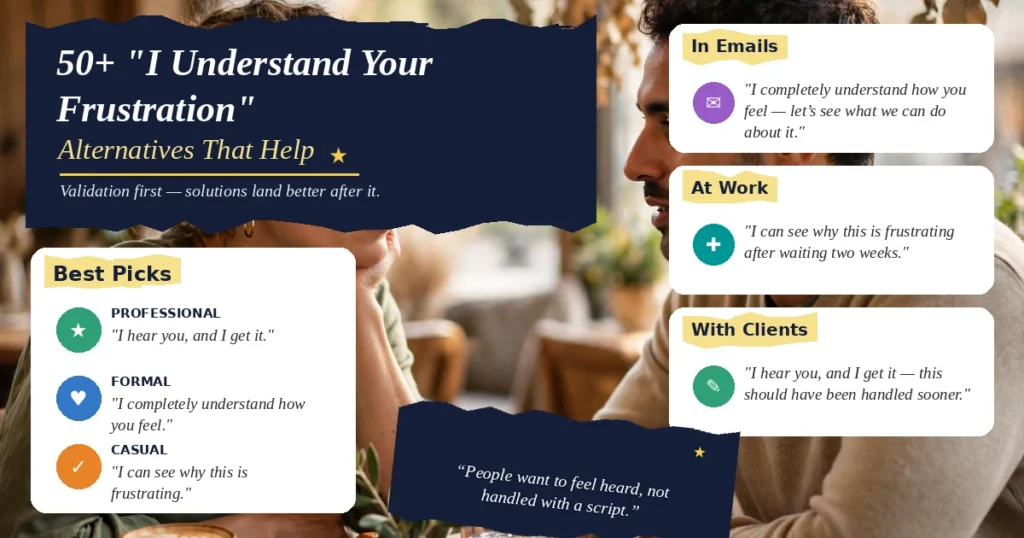
“I understand your frustration” is one of the most common empathy phrases in customer service, workplace emails, and everyday conversation. If you are searching for other ways to say “I understand your frustration,” you already know the problem: the phrase can sound flat, rehearsed, or even dismissive when it is used too often. People want to feel genuinely heard, not handled with a script.
The good news is that small wording changes make a big difference. A professional way to say “I understand your frustration” might acknowledge the specific situation, while a friendly alternative works better with a close friend or family member. The right phrase depends on who you are talking to and where the conversation is happening.
This guide gives you 55 alternatives grouped by tone and setting: professional, formal, friendly, email-ready, and workplace options. You will also find email examples, a quick comparison table, common mistakes to avoid, and answers to the questions people ask most. By the end, you will know exactly which phrase fits your situation — and how to use it so it sounds sincere every time.
Meaning
“I understand your frustration” means you recognize that someone is upset because their expectations were not met, and you accept their feelings as valid without arguing or dismissing them. It is an empathy statement used to calm tense conversations in customer service, management, and personal relationships.
Literally, the phrase says three things at once: I hear what happened, I see why it upset you, and I am not going to argue with your feelings. The tone is meant to be calming and supportive. Its purpose is to lower tension so the conversation can move toward a solution instead of staying stuck on the problem.
The emotional context matters a lot. People usually hear this phrase after something went wrong — a delayed order, a missed deadline, a broken promise, or a moment when they had to ask for help and did not get it. In those moments, they are not looking for perfect words. They are looking for proof that the other person actually gets it. That is why the phrase works best when it is followed by action, not silence.
It also sits close to simpler empathy phrases. Saying I understand acknowledges the facts of a situation, while “I understand your frustration” goes one step further and acknowledges the emotion. That extra step is what makes it powerful — and what makes it risky when it sounds insincere.
Professional usage
In emails
In professional emails, the phrase works as a bridge between the problem and the solution. Place it early in your message, right after you acknowledge what went wrong, and follow it with a clear next step. This order — empathy first, action second — keeps the tone respectful without sounding passive.
In the workplace
Managers and team leads use this phrase to defuse tension with employees. It signals that you take the concern seriously before discussing fixes or policy. Used well, it builds trust; used as a habit, it starts to sound like a way of avoiding real answers.
With clients
With clients, the phrase shows accountability. Clients who hear genuine empathy are more likely to stay calm and give you a chance to fix the issue. The key is specificity — “I understand your frustration with the delayed shipment” lands better than the generic version.
In networking
In networking conversations, frustration comes up when people share career setbacks or business challenges. Here the phrase works as a rapport builder. Keep it brief and warm, then ask a follow-up question that shows real interest.
In customer service
Customer service is where this phrase lives most. Support agents use it to validate upset customers before troubleshooting. Pairing empathy with appreciation works well here — for example, telling a customer that we value your feedback right after acknowledging their frustration turns a complaint into a conversation.
Alternatives
Professional alternatives
I completely understand how you feel. Warm and sincere; best for one-on-one conversations where trust matters. Example: “I completely understand how you feel — let’s see what we can do about it.”
I can see why this is frustrating. Direct and observant; works when you want to show you followed the details. Example: “I can see why this is frustrating after waiting two weeks.”
I hear you, and I get it. Conversational but professional; good for calls and video meetings. Example: “I hear you, and I get it — this should have been handled sooner.”
That sounds really frustrating. Simple and human; ideal when you want to sound natural, not corporate. Example: “That sounds really frustrating. Walk me through what happened.”
I understand where you’re coming from. Balanced and respectful; suits disagreements and negotiations. Example: “I understand where you’re coming from, and your timeline concerns are fair.”
I can imagine how difficult this must be. Thoughtful and gentle; best when the situation is genuinely hard. Example: “I can imagine how difficult this must be with the deadline moved up.”
Your frustration is completely valid. Affirming and strong; good when someone fears they are overreacting. Example: “Your frustration is completely valid — anyone would feel this way.”
I see exactly what you mean. Confident and clear; works in problem-solving discussions. Example: “I see exactly what you mean about the confusing instructions.”
That makes complete sense. Short and validating; ideal for quick acknowledgments. Example: “That makes complete sense given what you’ve been through this week.”
I recognize how challenging this has been. Formal-leaning and respectful; suits managers addressing teams. Example: “I recognize how challenging this quarter has been for everyone.”
I appreciate you sharing this with me. Grateful and open; encourages honest feedback. Example: “I appreciate you sharing this with me — it helps me fix the real issue.”
I can tell this has been a difficult experience. Observant and caring; good for sensitive topics. Example: “I can tell this has been a difficult experience, and I’m sorry.”
You’re right to feel this way. Bold and validating; use when the complaint is clearly justified. Example: “You’re right to feel this way — the error was on our side.”
I understand how important this is to you. Personal and attentive; shows you grasp the stakes. Example: “I understand how important this launch is to you.”
That would frustrate me too. Honest and relatable; builds instant connection. Example: “That would frustrate me too — let’s get it sorted today.”
Formal alternatives
I sincerely understand your frustration. Earnest and polished; best for formal letters and official replies. Example: “I sincerely understand your frustration regarding the billing error.”
I fully appreciate the difficulty of this situation. Diplomatic and measured; suits executive communication. Example: “I fully appreciate the difficulty of this situation for your team.”
I acknowledge how frustrating this must be. Respectful and composed; good for written complaints. Example: “I acknowledge how frustrating this delay must be for you.”
Your concerns are entirely understandable. Reassuring and formal; ideal for de-escalation. Example: “Your concerns are entirely understandable, and we are addressing them.”
I recognize the inconvenience this has caused. Accountable and professional; pairs well with an apology. Example: “I recognize the inconvenience this has caused your department.”
I deeply empathize with your position. Serious and compassionate; use for high-stakes matters. Example: “I deeply empathize with your position on this contract issue.”
Please know that I take your frustration seriously. Committed and formal; good when trust is damaged. Example: “Please know that I take your frustration seriously.”
I understand the gravity of this matter. Weighty and sincere; suits serious complaints. Example: “I understand the gravity of this matter and am escalating it now.”
Your frustration is duly noted and understood. Official and precise; best for documented correspondence. Example: “Your frustration is duly noted and understood by our team.”
I respect how trying this experience has been. Dignified and kind; works in sensitive formal contexts. Example: “I respect how trying this experience has been for your family.”
Friendly alternatives
I totally get it. Casual and warm; perfect for friends and close colleagues. Example: “I totally get it — waiting in that line was awful.”
Ugh, that’s the worst. Sympathetic and informal; best for peer-to-peer chats. Example: “Ugh, that’s the worst. Did they ever call you back?”
I feel you on this one. Relaxed and supportive; good for everyday venting. Example: “I feel you on this one — Mondays are brutal.”
That really stinks. Light and empathetic; suits casual conversation. Example: “That really stinks. Want me to help you sort it out?”
I’d be frustrated too. Honest and normalizing; removes any shame. Example: “I’d be frustrated too if my flight got cancelled twice.”
No wonder you’re upset. Validating and natural; good when the cause is obvious. Example: “No wonder you’re upset — that’s completely unfair.”
That’s so annoying. Simple and relatable; works for minor everyday frustrations. Example: “That’s so annoying. Technology never cooperates when it matters.”
I get why you’re fed up. Direct and understanding; suits repeated problems. Example: “I get why you’re fed up — this keeps happening.”
Man, that’s rough. Informal and caring; best with people you know well. Example: “Man, that’s rough. Let me know if you need anything.”
I know exactly how that feels. Personal and connecting; use when you truly relate. Example: “I know exactly how that feels — the same thing happened to me.”
Email alternatives
I understand your frustration, and I’m here to help resolve this. Action-oriented; best for support emails. Example: “I understand your frustration, and I’m here to help resolve this today.”
I completely understand — let’s find a solution together. Collaborative; good for client emails. Example: “I completely understand — let’s find a solution together this week.”
I hear your frustration, and I take it seriously. Firm and caring; suits complaint responses. Example: “I hear your frustration, and I take it seriously.”
Thank you for your patience; I understand how frustrating this delay has been. Grateful and empathetic; ideal after long waits. Example: “Thank you for your patience; I understand how frustrating this delay has been.”
I understand your frustration and apologize for the inconvenience. Accountable; best when the fault is yours. Example: “I understand your frustration and apologize for the inconvenience caused.”
Your frustration is understandable, and I’m looking into this right away. Reassuring; good for first replies. Example: “Your frustration is understandable, and I’m looking into this right away.”
I can see why this situation is frustrating, and I want to make it right. Committed; suits service recovery emails. Example: “I can see why this situation is frustrating, and I want to make it right.”
I understand how you feel, and I’ll personally follow up on this. Personal and responsible; builds confidence. Example: “I understand how you feel, and I’ll personally follow up on this tomorrow.”
Please accept my understanding of how frustrating this must be. Formal and courteous; good for official apologies. Example: “Please accept my understanding of how frustrating this must be for you.”
I get it — and I’m committed to fixing this for you. Direct and determined; works when brevity matters. Example: “I get it — and I’m committed to fixing this for you by Friday.”
Workplace alternatives
I understand your frustration — let’s talk through it. Open and inviting; good for one-on-ones. Example: “I understand your frustration — let’s talk through it after lunch.”
I can see this has been tough on the team. Observant and collective; suits team meetings. Example: “I can see this has been tough on the team lately.”
I hear you; this workload isn’t fair. Honest and direct; use when the complaint is legitimate. Example: “I hear you; this workload isn’t fair, and I’m adjusting it.”
Your frustration makes sense given the circumstances. Rational and validating; good for performance discussions. Example: “Your frustration makes sense given the circumstances.”
I understand the pressure you’re under. Empathetic and aware; suits high-stress periods. Example: “I understand the pressure you’re under with these deadlines.”
That deadline was unreasonable — I get it. Candid and supportive; builds manager trust. Example: “That deadline was unreasonable — I get it.”
I can see why the changes upset you. Specific and thoughtful; good after reorganizations. Example: “I can see why the changes upset you.”
I understand your frustration, and I value your honesty. Appreciative; encourages people to speak up. Example: “I understand your frustration, and I value your honesty.”
Let’s figure this out together — I understand where you’re coming from. Collaborative; ideal for conflict resolution. Example: “Let’s figure this out together — I understand where you’re coming from.”
I recognize this isn’t what you signed up for. Honest and human; good when roles shift unexpectedly. Example: “I recognize this isn’t what you signed up for.”
A quick note on email phrasing: many of these work even better when you add one specific detail, or when you follow up by thanking them for the clarification they provided. Specifics turn a generic empathy line into proof that you were actually listening.
Quick comparison table
| Alternative | Tone | Best use |
|---|---|---|
| I completely understand how you feel | Warm, sincere | One-on-one conversations |
| I can see why this is frustrating | Direct, observant | When details matter |
| Your frustration is completely valid | Affirming, strong | When someone fears overreacting |
| I sincerely understand your frustration | Earnest, polished | Formal letters |
| I acknowledge how frustrating this must be | Respectful, composed | Written complaints |
| I totally get it | Casual, warm | Friends and peers |
| I’d be frustrated too | Honest, normalizing | Everyday venting |
| I understand your frustration, and I’m here to help | Action-oriented | Support emails |
| I hear you; this workload isn’t fair | Honest, direct | Legitimate workplace complaints |
| Let’s figure this out together | Collaborative | Conflict resolution |
Email examples
Client email
Subject: Re: Delayed delivery
Hi Sarah,
I completely understand your frustration — the shipment should have arrived last Tuesday. I have spoken with our logistics partner, and your order is now scheduled for Thursday morning. I will send you the tracking details as soon as they are confirmed.
Best regards,
Daniel
Manager email
Subject: Re: Workload concerns
Hi James,
I hear you; this workload isn’t fair, and I take your concern seriously. Let’s meet tomorrow morning to redistribute the urgent tasks. Your frustration is completely valid, and I want to fix the balance this week.
Thanks,
Priya
Colleague email
Subject: Re: Meeting rescheduled again
Hi Alex,
I can see why this is frustrating — the third reschedule is a lot. I have blocked two backup slots on Thursday so we can lock this in. Let me know which one works for you.
Cheers,
Maria
Customer support email
Subject: Re: Account access issue [#4821]
Hello,
I understand your frustration, and I’m here to help resolve this today. I have reset your access on our end — please try logging in again. If the problem continues, reply to this email and I will escalate it personally.
Thank you,
Support Team
Networking email
Subject: Great meeting you yesterday
Hi Tom,
It was good talking with you about the challenges of scaling a small team. I can imagine how difficult this phase must be. If it helps, I went through something similar last year — happy to share what worked for us over coffee next week.
Best,
Lena
Meeting follow-up email
Subject: Follow-up: today’s discussion
Hi team,
Thank you for the honest conversation today. I recognize how challenging this quarter has been, and I understand your frustration with the shifting targets. I will share the revised plan by Friday so everyone has clarity going into next month.
Regards,
Sam
Common mistakes
1. Saying it without offering a next step
Empathy without action feels empty. Always pair the phrase with what happens next, even if the next step is small.
2. Using it before the person finishes explaining
Jumping in too early signals that you want the complaint to end, not that you understand it. Let them finish first.
3. Following it with “but”
“I understand your frustration, but…” cancels everything before the “but.” Replace it with “and” or start a new sentence.
4. Repeating it multiple times in one conversation
Saying it three times in one call turns empathy into a script. Say it once, then show understanding through your actions and questions.
5. Saying it when you clearly do not understand
If you have not grasped the problem, the phrase sounds dishonest. Ask a clarifying question first, then acknowledge the feeling.
6. Delivering it in a flat, scripted tone
Tone carries more weight than words. The same sentence can comfort or irritate depending on how it sounds — slow down and mean it.
7. Using it to shut down the conversation
Some people use the phrase as a polite full stop. Real empathy opens the conversation; if you say it, stay engaged until the issue is addressed.
One more trap: do not confuse empathy with asking for patience. Telling an upset person to be patient right after they complain can sound dismissive, no matter how politely you phrase it. Acknowledge the feeling first; discuss timelines second.
Related phrases
I feel your pain. Means you share or imagine their suffering; casual and warm. Example: “Missed the promotion again? I feel your pain.”
I know the feeling. Means you have experienced something similar; personal and relatable. Example: “I know the feeling — my application was rejected twice.”
That’s understandable. Means their reaction makes sense; neutral and safe for work. Example: “That’s understandable given the short notice.”
I get where you’re coming from. Means you follow their reasoning; conversational and respectful. Example: “I get where you’re coming from on the budget issue.”
I can relate to that. Means you connect from personal experience; friendly and honest. Example: “I can relate to that — I worked weekends for a month.”
That sounds tough. Means you recognize the difficulty; simple and caring. Example: “That sounds tough. How are you holding up?”
I’m sorry you’re dealing with this. Means you sympathize with their situation; gentle and kind. Example: “I’m sorry you’re dealing with this right now.”
That can’t be easy. Means you acknowledge the hardship; understated and sincere. Example: “That can’t be easy with two kids at home.”
I see your point. Means you accept their argument; calm and professional. Example: “I see your point about the unclear instructions.”
No wonder you’re frustrated. Means the cause is obvious; validating and direct. Example: “No wonder you’re frustrated — that’s the second delay.”
I hear you loud and clear. Means you fully received the message; emphatic and reassuring. Example: “I hear you loud and clear — this needs fixing now.”
That’s a lot to deal with. Means you recognize the burden; compassionate and simple. Example: “That’s a lot to deal with in one week.”
Your feelings are valid. Means their emotions are legitimate; affirming and modern. Example: “Your feelings are valid, and I’m glad you told me.”
I’m with you on this. Means you stand beside them; supportive and loyal. Example: “I’m with you on this — let’s push back together.”
That would get to anyone. Means the situation would upset most people; normalizing and kind. Example: “That would get to anyone after a day like yours.”
Thank you for your patience. Means you appreciate their calm; grateful and professional — see more ways to say thank you for your patience. Example: “Thank you for your patience while we sorted this out.”
Phrase comparison
“I understand your frustration” names the emotion directly, which gives it more weight than a plain “I hear you.” The latter is shorter and cooler — fine for quick chats, but it can feel thin when someone is genuinely upset. Naming the frustration tells the person you are not dodging what they feel.
Compared with “I apologize for the inconvenience,” the frustration phrase is warmer but less accountable. An apology admits fault; empathy only acknowledges feeling. In customer service, the strongest move is often both: acknowledge the emotion, then own the mistake. Used alone, “I apologize for the inconvenience” can sound corporate, while “I understand your frustration” on its own can sound like sympathy without responsibility.
The closest cousin is “I understand your point of view,” but the two do different jobs. Saying I understand your point of view engages with someone’s logic and reasoning, while “I understand your frustration” engages with their emotion. In a disagreement about ideas, the point-of-view version fits better. When someone is upset about an experience, the frustration version lands harder. Mixing them up is a common slip — logic acknowledgment rarely calms an emotional moment.
“That sounds frustrating” is the lighter, more casual sibling. It works beautifully in friendly conversation because it observes rather than claims — you are describing what you hear, not declaring that you fully grasp their inner state. In formal writing, though, it can feel too breezy, which is where the full “I understand your frustration” earns its place.
Cultural usage
US English
In American workplaces, the phrase is standard in customer service scripts and management training. Americans generally expect empathy to be followed by quick action — the phrase buys you about one sentence of goodwill before the listener wants a solution.
UK English
British professionals tend to soften it: “I quite understand your frustration” or “I do understand how frustrating this must be.” The understatement is cultural — direct emotional claims can feel overly familiar, so the softened versions land better in British business settings.
Corporate communication
In corporate settings, the phrase appears in complaint responses, HR conversations, and change-management messages. It works best when paired with specifics about what the company will do differently, since corporate audiences are quick to spot empathy used as a shield.
Customer service
Support teams across industries use this phrase as a de-escalation tool. The best agents personalize it — mentioning the actual problem — because customers can instantly tell the difference between a scripted line and a genuine one.
Networking
At networking events and in professional communities, the phrase builds rapport when people share setbacks. Keep it brief and follow it with curiosity: asking what happened next shows more empathy than any single sentence can.
FAQs
What is a professional way to say “I understand your frustration”?
“I completely understand how you feel” and “I can see why this is frustrating” are strong professional options. For written communication, “I acknowledge how frustrating this must be” or “Your concerns are entirely understandable” sound polished. Choose based on how formal the situation is.
How do you show empathy in customer service emails?
Start by naming the specific problem, acknowledge the emotion it caused, then state your next step clearly. For example: “I understand your frustration with the delayed refund. I have processed it manually, and you will see it within two business days.” Specifics prove sincerity.
What is the difference between “I understand your frustration” and “I understand your point of view”?
“I understand your frustration” acknowledges emotion, while “I understand your point of view” acknowledges reasoning. Use the frustration version when someone is upset about an experience, and the point-of-view version when you are engaging with their argument in a discussion or negotiation.
Is “I understand your frustration” rude?
No, it is not rude — but it can feel dismissive if it sounds scripted or is not followed by action. The rudeness people sense usually comes from tone, timing, or repetition, not from the words themselves. Said sincerely and paired with a next step, it is perfectly polite.
What can I say instead of “I understand” at work?
Try “I see what you mean,” “That makes sense,” or “I follow your reasoning” for neutral situations. When emotion is involved, “I can see why this is frustrating” or “Your frustration makes sense given the circumstances” work better than a plain “I understand.”
How do you respond to an angry customer email?
Acknowledge the specific issue first, validate the emotion, apologize if your side caused it, and give a clear resolution with a timeline. Keep the tone calm and avoid defensive language. One sincere empathy line beats three generic ones.
Should you apologize when a customer is frustrated?
Apologize when your company caused the problem or contributed to it. If the frustration comes from circumstances beyond your control, empathy without a direct apology is fine: “I understand your frustration” plus real help often satisfies the customer. Never apologize for things you cannot change — it sounds hollow.
What is a formal alternative to “I understand your frustration”?
“I sincerely understand your frustration” and “I fully appreciate the difficulty of this situation” are excellent formal choices. For official correspondence, “Your concerns are entirely understandable” or “I recognize the inconvenience this has caused” also work well.
How do you express empathy without sounding scripted?
Add one specific detail about their situation, vary your phrasing, and match your tone to the moment. Ask a genuine follow-up question instead of stacking empathy phrases. People believe empathy when it comes with evidence that you were listening.
Can I say “I understand your frustration” to my boss?
Yes, in the right moment — for example, when your manager is venting about a difficult client or a failed project. Keep it brief and professional: “I understand your frustration — is there anything I can take off your plate?” Avoid it in performance reviews, where it can sound presumptuous.
What is a friendly way to acknowledge someone’s frustration?
“I totally get it,” “I’d be frustrated too,” and “Ugh, that’s the worst” all work with friends. The key with friendly versions is honesty — only use them when you genuinely relate, and follow up with real support rather than changing the subject.
How do you validate someone’s feelings in a professional email?
Name the feeling, connect it to the facts, and keep your language measured: “Your frustration is completely understandable given the repeated delays.” Avoid over-the-top language — one calm, specific sentence validates more than a paragraph of sympathy.
Is it better to say “I understand” or “I hear you”?
“I hear you” is warmer and more conversational; “I understand” is clearer and slightly more formal. In emotional moments, “I hear you” often feels more human. In professional writing, “I understand” reads as more assured. Neither is wrong — match the tone to the relationship.
What should you not say to a frustrated customer?
Avoid “Calm down,” “That’s our policy,” “There’s nothing I can do,” and “You should have…” — all of them dismiss the person’s feelings. Also avoid “I understand your frustration, but…” because the “but” erases the empathy. Acknowledge, then act.
How do you say “I understand your frustration” in a formal letter?
Use “I sincerely understand your frustration regarding [specific matter]” or “Please know that I take your frustration seriously.” Place it after a clear summary of the issue and before your proposed resolution. Keep the surrounding language measured and precise throughout the letter.
Conclusion
Top professional picks: “I can see why this is frustrating” and “Your frustration is completely valid.” Top formal picks: “I sincerely understand your frustration” and “I acknowledge how frustrating this must be.” Top friendly picks: “I’d be frustrated too” and “I totally get it.” Top email picks: “I understand your frustration, and I’m here to help resolve this” and “Your frustration is understandable, and I’m looking into this right away.” Top workplace picks: “I hear you; this workload isn’t fair” and “Let’s figure this out together.”
Empathy is a doorway, not a destination. The phrases in this guide give you the right words to open difficult conversations, but what keeps them open is what you do next: the specific detail that proves you listened, the question that invites more, the follow-through that turns a tense moment into trust. Pick the line that fits your voice, say it like you mean it, and let your actions finish the sentence.




