
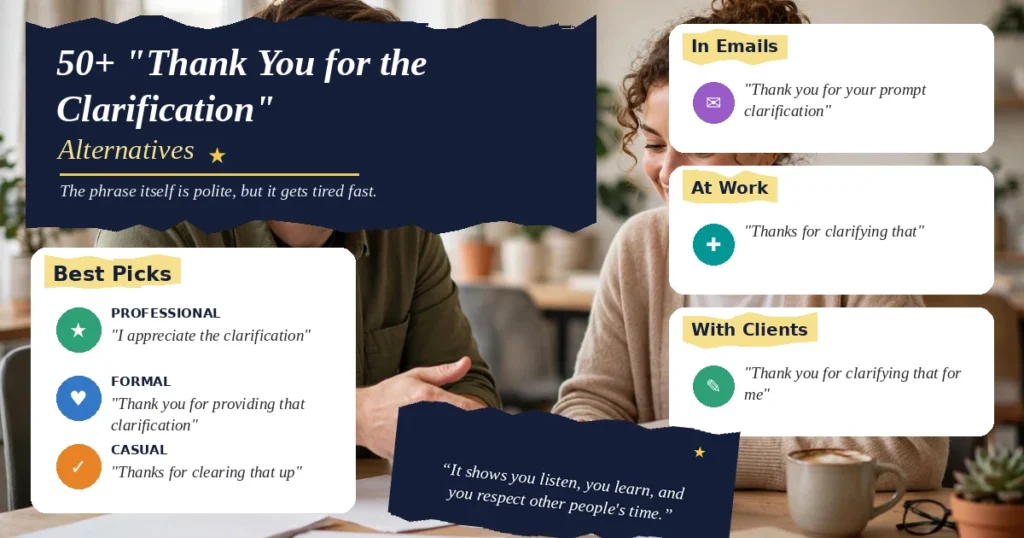
Learning the right ways to say thank you for the clarification can change how people see you at work. The phrase itself is polite, but it gets tired fast. When you type it in every email, it starts to sound like a habit instead of real gratitude. This guide gives you 50 professional and polite alternatives, with real examples for emails, meetings, and client calls. You will learn when the phrase works, when it falls flat, and what to say instead. Whether you write to a manager, a client, or a teammate, you will find the right words here.
Most people search for a fresh way to say thank you for the clarification because they use it too often. They worry it sounds stiff or robotic. Others need a warmer version for a friendly colleague or a more formal one for a senior executive. This article covers all of it: the meaning behind the phrase, email-ready examples, common mistakes, cultural differences, and answers to the questions people ask most. By the end, you will never struggle with this line again.
Meaning of thank you for the clarification
“Thank you for the clarification” is a polite expression people use after someone explains something more clearly. It thanks the speaker or writer for removing confusion, correcting a misunderstanding, or adding detail that was missing. The tone is professional and respectful. People use it when they want to show they listened, understood, and valued the effort someone made to explain. A simple example: your manager writes, “The deadline is Friday, not Thursday.” You reply, “Thank you for the clarification. I will adjust my schedule.” That one sentence closes the loop and shows respect.
Emotionally, the phrase does two jobs at once. It admits you were unsure about something, which takes a little humility. Then it gives credit to the other person for helping you, which builds goodwill. That is why it shows up so often in customer service, team chats, and client emails. Use it when someone cleared up a real question for you. Skip it when nothing was actually unclear, or it will sound hollow.
Professional usage of thank you for the clarification
The phrase works in many professional settings, but the right version depends on who you are talking to. Below are the most common contexts.
Business emails
Use it in emails when a colleague or client answers a question or corrects a detail. Keep it short and pair it with a next step, like “Thank you for the clarification. I will update the report today.”
Workplace conversations
In meetings or on calls, a quick “Thanks for clarifying that” keeps the discussion moving. It tells the speaker you followed along and agree with what they said.
Client communication
With clients, the phrase shows you take their input seriously. A slightly warmer version, like “I appreciate the clarification,” works well when the client took time to explain their needs.
Networking
After a mentor or contact explains an industry term or process, thanking them for the clarity shows you are a good listener. It makes people want to help you again.
Customer service
Support agents hear clarifications from customers every day. “Thank you for clarifying that for me” keeps the tone friendly and moves the ticket toward a solution.
50 alternatives to thank you for the clarification
These 50 options cover every tone you might need. Pick the group that matches your audience, then choose the line that fits the moment.
Professional alternatives
- Thanks for clarifying that. Direct and warm. Best for everyday work emails. Example: “Thanks for clarifying that. I will send the updated invoice today.”
- I appreciate the clarification. Slightly more formal than “thanks.” Best for managers and clients. Example: “I appreciate the clarification. That changes my plan for the launch.”
- Thank you for clearing that up. Friendly but still professional. Best for colleagues. Example: “Thank you for clearing that up. I was looking at the old version of the brief.”
- I appreciate you walking me through that. Shows extra gratitude for someone’s time. Best after a long explanation. Example: “I appreciate you walking me through that. The process makes sense now.”
- Thanks for shedding light on this. A touch more expressive. Best when the topic was confusing. Example: “Thanks for shedding light on this. The budget rules are much clearer now.”
- I appreciate the additional context. Works well when someone added background, not just an answer. Best for project discussions. Example: “I appreciate the additional context. It helps me write a better proposal.”
- Thank you for breaking that down. Good when someone simplified a complex point. Best for technical topics. Example: “Thank you for breaking that down. I can explain it to the client now.”
- Thanks for the clear explanation. Compliments the quality of the answer. Best for teachers, mentors, and trainers. Example: “Thanks for the clear explanation. I finally understand the reporting tool.”
- I appreciate you taking the time to clarify. Honors the other person’s effort. Best for busy senior staff. Example: “I appreciate you taking the time to clarify. I know your schedule is packed.”
- Thanks for ironing out the details. Casual-professional. Best for project logistics. Example: “Thanks for ironing out the details. The delivery plan looks solid.”
- Thank you for confirming that for me. Good when the clarification confirmed what you suspected. Best for fact-checking moments. Example: “Thank you for confirming that for me. I will tell the team the meeting is at ten.”
- I appreciate the extra detail. Short and sincere. Best for quick Slack or Teams messages. Example: “I appreciate the extra detail. That answers my question.”
Formal alternatives
- Thank you for providing that clarification. Polished and safe. Best for formal emails to executives. Example: “Thank you for providing that clarification. I will proceed accordingly.”
- I am grateful for your clarification. Stronger gratitude. Best for official correspondence. Example: “I am grateful for your clarification on the payment terms.”
- Many thanks for the clarification. A classic British-leaning formal line. Best for external partners. Example: “Many thanks for the clarification. We will adjust the timeline.”
- I sincerely appreciate your explanation. Adds sincerity for serious matters. Best for sensitive topics. Example: “I sincerely appreciate your explanation of the new policy.”
- Thank you for the thorough explanation. Praises the completeness of the answer. Best after detailed guidance. Example: “Thank you for the thorough explanation. Everything is clear now.”
- I am obliged to you for clarifying this matter. Very formal, old-school. Best for legal or official letters. Example: “I am obliged to you for clarifying this matter in writing.”
- My thanks for setting this straight. Dignified and brief. Best for written corrections. Example: “My thanks for setting this straight. The record is now correct.”
- I appreciate your candor in explaining this. Works when someone was honest about a tricky issue. Best for difficult conversations. Example: “I appreciate your candor in explaining this. It helps us plan better.”
- Thank you for putting that into perspective. Good when the clarification changed how you see the issue. Best for strategy talks. Example: “Thank you for putting that into perspective. I see the priorities differently now.”
- I value the clarity you have provided. Elegant and formal. Best for senior leaders. Example: “I value the clarity you have provided on our goals.”
Friendly alternatives
- Got it — thanks for explaining! Warm and upbeat. Best for teammates you know well. Example: “Got it — thanks for explaining! I will update the spreadsheet.”
- That helps a lot, thanks! Shows real relief. Best for quick chats. Example: “That helps a lot, thanks! I was stuck on that step for an hour.”
- Ah, that makes sense now — thanks! Shows the moment of understanding. Best for learning situations. Example: “Ah, that makes sense now — thanks! The formula works perfectly.”
- Thanks for the heads-up! Casual and quick. Best when the clarification was also a warning. Example: “Thanks for the heads-up! I will avoid that formatting issue.”
- Appreciate you clearing that up for me! Personal and friendly. Best for one-on-one conversations. Example: “Appreciate you clearing that up for me! Let’s move ahead.”
- Thanks — that clears things up nicely. Relaxed and positive. Best for team calls. Example: “Thanks — that clears things up nicely. I am good to start.”
- Perfect, thanks for the rundown! Energetic. Best after a summary. Example: “Perfect, thanks for the rundown! I have everything I need.”
- Thanks for spelling that out! Casual. Best when someone explained step by step. Example: “Thanks for spelling that out! I will follow those steps exactly.”
- Appreciate the quick explainer! Modern and light. Best for chat messages. Example: “Appreciate the quick explainer! Back to work now.”
Email alternatives
- Thank you for your prompt clarification. Praises fast replies. Best for time-sensitive emails. Example: “Thank you for your prompt clarification. We can meet the deadline.”
- Thanks for getting back to me with the details. Natural email tone. Best for follow-up threads. Example: “Thanks for getting back to me with the details. I have updated the file.”
- I appreciate your detailed response. Compliments thoroughness. Best for long answers. Example: “I appreciate your detailed response. It covers everything I asked.”
- Thanks for clarifying this so quickly. Friendly email line. Best for fast turnarounds. Example: “Thanks for clarifying this so quickly. I can send the draft today.”
- Thank you for the clarification — much appreciated. A classic sign-off style line. Best at the end of a reply. Example: “Thank you for the clarification — much appreciated. Best regards, Anna.”
- I appreciate you confirming the details in writing. Useful for paper trails. Best for contracts and agreements. Example: “I appreciate you confirming the details in writing. This protects both sides.”
- Thanks for the update and the clarity. Covers two things at once. Best for status emails. Example: “Thanks for the update and the clarity. The new dates work for me.”
- Thank you for taking the time to respond with clarification. Respectful and complete. Best for replies from busy people. Example: “Thank you for taking the time to respond with clarification. I understand the process now.”
- Appreciate the clarification; that answers my question. Closes the thread neatly. Best for support tickets. Example: “Appreciate the clarification; that answers my question. You can close the ticket.”
- Thanks for the detailed breakdown. Great after itemized explanations. Best for quotes and invoices. Example: “Thanks for the detailed breakdown. The pricing is clear now.”
Workplace alternatives
- Thanks for talking me through it. Good after verbal explanations. Best for calls and huddles. Example: “Thanks for talking me through it. I will brief the rest of the team.”
- Appreciate you clarifying that in the meeting. Names the setting. Best for meeting follow-ups. Example: “Appreciate you clarifying that in the meeting. The action items are clear.”
- Thanks for clearing that up before we moved on. Shows timing mattered. Best for live discussions. Example: “Thanks for clearing that up before we moved on. Let’s continue.”
- Appreciate the quick clarity on that. Snappy. Best for stand-ups and check-ins. Example: “Appreciate the quick clarity on that. I will adjust my tasks.”
- Thanks for looping me in on the details. Good when you were out of the loop. Best for CC’d threads. Example: “Thanks for looping me in on the details. I am up to speed now.”
- Appreciate you flagging that distinction. Shows you noticed the nuance. Best for precise topics. Example: “Appreciate you flagging that distinction. I will use the right term going forward.”
- Thanks for making that crystal clear. Strong and positive. Best for final decisions. Example: “Thanks for making that crystal clear. No more guesswork on my end.”
- Appreciate the straight answer. Praises directness. Best for honest feedback. Example: “Appreciate the straight answer. I would rather hear it plainly.”
- Thanks for connecting the dots for me. Good when the explanation linked ideas together. Best for complex projects. Example: “Thanks for connecting the dots for me. The strategy makes sense now.”
Quick comparison table
Here are the top ten picks at a glance. Match the tone to your reader and you cannot go wrong.
| Alternative | Tone | Best use |
|---|---|---|
| I appreciate the clarification | Professional | Managers and clients |
| Thank you for providing that clarification | Formal | Executive emails |
| Thanks for clarifying that | Professional | Everyday work emails |
| Thank you for your prompt clarification | Professional | Time-sensitive replies |
| Thanks for clearing that up | Friendly-professional | Colleagues and teammates |
| Got it — thanks for explaining! | Friendly | Team chats |
| I appreciate you walking me through that | Warm professional | Long explanations |
| Many thanks for the clarification | Formal | External partners |
| Thanks for the detailed breakdown | Professional | Quotes and invoices |
| Appreciate the quick clarity on that | Casual professional | Meetings and stand-ups |
Email examples
Copy and adapt these short templates. Each one puts an alternative in a real email setting.
Client email
Subject: Re: Project timeline
Hi Sarah,
I appreciate the clarification on the delivery dates. I will update the project plan today and share the revised timeline with you by tomorrow morning.
Best regards,
James
Manager email
Subject: Re: Q3 targets
Hi David,
Thank you for breaking that down. I now understand how the targets connect to the team goals. I will share my action plan by Friday.
Thanks,
Maria
Colleague email
Subject: Re: File locations
Hi Tom,
Thanks for clearing that up. I was looking in the old shared drive. I found the files now and will finish my part this afternoon.
Cheers,
Lisa
Customer support email
Subject: Re: Your refund request
Hi Alex,
Thank you for confirming the details in writing. I can see the order number now. I have processed your refund, and it should arrive within five business days.
Kind regards,
Support Team
Networking follow-up email
Subject: Great meeting you at the conference
Hi Priya,
It was great talking with you yesterday. Thanks for shedding light on how your team handles onboarding. I would love to stay in touch and hear how the new rollout goes.
Best,
Rachel
Meeting follow-up email
Subject: Notes from today’s meeting
Hi team,
Appreciate you clarifying that in the meeting. I have listed the action items below with owners and deadlines. Please reply if I missed anything.
Thanks,
Kevin
Common mistakes to avoid
1. Using it in every reply
Repeating the same line in every email makes you sound robotic. Rotate through the alternatives above so each message feels fresh.
2. Pairing a formal line with a casual email
“I am obliged to you for clarifying this matter” sounds strange in a quick Slack message. Match the tone to the channel.
3. Pairing a casual line with a serious email
“Got it — thanks for explaining!” can sound careless in a message to a CEO. Choose a formal alternative for senior readers.
4. Thanking someone when nothing was unclear
If no confusion existed, the phrase feels empty. Only thank people for clarification when they actually cleared something up.
5. Forgetting the next step
A thank-you with no action leaves the reader hanging. Add one line about what you will do next, like “I will update the document today.”
Related phrases
- Thank you for explaining. A warmer, broader thanks for any explanation. Example: “Thank you for explaining the new software to me.”
- Thanks for the update. Thanks someone for new information. Example: “Thanks for the update on the shipping delay.”
- I appreciate the insight. Thanks someone for a smart observation. Example: “I appreciate the insight on customer trends.”
- Thanks for the heads-up. Thanks someone for an early warning. Example: “Thanks for the heads-up about the server maintenance.”
- Thank you for confirming. Thanks someone for verifying a fact. Example: “Thank you for confirming the meeting time.”
- Thanks for the context. Thanks someone for background information. Example: “Thanks for the context. The decision makes more sense now.”
- I appreciate the transparency. Thanks someone for being open. Example: “I appreciate the transparency about the budget cuts.”
- Thank you for the guidance. Thanks someone for direction or advice. Example: “Thank you for the guidance on my presentation.”
- Thanks for walking me through it. Thanks someone for a step-by-step explanation. Example: “Thanks for walking me through it. I can do it alone now.”
- I appreciate the follow-up. Thanks someone for checking back. Example: “I appreciate the follow-up. I had forgotten about the form.”
- Thank you for the information. A neutral, all-purpose thanks. Example: “Thank you for the information. I will review it tonight.”
- Thanks for the recap. Thanks someone for summarizing. Example: “Thanks for the recap. I missed the first half of the call.”
- I appreciate the overview. Thanks someone for the big picture. Example: “I appreciate the overview of the project phases.”
- Thank you for the reminder. Thanks someone for jogging your memory. Example: “Thank you for the reminder. The deadline slipped my mind.”
- Thanks for the note. A short, casual thanks for a message. Example: “Thanks for the note. I will look into it.”
- I appreciate the direction. Thanks someone for telling you what to do. Example: “I appreciate the direction. I will start on the draft.”
Thank you for the clarification vs top alternatives
The original phrase is the safest all-rounder. It works in almost any professional setting and nobody will misunderstand it. Its weakness is overuse: when a manager sees it for the tenth time, it stops sounding sincere.
“I appreciate the clarification” feels a shade warmer and more personal. It suits messages where you want to show real gratitude, not just good manners. Use it with clients and senior colleagues.
“Thanks for clearing that up” sits one step more casual. It fits teammates and quick threads where a stiff formal line would feel out of place. It keeps the same meaning with a friendlier sound.
“Thank you for providing that clarification” is the most formal of the four. It belongs in official emails, legal contexts, and messages to executives you do not know well. In a casual chat it would sound overdressed.
The rule is simple: keep the original phrase as your default, reach for the warmer option when gratitude matters, the casual one with peers, and the formal one when the stakes are high.
Cultural usage
US English
Americans use shorter, warmer versions in most workplaces. “Thanks for clarifying that” and “Appreciate the clarification” are standard. Very formal lines like “I am obliged to you” can sound old-fashioned.
UK English
British professionals lean slightly more formal. “Many thanks for the clarification” is common and natural. “Thank you for providing that clarification” also fits well in UK business emails.
Corporate communication
In large companies, the phrase often appears in email chains with many people copied. Keep it brief and add a next step so the thread moves forward.
Customer service
Support teams use it to keep conversations calm and polite. Pair it with empathy: “Thank you for clarifying that for me. I understand how frustrating this must be.”
Networking
In networking, warmth matters more than formality. “Thanks for shedding light on this” or “I appreciate you walking me through that” builds a stronger connection than the plain original.
Frequently asked questions
What does “thank you for the clarification” mean?
It means you are grateful because someone explained something more clearly. You use it after a person removes confusion, corrects a mistake, or adds missing detail. It is polite, professional, and works in emails, meetings, and customer service chats.
Is “thank you for the clarification” professional?
Yes, it is fully professional. Managers, clients, and colleagues all accept it in business writing. If you use it too often, though, it can sound automatic. Rotate in alternatives like “I appreciate the clarification” to keep your messages fresh.
How do I use “thank you for the clarification” in an email?
Place it early in your reply, right after the greeting. Then add a next step. For example: “Thank you for the clarification. I will update the report and send it by Friday.” This keeps the email short and action-focused.
What is a formal alternative to “thank you for the clarification”?
“Thank you for providing that clarification” and “I am grateful for your clarification” are strong formal choices. “Many thanks for the clarification” also works well, especially in British business English. Save these for executives and official correspondence.
What is a casual way to say “thank you for the clarification”?
Try “Got it — thanks for explaining!” or “That helps a lot, thanks!” Both sound natural in team chats and quick messages. Keep them for colleagues you know well, not for first emails to senior leaders.
What is the difference between “thanks for explaining” and “thanks for the clarification”?
“Thanks for explaining” is broader. It fits any explanation, even a first one. “Thanks for the clarification” fits a specific moment: someone cleared up confusion or corrected something. Use the second one when there was a real question or misunderstanding.
How should I reply when someone clarifies something for me?
Thank them briefly and show what you will do next. A good reply looks like this: “Thanks for clarifying that. I will fix the dates in the document today.” This proves you understood and keeps work moving.
Can I use “thank you for the clarification” in customer service?
Yes, it is a great fit. Support agents use it daily when customers explain their problems. Add empathy to make it warmer: “Thank you for clarifying that for me. Let me fix this for you right now.”
Is it too formal to say to a colleague?
The full phrase can feel a bit stiff with close teammates. With colleagues you work with daily, prefer “Thanks for clearing that up” or “Appreciate the quick clarity on that.” Save the formal version for people outside your team.
Can I use it in a cover letter?
Only if it fits the context. A cover letter rarely needs it, since nobody has clarified anything for you yet. In a follow-up email after an interview, though, it works well: “Thank you for clarifying the role’s responsibilities.”
Do British and American professionals use it differently?
The core phrase works in both. Americans often shorten it to “Thanks for clarifying that” or “Appreciate the clarification.” British writers favor “Many thanks for the clarification.” Both versions are correct everywhere.
When should I not use “thank you for the clarification”?
Skip it when nothing was actually unclear. Thanking someone for a clarification they never gave sounds confusing or sarcastic. Also avoid it in very casual chats with friends, where a simple “got it, thanks” feels more natural.
How do I stop repeating “thank you for the clarification” in every email?
Build a small rotation of five or six favorites from this article. For example, alternate between “I appreciate the clarification,” “Thanks for clearing that up,” and “Thank you for the detailed breakdown.” Variety keeps your writing human.
What is the difference between “clarification” and “explanation”?
An explanation teaches something, often for the first time. A clarification fixes something that was unclear, confusing, or wrong. You ask for an explanation to learn; you ask for a clarification to correct.
Is “thanks for the clarification” grammatically correct?
Yes, it is grammatically correct. “Thanks for” followed by a noun phrase is standard English. Both “thanks for the clarification” and “thank you for the clarification” are correct; the second is slightly more formal.
Conclusion
Quick picks — Professional: “Thanks for clarifying that” and “I appreciate the clarification.” Formal: “Thank you for providing that clarification” and “I am grateful for your clarification.” Friendly-casual: “Got it — thanks for explaining!” and “That helps a lot, thanks!” Email: “Thank you for your prompt clarification” and “Thanks for getting back to me with the details.”
Clarity is a gift, so thank the giver like you mean it. Match the weight of your thanks to the help you received — brief for quick answers, fuller for long explanations. Always add one line about your next step. A grateful, specific reply turns a small exchange into lasting goodwill.
Related Articles
- Other Ways to Say Thank You: Professional & Polite Alternatives in 2026
- Other Ways to Say Please Advise: Professional & Polite Alternatives in 2026
- Other Ways to Say “Let Me Know What You Think”: Professional & Polite Alternatives in 2026
- 55+ “We Value Your Feedback” Lines People Believe
- Other Ways to Say “Sorry for the Inconvenience”
- Other Ways to Say “Please Find Attached”: Professional & Polite Alternatives in 2026
- Other Ways to Say As Soon As Possible Professional & Polite Alternatives




