
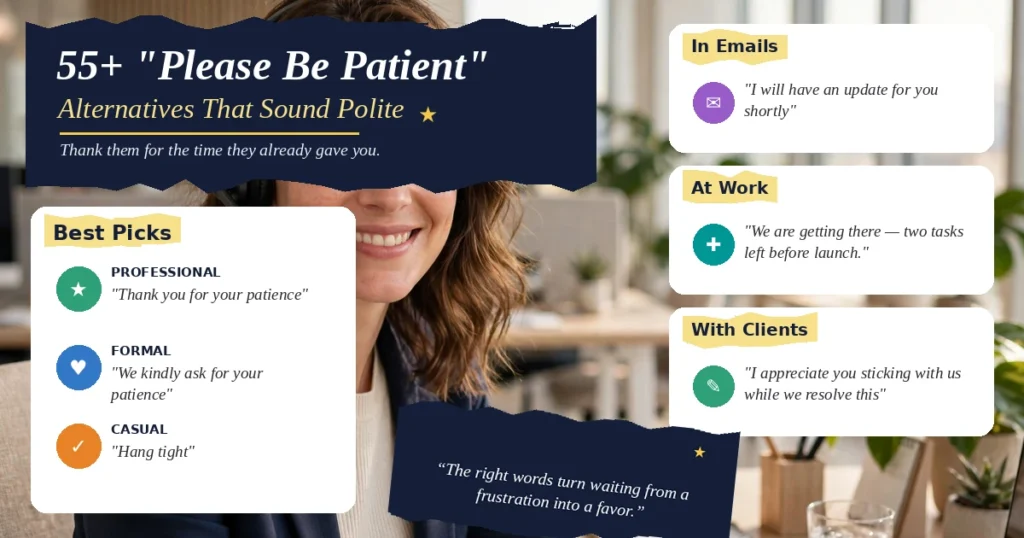
If you need other ways to say “please be patient,” you already sense the problem with the phrase: it sounds like an order. It tells the reader to calm down, and nobody enjoys hearing that. A professional way to say “please be patient” does the opposite. It thanks the reader, takes responsibility for the delay, and keeps the tone warm. This guide gives you 55 polished alternatives for emails, client updates, and workplace conversations. Every alternative comes with a tone note, a best-use tip, and a real example you can copy straight into your message.
You will also find a quick comparison table of the top picks, six ready-to-send email examples, the most common mistakes people make with this phrase, related expressions, cultural notes for US and UK English, and answers to the fifteen questions readers ask most. Whether you write to a client, a manager, a colleague, or a customer, you will leave this page with the right words for the moment.
Meaning of “please be patient”
“Please be patient” is a polite request that asks someone to wait calmly without complaining. People use it when a delay, a process, or a decision takes longer than expected. It carries a slightly formal tone, and it can sound cold or commanding when the reader is already frustrated.
The literal meaning is simple: please wait, and please stay calm while you wait. The tone depends on context. A nurse who says it with a smile sounds caring. A support agent who pastes it into a chat after a two-hour wait sounds dismissive. The purpose is always the same — to buy time gracefully — but the emotional context decides whether it lands well. When someone feels ignored, the phrase can read as “stop bothering us.” That is why skilled communicators replace it with words that show gratitude instead of giving instructions. For example, “Thank you for your patience while we fix this” acknowledges the wait, while “Please be patient while we fix this” only commands it. The first sentence respects the reader. The second one manages the reader. Small shift, big difference.
When to use “please be patient” professionally
The phrase and its alternatives fit any moment when someone must wait on you, your team, or a process. Use them to protect the relationship while the clock runs. Here is how the contexts differ.
In emails
Use a patient-asking line in status updates, delayed replies, and apology emails. It works best near the end of the message, right after you explain the delay and give a timeline. “I will share the revised draft by Friday. Thank you for your patience.” The reader leaves with a date, not just a request to wait.
In the workplace
Managers use these phrases in standups, project updates, and change announcements. They keep teams calm during system migrations, restructures, and long approval chains. Pair the phrase with a concrete next step so the team sees progress, not just a plea. “The migration finishes Thursday. Thanks for hanging in there.”
With clients
Client relationships run on trust, so choose warmer alternatives here. “Please be patient” can sound like you take their business for granted. “I appreciate you sticking with us while we resolve this” shows you value the account. Always add what happens next and when.
In networking
When a contact introduces you to someone and the reply takes days, thank them for the wait instead of asking for patience. “Thanks for your patience while I connected with her” keeps the goodwill alive. Networking runs on generosity, so gratitude beats instruction every time.
In customer service
Support teams ask for patience during outages, long queues, and complex tickets. Lead with empathy and a time estimate. “We know this wait is frustrating. Thank you for bearing with us — an agent will join you in about five minutes.” Specifics calm people faster than any phrase.
55 professional alternatives to “please be patient”
These alternatives are grouped by tone so you can pick the right one fast. Each entry shows the phrase in bold, a one-line note on tone and best use, and a short example. No two entries repeat the same phrasing.
Professional alternatives
Thank you for your patience. Warm and professional; the safest all-purpose pick for status updates. Example: “Thank you for your patience while our team reviews your application.”
I appreciate your patience. Personal and sincere; best for one-to-one replies where you own the delay. Example: “I appreciate your patience while I pull the numbers together.”
We appreciate your patience. Team-voiced and steady; ideal for company updates and announcements. Example: “We appreciate your patience as we roll out the new system.”
Thank you for bearing with us. Polite and conversational; fits service delays and long waits. Example: “Thank you for bearing with us during this longer-than-usual wait.”
I appreciate your understanding. Empathetic and calm; use it when plans change through no fault of the reader. Example: “I appreciate your understanding while we adjust the timeline.”
Thank you for your understanding. Formal-leaning and respectful; suits policy changes and official notices. Example: “Thank you for your understanding as we update our process.”
Thanks for hanging in there. Casual-professional and encouraging; best for long projects with a friendly team. Example: “Thanks for hanging in there while we finalize the details.”
I appreciate you sticking with us. Relationship-focused; protects client loyalty during rough patches. Example: “I appreciate you sticking with us through these delays.”
We value your patience. Respectful and measured; strong for customer-facing updates. Example: “We value your patience while we improve the service.”
Your patience means a lot to us. Heartfelt and appreciative; use it in service recovery moments. Example: “Your patience means a lot to us while we fix this issue.”
Thanks for your continued patience. Honest about repeated delays; best for multi-stage projects. Example: “Thanks for your continued patience as the work enters its final stage.”
Thank you for staying the course. Encouraging and steady; fits long approval chains and processes. Example: “Thank you for staying the course while the approval moves through.”
I am grateful for your patience. Deeply sincere; reserve it for high-stakes or sensitive situations. Example: “I am grateful for your patience during this sensitive review.”
Thanks for giving us the time we need. Direct and confident; works for project timelines you control. Example: “Thanks for giving us the time we need to get this right.”
We are thankful for your patience. Corporate and dignified; suits official statements and press-style updates. Example: “We are thankful for your patience during the transition.”
Formal alternatives
We kindly ask for your patience. Diplomatic and courteous; best for official notices and public messages. Example: “We kindly ask for your patience while maintenance is underway.”
Your patience is greatly appreciated. Formal acknowledgment; fits letters and official correspondence. Example: “Your patience is greatly appreciated during this process.”
We request your patience at this time. Very formal; use it in announcements where authority matters. Example: “We request your patience at this time while we complete the review.”
Thank you for your forbearance. Elevated and old-school formal; suits legal and corporate writing. Example: “Thank you for your forbearance while the matter is resolved.”
We appreciate your indulgence. Gracious and traditional; works in apology letters for serious errors. Example: “We appreciate your indulgence as we correct the error.”
Kindly bear with us. Polite directive; good for instructions during upgrades or changes. Example: “Kindly bear with us while we upgrade the system.”
We thank you in advance for your patience. Anticipatory and courteous; ideal before a known upcoming delay. Example: “We thank you in advance for your patience during the office move.”
Your understanding in this matter is appreciated. Formal and precise; fits written complaints and investigations. Example: “Your understanding in this matter is appreciated while we investigate.”
We are obliged for your patience. Very formal and humble; use it in high-level corporate messages. Example: “We are obliged for your patience during the audit.”
Please allow us a little more time. Courteous direct request; best when you need to name the ask plainly. Example: “Please allow us a little more time to finish the report.”
Friendly alternatives
Hang tight. Upbeat and brief; best for casual teams and quick waits. Example: “Hang tight — the files are uploading now.”
Just a little longer. Reassuring and light; fits short delays in chats and calls. Example: “Just a little longer and the page will load.”
Almost there. Encouraging and positive; use it when the end is genuinely near. Example: “Almost there — I am saving the last section now.”
Sit tight. Friendly and informal; works in relaxed team chats. Example: “Sit tight while I check with the team.”
Hold on one sec. Conversational and immediate; natural in live chats and calls. Example: “Hold on one sec — I am finding your order.”
Give me a moment. Personal and polite; best for one-to-one conversations. Example: “Give me a moment to pull up your account.”
Stay with me. Engaging and energetic; fits presentations and walkthroughs. Example: “Stay with me — the next slide explains it all.”
We are nearly done. Positive and team-spirited; good for group updates. Example: “We are nearly done with the final checks.”
Bear with me. Warm and humble; use it when you personally need a minute. Example: “Bear with me while I sort out these numbers.”
Thanks for waiting. Simple and sincere; the everyday default that never offends. Example: “Thanks for waiting — here is your receipt.”
Email-ready alternatives
I will have an update for you shortly. Proactive and professional; best for status emails that need a promise. Example: “I will have an update for you by Thursday afternoon.”
This is taking a bit longer than expected. Honest and disarming; ideal for delay emails. Example: “This is taking a bit longer than expected, so I wanted to keep you posted.”
I wanted to keep you in the loop. Transparent and considerate; fits progress emails during long tasks. Example: “I wanted to keep you in the loop while the team finishes testing.”
We are working on it and will update you soon. Reassuring and clear; strong for support and service emails. Example: “We are working on it and will update you as soon as we know more.”
I appreciate you waiting for my reply. Courteous and personal; perfect for late replies. Example: “I appreciate you waiting for my reply — here is the summary you asked for.”
Thank you for waiting for our response. Professional and formal; suits official email correspondence. Example: “Thank you for waiting for our response to your proposal.”
The team is on it. Confident and concise; best for internal updates that need energy. Example: “The team is on it, and I will share the result today.”
I will circle back with details soon. Forward-looking and professional; ideal for follow-up emails. Example: “I will circle back with details once finance approves it.”
Your request is in good hands. Reassuring and warm; excellent for customer service emails. Example: “Your request is in good hands — it is with our senior team now.”
I will keep you posted. Casual-professional and reliable; fits ongoing work threads. Example: “I will keep you posted as soon as the shipment moves.”
Workplace alternatives
We are getting there. Team-friendly and honest; natural in standups and check-ins. Example: “We are getting there — two tasks left before launch.”
The pieces are coming together. Optimistic and visual; best for creative and project work. Example: “The pieces are coming together; the design draft lands Friday.”
We are in the final stretch. Motivating and focused; fits deadline pushes. Example: “We are in the final stretch — thank you for staying focused.”
Good things take time. Light and philosophical; softens waits in creative work. Example: “Good things take time, and this design is worth it.”
We are ironing out the last details. Precise and professional; ideal for QA and finishing stages. Example: “We are ironing out the last details before we ship.”
Progress is underway. Neutral and factual; suits status reports to leadership. Example: “Progress is underway, and milestones are on track.”
We are on track. Confident and brief; best when a manager needs reassurance. Example: “We are on track — the delay only affects the bonus feature.”
The finish line is in sight. Encouraging and vivid; lifts teams during long sprints. Example: “The finish line is in sight — one more review round.”
We are working through it. Steady and calm; fits problem-solving updates. Example: “We are working through it and will report back at noon.”
Rome was not built in a day. Idiomatic and light; best for casual moments, never formal email. Example: “Rome was not built in a day — the new system will be worth the wait.”
Quick comparison table
These ten picks cover nearly every situation. Match the tone to your reader and your relationship with them.
| Alternative | Tone | Best use |
|---|---|---|
| Thank you for your patience | Warm, professional | Status-update emails |
| I appreciate your patience | Personal, sincere | One-to-one replies |
| We appreciate your patience | Steady, corporate | Company announcements |
| Thank you for bearing with us | Polite, conversational | Service delays |
| I appreciate your understanding | Empathetic, calm | Changed plans |
| We kindly ask for your patience | Diplomatic, formal | Official notices |
| Your patience is greatly appreciated | Formal, respectful | Formal letters |
| Hang tight | Upbeat, casual | Team chats |
| I will have an update for you shortly | Proactive, professional | Delay emails |
| We are in the final stretch | Motivating, vivid | Deadline pushes |
Email examples
Copy these, swap in your details, and send. Each one pairs an alternative with a clear next step, because a timeline calms readers more than any phrase.
Email to a client
Subject: Update on your project timeline
Hi Sarah,
The design revisions are taking a bit longer than expected because we want the homepage to match your brand exactly. I will send the new mockups by Thursday morning. I appreciate you sticking with us while we get this right.
Best,
Daniel
Email to your manager
Subject: Q3 report — one-day delay
Hi Ms. Carter,
The Q3 report needs one more day. Finance sent revised figures this morning, and I want the final version to be accurate. I will have it on your desk by 10 a.m. tomorrow. Thank you for your patience.
Regards,
James
Email to a colleague
Subject: Re: shared drive access
Hi Priya,
I have requested your access to the shared drive. IT usually approves these within a day, so you should be in by tomorrow. Thanks for hanging in there.
Cheers,
Alex
Email to a customer
Subject: Your order #48291 — shipping update
Hello,
Your order is packed and waiting for the courier pickup scheduled tomorrow. You will receive the tracking link by email tomorrow evening. Thank you for bearing with us during this busy week.
Warm regards,
The BrightBox Team
Networking email
Subject: Introduction — thanks for connecting
Hi Marcus,
Thanks again for introducing me to Lena last week. I finally had the call with her this morning, and it went well. Thanks for your patience while our calendars lined up — I really appreciate the connection.
Best,
Nina
Meeting follow-up email
Subject: Follow-up — action items from today
Hi team,
Thanks for a productive session. The budget sheet needs final numbers from accounting, so I will circulate the action list tomorrow morning. I appreciate your understanding while we wait on those figures.
Best,
Tom
Common mistakes to avoid
1. Saying it on every update
Repeating any patience phrase in back-to-back emails trains readers to expect delays. Vary your wording or drop it when you have real news.
2. Using it without a timeline
“Please be patient” with no date feels endless. Always add when the wait ends: “by Friday,” “in two days,” “tomorrow morning.”
3. Sounding like a command
The bare phrase orders the reader to behave. Gratitude-based versions (“Thank you for your patience”) keep you on the reader’s side.
4. Picking a casual phrase for a formal reader
“Hang tight” charms a teammate but insults an angry client. Match the formality to the relationship and the stakes.
5. Picking a stiff phrase for a friendly team
“We request your patience at this time” in a team chat sounds robotic. Save formal alternatives for formal channels.
6. Apologizing and asking for patience twice
“Sorry for the delay, please be patient” doubles the negativity. Pick one move: apologize with a fix date, or thank them for waiting.
7. Using it to dodge accountability
Readers see through patience requests that hide missed deadlines. Own the delay first, then ask for time: “This is on us. Here is the new date.”
8. Forgetting email etiquette basics
A patience line cannot rescue a message with no greeting, no subject clarity, or no sign-off. Good email etiquette frames the phrase; it never replaces it.
Related phrases
Thanks for waiting. A simple acknowledgment of someone’s time. Example: “Thanks for waiting — the line is clear now.”
Bear with me. A humble request for a short pause. Example: “Bear with me while I find that file.”
Hold your horses. An idiom that means slow down; casual only. Example: “Hold your horses — the results post at noon.”
Good things come to those who wait. A proverb that reframes waiting as worthwhile. Example: “Good things come to those who wait — the feature launches Friday.”
It will be worth the wait. A promise that the delay pays off. Example: “It will be worth the wait — the new menu starts Monday.”
Just a moment. A brief, polite pause request. Example: “Just a moment while I check your balance.”
One moment, please. A courteous hold request for calls and service. Example: “One moment, please — I will transfer you.”
Stay tuned. An upbeat promise of coming news. Example: “Stay tuned — the announcement drops tomorrow.”
We are on it. A confident signal that work has started. Example: “We are on it — expect a fix within the hour.”
It is in progress. A neutral status update. Example: “Your refund is in progress and lands in 3–5 days.”
Coming right up. A cheerful promise of fast service. Example: “Coming right up — your coffee is brewing.”
Watch this space. A casual invitation to await news. Example: “Watch this space — big updates land next month.”
All in good time. A gentle reminder that rushing rarely helps. Example: “All in good time — the contract needs legal review first.”
Patience is a virtue. A proverb used lightly, never toward frustrated people. Example: “Patience is a virtue — the seeds sprout in spring.”
Slow and steady wins the race. An idiom praising careful pace. Example: “Slow and steady wins the race — we test before we launch.”
Thank you for your understanding. Gratitude for accepting a change or delay. Example: “Thank you for your understanding during the schedule change.”
“Please be patient” vs. its top alternatives
The original phrase is a directive: it tells the reader what to do. That bluntness is its weakness and, in rare cases, its strength. In a safety briefing or an emergency notice, directness beats warmth — “Please be patient while we clear the area” leaves no room for argument. But in business writing, directness without gratitude reads as cold.
“Thank you for your patience” flips the dynamic. It treats the wait as a favor the reader already gave you, which makes people more willing to keep waiting. Use it as your default in emails and client messages. “I appreciate your patience” goes one step further by making the gratitude personal; it suits one-to-one conversations where you caused the delay yourself.
“We kindly ask for your patience” keeps the formal register of the original but softens the command into a request. Choose it for official notices where you must sound authoritative yet polite. “Hang tight” and “Almost there” drop the formality entirely and replace it with energy — perfect for teams, terrible for complaints.
The pattern is simple. Direct commands suit emergencies. Gratitude suits relationships. Energy suits teams. Pick the alternative that matches your reader’s mood, and you will rarely need the original phrase at all.
Cultural usage notes
US English
American business writing favors warmth and brevity. “Thanks for your patience” and “Appreciate your patience” dominate emails, and casual picks like “Hang tight” feel normal in startups. Americans expect a timeline with the phrase — waiting without a date reads as poor service.
UK English
British business writing leans more formal. “Thank you for your patience” and “We appreciate your understanding” are standard, and understatement rules: “This is taking a little longer than expected” softens bad news elegantly. Casual idioms like “Sit tight” appear in spoken English more than in writing.
Corporate communication
Large companies standardize on “We appreciate your patience” and “Thank you for your understanding” in official messages. The plural “we” spreads responsibility across the organization and sounds less personal, which is exactly what corporate statements want.
Customer service
Support scripts worldwide pair a patience phrase with empathy and a time estimate. “I understand this is frustrating. Thank you for bearing with me — I need about three more minutes.” The estimate does the heavy lifting; the phrase just keeps the tone human.
Networking
In networking, patience phrases almost always take gratitude form. “Thanks for your patience while we found a time” acknowledges that the other person did you a favor by waiting. Command-style phrasing has no place here — nobody owes you their waiting.
Frequently asked questions
What is a professional way to say “please be patient”?
“Thank you for your patience” is the most professional choice. It sounds warm, works in any business email, and thanks the reader instead of instructing them. Pair it with a timeline for best results.
What is a formal alternative to “please be patient”?
“We kindly ask for your patience” and “Your patience is greatly appreciated” are strong formal alternatives. They suit official notices, legal correspondence, and messages to senior stakeholders. Both keep a respectful distance without sounding cold.
Is it rude to say “please be patient”?
It can feel rude when the reader is already frustrated, because it orders them to calm down. In neutral situations it is simply formal. Switching to “Thank you for your patience” removes the risk entirely.
What is a synonym for “please be patient”?
Common synonyms include “Thank you for your patience,” “Bear with me,” “Hang tight,” and “We appreciate your understanding.” Each carries a different tone, so match your pick to the situation.
How do you say “please be patient” in a business email?
Write something like: “This is taking a bit longer than expected. I will have an update for you by Thursday. Thank you for your patience.” Explain the delay, give a date, and close with gratitude.
How do you ask a client to be patient politely?
Thank them and own the delay: “I appreciate you sticking with us while we resolve this. The fix lands tomorrow morning.” Clients respond to accountability paired with a clear timeline.
What can I say instead of “please be patient” to my boss?
Try “I will have it to you by 10 a.m. tomorrow. Thank you for your patience.” Bosses want dates and confidence, so lead with the delivery time and keep the phrase short.
How do you say “be patient” in a funny way?
Light options include “Hang tight,” “Good things take time,” and “Rome was not built in a day.” Use humor only with friendly colleagues and never with frustrated clients.
What is a polite way to say “wait” in customer service?
“Thank you for bearing with us” and “One moment, please” are polite service staples. Always add empathy and an estimate: “I know this wait is long — I need about three more minutes.”
Can I say “thanks for your patience” in advance?
Yes, when a delay is certain: “We thank you in advance for your patience during tomorrow’s maintenance.” It warns the reader kindly and sets expectations before frustration builds.
What is the difference between “patience” and “understanding” in these phrases?
“Patience” asks someone to keep waiting calmly, while “understanding” asks them to accept a change or problem. Use “patience” for delays and “understanding” for disruptions, cancellations, or new policies.
How do I ask for patience without sounding weak?
Pair the phrase with confidence and specifics: “We are in the final stretch and ship Friday. Thanks for hanging in there.” A clear plan makes patience sound like leadership, not helplessness.
Is “bear with me” professional?
Yes, in most workplaces it reads as warm and humble. It suits calls, meetings, and team chats. For very formal writing, choose “We kindly ask for your patience” instead.
What should I avoid when asking someone to wait?
Avoid commanding language, repeated apologies with no timeline, and casual idioms in formal settings. Never use a patience phrase to hide a missed deadline — own the delay first.
How long should a patience-related email be?
Keep it short: three to five sentences. State the delay, give the new timeline, and close with a gratitude-based phrase. Long explanations make small delays feel bigger.
Conclusion
Quick picks — Professional: “Thank you for your patience” and “I appreciate your patience.” Formal: “We kindly ask for your patience” and “Your patience is greatly appreciated.” Friendly-casual: “Hang tight” and “Thanks for waiting.” Email: “I will have an update for you shortly” and “This is taking a bit longer than expected.”
Waiting is never fun, but the right words make it feel like a favor instead of a frustration. Lead with gratitude, name a clear timeline, and skip the command entirely. Readers forgive delays when they feel respected and informed. Say thanks, give a date, and the wait takes care of itself.
Related Articles
- Other Ways to Say Thank You for Your Patience
- Other Ways to Say Sorry for the Inconvenience
- Other Ways to Say Please Find Attached (2026 Guide)
- Other Ways to Say As Soon As Possible: 50 Alternatives
- Other Ways to Say Please Advise (2026 Guide)
- 55+ “We Value Your Feedback” Lines People Believe
- Other Ways to Say Thank You: Professional & Polite Alternatives in 2026




