Introduction
If you are looking for other ways to say “take your time,” you probably use the phrase so often that it has started to feel invisible. A colleague is weighing a job offer, a friend is choosing between two apartments, a customer is reading a long contract — and out of your mouth comes the same automatic line: “Take your time.” It is kind, it is correct, and after the hundredth repetition, it sounds like a recording.
The good news is that English gives you dozens of warmer, sharper, and more professional ways to say the same thing. Some are calm and neutral, some are formal enough for official letters, and some are playful enough for close friends. The right version depends on who you are talking to and how much pressure they already feel.
This guide collects 45 alternatives grouped by tone: professional, formal, friendly, email-ready, and workplace picks. Each one comes with a quick note on tone and best use, plus a short example you can copy today. You will also find email examples, common mistakes to avoid, related phrases, and answers to the questions people ask most about this everyday expression.
Why does the swap matter? Because small phrases carry big signals. The same care that goes into reaching out with the right tone applies when you tell someone to slow down: a thoughtful version says you actually mean it, while the automatic version just fills the silence.
Meaning
“Take your time” is an idiom that means “don’t hurry” or “use as much time as you need.” People say it to give someone permission to slow down — to think, to decide, to finish something without pressure. The literal picture is simple: the time belongs to you, so take it.
Almost nobody means it literally, though. When a manager says “take your time on the report,” they are not handing over ownership of the clock. They are sending a social signal: I will not judge you for being slow, and I value a good result more than a fast one. That signal is the whole point of the phrase.
The tone is warm and generous by default. It tells the listener that their pace is acceptable. But context can twist it. Said with a sigh in the middle of a deadline crunch, “take your time” turns sarcastic — it means the exact opposite. Said to someone who is already anxious, it can accidentally add pressure: now they worry that needing time is a problem you are graciously tolerating.
Emotionally, the phrase sits in a kind place. It reduces the listener’s stress by removing the invisible stopwatch. That is why it works so well in customer service, teaching, and management. But like any reassurance, it loses power through repetition. The tenth “take your time” in one conversation sounds less like patience and more like a script.
The phrase also carries a subtle power dynamic. The person who says it is usually the one who could demand speed but chooses not to — the boss, the seller, the host. That is why the alternatives matter: the right version can soften that dynamic and make the kindness feel genuine instead of top-down.
Professional usage
“Take your time” is common in spoken professional English and acceptable in most emails. But it is casual, so the setting decides whether it fits or a stronger alternative wins.
Emails
In emails, the phrase reads as friendly and low-pressure. It works well in a quick note to a colleague or a warm reply to a client. But in formal messages — proposals, contracts, official notices — it can sound too relaxed. Swap in “please take whatever time is necessary” or “review it at your leisure” for the same meaning with a more polished feel. And when a client is waiting on your decision rather than the other way around, ask them to be patient while you finalize things instead of rushing out a half-ready answer.
The workplace
Spoken workplace settings tolerate the phrase easily. In standups, one-on-ones, and team huddles, “take your time” sounds natural and supportive. Managers use it to signal trust: I believe you will deliver, so I am not hovering. Still, leaders who want to sound intentional often prefer “let’s give this the time it deserves” or “quality over speed on this one,” which frame patience as a deliberate choice rather than a default pleasantry.
With clients
With clients, every word shapes trust. “Take your time” reassures them that you are not pushing for a quick yes, which is especially valuable in sales and consulting. But pair it with a concrete next step, or the client may drift. “Take all the time you need — I’ll check back Thursday” combines patience with gentle momentum. Vague reassurance with no follow-up often means the deal quietly dies.
Networking
In networking chats and follow-up messages, warmth matters more than polish. “Take your time getting back to me” keeps the door open without pressure, which is exactly what a new contact needs to hear. Networking runs on goodwill, and nothing kills goodwill faster than a follow-up that feels like a chase. Patience here is strategic as well as kind.
Customer service
Support conversations need patience as a core skill. “Take your time explaining what happened” tells a frustrated customer that they will be heard, not rushed. It is one of the most disarming sentences in service language. But agents should mean it: saying “take your time” and then interrupting thirty seconds later destroys trust faster than never saying it at all.
Alternatives
Here are 45 alternatives grouped by tone. Each entry gives the phrase, its tone and best use, and a short example.
Professional
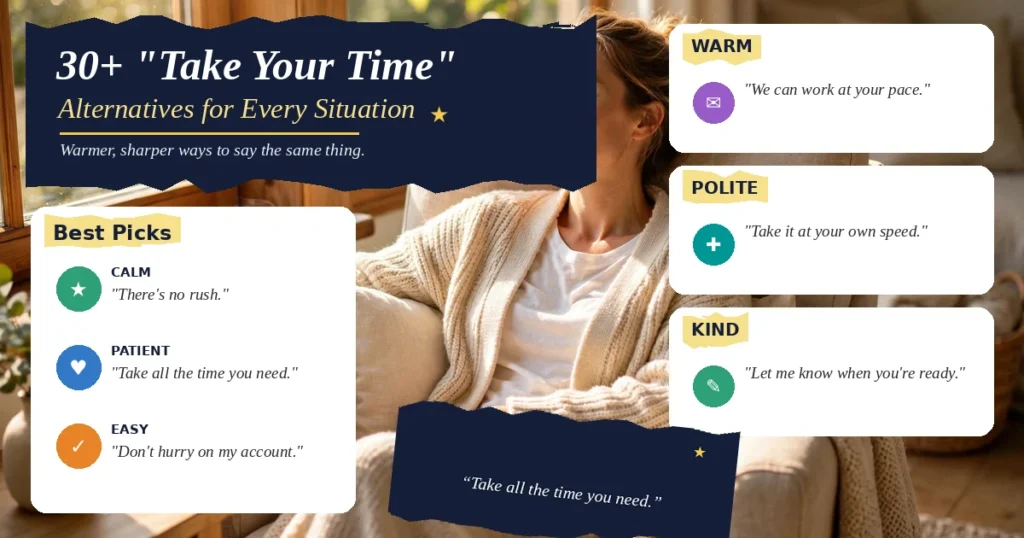
- “There’s no rush.” — Calm and reassuring; best for everyday professional settings. Example: “There’s no rush — get back to me whenever you’re ready.”
- “Take all the time you need.” — Generous and warm; best for important decisions. Example: “Take all the time you need to review the contract.”
- “Don’t hurry on my account.” — Courteous; best when the other person feels pressured. Example: “Don’t hurry on my account — accuracy matters more here.”
- “Please take whatever time is necessary.” — Polite and formal-leaning; best for written requests. Example: “Please take whatever time is necessary to complete the audit.”
- “We can work at your pace.” — Collaborative; best for projects and partnerships. Example: “We can work at your pace — just keep me posted.”
- “Feel free to take your time with this.” — Open and relaxed; best for creative work. Example: “Feel free to take your time with this — the first draft isn’t due until Friday.”
- “There’s no deadline pressure from my side.” — Clear and honest; best for negotiations. Example: “There’s no deadline pressure from my side, so think it through.”
- “Take it at your own speed.” — Casual-professional; best for onboarding and training. Example: “Take it at your own speed — the training modules will still be there.”
- “I’ll wait for your answer.” — Patient and confident; best for proposals. Example: “I’ll wait for your answer — I know there’s a lot to consider.”
- “Let me know when you’re ready.” — Simple and low-pressure; best for follow-ups. Example: “The documents are attached — let me know when you’re ready.”
Formal
- “Please proceed at your convenience.” — Very formal; best for official correspondence. Example: “Please proceed at your convenience and inform us of your decision.”
- “We await your response in due course.” — Traditional; best for legal or institutional writing. Example: “We await your response in due course regarding the settlement.”
- “You may deliberate for as long as required.” — Weighty; best for serious decisions. Example: “The board may deliberate for as long as required.”
- “Kindly take the time you need.” — Polite and formal; best for client emails. Example: “Kindly take the time you need to review the terms.”
- “There is no urgency attached to this request.” — Precise; best for formal requests. Example: “There is no urgency attached to this request, so review it thoroughly.”
- “We remain at your disposal while you decide.” — Gracious; best for client relations. Example: “We remain at your disposal while you decide on the package.”
- “You are welcome to consider this at length.” — Considerate; best for proposals. Example: “You are welcome to consider this proposal at length.”
- “Take whatever time the matter deserves.” — Respectful; best for complex issues. Example: “Take whatever time the matter deserves — it affects the whole team.”
- “We will hold the matter open for you.” — Reassuring; best for offers and applications. Example: “We will hold the matter open for you until Friday.”
Friendly
- “No hurry at all.” — Light and warm; best for friends and casual chats. Example: “No hurry at all — I’ll be right here.”
- “Take your sweet time.” — Playful; best for close friends and family. Example: “Take your sweet time picking a movie — I’m not going anywhere.”
- “Whenever you’re ready.” — Easy and pressure-free; best for casual plans. Example: “Dinner’s in the oven — come down whenever you’re ready.”
- “No pressure from me.” — Reassuring; best when someone feels rushed. Example: “No pressure from me — decide whenever it feels right.”
- “Take as long as you like.” — Generous; best for relaxed situations. Example: “Take as long as you like browsing — the shop closes at nine.”
- “Don’t rush on my account.” — Casual and kind; best for everyday favors. Example: “Don’t rush on my account — I’m in no hurry.”
- “Chill — we’ve got time.” — Very casual; best for close friends. Example: “Chill — we’ve got time before the train leaves.”
- “The floor is yours for as long as you need.” — Warm and encouraging; best for presentations or big decisions. Example: “The floor is yours for as long as you need — no one’s counting minutes.”
- “Sleep on it if you want.” — Thoughtful; best for big personal decisions. Example: “It’s a big move — sleep on it if you want.”
- “I’ll be here whenever.” — Loyal and relaxed; best for friends who need space. Example: “Text me when you’ve decided — I’ll be here whenever.”
- “Please don’t feel rushed.” — Warm and direct; best for email check-ins. Example: “Please don’t feel rushed — I wanted to get this on your radar early.”
- “Take the time you need to decide.” — Clear; best for decision emails. Example: “Take the time you need to decide — I’ll follow up next week.”
- “I’m happy to wait for your reply.” — Patient; best for proposal emails. Example: “I’m happy to wait for your reply while you discuss it with your team.”
- “There’s no need to rush your response.” — Polite; best for formal email threads. Example: “There’s no need to rush your response — accuracy matters most.”
- “Review it at your leisure.” — Relaxed and slightly formal; best for attachments. Example: “The report is attached — review it at your leisure.”
- “Let me know your thoughts when you’re ready.” — Open; best for feedback requests. Example: “Let me know your thoughts when you’re ready — no deadline on this one.”
- “Take a few days to think it over.” — Practical; best for offers. Example: “Take a few days to think it over and we’ll talk Thursday.”
- “I’ll check back in next week.” — Forward-looking; best for gentle follow-ups. Example: “I’ll check back in next week — no need to decide today.”
Workplace
- “Let’s not rush this decision.” — Team-oriented; best for meetings. Example: “Let’s not rush this decision — the deadline is still two weeks out.”
- “We have time to get this right.” — Reassuring; best for project work. Example: “We have time to get this right, so let’s do another review round.”
- “Take the afternoon to think it through.” — Practical; best for managers to reports. Example: “Take the afternoon to think it through and bring me your recommendation.”
- “No one’s watching the clock here.” — Relaxed; best for creative teams. Example: “No one’s watching the clock here — focus on quality.”
- “Let’s give this the time it deserves.” — Respectful; best for important initiatives. Example: “Let’s give this launch the time it deserves.”
- “Work through it at your own pace.” — Supportive; best for training and onboarding. Example: “Work through the modules at your own pace — ask questions anytime.”
- “We’ll revisit this when you’re ready.” — Patient; best for deferred decisions. Example: “We’ll revisit the budget when you’re ready — no rush.”
- “Quality over speed on this one.” — Clear priority-setting; best for managers. Example: “Quality over speed on this one — take the time to get it right.”
Quick comparison
| Alternative | Tone | Best use |
|---|---|---|
| “Take all the time you need” | Warm, generous | Big decisions |
| “There’s no rush” | Calm, neutral | Everyday professional use |
| “Please proceed at your convenience” | Very formal | Official letters |
| “Take your sweet time” | Playful | Friends and family |
| “Review it at your leisure” | Relaxed, slightly formal | Email attachments |
| “Let’s not rush this decision” | Team-oriented | Meetings |
| “Sleep on it if you want” | Thoughtful | Personal decisions |
| “I’m happy to wait for your reply” | Patient | Proposals |
| “Quality over speed on this one” | Clear, managerial | Project work |
| “In your own time” | British, polite | UK correspondence |
Email examples
Client email
Subject: Proposal attached — no rush on the review
Hi Daniel,
I’ve attached the revised proposal with the pricing options we discussed. Take all the time you need to review it with your team — there’s no deadline pressure from my side. If anything in the terms needs explaining, thank you for the clarification you sent last week — it helped me tailor the options.
Best,
Anna
Manager email
Subject: Your call on the vendor shortlist
Hi Mr. Thompson,
The vendor comparison is ready in the shared folder. Take the afternoon to think it through and bring me your recommendation tomorrow — quality over speed on this one. There are three strong options and no wrong answer.
Thanks,
Rachel
Colleague email
Subject: Feedback on the homepage draft
Hi Priya,
I dropped the new homepage draft in Figma. Let me know your thoughts when you’re ready — no deadline on this one. Don’t rush on my account; I’d rather get your honest take than a fast one.
Cheers,
Leo
Customer email
Subject: Your refund options — decide at your pace
Hello,
Thanks for your patience. You can choose between a full refund or store credit — take the time you need to decide, and just reply with your choice. There’s no need to rush your response.
Regards,
Chris
Networking email
Subject: Great meeting you — reply whenever
Hi Sofia,
Loved our chat at the conference about the spring campaign. I’ve attached a one-pager on what we do — review it at your leisure. I’m happy to wait for your reply while things settle after the event.
Cheers,
Ben
Meeting follow-up email
Subject: Action items — we’ll revisit Thursday
Hi team,
Thanks for a productive session. Two items need decisions: the launch date and the budget split. Let’s not rush this decision — we’ll revisit this when you’re ready on Thursday’s call. Take a few days to think it over.
Best,
Maya
Common mistakes
1. Using it to stall instead of decide
Some people say “take your time” when they really mean “I don’t want to decide.” The phrase becomes a delaying tactic, and everyone feels it. If you are the one deciding, set a real date: “Take your time — let’s decide by Friday.” Patience with a deadline is leadership; patience without one is avoidance.
2. Saying it when you actually need speed
Telling someone to take their time when the deadline is tomorrow creates confusion, not comfort. They slow down, miss the deadline, and then blame your mixed signal. Match your words to the reality. If speed matters, say so kindly: “I need this by Thursday — what can I clear off your plate to help?”
3. Sounding condescending
Tone can turn kindness into insult. “Take your time” said slowly to a struggling colleague sounds like “you’re slow.” Watch your delivery, especially with people who are already frustrated. If someone is upset about a delay, first show you understand their frustration — then offer patience, not before.
4. Repeating it too often
One “take your time” is reassuring. Five in the same conversation sounds like a customer-service script. If you catch yourself repeating it, switch to a specific alternative: “there’s no rush on the first draft” or “let me know when you’re ready.” Specificity always beats repetition.
5. Offering time without removing the pressure
Saying “take your time” while hovering, checking in hourly, or CC’ing their manager cancels the message completely. The words promise patience; your behavior must match. If you truly want to give someone space, give them actual space — fewer check-ins, no passive-aggressive “just circling back” emails.
6. Pairing it with a hard deadline in the same breath
“Take your time — I need it by 3 PM” is a contradiction that confuses everyone. The listener doesn’t know which instruction to follow. Pick one message. If there is a deadline, own it: “The deadline is 3 PM — let me know now if that’s unrealistic.” Honest urgency beats fake patience every time.
Related phrases
- “Take it easy.” — Relax and don’t stress. Example: “Take it easy this weekend — you’ve earned it.”
- “Slow down.” — Reduce your speed or intensity. Example: “Slow down and read the question twice.”
- “One step at a time.” — Proceed gradually instead of all at once. Example: “One step at a time — finish the outline first.”
- “No rush.” — There is no need to hurry. Example: “No rush on the slides — the meeting moved to Thursday.”
- “At your own pace.” — At whatever speed feels comfortable. Example: “Complete the course at your own pace.”
- “In your own time.” — British; whenever suits you. Example: “Have a look in your own time and let me know.”
- “Don’t sweat it.” — Don’t worry about it. Example: “Don’t sweat the small errors — we’ll fix them in review.”
- “All in good time.” — Things will happen when they are ready. Example: “All in good time — the promotion will come.”
- “Rome wasn’t built in a day.” — Great things take time. Example: “Rome wasn’t built in a day — give the project room to grow.”
- “Good things come to those who wait.” — Patience pays off. Example: “Good things come to those who wait — the right role will appear.”
- “Take a breather.” — Pause and rest briefly. Example: “Take a breather before you reply to that email.”
- “Mull it over.” — Think about something carefully. Example: “Mull it over tonight and tell me tomorrow.”
- “Chew on it.” — Informal; think something over. Example: “Chew on the offer for a day or two.”
- “Let it simmer.” — Let an idea develop slowly. Example: “Let the idea simmer — don’t force a decision today.”
- “Don’t jump the gun.” — Don’t act too hastily. Example: “Don’t jump the gun on the announcement.”
- “Patience is a virtue.” — Waiting calmly is admirable. Example: “Patience is a virtue — especially in negotiations.”
Phrase comparison
“Take your time” is the friendly all-rounder — warm, casual, and slightly overused. It works in speech and informal writing, and it suits almost any relationship. Its weakness is vagueness: it promises patience but says nothing about how much time, which can leave the listener guessing.
“Take all the time you need” is the more generous upgrade. It sounds intentional rather than automatic, and the word “all” removes the guesswork — there is no hidden limit. Use it for big decisions: job offers, contracts, medical choices. Where the original is a pleasantry, this one is a promise.
“No rush” is the casual shortcut. It is shorter, breezier, and perfect for low-stakes situations — a friend picking a restaurant, a colleague formatting slides. But it can sound dismissive in serious contexts. Telling someone “no rush” about a decision that affects their career feels too light.
“Sleep on it” is the most specific of the group. It doesn’t just permit time; it suggests how to use it — rest, let the subconscious work, decide tomorrow. It is warm and wise, but it only fits decisions, not tasks. “Sleep on the report” makes no sense; “sleep on the offer” is perfect.
“At your convenience” sits at the formal end. It is polished and respectful, ideal for official letters and client emails. But it creates distance — it sounds like a bank, not a friend. In personal contexts it feels cold.
The practical rule: match the weight of the phrase to the weight of the moment. Small moments get “no rush”; big moments get “take all the time you need”; formal moments get “at your convenience.” And when someone does take the time you offered and delivers something good, tell them you appreciate it — gratitude is what makes patience feel mutual instead of one-sided.
Cultural usage
United States
Americans use “take your time” constantly — in stores, offices, and customer service. It is one of the friendliest default phrases in American English. US business culture pairs it with efficiency, though: patience is offered, but a follow-up date usually comes with it. “Take your time — I’ll check back Friday” is the classic American blend of warmth and momentum.
United Kingdom
British speakers favor “in your own time” and “no rush” alongside the standard phrase. British politeness leans toward understatement, so “take your time” can sound almost too generous in very formal UK settings, where “at your convenience” feels more natural. In everyday British conversation, though, the phrase is just as common as in the US.
Corporate communication
Large companies often formalize patience. Corporate style prefers measurable reassurance — “the review window is two weeks” beats a vague “take your time.” Managers are trained to pair patience with clarity: what exactly is flexible, and what isn’t. Vague kindness in corporate writing creates vague accountability, so the best corporate versions name the boundary.
Customer service
Service scripts love this phrase because it de-escalates. “Take your time explaining” tells an upset customer they won’t be rushed off the phone. But the best service teams go further: they remove every other pressure too — no hold music countdowns, no “is there anything else” rush at the end. Real patience is a system, not a sentence. Close with warmth, such as letting the customer know it’s been my pleasure to help, and the patience feels genuine.
Networking
In networking, patience is a competitive advantage. Most follow-ups push; a patient one stands out. “Take your time getting back to me” signals confidence — you are not desperate for the reply. That confidence is attractive. The people who reply to patient follow-ups tend to reply with real interest rather than polite deflection.
Frequently asked questions
Is “take your time” polite?
Yes, it is polite in almost every context. It is a kind, generous phrase that tells the listener they won’t be judged for being slow. The only risk is tone: said sarcastically or with visible impatience, it becomes rude. As long as you mean it, the phrase is one of the safest polite expressions in English.
What’s a more formal way to say “take your time”?
Try “please proceed at your convenience” or “kindly take the time you need.” Both are formal without sounding stiff. For official letters, “we await your response in due course” is the traditional choice. Match the formality to the document — a contract wants “at your convenience,” while a friendly client email is fine with “take all the time you need.”
Can I say “take your time” to my boss?
Yes, but choose the moment carefully. It works when your boss is deciding something and you want to signal that you’re not pushing — for example, “take your time reviewing the draft.” Avoid it when your boss is the one waiting on you; then it sounds like you’re granting permission you don’t have. In that case, give a status update and a real timeline instead.
Is “take your time” rude in some contexts?
It can be. Said with a sigh during a deadline crunch, it becomes sarcasm — everyone hears “hurry up” instead. It can also sting when said to someone who is struggling; they may hear “you’re slow, but I’ll tolerate it.” If there’s any chance of that reading, use a warmer alternative like “there’s no rush at all” and mean it with your body language too.
How do you say “take your time” in a business email?
Use “take all the time you need” for warmth, “please take whatever time is necessary” for polish, or “review it at your leisure” for attachments. Always pair it with a next step so the email doesn’t drift: “Take all the time you need — I’ll follow up next Thursday.” Patience plus a timeline is the professional standard.
What’s the difference between “take your time” and “take your sweet time”?
“Take your time” is neutral and works everywhere. “Take your sweet time” adds playfulness — the word “sweet” makes it warmer but also more casual. It suits friends, family, and relaxed colleagues, but it would sound odd in a formal email or to a stranger. Think of it as the cozy sweater version of the phrase: comfortable, but not for the boardroom.
Is it okay to say “take your time” to a customer?
Yes — it’s one of the best things you can say to a customer. It reduces pressure at exactly the moment customers feel most of it: while deciding, while explaining a problem, while reading terms. Just make sure your actions match your words. Rushing a customer right after saying “take your time” breaks trust instantly.
What should I say instead of “take your time” in a job interview?
In an interview, you usually receive this phrase rather than say it — the interviewer tells you to take your time answering. If you want to offer it (for example, as the interviewer), “take a moment to think” or “no rush at all” sound natural. As a candidate, a simple “thank you” is the right response; don’t over-explain your pause.
Can “take your time” sound passive-aggressive?
Yes, when the context contradicts it. “Take your time” followed by hourly check-in emails is passive-aggressive — the words say patience, the behavior says hurry. It also turns sharp when said to someone who is already late: everyone hears the edge. The fix is alignment: only say it when your behavior will actually be patient.
How do you politely tell someone to hurry up?
Flip the frame from pressure to help: “What can I clear off your plate so we hit Thursday?” or “I need this by 3 PM — what’s realistic on your end?” Both are honest about the deadline without attacking the person. Avoid fake patience (“take your time, but…”) — it confuses people and erodes trust faster than a direct ask.
What does “take your time” mean in British English?
It means the same as in American English: don’t hurry, use the time you need. Brits also commonly say “in your own time,” which is slightly more formal and very British. In the UK, the phrase carries the same warmth — though in very formal British business writing, “at your convenience” is the safer choice.
Is “take as much time as you need” better than “take your time”?
It’s warmer and more specific, which makes it better for important moments. “As much time as you need” removes the listener’s fear of a hidden limit. For everyday casual use, though, it’s a bit long — “take your time” or “no rush” does the job faster. Save the longer version for decisions that actually deserve it.
How do you say “take your time” to someone who is grieving?
Gently, and without any timeline at all. “Take all the time you need — I’m here whenever” works because it offers presence without pressure. Avoid cheerful versions like “take your sweet time,” which can feel tone-deaf. With grief, the kindest patience is open-ended: no follow-up date, no expectations, just availability.
What’s the shortest alternative for “take your time”?
“No rush” — two words, same message. It fits texts, chats, and quick spoken reassurance. For written notes where you want a touch more warmth, “no hurry” works too. Both are casual, so save the longer formal versions for official contexts.
When should you NOT say “take your time”?
Don’t say it when there’s a real deadline you can’t move — false patience confuses people. Don’t say it sarcastically, ever. And don’t say it when someone needs action, not comfort: a person drowning in work doesn’t need “take your time,” they need help. Read the situation first; the phrase is a gift, and gifts should fit the recipient.
Conclusion
The shortlist, if you only remember a few:
- Professional: “Take all the time you need” and “There’s no rush”
- Formal: “Please proceed at your convenience” and “Kindly take the time you need”
- Friendly: “No hurry at all” and “Sleep on it if you want”
- Email: “Review it at your leisure” and “I’m happy to wait for your reply”
- Workplace: “Let’s not rush this decision” and “Quality over speed on this one”
Patience is easy to promise and hard to practice. Pick the version that fits your listener, pair it with a real next step so nothing drifts, and then actually be patient — no hovering, no passive-aggressive check-ins. Do that consistently, and your “take your time” will sound like the kindness it is instead of just another automatic phrase.
For the dictionary definition of the idiom, see Cambridge Dictionary’s entry on “take your time”.