
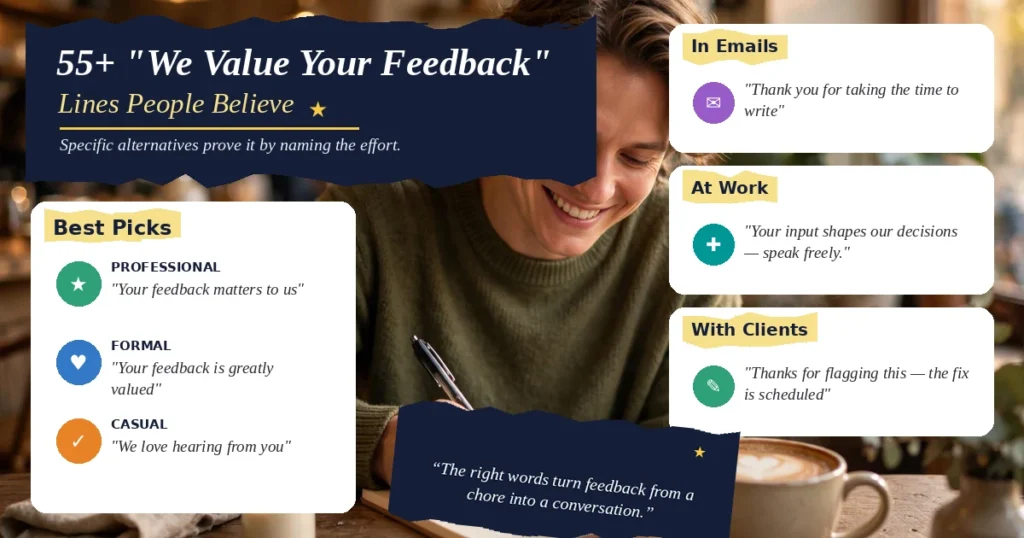
If you are searching for other ways to say “we value your feedback,” you know the phrase has gone stale. Companies paste it into every survey, auto-reply, and support ticket until it means nothing. A professional way to say “we value your feedback” sounds like a human wrote it. It names what the reader did, shows what happens next, and earns the next response. This guide gives you 55 fresh alternatives for emails, surveys, customer service, and workplace conversations. Every alternative includes a tone note, a best-use tip, and a real example you can use immediately.
You will also find a quick comparison table of the top picks, six ready-to-send email examples, common mistakes that make feedback requests fall flat, related expressions, cultural notes for US and UK English, and answers to the fifteen questions readers ask most. Whether you write to customers, colleagues, or clients, you will finish this page with sharper words for every feedback moment.
Meaning of “we value your feedback”
“We value your feedback” is a polite statement that tells someone their opinions, suggestions, or criticisms matter to you or your organization. Businesses use it to encourage responses and to show they take input seriously. It carries a formal, corporate tone, and overuse has made many readers skim past it without feeling anything.
The literal meaning is simple: your feedback has worth to us. The tone depends on what follows. A company that says it and then acts on suggestions sounds genuine. A company that says it into an unmonitored inbox sounds hollow. The purpose is twofold — to invite honest input and to protect the relationship with the person giving it. The emotional context matters because giving feedback takes effort and sometimes courage. When someone reports a problem, “we value your feedback” can feel like a brush-off unless you add specifics. Compare “We value your feedback” with “Thank you for flagging this — the fix is scheduled for Thursday.” The second version proves the value instead of just claiming it. That is the standard every alternative in this guide is built to meet.
When to use “we value your feedback” professionally
The phrase and its alternatives fit any moment when someone gives you input and you want more of it. Use them to close the loop, encourage honesty, and show that speaking up leads somewhere. Here is how the contexts differ.
In emails
Use a feedback-valuing line when replying to suggestions, complaints, and survey responses. Place it early so the reader feels heard before you explain next steps. “Thank you for taking the time to write — your notes are with the product team.” Then say what happens next.
In the workplace
Managers use these phrases in one-to-ones, retrospectives, and team meetings. They signal that honest input is safe and welcome. Be specific about what you will do with the feedback, or the phrase becomes decoration. “Your input shapes our decisions — I am bringing your idea to Monday’s planning session.”
With clients
Clients give feedback when they care about the outcome, so treat it as a gift. “We take your feedback seriously and are reviewing the process this week” shows accountability. Vague thanks without action make clients stop bothering to tell you things.
In networking
When a contact shares advice or an introduction, thank them concretely. “Your perspective means a lot — you see angles I miss” keeps the relationship warm. Networking feedback is personal, so make your gratitude personal too.
In customer service
Support teams hear feedback at the exact moment of frustration. Acknowledge the effort it took to report the issue. “Thanks for flagging this — the fix is scheduled” turns a complainer into a contributor. Log the feedback visibly so the customer believes it landed somewhere.
55 professional alternatives to “we value your feedback”
These alternatives are grouped by tone so you can pick the right one fast. Each entry shows the phrase in bold, a one-line note on tone and best use, and a short example. No two entries repeat the same phrasing.
Professional alternatives
Your feedback matters to us. Warm and professional; the safest all-purpose pick for service messages. Example: “Your feedback matters to us — it shapes every update we ship.”
We appreciate your feedback. Classic and sincere; works in emails, chats, and replies. Example: “We appreciate your feedback on the new dashboard.”
Thank you for your feedback. Direct and grateful; ideal for survey and review responses. Example: “Thank you for your feedback — we have shared it with the product team.”
Your input is important to us. Respectful and steady; suits customer messages and forms. Example: “Your input is important to us, so we read every response.”
We take your feedback seriously. Committed and accountable; best for complaints and criticism. Example: “We take your feedback seriously and are reviewing the process.”
Thank you for sharing your thoughts. Open and friendly-professional; fits meetings and discussions. Example: “Thank you for sharing your thoughts in today’s meeting.”
We are grateful for your input. Sincere and slightly formal; strong for proposal and document feedback. Example: “We are grateful for your input on the proposal.”
Your perspective means a lot. Personal and warm; best for one-to-one conversations. Example: “Your perspective means a lot — you see things we miss.”
Your opinion counts. Encouraging and simple; excellent for surveys and polls. Example: “Your opinion counts — the survey takes two minutes.”
We welcome your suggestions. Inviting and open-ended; fits ongoing programs and forums. Example: “We welcome your suggestions for next quarter’s topics.”
Your insights help us improve. Purposeful and concrete; strong for product and service contexts. Example: “Your insights help us improve every release.”
We appreciate you taking the time. Considerate and human; best after long surveys or interviews. Example: “We appreciate you taking the time to speak with us today.”
Thank you for your honest input. Candid and brave; use it when the feedback was tough to hear. Example: “Thank you for your honest input — it flagged a real gap.”
Your voice matters here. Inclusive and empowering; fits teams and communities. Example: “Your voice matters here, so please keep the ideas coming.”
We are listening. Attentive and modern; natural for social media and support channels. Example: “We are listening — tell us what would make this better.”
Formal alternatives
Your feedback is greatly valued. Formal acknowledgment; suits official letters and statements. Example: “Your feedback is greatly valued by our leadership team.”
We hold your opinions in high regard. Elevated and respectful; best for executive-level messages. Example: “We hold your opinions in high regard and act on them.”
We are sincerely grateful for your input. Formal gratitude; fits written correspondence and reports. Example: “We are sincerely grateful for your input on this matter.”
Your counsel is deeply appreciated. Very formal and dignified; suits advisory and board contexts. Example: “Your counsel is deeply appreciated as we plan ahead.”
We value the insights you have shared. Dignified and precise; works in committee and review settings. Example: “We value the insights you have shared with the committee.”
Please accept our thanks for your feedback. Ceremonial and polite; ideal for formal reply letters. Example: “Please accept our thanks for your feedback on the draft.”
Your contributions are highly esteemed. Elevated and honorific; best for recognition messages. Example: “Your contributions are highly esteemed by the entire board.”
We recognize the value of your input. Corporate and measured; suits official policy statements. Example: “We recognize the value of your input in shaping policy.”
Your considered opinion is appreciated. Precise and flattering; fits expert and specialist feedback. Example: “Your considered opinion is appreciated — few know this field like you.”
We are thankful for your thoughtful feedback. Warm-formal; excellent for detailed, careful responses. Example: “We are thankful for your thoughtful feedback on the redesign.”
Friendly alternatives
We love hearing from you. Warm and enthusiastic; best for newsletters and communities. Example: “We love hearing from you — reply and tell us what you think.”
Keep the ideas coming. Upbeat and energizing; fits creative teams. Example: “Keep the ideas coming — the best ones ship fastest.”
Thanks for speaking up. Encouraging and affirming; natural in meetings. Example: “Thanks for speaking up — that point needed airtime.”
Your two cents matter. Casual and disarming; works in informal team chats. Example: “Your two cents matter — drop them in the thread.”
We are all ears. Playful and open; best for live chats and Q&A sessions. Example: “We are all ears — what should we fix first?”
Tell us what you think. Direct and inviting; strong for surveys and polls. Example: “Tell us what you think — the poll closes Friday.”
Your take helps us grow. Positive and startup-flavored; suits young companies. Example: “Your take helps us grow — keep it coming.”
We are glad you shared that. Affirming and gentle; best for sensitive topics. Example: “We are glad you shared that — it took courage.”
Thanks for the honest take. Casual and real; fits peer-to-peer feedback. Example: “Thanks for the honest take — I will rework the slide.”
Keep the feedback coming. Open and ongoing; ideal for permanent feedback channels. Example: “Keep the feedback coming — this channel stays open.”
Email-ready alternatives
Thank you for taking the time to write. Courteous and personal; best for replying to long emails. Example: “Thank you for taking the time to write — your notes are with the team.”
We appreciate you reaching out. Warm and welcoming; fits inbound messages and cold emails. Example: “We appreciate you reaching out with these suggestions.”
Your email helps us do better. Purposeful and concrete; strong for support replies. Example: “Your email helps us do better — we have logged the issue.”
Thanks for flagging this. Direct and action-oriented; ideal for bug and issue reports. Example: “Thanks for flagging this — the fix is scheduled.”
We have noted your suggestions. Professional and factual; suits formal email replies. Example: “We have noted your suggestions for the next review.”
Your message has been shared with the team. Transparent and reassuring; excellent for service emails. Example: “Your message has been shared with the team this morning.”
Thank you for your detailed response. Appreciative and specific; best for thorough replies. Example: “Thank you for your detailed response — every point is useful.”
We appreciate your thorough review. Respectful and professional; fits document and contract feedback. Example: “We appreciate your thorough review of the contract.”
Your comments have been logged. Factual and clear; natural for ticketing systems. Example: “Your comments have been logged under ticket 5521.”
Thanks for completing our survey. Grateful and closing; perfect for post-survey messages. Example: “Thanks for completing our survey — results go out next week.”
Workplace alternatives
Your input shapes our decisions. Empowering and direct; best for team meetings. Example: “Your input shapes our decisions — speak freely.”
We build on your ideas. Collaborative and credit-giving; fits project work. Example: “We build on your ideas — that is how this feature started.”
Team feedback drives us forward. Motivational and collective; strong for all-hands meetings. Example: “Team feedback drives us forward — keep it honest.”
Your suggestions are on the table. Inclusive and concrete; best for planning sessions. Example: “Your suggestions are on the table for Monday’s review.”
We act on what you tell us. Accountable and bold; suits leadership messages. Example: “We act on what you tell us — last month’s change proves it.”
Every voice counts on this team. Egalitarian and warm; fits culture-building moments. Example: “Every voice counts on this team, including the quiet ones.”
Your experience guides us. Respectful and wise; best for seasoned staff and experts. Example: “Your experience guides us — that is why we asked.”
We improve because you speak up. Causal and encouraging; natural for retrospectives. Example: “We improve because you speak up — do not hold back.”
Your ideas fuel our progress. Energetic and vivid; fits innovation and R&D teams. Example: “Your ideas fuel our progress — the lab runs on them.”
Feedback like yours sets our direction. Strategic and weighty; best for planning and vision work. Example: “Feedback like yours sets our direction for next year.”
Quick comparison table
These ten picks cover nearly every situation. Match the tone to your reader and the channel you are writing in.
| Alternative | Tone | Best use |
|---|---|---|
| Your feedback matters to us | Warm, professional | Service messages |
| We appreciate your feedback | Classic, sincere | Emails and replies |
| We take your feedback seriously | Committed, accountable | Complaints |
| Thank you for sharing your thoughts | Open, friendly | Meetings |
| Your feedback is greatly valued | Formal, respectful | Official letters |
| We hold your opinions in high regard | Elevated, dignified | Executive messages |
| We love hearing from you | Warm, enthusiastic | Newsletters |
| Thanks for flagging this | Direct, action-oriented | Issue reports |
| Your message has been shared with the team | Transparent, reassuring | Support emails |
| Your input shapes our decisions | Empowering, direct | Team meetings |
Email examples
Copy these, swap in your details, and send. Each one pairs gratitude with a concrete next step, because feedback only feels valued when it leads somewhere.
Email to a client
Subject: Your notes on the proposal
Hi Rachel,
Thank you for your detailed response to the proposal. Your point about the timeline is fair, and we are adjusting the milestones this week. We take your feedback seriously, and I will send the revised plan by Friday.
Best,
Michael
Email to your manager
Subject: Re: your comments on the draft
Hi Mr. Lee,
Thank you for sharing your thoughts on the draft. Your suggestion to lead with the results section makes the argument much stronger. I have restructured it and attached the new version.
Regards,
Amara
Email to a colleague
Subject: Re: landing page copy
Hi Jonas,
Thanks for the honest take on the landing page copy. You were right about the headline — it promised too much. I rewrote it along the lines you suggested. Keep the ideas coming.
Cheers,
Sofia
Email to a customer
Subject: Re: your support ticket #5521
Hello,
Thanks for flagging this checkout issue. Your comments have been logged, and our engineers are fixing it today. Your email helps us do better — we will confirm once the fix is live.
Warm regards,
The BrightBox Team
Networking email
Subject: Thank you for the advice
Hi Elena,
Your perspective means a lot — the pricing angle you suggested completely changed how I framed the offer. I wanted you to know your advice landed. Thank you for sharing your thoughts so generously.
Best,
David
Meeting follow-up email
Subject: Follow-up — retrospective actions
Hi team,
Thanks to everyone who spoke up in today’s retrospective. Your suggestions are on the table, and I have assigned owners to the top three. We improve because you speak up — same time next month.
Best,
Tom
Common mistakes to avoid
1. Saying it in every auto-reply
When every template ends with “we value your feedback,” readers stop believing it. Reserve the phrase for moments when you genuinely engage with the input.
2. Thanking without acting
Gratitude with no follow-through teaches people that feedback goes nowhere. Always name the next step: who sees it, what changes, and when.
3. Using it to deflect criticism
“We value your feedback” after a serious complaint can sound like a dodge. Acknowledge the specific problem first, then thank them for raising it.
4. Sounding corporate to a friendly audience
“Your feedback is greatly valued” in a casual community forum feels stiff. Match the register: warm picks for communities, formal picks for official letters.
5. Sounding casual about serious input
“Thanks for the honest take” underplays a whistleblower-style concern. Serious feedback deserves serious language and a serious response.
6. Asking for feedback you will ignore
Surveys nobody reads destroy trust faster than silence. Only request input you have capacity to review, or say plainly what the survey is for.
7. Burying the thanks at the end
Readers skim. Put the gratitude in the first two sentences so the person feels heard before you move to logistics.
8. Forgetting email etiquette basics
A feedback line cannot fix a message with no greeting, no clear subject, or no sign-off. Good email etiquette frames the phrase; it never replaces it.
Related phrases
Thank you for your input. Gratitude for someone’s contribution to a decision. Example: “Thank you for your input — it settled the debate.”
We appreciate your thoughts. A warm acknowledgment of shared ideas. Example: “We appreciate your thoughts on the new policy.”
Your opinion matters. A short, strong encouragement to speak. Example: “Your opinion matters — vote in the poll by Friday.”
Thanks for your candor. Gratitude for honest, possibly blunt feedback. Example: “Thanks for your candor — I needed to hear that.”
We hear you. A brief signal that a message landed. Example: “We hear you — the loud checkout page is getting a redesign.”
Point taken. An acknowledgment that criticism was fair. Example: “Point taken — the instructions were unclear.”
Noted with thanks. A crisp, professional acknowledgment. Example: “Noted with thanks — I will raise it in the review.”
Duly noted. A formal way to say feedback was recorded. Example: “Duly noted — the suggestion is in the minutes.”
Thanks for the heads-up. Gratitude for an early warning. Example: “Thanks for the heads-up about the broken link.”
We will take that on board. A promise to consider the input seriously. Example: “We will take that on board for the next sprint.”
Your suggestion is welcome. An open invitation for more ideas. Example: “Your suggestion is welcome — the floor is open.”
Thanks for keeping us honest. Gratitude for accountability. Example: “Thanks for keeping us honest about the deadlines.”
We could not do this without you. Strong appreciation for contributors. Example: “We could not do this without you — the beta group found every bug.”
Every comment counts. An encouragement aimed at quiet voices. Example: “Every comment counts — even a one-line reply helps.”
Speak your mind. An invitation to be fully honest. Example: “Speak your mind — this is a safe space for tough truths.”
We are open to suggestions. A standing invitation for ideas. Example: “We are open to suggestions on the event format.”
“We value your feedback” vs. its top alternatives
The original phrase is a claim: it states that feedback has value without proving it. That vagueness is its weakness and, in mass communication, its strength. On a survey banner seen by thousands, a short generic line does the job. But in a personal reply, vagueness reads as indifference.
“Thank you for taking the time to write” beats the original by naming the effort. It tells the reader you noticed what giving feedback cost them. Use it in email replies where someone wrote at length. “Thanks for flagging this” goes further by pointing at the specific act — the flag, the catch, the warning — and it pairs naturally with an action: “the fix is scheduled.”
“We take your feedback seriously” carries weight for complaints because “seriously” promises consequences. It suits situations where trust is damaged. “Your input shapes our decisions” is the strongest workplace pick because it hands the reader real power. People give better feedback when they believe it steers the ship.
The pattern is simple. Generic claims suit mass channels. Specific gratitude suits personal replies. Promises of action suit complaints. Pick the alternative that proves the value instead of just declaring it, and readers will keep talking to you.
Cultural usage notes
US English
American business writing favors direct warmth. “Thanks for your feedback” and “We appreciate you reaching out” dominate inboxes, and casual picks like “We are all ears” feel normal in startups. Americans expect a visible next step — feedback without follow-up reads as a black hole.
UK English
British business writing leans polite and understated. “We are grateful for your input” and “Noted with thanks” are standard, and “We will take that on board” is the classic British promise to consider something. Over-enthusiasm can read as insincere, so keep the tone measured.
Corporate communication
Large companies standardize on “We appreciate your feedback” and “Your feedback is greatly valued” in official messages. The plural “we” distributes responsibility, and the formal register protects the brand. Personalized follow-ups sit with account teams, not in the template.
Customer service
Support scripts worldwide pair a feedback phrase with proof of action. “Thanks for flagging this — your comments have been logged under ticket 5521” works because the ticket number makes the value tangible. Vague thanks without a reference number feel empty.
Networking
In networking, feedback thanks are always personal. “Your perspective means a lot” beats any corporate line because the relationship is one-to-one. Mention what you did with the advice — nothing flatters an advisor like seeing their idea in action.
Frequently asked questions
What is a professional way to say “we value your feedback”?
“Your feedback matters to us” is the most professional all-purpose choice. It sounds warm in emails, service messages, and surveys. Add a next step — who reads it and what changes — to make it believable.
What is a formal alternative to “we value your feedback”?
“Your feedback is greatly valued” and “We hold your opinions in high regard” are strong formal alternatives. They suit official letters, board messages, and executive correspondence where the register must stay elevated.
Is “we value your feedback” overused?
Yes, in templates and auto-replies it has become wallpaper. It still works when followed by real action. If you cannot show the action, pick a more specific alternative like “Thanks for flagging this.”
What is a synonym for “we value your feedback”?
Common synonyms include “We appreciate your feedback,” “Your input is important to us,” “We are listening,” and “Thank you for sharing your thoughts.” Each fits a different tone and channel.
How do you say “we value your feedback” in a business email?
Write something like: “Thank you for taking the time to write. Your notes are with the product team, and I will update you next week.” Lead with gratitude, then name the next step.
How do you respond to customer feedback politely?
Thank them specifically and show the action: “Thanks for flagging this — the fix is scheduled for Thursday.” Specific responses turn one-time complainers into loyal contributors.
What can I say instead of “we value your feedback” in a survey?
Try “Your opinion counts — the survey takes two minutes” at the start and “Thanks for completing our survey — results go out next week” at the end. Tell people their time matters and what happens with it.
How do you thank someone for honest criticism?
Say “Thank you for your honest input — it flagged a real gap.” Naming the value of the criticism shows you heard it instead of just enduring it. Then explain what you will change.
What is a polite way to ask for feedback?
“We welcome your suggestions” and “Tell us what you think” are polite, low-pressure asks. Keep the request short, say how long it takes, and explain what the feedback is for.
Can I say “we value your feedback” to my boss?
You can, but a personal version lands better: “Thank you for sharing your thoughts — your suggestion made the argument stronger.” Upward feedback thanks should name the specific help you received.
What is the difference between “feedback” and “input”?
“Feedback” usually reacts to something that already exists, like a product or draft. “Input” often shapes something still being decided. Both deserve thanks, but “input” phrases suit planning while “feedback” phrases suit reviews.
How do I encourage more feedback from my team?
Use empowering language like “Your input shapes our decisions” and then visibly act on what you hear. Teams speak up when past feedback led to real changes, not when the invitation sounds nice.
Is “noted with thanks” professional?
Yes, it is crisp and professional, especially in British business English. It suits quick acknowledgments. For warmer relationships, choose “Thank you for sharing your thoughts” instead.
What should I avoid when responding to feedback?
Avoid generic thanks with no action, defensive replies, and delayed responses. Never punish honest criticism — one punished truth-teller silences the whole team.
How long should a feedback thank-you email be?
Keep it to three to five sentences: thank them specifically, name what happens next, and close warmly. Short replies get read; long ones get skimmed.
Conclusion
Quick picks — Professional: “Your feedback matters to us” and “We appreciate your feedback.” Formal: “Your feedback is greatly valued” and “We hold your opinions in high regard.” Friendly-casual: “We love hearing from you” and “Thanks for speaking up.” Email: “Thank you for taking the time to write” and “We appreciate you reaching out.”
Feedback is a gift, but only when the giver feels heard. Thank people specifically, name what happens next, and never let gratitude stand alone without action. Match the register to the reader — warm for communities, measured for executives. Do that consistently, and the feedback will keep coming.
Related Articles
- Other Ways to Say Thank You | 50+ Professional Alternatives
- Other Ways to Say Sorry for the Inconvenience
- Other Ways to Say Please Advise (2026 Guide)
- 50 Other Ways to Say Let Me Know What You Think
- Other Ways to Say Please Find Attached (2026 Guide)
- 55+ “I Appreciate It” Alternatives That Sound Sincere
- 50+ “Thank You for the Clarification” Alternatives




