
Introduction
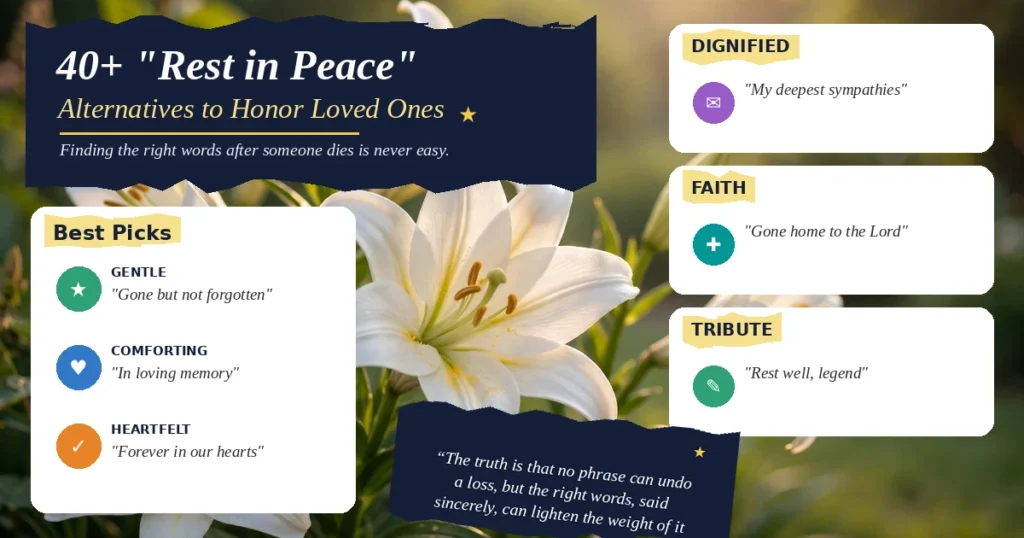
Finding the right words after someone dies is never easy. If you are searching for ways to say rest in peace, you want phrases that feel sincere, respectful, and comforting, not flat or rehearsed. The words we choose in moments of grief carry real weight: they can bring comfort to a grieving family or, said carelessly, fall hollow. This guide gives you 40 thoughtful alternatives, grouped by tone and situation, so you always have the right words. Whether you are writing a sympathy card, sending a message to a coworker, or posting a tribute online, you will find language that honors the person who died and supports the people left behind. Choose with care, speak from the heart, and let these gentle expressions help you say what matters most.
Meaning
“Rest in peace” is a traditional expression of sympathy used to wish that a person who has died will rest free from suffering, and to express sorrow for their loss. It comes from the Latin phrase “requiescat in pace” and is commonly used on gravestones, in funeral services, sympathy cards, and messages of condolence. It carries a tone of peace, release, and respect for the departed.
Professional usage
In professional settings, condolences need to be brief, dignified, and warm without becoming personal or overly emotional. Here is when each type of message fits best.
Workplace condolences
When a coworker loses someone, acknowledge the loss and offer support without prying. A short line like “I was so sorry to hear about your loss” works well. Keep it kind and let them know work will be handled while they are away.
Client messages
With clients, stay formal and respectful. “Please accept my sincere condolences on the passing of your loved one” is a safe, professional choice. Avoid casual phrases and keep the tone polished.
Formal sympathy notes
A written sympathy note to a business contact should be short, structured, and sincere. Express sadness, acknowledge the person who died, and close with an offer of support. Handwritten notes feel especially respectful.
Team announcements
When informing a team that a colleague has lost a family member, be factual and gentle. Share only what the family has approved, give the team’s wishes of support, and respect privacy. If you need to inform someone about a difficult delay in the process, use gentle phrasing like showing patience to keep the tone respectful.
Alternatives
Below are 40 respectful ways to say rest in peace, grouped by tone so you can pick the one that fits the moment. Each phrase notes its best use and includes a short example sentence.
Gentle & comforting
These soft, warm expressions suit close friends, family, and personal messages where tenderness matters more than formality.
- Gone but not forgotten — Warm and timeless; best for sympathy cards and tributes to someone who will be remembered. Example: “Your father is gone but not forgotten; his stories will live on in all of us.”
- In loving memory — Tender and classic; perfect for memorial messages, photo tributes, and dedication lines. Example: “In loving memory of a man who made every room brighter.”
- Forever in our hearts — Deeply personal; ideal for messages to a grieving family you know well. Example: “She will be forever in our hearts and in every memory we share.”
- At peace at last — Comforting; suggests the person’s suffering has ended, gentle for those who were ill. Example: “After a long illness, he is at peace at last, surrounded by love.”
- Sleep well, dear friend — Soft and intimate; best for a close friend or someone you knew personally. Example: “Sleep well, dear friend; thank you for all the laughter you gave us.”
- May you rest easy — Calm and kind; works in cards, texts, and quiet conversations about loss. Example: “May you rest easy, knowing how deeply you were loved.”
- Their light will never fade — Poetic and warm; a beautiful line for tributes and eulogies. Example: “Her light will never fade from the lives she touched.”
- Holding them in our hearts — Gentle and collective; good when speaking for a family or community. Example: “We are holding them in our hearts today and always.”
Formal & dignified
These polished expressions fit business settings, official statements, and condolences to people you do not know well.
- My deepest sympathies — Formal and respectful; the standard line for professional condolence messages. Example: “My deepest sympathies to you and your family on the loss of your mother.”
- Please accept my sincere condolences — Dignified and traditional; ideal for letters, client messages, and official notes. Example: “Please accept my sincere condolences on the passing of your colleague.”
- With heartfelt sympathy — Formal but warm; a strong closing line for sympathy cards and letters. Example: “With heartfelt sympathy, we wish you strength in the days ahead.”
- They will be dearly missed — Respectful and understated; suits notices, announcements, and workplace messages. Example: “Mr. Thompson will be dearly missed by everyone at the company.”
- Honoring a life well lived — Dignified and celebratory; best for obituaries and memorial services. Example: “Today we are honoring a life well lived, full of service and kindness.”
- A life of grace and dignity — Elevated and reverent; fits formal tributes and published memorials. Example: “She lived a life of grace and dignity, and leaves a lasting legacy.”
- With profound respect — Solemn and formal; good for official statements and messages to leadership. Example: “We received the news with profound respect and deep sadness.”
- Forever remembered, forever missed — Polished and timeless; works for plaques, programs, and formal cards. Example: “Forever remembered, forever missed — our thoughts are with the family.”
Faith-based
These expressions bring comfort through faith. Use them when you know the family’s beliefs and they align with yours.
- Gone home to the Lord — Christian and comforting; best when the family holds Christian faith. Example: “She has gone home to the Lord, where there is no more pain.”
- May they rest with the angels — Gentle faith imagery; suits Catholic and Christian sympathy messages. Example: “May they rest with the angels and watch over you always.”
- In God’s hands now — Reassuring and simple; good for believers seeking peace after a loss. Example: “He is in God’s hands now, and at peace.”
- May God grant them eternal peace — Prayerful and respectful; a strong line for cards and funeral messages. Example: “May God grant them eternal peace and comfort your family.”
- Blessed are those who mourn — Scriptural and soothing; fits notes referencing faith and scripture. Example: “Blessed are those who mourn, for they shall be comforted.”
- May their soul be at peace — Spiritual and inclusive; works across many faith traditions. Example: “May their soul be at peace, and may your memories bring you comfort.”
- Called home to glory — Uplifting faith language; best for memorial services and church announcements. Example: “After 92 wonderful years, she has been called home to glory.”
- Resting in God’s eternal care — Calm and reverent; a tender way to close a faith-based condolence. Example: “Your grandmother is resting in God’s eternal care now.”
For cards & flowers
Short, elegant lines that fit on sympathy cards, flower ribbons, and gift enclosures.
- Thinking of you with sympathy — Brief and kind; a classic card message. Example: “Thinking of you with sympathy during this difficult time.”
- With love and remembrance — Warm and compact; perfect for flower cards. Example: “With love and remembrance, from all of us at the office.”
- In sympathy and sorrow — Simple and traditional; suits small enclosures. Example: “In sympathy and sorrow, we send our love.”
- May peace be with you — Gentle and brief; good for cards when words feel hard. Example: “May peace be with you and your family.”
- Our hearts are with you — Caring and concise; ideal for group-signed cards. Example: “Our hearts are with you — with love from the whole team.”
- Cherished always — Short and sweet; fits small cards and photo frames. Example: “Cherished always, by everyone who knew her.”
- Loved and remembered — Elegant and minimal; a lovely ribbon or card line. Example: “Loved and remembered, today and forever.”
- Deepest sympathy, with love — Personal yet brief; good for cards to friends. Example: “Deepest sympathy, with love — we are here for you.”
For social tributes
Respectful lines for online memorials, social media posts, and shared memories.
- Rest well, legend — Admiring and warm; best for public figures or beloved community members. Example: “Rest well, legend. Your music will play on forever.”
- A beautiful soul, gone too soon — Emotional and sincere; common in heartfelt online tributes. Example: “A beautiful soul, gone too soon. We will miss your smile.”
- Fly high — Brief and uplifting; often used with a photo of someone young or free-spirited. Example: “Fly high, cousin. We love you and we will see you again.”
- Your legacy lives on — Respectful and lasting; honors what the person built or gave. Example: “Your legacy lives on in every student you taught.”
- One of the good ones — Sincere and simple; a genuine tribute for a kind person. Example: “One of the good ones — the neighborhood will never be the same.”
- Grateful for every moment — Warm and reflective; good for photo tributes and memory posts. Example: “Grateful for every moment we had with you, Grandpa.”
- Watching over us now — Comforting and spiritual; suits posts addressed to the departed. Example: “Watching over us now — keep us safe, Dad.”
- Forever our guiding star — Poetic and enduring; a strong line for memorial pages. Example: “Forever our guiding star. We will carry your light forward.”
Quick comparison
| Alternative | Tone | Best use |
|---|---|---|
| Gone but not forgotten | Gentle, timeless | Sympathy cards and tributes |
| My deepest sympathies | Formal, respectful | Professional condolence messages |
| In loving memory | Tender, classic | Memorial messages and dedications |
| Please accept my sincere condolences | Dignified, traditional | Letters and client messages |
| Forever in our hearts | Deeply personal | Messages to a grieving family |
| Gone home to the Lord | Christian, comforting | Faith-based families |
| Thinking of you with sympathy | Brief, kind | Sympathy cards |
| Rest well, legend | Admiring, warm | Social tributes to beloved figures |
| They will be dearly missed | Respectful, understated | Workplace announcements |
| May their soul be at peace | Spiritual, inclusive | Cross-faith condolence notes |
Email examples
These templates show how to use condolence phrases naturally in workplace writing. Adjust the names and details to fit your situation.
To a coworker
Subject: Thinking of you
Hi Sarah,
I was so sorry to hear about your father’s passing. Please take all the time you need — we will take care of everything here. Gone but not forgotten; I know how much he meant to you.
With sympathy,
James
To your manager
Subject: My sincere condolences
Dear Ms. Carter,
Please accept my sincere condolences on the loss of your mother. If there is anything I can do to support you or the team during this time, please let me know. If you ever need my help, do not hesitate to ask.
Kind regards,
Daniel
To a client
Subject: Condolences
Dear Mr. Lawson,
We were saddened to hear of your loss. Please accept our sincere condolences, and know that our thoughts are with you and your family. If you need flexibility on any deadlines, we completely understand.
With sympathy,
The team at Brightfield
To a customer
Subject: Re: Your support ticket #4821
Hello,
We were sorry to learn about your recent loss. Your account will be handled with care, and there is no rush on anything pending. If any reply takes a little longer than usual, we ask you to understand our situation during this time.
Warm regards,
Customer care team
Condolence note
Dear Anna,
There are no words that can truly comfort you right now, but please know I am thinking of you. Your grandmother was a wonderful woman, and she will be forever in our hearts. I am here if you need anything at all.
With love,
Maria
Team announcement
Team,
It is with sadness that I share that David’s father passed away yesterday. Please join me in keeping David and his family in our thoughts. We ask that you show patience with response times this week while he is away, and direct urgent matters to Lisa in the meantime.
Thank you,
Rachel
Common mistakes
1. Using the phrase as a throwaway line
Saying “rest in peace” quickly and moving on can sound empty. Pause, be sincere, and say it like you mean it.
2. Adding humor or jokes
Grief is not the moment for jokes, even gentle ones. Avoid funny lines entirely; save them for a later, happier time.
3. Making it about yourself
Do not center your own story or a bigger loss you experienced. Keep the focus on the grieving person and their loved one.
4. Assuming religious beliefs
Faith-based phrases comfort only when shared beliefs exist. When in doubt, choose a neutral, respectful line instead of a religious one.
5. Saying “I know how you feel”
You cannot know exactly how someone feels in grief. Saying it can sound dismissive, so say “I cannot imagine what you are going through” instead.
6. Writing a long, rambling message
Long condolence messages can overwhelm a grieving person. Keep it short, sincere, and focused — two or three sentences are often enough.
7. Avoiding the person’s name
Saying “your loss” instead of the loved one’s name can feel cold. Using their name honors them and shows genuine care.
8. Forgetting to follow up later
Grief does not end after the funeral. Check in again in a few weeks; a simple “I am still thinking of you” means a great deal.
Related phrases
These related expressions of sympathy each carry a slightly different shade of meaning. Learn them to widen your comforting vocabulary.
- My condolences — A short, formal way to express sympathy; “My condolences on the loss of your father.”
- I am so sorry for your loss — The most common English condolence; sincere in almost every situation. Example: “I am so sorry for your loss. Please let me know if you need anything.”
- Thinking of you — A gentle note that you care, without many words. Example: “Thinking of you and your family during this hard time.”
- You are in my prayers — A faith-based comfort showing spiritual support. Example: “You are in my prayers, and I hope they bring you peace.”
- Wishing you strength — Offers encouragement for the hard days ahead. Example: “Wishing you strength and comfort in the weeks to come.”
- With deepest sympathy — A formal card-ready line. Example: “With deepest sympathy on the passing of your beloved husband.”
- He was a wonderful man — Personal praise that honors the departed. Example: “He was a wonderful man; I will never forget his kindness.”
- She touched so many lives — Celebrates the person’s impact. Example: “She touched so many lives, and hers will be remembered with love.”
- What a tremendous loss — Acknowledges the size of the grief. Example: “What a tremendous loss for your family and the whole community.”
- I share your grief — Shows you are mourning too. Example: “I share your grief; he meant a great deal to all of us.”
- May you find comfort — A soft wish for healing. Example: “May you find comfort in your memories and in each other.”
- In this time of sorrow — A gentle opening for sympathy notes. Example: “In this time of sorrow, please know we are thinking of you.”
- A life beautifully lived — Honors a full, meaningful life. Example: “A life beautifully lived — we celebrate everything she gave us.”
- Gone too soon — Expresses the pain of an early death. Example: “Gone too soon, but never forgotten by those who loved him.”
- Until we meet again — A hopeful, faith-tinged farewell. Example: “Until we meet again, dear friend — thank you for everything.”
- Their memory is a blessing — A traditional Jewish-inspired comfort. Example: “Their memory is a blessing to everyone who knew them.”
- Peace be upon them — A respectful wish for the departed’s rest. Example: “Peace be upon them, and comfort to all who loved them.”
Phrase comparison
“Rest in peace” itself is calm, brief, and universally understood, which is why it appears on gravestones and in headlines. Its strength is simplicity, but that same simplicity can make it feel impersonal in a handwritten card. “Gone but not forgotten” shifts the focus from the person’s rest to the living memory they leave behind, making it warmer for family tributes. “My deepest sympathies” moves in the opposite direction: it says nothing about the departed and everything about your respect for the grieving, which is exactly right in professional settings. Faith-based lines like “gone home to the Lord” add spiritual hope, but they belong only where the family’s beliefs make them welcome. The best choice is never about which phrase sounds nicest in isolation; it is about who is grieving, what you knew of the person who died, and how close you stand to the family. Match the tone to the relationship, keep the words simple and honest, and the message will land.
Cultural usage
US English
In American English, “rest in peace” is used broadly, including on social media after public deaths. Americans often add personal warmth, such as “rest in peace, beautiful soul,” and longer messages are common.
UK English
British usage tends toward understatement. Short, restrained lines like “so sorry for your loss” or “with deepest sympathy” are preferred, and effusive language can feel over the top.
Faith traditions
Christian families often welcome phrases like “gone home to the Lord.” Jewish tradition favors “may their memory be a blessing.” Muslim condolences often include “inna lillahi wa inna ilayhi raji’un” (we belong to God and to Him we return). Always follow the family’s own customs rather than introducing your own.
Workplace etiquette
At work, keep condolences brief, formal, and private unless the family has shared the news publicly. A group-signed card is a kind gesture, and managers should offer practical support like time off. When a bereaved colleague returns, a quiet word like “I missed you while you were away” can mean more than a grand speech.
Frequently asked questions
What does “rest in peace” mean?
“Rest in peace” is a wish that a person who has died will rest free from suffering. It comes from the Latin “requiescat in pace” and is used to express sympathy and respect for the departed.
Is it okay to say “rest in peace” to anyone?
It is respectful in most situations, but consider the family’s beliefs. Faith-based alternatives may suit religious families better, while a simple “I am so sorry for your loss” works universally.
What is a nicer way to say “rest in peace”?
“Gone but not forgotten,” “in loving memory,” and “forever in our hearts” are warmer, more personal options. The nicest choice depends on your relationship with the grieving family.
Can I say “rest in peace” in a work email?
Yes, but it is usually better to use a fuller professional phrase like “please accept my sincere condolences.” Keep the tone formal and the message brief.
What should I write in a sympathy card?
Two to four sincere sentences are enough: express sadness, mention the person by name, and offer support. “In loving memory of a kind soul — our hearts are with you” is a strong, simple example.
What should I not say to someone who is grieving?
Avoid clichés like “they are in a better place” unless you share the person’s faith, never make jokes, and do not say “I know how you feel.” Keep the focus on them, not on yourself.
How do I express condolences to a client?
Use a formal, polished line such as “Please accept our sincere condolences on your loss.” Offer practical flexibility, like extended deadlines, and keep the message short.
Is “rest in peace” religious?
It has Latin and Christian roots, but today it is used widely by people of many beliefs as a general expression of sympathy. If the family is not religious, neutral phrases like “with deepest sympathy” are safer.
What do I say at a funeral?
Keep spoken words simple: “I am so sorry for your loss” or “He will be dearly missed.” If you speak at the service, share one genuine memory rather than many polished sentences.
How do I comfort a grieving friend over text?
Short is fine: “Thinking of you. She will be forever in our hearts.” A text cannot replace presence, but it shows you care. Follow up with a call or visit when you can.
What is a good tribute phrase for social media?
“Gone but not forgotten,” “rest well, legend,” and “your legacy lives on” are popular for online tributes. Pair the words with a genuine memory or photo rather than a generic line.
Should I mention the cause of death?
No. Never mention or speculate about the cause of death in a condolence message. Focus on the person, the memories, and your support for the family.
How long should a condolence message be?
Two to five sentences is ideal. Grieving people are overwhelmed, so short, sincere messages are easier to receive than long letters. A longer note is fine only if you were very close.
What if I did not know the person who died?
You can still offer comfort: “I did not have the honor of knowing him, but I know how much he meant to you. Please accept my deepest sympathies.” Honesty is always better than pretending.
How do I follow up after the funeral?
Grief lasts long after the service. A few weeks later, send a simple message: “I am still thinking of you.” If they need a helping hand, offer something specific, like bringing a meal, rather than a vague “let me know if you need anything.” And always thank them for trusting you if they share their feelings with you — gratitude keeps the connection warm.
Conclusion
If you remember nothing else, keep these best picks: from the gentle group, “gone but not forgotten” and “in loving memory”; from the formal group, “my deepest sympathies” and “please accept my sincere condolences”; from the faith-based group, “gone home to the Lord” and “may their soul be at peace”; from cards and flowers, “thinking of you with sympathy” and “with love and remembrance”; and from social tributes, “rest well, legend” and “your legacy lives on.”
Grief asks so little of us and yet gives us so few words that feel big enough. The truth is that no phrase can undo a loss, but the right words, said sincerely, can lighten the weight of it for a moment. Speak gently, honor the person who died by name, and let your kindness do the rest. For the formal definition of this kind of sympathy, you can read more about condolence in the Cambridge Dictionary.