Introduction
If you are searching for other ways to say have a good rest of the day, you are in the right place. This warm little sign-off shows up everywhere: at the end of customer service calls, in work emails, and in friendly chats. It is polite and kind, but it can start to sound stale if you use it ten times before lunch.
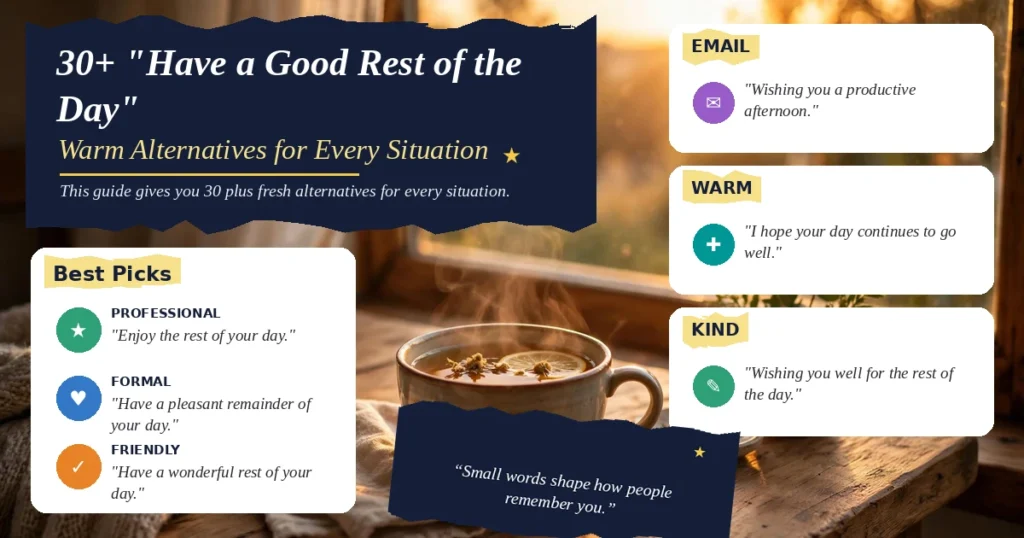
This guide gives you 30 plus fresh alternatives for every situation. You will find professional options for clients, formal picks for official messages, friendly lines for people you know well, email-ready closings, and workplace favorites for coworkers. Each one comes with a tone note, a best-use tip, and a short example you can copy or adapt.
Why bother changing it up? Small words shape how people remember you. A varied closing sounds more personal and thoughtful than the same line on repeat. It shows you chose your words for this person and this moment, not for a script. Listeners and readers notice that extra effort, even if they cannot name it.
Below, you will find everything you need to close conversations with warmth and confidence. Read the meaning and usage notes first, then pick your favorite alternatives. By the end of this guide, you will never run out of ways to wish someone well.
Meaning
“Have a good rest of the day” is a polite wish you share when a conversation or meeting ends. It means you hope the remaining hours of the person’s day go well and feel pleasant. People use it as a friendly closing in phone calls, emails, and chats.
The phrase works best from mid-morning through the late afternoon. The words “rest of the day” point to the hours that are still ahead, so it makes little sense at nine in the morning or after sunset. It carries a warm, caring tone without sounding too personal or too stiff.
It also signals that a conversation is ending. When you say it, the other person understands that you are wrapping up. That makes it useful in customer service, office life, and casual chats. The wish feels genuine because it focuses on the other person’s comfort, not on your own plans.
Professional usage
In professional settings, this phrase works as a safe and polite closing. Use it after client calls, support chats, and business meetings. It shows courtesy without creating pressure or demanding a reply.
Match the tone to the relationship. With long-term clients, a warmer version fits well. With new contacts, keep it simple and polished. Always check the time zone of the reader before you use it. Sending “have a good rest of the day” to someone who is starting their morning can feel odd.
In writing, place the wish in the final line of your email, right before your sign-off. In speech, say it slowly and with a smile in your voice. That small pause makes the wish sound sincere instead of rushed. If your reader is clearly swamped, acknowledge that first with ideas like other ways to say I know you are busy, then add your warm closing.
Alternatives
Below are 35 polished alternatives, sorted into five tone groups. Pick the group that matches your situation, then choose the line that fits your voice. Each entry tells you the tone, the best use, and a short example.
Professional
Enjoy the rest of your day.
Tone: warm and professional. Best use: ending client calls and sales conversations.
Example: “Thanks for your time. Enjoy the rest of your day.”
Have a pleasant remainder of your day.
Tone: polished and courteous. Best use: formal client emails and support tickets.
Example: “I have attached the report. Have a pleasant remainder of your day.”
Wishing you a productive afternoon.
Tone: upbeat and work-focused. Best use: messages to colleagues and business partners.
Example: “Let me know if you need anything. Wishing you a productive afternoon.”
Hope the rest of your day goes smoothly.
Tone: caring and professional. Best use: after helping a customer solve a problem.
Example: “Your issue is now resolved. Hope the rest of your day goes smoothly.”
Enjoy the rest of your afternoon.
Tone: light and friendly. Best use: mid-day calls and quick check-ins.
Example: “Great catching up. Enjoy the rest of your afternoon.”
Have a wonderful rest of your day.
Tone: warm with a touch of enthusiasm. Best use: polite endings to video meetings.
Example: “We will follow up next week. Have a wonderful rest of your day.”
I hope your day continues to go well.
Tone: sincere and thoughtful. Best use: after delivering good news or results.
Example: “Your request is approved. I hope your day continues to go well.”
Formal
I wish you a pleasant remainder of the day.
Tone: formal and respectful. Best use: official letters and first-time business contacts.
Example: “Thank you for your attention. I wish you a pleasant remainder of the day.”
May the rest of your day be pleasant.
Tone: dignified and courteous. Best use: formal correspondence with senior clients.
Example: “We value your partnership. May the rest of your day be pleasant.”
Have a good day ahead.
Tone: refined and simple. Best use: closing remarks in presentations and meetings.
Example: “That concludes the briefing. Have a good day ahead.”
Wishing you well for the rest of the day.
Tone: formal with a hint of warmth. Best use: messages to executives and officials.
Example: “I will send the documents shortly. Wishing you well for the rest of the day.”
I trust the remainder of your day will be pleasant.
Tone: very formal. Best use: diplomatic or legal correspondence.
Example: “We appreciate your cooperation. I trust the remainder of your day will be pleasant.”
Have a splendid rest of the day.
Tone: elegant and slightly old-fashioned. Best use: luxury service and hospitality.
Example: “Your suite is ready. Have a splendid rest of the day.”
Enjoy your day ahead.
Tone: formal yet warm. Best use: hotel, airline, and concierge messages.
Example: “Breakfast is served until ten. Enjoy your day ahead.”
Friendly
For playful sign-off ideas beyond this list, check our guide to funny ways to say goodbye for even more casual options.
Have an awesome rest of your day.
Tone: cheerful and casual. Best use: chats with friends and close coworkers.
Example: “Talk later. Have an awesome rest of your day.”
Hope your day keeps getting better.
Tone: caring and personal. Best use: cheering up a friend who feels low.
Example: “Lunch helped, right? Hope your day keeps getting better.”
Enjoy the rest of your day, friend.
Tone: warm and familiar. Best use: informal texts and social media chats.
Example: “Thanks for the playlist. Enjoy the rest of your day, friend.”
Have a great rest of your day.
Tone: upbeat and relaxed. Best use: everyday goodbyes with people you know.
Example: “See you at dinner. Have a great rest of your day.”
Make the rest of your day amazing.
Tone: playful and encouraging. Best use: motivating a friend before an event.
Example: “You will do great in the interview. Make the rest of your day amazing.”
Catch you later, have a good one.
Tone: casual and breezy. Best use: quick farewells with classmates or teammates.
Example: “Off to practice. Catch you later, have a good one.”
Hope the rest of your day is as great as you are.
Tone: sweet and affectionate. Best use: messages to a partner or close friend.
Example: “Thinking of you. Hope the rest of your day is as great as you are.”
Email-ready
Thank you, and have a good rest of your day.
Tone: polite and professional. Best use: closing service and support emails.
Example: “Your ticket is now closed. Thank you, and have a good rest of your day.”
Wishing you a smooth rest of the day.
Tone: calm and professional. Best use: follow-up emails and status updates.
Example: “I will check in tomorrow. Wishing you a smooth rest of the day.”
Enjoy the rest of your day. Best regards, Sam.
Tone: classic email style. Best use: routine business correspondence.
Example: “The invoice is attached. Enjoy the rest of your day. Best regards, Sam.”
Hope you have a wonderful afternoon.
Tone: friendly and professional. Best use: emails sent before three in the afternoon.
Example: “I have sent the files. Hope you have a wonderful afternoon.”
Thanks again, and enjoy the rest of your day.
Tone: appreciative and warm. Best use: after someone helps you or answers your questions.
Example: “That clears it up. Thanks again, and enjoy the rest of your day.”
Have a pleasant afternoon ahead.
Tone: neat and professional. Best use: scheduling and confirmation emails.
Example: “Your appointment is confirmed. Have a pleasant afternoon ahead.”
Wishing you a calm and pleasant rest of the day.
Tone: gentle and considerate. Best use: emails after a stressful or busy exchange.
Example: “No rush on the reply. Wishing you a calm and pleasant rest of the day.”
Workplace
Pair these closings with a quick thank-you like I appreciate it to leave coworkers with a genuinely warm feeling.
Have a good one, team.
Tone: casual and team-spirited. Best use: signing off from group chats.
Example: “Wrapping up for the day. Have a good one, team.”
Enjoy the rest of your workday.
Tone: friendly and professional. Best use: office messages and standup endings.
Example: “Standup is done. Enjoy the rest of your workday.”
Hope your shift goes well.
Tone: caring and direct. Best use: speaking to service and retail coworkers.
Example: “I am clocking out. Hope your shift goes well.”
Have a great rest of your day at work.
Tone: warm and collegial. Best use: messages to coworkers across departments.
Example: “Thanks for the update. Have a great rest of your day at work.”
Wishing you an easy afternoon at the office.
Tone: relaxed and kind. Best use: chatting with desk mates and office friends.
Example: “Back to the reports. Wishing you an easy afternoon at the office.”
Take care and have a good rest of your day.
Tone: warm and caring. Best use: leaving the office or ending a shift.
Example: “I am heading out. Take care and have a good rest of your day.”
Hope the rest of your day at work flies by.
Tone: lighthearted and supportive. Best use: comforting coworkers on busy days.
Example: “Only two meetings left. Hope the rest of your day at work flies by.”
Quick comparison
If you need a fast pick, scan this table and choose the line that fits your tone and situation.
| Alternative | Tone | Best use |
|---|---|---|
| Enjoy the rest of your day | Warm professional | Client calls and sales talks |
| Have a pleasant remainder of your day | Polished | Formal client emails |
| Wishing you a productive afternoon | Upbeat | Colleagues and partners |
| Have an awesome rest of your day | Cheerful | Friends and close coworkers |
| Make the rest of your day amazing | Playful | Motivating someone |
| Thank you, and have a good rest of your day | Polite | Support emails |
| Hope you have a wonderful afternoon | Friendly professional | Mid-day emails |
| Enjoy the rest of your workday | Collegial | Office messages |
| Hope your shift goes well | Caring | Service and retail teams |
Email examples
Real emails make these closings feel natural. Copy the tone of the snippets below and adjust the details to fit your message. For client emails, you can also combine your closing with a forward-looking line like looking forward to your call. In a thank-you message to a manager, you might pair your wish with a note like thank you for taking care of this.
To a colleague
Hi Dana,
I finished the draft of the report. Please review the second section when you get a chance. I will update the slides once you send your notes.
Wishing you a productive afternoon.
Best,
Mira
To a client
Dear Mr. Harris,
Thank you for meeting with us today. The proposal is attached, and I have highlighted the changes you requested. Please let me know if anything needs more detail.
Have a pleasant remainder of your day.
Kind regards,
Tom
To a manager
Hi Sarah,
The budget sheet is ready for your review. I included the notes from yesterday’s meeting. Let me know if you want me to change any numbers before Friday.
Thanks again, and enjoy the rest of your day.
Best,
Ali
To a customer
Hello,
Your order has been shipped and should arrive by Thursday. You can track the package with the link below. If anything is wrong with the delivery, just reply to this email and we will fix it.
Support agents often close with a line like my pleasure to help before the final wish, so here is the full ending:
It was my pleasure to help. Thank you, and have a good rest of your day.
Warm regards,
The Support Team
To a friend
Hey! Had so much fun at lunch today. Let’s do it again next week. I will text you about the movie night once I check the timings.
Have an awesome rest of your day!
Common mistakes
These small errors can make a warm wish sound odd or careless. Avoid them and your closings will always land well.
1. Using it late at night
The phrase points to the hours ahead, so it sounds strange after sunset. Switch to “have a good evening” or “good night” in the evening.
2. Repeating it twice in one message
Say it once, at the end. Repeating it in the opening and the closing makes the message feel robotic.
3. Mixing it with “good morning”
Never pair it with a morning greeting. The two wishes point in opposite directions and confuse the reader.
4. Adding it to very formal legal writing
Contracts and legal notices need a plain, neutral tone. A warm wish can look out of place there.
5. Forgetting the reader’s time zone
A reader in another country may be starting their day when you are ending yours. Check the time difference first.
6. Using it as an opening line
This phrase closes conversations; it never opens them. Starting with it makes the message feel backwards.
7. Pairing it with a complaint
Do not end a complaint email with this wish. The warm tone clashes with a frustrated message.
8. Sounding robotic by overusing it
If every call ends with the same sentence, it loses its warmth. Rotate through a few alternatives to stay genuine.
Related phrases
These expressions share the same warm spirit. Use them to add variety to your closings and everyday wishes.
Have a nice day. A simple and universal wish for a pleasant day. Example: “Thanks for shopping with us. Have a nice day.”
Have a great day. A slightly stronger and warmer version of the classic wish. Example: “Good luck with the test. Have a great day.”
Enjoy your day. A short and friendly wish for someone to savor their day. Example: “The sun is out. Enjoy your day.”
Have a good one. A casual and relaxed way to wish someone well. Example: “See you tomorrow. Have a good one.”
Take care. A warm wish that also shows concern for the person’s safety. Example: “Drive safe. Take care.”
Have a wonderful day. A warm and enthusiastic wish for a lovely day. Example: “Happy birthday. Have a wonderful day.”
Have a lovely afternoon. A gentle wish suited for the afternoon hours. Example: “I will call you later. Have a lovely afternoon.”
Have a good evening. The right wish for the hours after work. Example: “Enjoy your dinner. Have a good evening.”
Have a pleasant day. A polite and slightly formal version of the classic wish. Example: “Thank you for calling. Have a pleasant day.”
Wishing you all the best. A broad and kind wish for good fortune. Example: “Good luck on the new job. Wishing you all the best.”
Have a fantastic day. A high-energy wish for an excellent day. Example: “Enjoy the concert. Have a fantastic day.”
Hope your day goes well. A caring wish that feels personal and sincere. Example: “Big meeting today? Hope your day goes well.”
Have a blessed day. A warm wish with a spiritual or religious touch. Example: “Say hi to your mom. Have a blessed day.”
Make it a great day. A motivating wish that encourages action. Example: “You have got this. Make it a great day.”
Have a relaxing day. A wish for calm and rest, perfect for weekends. Example: “No plans today? Have a relaxing day.”
Enjoy the rest of your week. A wider version of the wish for longer time spans. Example: “See you Monday. Enjoy the rest of your week.”
Phrase comparison
The core phrase “have a good rest of the day” sits in the middle of the formality scale. It is warmer than a plain “goodbye” but less formal than “I wish you a pleasant remainder of the day.” That middle position is exactly why it works in so many settings, from support calls to office chats. It feels human without crossing into casual slang.
“Enjoy the rest of your day” is its closest cousin. The two share the same tone and fit the same situations. “Enjoy” adds a tiny spark of energy, so it suits cheerful speakers. “Have a good rest of the day” sounds a touch softer and calmer. In practice, most people can swap them freely.
“Have a good day” is shorter and more general. Use it when you do not know the time of day for the reader, or when you want the simplest possible wish. It carries less warmth than the full phrase because it skips the word “rest,” which adds a personal touch. The full phrase tells the listener that you are thinking about their remaining hours.
Formal picks like “I wish you a pleasant remainder of the day” raise the register clearly. They fit official letters, senior clients, and first meetings. They would sound stiff in a chat with a friend, just as “have an awesome rest of your day” would sound too casual in a boardroom. Match the formality to the relationship and the channel.
Friendly options such as “make the rest of your day amazing” trade polish for personality. They work when warmth matters more than decorum, like texts to friends or upbeat team chats. They can feel unprofessional in serious emails, so keep them in personal spaces.
Choose by asking two questions: who is reading, and what is the channel? A client email calls for the polished middle ground. A friend’s text welcomes playfulness. A formal letter needs the elevated version. When in doubt, the original phrase is a safe default that rarely offends anyone.
Cultural usage
In the United States, “have a good rest of the day” is a standard closing in customer service. Call centers train agents to use it because it sounds warm and ends calls on a positive note. Office workers use it too, especially in the early afternoon.
In the United Kingdom, people often prefer shorter wishes like “have a good day” or “cheers.” The full phrase still appears, but it can sound slightly American to British ears. In formal British business writing, “kind regards” usually replaces any spoken wish at the end of an email.
In Australia and Canada, the phrase feels natural and friendly. Australians may shorten it to “have a good one” in casual speech. Canadians use it in both English and French workplaces, often with the same warm tone as Americans.
In digital messaging, the phrase works well on Slack, Teams, and WhatsApp. Keep it short on chat apps, where long closings feel heavy. In cultures that value directness, such as Germany or the Netherlands, use the plainer alternatives and skip the extra warmth.
Timing matters across cultures. In the Middle East and South Asia, afternoon greetings carry extra weight because hospitality is a strong value. A warm closing there builds real goodwill. Always respect local norms about formality when you write to someone from another culture.
Frequently asked questions
Is “have a good rest of the day” grammatically correct?
Yes, it is fully correct. “Rest” here is a noun that means the remaining part of the day. The sentence follows normal English grammar, and native speakers use it every day without any issue.
What does “have a good rest of the day” mean?
It means you hope the remaining hours of the person’s day go well. It is a friendly closing wish, similar to “have a nice day,” but it points specifically to the hours that are still ahead.
When should I say “have a good rest of the day”?
Say it from late morning through the late afternoon. It fits best after a call, meeting, or service interaction. Avoid it early in the morning and late at night, when the timing feels wrong.
Is it professional to say “have a good rest of the day”?
Yes, it is professional and widely accepted. Customer service teams, sales staff, and office workers use it daily. For very formal writing, choose a more elevated alternative from the formal group above.
Can I use it in emails?
Yes, it works well as the final line before your sign-off. Place it after your main message and before “best regards” or a similar closing. Keep it to one line so the email stays crisp.
What is a formal alternative to “have a good rest of the day”?
“I wish you a pleasant remainder of the day” is the most formal option. “May the rest of your day be pleasant” is another strong choice. Both suit official letters and senior contacts.
What is a casual alternative for friends?
“Have an awesome rest of your day” and “have a great rest of your day” both work well. They sound relaxed and warm. Save them for people you know personally, not for formal emails.
Can I say it to my boss?
Yes, in most workplaces it is perfectly fine. Choose a professional version like “wishing you a productive afternoon” for a slightly more polished feel. Avoid the playful versions with senior managers.
Is “have a good rest of your day” the same thing?
Yes, the two versions mean the same thing. Adding “your” makes it slightly more personal. Both are correct, so pick the one that sounds natural to you.
What should I say instead at night?
Switch to “have a good evening” for the early evening and “good night” when someone is heading to sleep. These wishes match the time of day and sound more thoughtful.
Is it rude to say “have a good rest of the day”?
No, it is polite and kind. It only sounds off when the timing is wrong, such as late at night. Used at the right hour, it always comes across as friendly.
Can I use it in a text message?
Yes, it works well in texts, especially after making plans or finishing a chat. Keep the tone casual with versions like “have a great rest of your day” for friends.
How do you reply to “have a good rest of the day”?
Simply say “thank you, you too” or “thanks, same to you.” You can also return the wish with one of the alternatives from this guide. A short and warm reply is all you need.
Is it better than “have a nice day”?
Neither is better in every case. “Have a nice day” is polite and common. “Have a good rest of the day” feels more personal because it mentions the remaining hours. Choose based on the moment.
Can non-native speakers use this phrase safely?
Yes, it is one of the safest English closing phrases to learn. It is polite, common, and easy to pronounce. Practice the professional alternatives too, and you will sound natural in any setting.
Conclusion
You now have 35 fresh ways to wish someone a good rest of the day, from polished formal lines to playful friendly ones. The best pick always depends on the person and the moment. For clients, stay with the warm professional group. For official letters, use the formal group. For friends, let the friendly lines do the talking.
My top three all-round picks are “enjoy the rest of your day,” “have a pleasant remainder of your day,” and “wishing you a productive afternoon.” The first fits almost anywhere. The second adds polish for important contacts. The third brings energy to workplace messages. Keep these three in your pocket and rotate the rest for variety.
At the end of the day, the best closing is the one that sounds like you. A sincere wish in your own voice always beats a perfect phrase copied without feeling. Pick the line that fits, say it with warmth, and move on with confidence.
If you are curious about the language itself, you can learn how the Cambridge Dictionary defines “rest” and see how this small word carries the whole wish.