Introduction
If you are looking for other ways to say columbus day, you have come to the right place. The right words matter when you write a card, send a holiday email, or post on social media. A warm greeting can make someone smile. A clear notice can save your team from confusion.
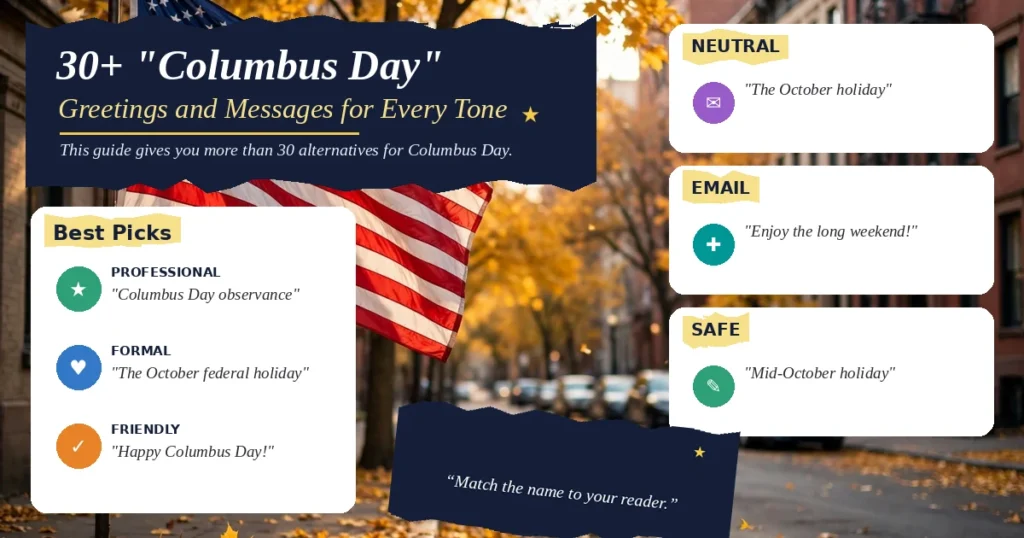
This guide gives you more than 30 alternatives for Columbus Day. You will find phrases for every tone: professional, formal, friendly, email-ready, and workplace. Each one comes with a short example so you can copy the style right away.
You will also get email samples, a quick comparison table, common mistakes to avoid, and answers to 15 common questions. Whether you write holiday notices for work or send a quick text to family, you will find the exact words you need.
One quick note: Columbus Day is observed in different ways across the United States. Some states, cities, and companies now use the name Indigenous Peoples’ Day for the same date. We cover this topic with care in the Cultural usage section below. The neutral phrases in this guide work for every workplace, whichever name your calendar uses.
Meaning
Columbus Day is a federal holiday in the United States on the second Monday of October. It marks the anniversary of Christopher Columbus reaching the Americas in 1492. Federal offices, banks, and many schools close for the day. Some states and cities observe Indigenous Peoples’ Day on the same date instead.
The holiday became a federal observance in 1937. For many years, parades and school lessons marked the day across the country. Today, the day means different things to different people. For some, it honors Italian American heritage. For others, it is a moment to reflect on the history of Indigenous peoples.
In everyday life, most people treat Columbus Day as a welcome day off. It creates a three-day weekend in the middle of fall. Retailers run sales, families travel, and workers enjoy a short break. That is why so many greetings focus on the long weekend rather than the history.
Because the day carries mixed feelings, word choice matters. A neutral phrase like “the October holiday” keeps things simple at work. A cheerful “Happy Columbus Day” fits a card for someone who celebrates it. Pick the phrase that fits your reader, and you will always sound thoughtful.
Professional usage
At work, Columbus Day phrases show up in holiday notices, auto-replies, and schedules. Keep them short and clear. Your reader should know one thing fast: are we open or closed.
HR teams often write the main notice. A line like “Our offices will be closed Monday for the October federal holiday” works well. It names the day, states the closure, and stays neutral. Add reopening hours so nobody has to guess.
Client emails need the same clarity. Tell customers how the holiday affects orders, shipping, or support. A sentence like “Support replies will resume Tuesday” sets the right expectation. Thank your team for covering the holiday with a line from thank you for taking care of this, and morale stays high through the long weekend.
In calendars and planners, use the exact name your company uses. Some firms list “Columbus Day.” Others list “Indigenous Peoples’ Day.” A few list both. Match the calendar so your message never contradicts the official schedule.
On social media, company accounts keep it simple. A post like “Wishing everyone a restful long weekend” works for any audience. Avoid jokes about the history of the day. Keep the tone kind and inclusive.
Alternatives
Here are 35 ways to say Columbus Day, grouped by tone. Pick the group that fits your reader, then borrow the example style.
Professional
The October federal holiday
Tone: neutral and calendar-ready. Best use: HR notices and company calendars.
Example: “The office will close Monday for the October federal holiday.”
Columbus Day observance
Tone: formal and official. Best use: policy documents and press releases.
Example: “Our Columbus Day observance follows the federal schedule.”
Second Monday in October
Tone: precise and factual. Best use: date-specific announcements.
Example: “We are closed the second Monday in October.”
Federal holiday on Monday
Tone: clear and practical. Best use: customer and shipping alerts.
Example: “Deliveries will pause for the federal holiday on Monday.”
Mid-October holiday
Tone: light and seasonal. Best use: newsletters and blog posts.
Example: “Make the most of the mid-October holiday with family.”
Indigenous Peoples’ Day
Tone: respectful and current. Best use: workplaces and regions that use this name.
Example: “We will observe Indigenous Peoples’ Day on Monday.”
Fall federal holiday
Tone: relaxed but professional. Best use: internal memos and reminders.
Example: “Please plan your deadlines around the fall federal holiday.”
Formal
National Columbus Day
Tone: ceremonial and grand. Best use: invitations and public speeches.
Example: “You are invited to the National Columbus Day ceremony downtown.”
Columbus Day commemoration
Tone: dignified and serious. Best use: civic events and programs.
Example: “The city will hold a Columbus Day commemoration at the plaza.”
The Columbus Day holiday
Tone: standard and polite. Best use: business letters and emails.
Example: “Our offices will observe the Columbus Day holiday.”
Day of observance
Tone: neutral and inclusive. Best use: official calendars and policies.
Example: “Monday is a day of observance for all staff.”
October civic holiday
Tone: formal and impartial. Best use: municipal notices.
Example: “The library will close for the October civic holiday.”
Heritage Day
Tone: warm and community-minded. Best use: local festivals and parades.
Example: “Bring the kids to the Heritage Day parade on Monday.”
Annual October observance
Tone: institutional and steady. Best use: yearly planners and handbooks.
Example: “The annual October observance is marked on the company calendar.”
Friendly
Happy Columbus Day!
Tone: classic and cheerful. Best use: cards and family texts.
Example: “Happy Columbus Day! I hope you enjoy the extra day off.”
Enjoy the long weekend!
Tone: warm and easygoing. Best use: social posts and chats.
Example: “Enjoy the long weekend! See everyone on Tuesday.”
Happy three-day weekend!
Tone: upbeat and fun. Best use: captions and group texts.
Example: “Happy three-day weekend! What are your plans?”
Happy October holiday!
Tone: simple and sweet. Best use: quick messages to friends.
Example: “Happy October holiday to you and yours!”
Have a great Monday off!
Tone: light and kind. Best use: casual notes to coworkers.
Example: “Have a great Monday off! You have earned it.”
Wishing you a relaxing holiday!
Tone: caring and sincere. Best use: greeting cards.
Example: “Wishing you a relaxing holiday with the people you love.”
Happy fall break!
Tone: playful and bright. Best use: messages to friends and kids. If you want a fun sign-off for the group chat, browse funny ways to say goodbye for a light closing line.
Example: “Happy fall break! Any fun plans for Monday?”
Email-ready
Holiday closure notice
Tone: direct and clear. Best use: subject lines.
Example: “Subject: Holiday closure notice for Monday.”
Out of office: federal holiday
Tone: professional and brief. Best use: auto-replies.
Example: “I am out of office for the federal holiday and will reply Tuesday.”
Closed in observance of Columbus Day
Tone: standard business. Best use: auto-replies and door signs.
Example: “Our branch is closed in observance of Columbus Day.”
Back in the office Tuesday
Tone: short and helpful. Best use: client updates.
Example: “I am off Monday and back in the office Tuesday.”
Monday holiday schedule
Tone: practical and organized. Best use: team emails.
Example: “Here is the Monday holiday schedule for the support team.”
Holiday staffing update
Tone: managerial and calm. Best use: shift planning.
Example: “This holiday staffing update covers the long weekend.”
October holiday hours
Tone: customer-friendly. Best use: store and service emails.
Example: “Please note our October holiday hours below.”
Workplace
The Monday holiday
Tone: casual and natural. Best use: team chats.
Example: “Quick reminder about the Monday holiday: no standup meeting.”
Office closed Monday
Tone: straight and simple. Best use: Slack messages and signs.
Example: “Office closed Monday. See you Tuesday!”
Paid holiday on Monday
Tone: practical and clear. Best use: HR questions.
Example: “Yes, the paid holiday on Monday applies to the whole team.”
Day off this Monday
Tone: friendly and light. Best use: coworker messages.
Example: “Enjoy your day off this Monday!”
Short week ahead
Tone: upbeat and motivating. Best use: Monday morning chats.
Example: “Short week ahead, team. Let us make it count.”
Long weekend plans
Tone: social and curious. Best use: small talk.
Example: “Any long weekend plans for the holiday?”
No school Monday
Tone: parent-friendly and direct. Best use: family and school messages.
Example: “Heads up: no school Monday because of the holiday.”
Quick comparison
Use this table to pick the right phrase fast. It shows ten top options with their tone and best use.
| Alternative | Tone | Best use |
|---|---|---|
| The October federal holiday | Neutral | HR notices |
| Columbus Day observance | Formal | Policy documents |
| Happy Columbus Day! | Cheerful | Greeting cards |
| Enjoy the long weekend! | Warm | Social posts |
| Second Monday in October | Precise | Calendars |
| Closed in observance of Columbus Day | Businesslike | Auto-replies |
| Indigenous Peoples’ Day | Respectful | Inclusive workplaces |
| The Monday holiday | Casual | Team chats |
| Office closed Monday | Direct | Signs and Slack |
| Wishing you a relaxing holiday! | Sincere | Cards for loved ones |
When you need speed, match the column to your task. Writing an HR notice? Take the neutral row. Sending a card? Take the cheerful or sincere row. Posting for your brand? The warm row fits best.
Email examples
HR holiday notice
Send this to the whole company a few days before the holiday.
Subject: Office closed Monday, October 12
Hi team,
Our offices will be closed on Monday, October 12 for the October federal holiday. We will reopen on Tuesday at normal hours. The on-call list for urgent issues is attached.
Thank you,
HR
Promise follow-ups with a softer line like the ones in other ways to say I will let you know so staff feel informed, not rushed.
Team
Use this in a team channel to sort out coverage.
Hi all,
Quick plan for the Monday holiday: Priya and I will cover urgent tickets. Everyone else is fully off. Please finish your Friday handoffs by 4 p.m.
Thanks for making this work.
Thank volunteers with a line from I appreciate it to keep the tone warm and genuine.
Colleague
Keep it short and friendly for a one-to-one message.
Hey Sam,
Are you around on Friday to wrap up the report? I am off Monday for the holiday but back Tuesday morning.
I am looking forward to your call on Tuesday to go over the final numbers.
Client
Warn clients early about delays, and stay polite about the closure.
Hi Dana,
A quick heads-up: our office is closed Monday, October 12 in observance of Columbus Day. Your order will ship Tuesday morning. We will send tracking as soon as it leaves.
Ask customers to stay patient with a softer line like the ones in please be patient if replies run a little slow on Tuesday.
Family
A group text works best for family plans.
Happy October holiday, everyone! We are thinking of a picnic on Monday since the kids have no school. Who is in?
Love, Mom
End the thread with a playful line from funny ways to say goodbye to keep the mood light.
Common mistakes
1. Calling it a “bank holiday” in a US email
In the US, people say “federal holiday.” “Bank holiday” is a British term and can confuse American readers.
2. Assuming everyone gets the day off
Many private companies stay open on Columbus Day. Say “our office is closed” instead of “everyone is off.”
3. Using the wrong name for your audience
Some workplaces and cities say Indigenous Peoples’ Day. Check your company calendar before you write.
4. Writing “Columbus day” with a lowercase d
Day is part of the proper name. Always write “Columbus Day” with both words capitalized.
5. Naming only the weekday in formal notices
Write “Monday, October 12” in formal notices, not just “Monday.” The date removes all doubt.
6. Sounding too casual in a client email
Skip “woohoo, long weekend!” in client emails. Use “closed in observance of Columbus Day” instead.
7. Posting a greeting without checking company policy
Some brands avoid holiday greetings for this day. Check your style guide before you post.
Related phrases
Long weekend: three or four days off in a row. Example: “We are heading to the lake for the long weekend.”
Three-day weekend: a weekend stretched by a Monday holiday. Example: “The three-day weekend came at the perfect time.”
Federal holiday: a US holiday when federal offices close. Example: “Columbus Day is a federal holiday.”
Day off: a day with no work or school. Example: “I am taking a day off on Monday.”
Fall break: a short autumn break from school or routine. Example: “The kids have fall break next week.”
Holiday weekend: a weekend that includes a holiday. Example: “Traffic gets heavy every holiday weekend.”
Public holiday: a holiday recognized by the government. Example: “The store closes on every public holiday.”
Day of observance: a day set aside to mark an occasion. Example: “Monday is a day of observance at city hall.”
Columbus Day weekend: the weekend around the holiday. Example: “We booked a cabin for Columbus Day weekend.”
Holiday closure: a temporary shutdown for a holiday. Example: “The holiday closure starts Friday at 5 p.m.”
Paid day off: a day off that still counts as paid work time. Example: “Columbus Day is a paid day off here.”
Staff holiday: a holiday given to employees. Example: “The staff holiday calendar lists Monday as closed.”
October break: time off in October. Example: “We planned a short trip for the October break.”
School holiday: a day when schools close. Example: “Monday is a school holiday in our district.”
Extended weekend: a weekend made longer by a holiday. Example: “An extended weekend is perfect for a road trip.”
Time off: hours or days away from work. Example: “I saved some time off for the fall.”
Phrase comparison
The table above gives you a fast lookup. This section explains how the main names actually feel in use, so you can choose with confidence.
“Columbus Day” is the traditional and official federal name. It sounds formal and historical. Use it in legal notices, calendars, and formal writing. It fits best when accuracy matters more than warmth.
“Indigenous Peoples’ Day” is the name many states, cities, and companies now use for the same date. It sounds respectful and modern. Use it when your organization has adopted it, and never mix the two names in one message. Check the official calendar first.
“The October holiday” and “the October federal holiday” are neutral workhorses. They carry no strong feeling at all. That is their strength. Use them in HR notices, customer emails, and any message where clarity beats personality.
“Happy Columbus Day” and “Happy October holiday” are warm greetings, not announcements. They belong in cards, texts, and social posts. They would sound odd in a closure notice, where the reader needs facts, not cheer.
“Long weekend” and “three-day weekend” are the most casual options. They focus on the time off, not the meaning of the day. Use them with friends, family, and close coworkers. Skip them in formal client emails.
The pattern is simple. Formal settings want the official name. Mixed audiences want the neutral name. Personal messages want the warm greeting. Match the name to the reader, and your message will always land well.
Cultural usage
Columbus Day sits at the center of an ongoing public conversation in the United States. Many people celebrate Italian American heritage on this day. Many others honor Indigenous peoples and their history instead. Both views are common, and both deserve respect in your writing.
The practical result is simple: different places use different names. Federal calendars still say Columbus Day. A growing number of states, cities, universities, and companies say Indigenous Peoples’ Day. Some list both names side by side. A few avoid naming the day at all and simply note a holiday closure.
For your own writing, the safe rule is to mirror your audience. Use the name your company, school, or city uses. When you write for a mixed or unknown audience, choose a neutral phrase like “the October holiday.” Neutral wording keeps your message kind and professional for everyone.
US English
In the US, “Columbus Day” remains the federal name, and most Americans recognize it at once. “Federal holiday” is the standard term for the day off. “Bank holiday” sounds British to American ears, so avoid it in US messages.
Many US workplaces now say “Indigenous Peoples’ Day.” This is normal and respectful. If your company uses that name, use it in every message without apology or explanation.
UK English
Columbus Day is not observed in the UK, so British readers may not know the holiday. If you write to a UK audience, add a short explanation. A line like “Monday is a US federal holiday” gives all the context they need.
In British English, “bank holiday” is the everyday term for a public day off. It works fine for a UK reader. Just remember that the same phrase can confuse an American reader.
Corporate communication
Companies prize clarity and neutrality in holiday messages. The safest choice is the exact name on the company calendar. The second safest is a neutral phrase like “the October holiday.”
Keep greetings out of closure notices. A closure notice should state the dates, the reopening time, and a contact for urgent issues. Save the warm wishes for social posts and cards.
When in doubt, ask HR or check the employee handbook. Using the official name protects you from well-meaning mistakes.
Customer service
Customers care about one thing: how the holiday affects them. Lead with the practical facts. State the closure dates, the shipping delay, and when normal service returns.
Add a short line of empathy. A sentence like “We know delays are frustrating, and we will catch up fast on Tuesday” goes a long way. For trickier conversations, phrases from other ways to say I understand help you sound caring without overpromising.
Keep the holiday name neutral in customer messages. “The October holiday” works for every customer, whatever they call the day themselves.
Networking
At networking events and on LinkedIn, keep holiday talk light and brief. A line like “Hope you enjoyed the long weekend” opens a conversation without touching a sensitive topic.
Avoid debating the meaning of the day in professional settings. If someone brings it up, listen with respect and steer back to business. Your goal is connection, not controversy.
A short, kind follow-up after the weekend works well. Try “Great meeting you last week. Hope you had a restful break.” It is warm, neutral, and professional.
Frequently asked questions
What is another name for Columbus Day?
Many people say “Indigenous Peoples’ Day,” which is now the official name in several states and cities. Neutral options include “the October holiday,” “the October federal holiday,” and “the second Monday in October.” Choose the name your audience or company uses.
Is it okay to say “Happy Columbus Day”?
Yes, it is fine in personal messages like cards and texts. Many people still greet each other this way. At work, check your company style first, since some workplaces prefer a neutral phrase.
What do companies call Columbus Day in emails?
Most companies use either “Columbus Day” or the neutral “October holiday” in emails. HR notices often say “our offices will be closed Monday for the October federal holiday.” Match the name on your company calendar.
Is Columbus Day the same as Indigenous Peoples’ Day?
They fall on the same date: the second Monday of October. Columbus Day is the federal name. Indigenous Peoples’ Day is the name many states, cities, and organizations use instead. They are not two different days.
How do I write a Columbus Day holiday notice?
State the closure date, the reopening date, and a contact for urgent issues. Keep it short. For example: “Our offices will be closed Monday, October 12 and will reopen Tuesday at 9 a.m.”
What is a polite way to say the office is closed?
“Our office will be closed on Monday for the October holiday” is polite and clear. “Closed in observance of Columbus Day” also works well. Both sound professional without extra words.
Do all US states observe Columbus Day?
No. It is a federal holiday, so federal offices close everywhere. But states decide for themselves, and not every state observes it. Some states observe Indigenous Peoples’ Day instead.
What should I write in a Columbus Day card?
Keep it warm and simple. “Happy Columbus Day! Wishing you a relaxing long weekend” works well. For a neutral card, try “Wishing you a restful October holiday.”
How do I mention Columbus Day on social media?
Keep brand posts short and kind. “Wishing everyone a restful long weekend” fits any audience. Add your holiday hours if your business is closing.
What is a professional alternative to “Happy Columbus Day”?
“The October federal holiday” is the most professional swap. “Columbus Day observance” also works in formal writing. Both keep the tone businesslike.
How do I ask about holiday pay for Columbus Day?
Ask HR directly and politely. Try: “Is Monday a paid holiday for our team?” This is clearer than asking coworkers, who may only guess at the policy.
Can I say “Columbus Day weekend” in a formal email?
It is better to save “Columbus Day weekend” for casual messages. In formal emails, write “the Columbus Day holiday” or “the October holiday” instead. Formal readers expect the official name.
What do schools call the day off?
It varies by district. Many school calendars say “Columbus Day” or “No school: federal holiday.” Some districts now list “Indigenous Peoples’ Day.” Check your local school calendar.
How do I wish someone a good long weekend professionally?
“Hope you enjoy the long weekend” is professional and warm. “Wishing you a restful break” also works well. Both fit emails to clients and coworkers.
What is the difference between a federal holiday and a bank holiday?
A federal holiday is a US holiday when federal offices close. A bank holiday is the British term for a public holiday. In US writing, always say “federal holiday” to avoid confusion.
Conclusion
You now have more than 30 ways to talk about Columbus Day with confidence. For formal writing, “Columbus Day observance” and “the October federal holiday” are your strongest picks. For cards and texts, “Happy Columbus Day!” and “Enjoy the long weekend!” bring the warmth. For mixed audiences at work, the neutral “October holiday” keeps every message safe and kind.
The golden rule is simple: match the name to your reader. Check the calendar, pick the right tone, and keep closure notices factual. Do that, and your words will always feel thoughtful, whether you are writing to family, clients, or your whole company.
For the formal definition and pronunciation, see the Columbus Day entry in the Cambridge Dictionary. Keep this guide bookmarked, and the next October holiday will be the easiest message you write all year.