Introduction
If you are searching for other ways to say can’t wait, you already know the problem. The phrase is everywhere. We text it to friends, drop it into emails, and say it on calls, until it starts to sound flat and automatic. “Can’t wait” works fine with people who know you well, but it can feel too casual, too childish, or too vague when the setting matters more.
Think about the difference. Texting your sister “Can’t wait to see you Saturday” is warm and perfect. Writing the same line to a hiring manager, a client, or a business partner can land the wrong way. It can sound impatient, unprofessional, or simply lazy. The good news is that English is full of better options, and choosing the right one takes only a few seconds once you know your choices.
This guide gives you 40 alternatives grouped by tone, so you can match your words to your audience. You will find polished options for professional emails, formal letters, friendly chats, quick workplace messages, and everyday conversation. Each one comes with a clear note on when to use it and a short example sentence you can copy or adapt.
By the end, you will never feel stuck repeating the same phrase again. Whether you are looking forward to your call with a client or counting down the days to a vacation with friends, you will have the exact words that fit the moment.
Meaning
“Can’t wait” is an informal expression that means you feel strong excitement or eagerness about something in the future, and you wish it would happen sooner. It signals positive anticipation: you are not just aware of an upcoming event, you actively look forward to it with energy and enthusiasm.
People use it for events big and small. It can describe excitement about a wedding, a new job, a holiday, a movie release, or even something as simple as lunch with a friend. The tone is always upbeat, but the phrase itself is casual, so it fits relaxed settings far better than formal ones.
Professional usage
In professional life, excitement is welcome, but the wording has to match the room. Here is how to handle “can’t wait” energy across the settings where your word choice shapes how people see you.
Emails
In emails, replace “can’t wait” with a calmer, more deliberate phrase. “I look forward to our meeting on Thursday” says the same thing as “Can’t wait for Thursday” but sounds controlled and respectful. Save the casual version for colleagues you know well, and use the polished version for clients, executives, and first-time contacts.
Workplace
At work, enthusiasm builds momentum, but slang can shrink your credibility. In a team chat you can write “Excited to kick this off,” which keeps the energy without sounding sloppy. In a presentation or a status update, prefer “I am eager to see the results,” which carries the same feeling in a steadier tone.
Clients
With clients, your words should show enthusiasm without pressure. “I look forward to working with you” tells a client you are engaged and confident. Avoid anything that hints at impatience, because a client may read “I can’t wait” as “hurry up.” Keep the focus on the shared outcome, not on your own restlessness.
Customer service
In customer service, excitement must always come second to clarity and care. “We look forward to helping you get started” reassures a customer while sounding professional. If a customer is waiting on a fix or a delivery, never write “Can’t wait for you to get it,” because it can sound careless when someone is already frustrated. Instead, acknowledge the wait and set a clear next step.
Alternatives
Below are 40 alternatives in five tone groups. Each entry shows the phrase in bold, a short note on tone and best use, and one example sentence.
Professional
- I look forward to it — Neutral and safe for almost any business setting. Example: “Thank you for the invitation. I look forward to it.”
- I am excited about this — Warm and confident without sounding casual. Example: “I am excited about this partnership and what we can build together.”
- I eagerly anticipate it — Polished and slightly formal, great for written updates. Example: “I eagerly anticipate the launch of the new program.”
- I anticipate it with great interest — Measured and thoughtful, ideal for senior audiences. Example: “I anticipate the board’s decision with great interest.”
- I am keen to get started — Energetic yet professional, common in British-leaning business English. Example: “The plan looks solid, and I am keen to get started.”
- I look forward to seeing the results — Forward-looking and confident, perfect for projects. Example: “The team has done great work, and I look forward to seeing the results.”
- I await your response — Direct and businesslike, best when you need a reply. Example: “Please review the draft at your convenience. I await your response.”
- I am excited for what lies ahead — Optimistic and steady, good for announcements. Example: “With the merger complete, I am excited for what lies ahead.”
Formal
- I await it with anticipation — Classic formal phrasing for letters and official notes. Example: “I await the ceremony with anticipation.”
- I eagerly await — Short, formal, and dignified in written communication. Example: “I eagerly await your decision on the proposal.”
- I anticipate it eagerly — Formal with a touch of warmth, suits invitations. Example: “We anticipate your visit eagerly.”
- I look forward with keen anticipation — Elevated and respectful, ideal for ceremonies. Example: “I look forward to the graduation with keen anticipation.”
- I am greatly looking forward to it — Formal but human, works in respectful emails. Example: “I am greatly looking forward to the conference in May.”
- I await the opportunity with enthusiasm — Formal and positive, great for applications. Example: “I await the opportunity to contribute with enthusiasm.”
- It is with great anticipation that I await — Very formal, best for ceremonial writing. Example: “It is with great anticipation that I await the award ceremony.”
- I keenly anticipate — Crisp and formal, common in official correspondence. Example: “I keenly anticipate our discussion next week.”
Friendly
- I am so excited — Simple, warm, and natural for friends and family. Example: “I am so excited for your birthday party on Friday.”
- Counting down the days — Playful and visual, perfect for trips and events. Example: “Counting down the days until our beach trip.”
- I am buzzing — Casual British slang for feeling thrilled. Example: “I am buzzing about the concert tonight.”
- I literally cannot wait — Extra emphasis for close friends who get the drama. Example: “I literally cannot wait to tell you everything.”
- Bring it on — Bold and fun, shows you are ready for a challenge. Example: “Marathon training starts Monday. Bring it on.”
- I am hyped — Modern casual slang, best for peers and social media. Example: “I am hyped for the new season.”
- I cannot even wait — Playful exaggeration for lighthearted chats. Example: “I cannot even wait to see your reaction.”
- I miss you and cannot wait to see you — Tender and personal, ideal for loved ones far away. If distance is the reason for your excitement, you can also say you miss them first, then add the anticipation. Example: “I miss you so much and cannot wait to see you at Christmas.”
- Looking forward to it — The standard email-safe replacement, short and polite. Example: “Thanks for setting this up. Looking forward to it.”
- Excited to connect — Friendly and modern, great for introductions. Example: “Excited to connect and learn more about your team.”
- Eagerly awaiting your reply — Polite urgency when you need an answer. Example: “Eagerly awaiting your reply so we can finalize the schedule.”
- Anticipating a great session — Positive and specific, ideal before meetings. Example: “Anticipating a great session with the design team tomorrow.”
- Really looking forward to our chat — Warm but still professional for calls. Example: “Really looking forward to our chat on Thursday.”
- Excited about this opportunity — Confident and grateful, good for new roles. Example: “Excited about this opportunity and ready to contribute.”
- Looking forward to your update — Courteous way to show interest while waiting. When you are waiting on news, you can also promise that you will let them know the moment you have your own update. Example: “Looking forward to your update after the client review.”
- Cannot wait to hear more — Slightly casual, fine for friendly business contacts. Example: “Your preview sounded amazing. Cannot wait to hear more.”
Workplace
- I am pumped for this — High energy for team chats and standups. Example: “I am pumped for this sprint. Let us build something great.”
- Cannot wait to dig in — Shows readiness to start real work. Example: “The brief is clear. Cannot wait to dig in.”
- Ready when you are — Cooperative and upbeat, signals you are prepared. Example: “The files are uploaded. Ready when you are.”
- I am raring to go — Lively idiom that shows strong motivation. Example: “After the training, I am raring to go.”
- Let us get this show on the road — Fun team rallying cry for kickoffs. Example: “Everyone is here, so let us get this show on the road.”
- I am excited to kick things off — Professional energy for project starts. Example: “I am excited to kick things off with the new client.”
- Bring on the challenge — Confident and bold, good for ambitious goals. Example: “Q4 targets are set. Bring on the challenge.”
- I am all in — Short and strong, shows full commitment. Example: “This plan has my full support. I am all in.”
Quick comparison
Use this table to pick the right phrase at a glance. These are the top picks from the full list above.
| Alternative | Tone | Best use |
|---|---|---|
| I look forward to it | Professional | Client emails and formal messages |
| I eagerly anticipate it | Professional | Written updates and announcements |
| I await it with anticipation | Formal | Official letters and ceremonies |
| I am greatly looking forward to it | Formal | Respectful emails to senior people |
| I am so excited | Friendly | Texts to friends and family |
| Counting down the days | Friendly | Trips, holidays, and fun events |
| Looking forward to it | Everyday business email closings | |
| Eagerly awaiting your reply | Follow-ups that need an answer | |
| I am pumped for this | Workplace | Team chats and standup meetings |
| Ready when you are | Workplace | Signaling you are prepared to start |
Email examples
Copy these templates and adjust the details to fit your message.
Client email
Subject: Excited about our kickoff next week
Hi Sarah,
Thank you for choosing us for the website redesign. I have reviewed your goals, and I am excited about what we can build together. I look forward to our kickoff call on Tuesday, and I will share the agenda by Monday morning.
Best regards,
Daniel
Manager email
Subject: Looking forward to the quarterly review
Hi Mr. Thompson,
Thank you for scheduling my quarterly review. I have prepared a summary of my projects and results, which I will bring to the meeting. I am keen to get started on the goals we discussed, and I look forward to your feedback.
Kind regards,
Priya
Colleague email
Subject: Really looking forward to our chat
Hi James,
Great news about the product launch date. Really looking forward to our chat tomorrow so we can divide up the tasks. I am excited to kick things off with you and the rest of the team.
Cheers,
Amelia
Customer email
Subject: We look forward to helping you get started
Hi Maria,
Welcome aboard. Your account is now active, and we look forward to helping you get started. If anything feels unclear during setup, just reply to this email and our team will guide you step by step.
Warm regards,
The Support Team
Networking email
Subject: Excited to connect
Hi David,
It was great meeting you at yesterday’s conference. Your talk on brand storytelling gave me several new ideas. Excited to connect and continue the conversation, and I look forward to staying in touch.
Best,
Lena
Meeting follow-up email
Subject: Anticipating a great session next week
Hi team,
Thank you for a productive discussion today. I have attached the notes and the action items we agreed on. Anticipating a great session next week when we review the first drafts together.
Thanks,
Marcus
Common mistakes
Small word choices can change how your excitement is received. Avoid these common errors.
1. Using “can’t wait” with a brand-new client
It can sound pushy or overly familiar before trust is built. Use “I look forward to working with you” until the relationship warms up.
2. Writing “can’t wait!!!” with multiple exclamation marks in work emails
Excess punctuation looks unprofessional and can feel aggressive. One calm sentence carries more weight than three exclamation marks.
3. Saying “can’t wait” when someone is already waiting on you
If you owe someone a reply or a delivery, excitement about the future can sound tone-deaf. Acknowledge the delay first, and ask them to please be patient while you finish the work.
4. Using “can’t wait” in a condolence or apology message
Excitement clashes with sympathy. In serious or sensitive messages, keep the tone gentle and focused on the other person.
5. Repeating “can’t wait” in every message of a thread
Repetition makes your writing feel lazy and robotic. Rotate through alternatives so each message sounds fresh and intentional.
6. Choosing slang like “hyped” for senior executives
Casual slang can shrink your credibility with senior audiences. Match your vocabulary to the seniority of the reader.
7. Writing “I can’t wait for your reply” as a demand
Without softening, it reads as pressure. Prefer “Eagerly awaiting your reply” or “I look forward to hearing from you.”
8. Forgetting the apostrophe in “can’t”
Writing “cant wait” looks careless in any professional context. The apostrophe matters, and spellcheck will not always catch the tone problem anyway.
Related phrases
These expressions carry a similar feeling of anticipation and pair naturally with the alternatives above.
- Looking forward to it — means you await something with pleasure. Example: “Looking forward to it. See you at noon.”
- Eagerly awaiting — means waiting with keen interest. Example: “We are eagerly awaiting the test results.”
- Counting down — means tracking the time until an event. Example: “We are counting down to the wedding.”
- On the edge of my seat — means feeling tense excitement about an outcome. Example: “I was on the edge of my seat during the final match.”
- Bursting with excitement — means barely able to contain happy feelings. Example: “She was bursting with excitement about the news.”
- Over the moon — means extremely happy about something coming. Example: “He was over the moon about the promotion.”
- Thrilled — means very excited and pleased. Example: “I am thrilled to join the team.”
- Anxious to begin — means eager to start, with a formal touch. Example: “The volunteers are anxious to begin.”
- Raring to go — means full of energy and ready to start. Example: “After the break, the kids were raring to go.”
- Chomping at the bit — means impatient to start an activity. Example: “The sales team is chomping at the bit for the launch.”
- In anticipation of — means in preparation for something expected. Example: “In anticipation of your visit, we prepared the guest room.”
- With bated breath — means waiting nervously and eagerly. Example: “Fans waited with bated breath for the announcement.”
- Eyes on the prize — means focused on a future goal. Example: “With eyes on the prize, she trained every morning.”
- Itching to start — means feeling a strong urge to begin. Example: “I am itching to start the new project.”
- On tenterhooks — means waiting anxiously for news. Example: “We were on tenterhooks until the results came in.”
- Full of anticipation — means filled with excited expectation. Example: “The room was full of anticipation before the keynote.”
Phrase comparison
Saying “can’t wait” and saying “I look forward to it” both express excitement, but they paint different pictures of the speaker. “Can’t wait” is raw and immediate. It sounds like something blurted out in the moment, which is exactly why it works so well between friends. It carries warmth, spontaneity, and a hint of playfulness. The trade-off is control. In a professional setting, that same spontaneity can read as impatience or a lack of polish.
“I look forward to it” is the composed older sibling. It expresses the same positive feeling but with steady hands. It tells the reader that you are organized, respectful, and confident. In client communication, that steadiness builds trust. A client who reads “I look forward to our partnership” feels reassured. A client who reads “Can’t wait!!!” may wonder whether you will rush the work too.
“I’m eager” sits between the two. It keeps the energy of “can’t wait” but dresses it in professional clothing. It works beautifully in cover letters, project updates, and introductions, where you want to show drive without sounding casual. “Counting down the days,” on the other hand, leans fully into the friendly zone. It is visual and fun, perfect for vacations and celebrations, but it would feel out of place in a contract negotiation.
The practical rule is simple. Match the weight of your words to the weight of the relationship. New and formal relationships deserve the steadier phrases. Warm and established relationships can handle the playful ones. When in doubt, choose the calmer option. You can always add warmth with a friendly sentence around it, but you cannot take back an impression of carelessness.
For a lighter touch at the very end of a friendly message, some people pair their excitement with one of the funny ways to say goodbye instead of a plain sign-off, which keeps the cheerful mood going right to the last line.
Cultural usage
Excitement translates across cultures, but the preferred wording shifts. A quick tour of the differences helps you choose well.
US English
Americans use “can’t wait” freely and often. It appears in work emails, marketing copy, and everyday speech without raising eyebrows. In casual American workplaces, even managers write “Can’t wait to see the deck.” Still, in formal industries like law, finance, and government, the steadier “look forward to” remains the safer default.
UK English
British speakers also say “can’t wait,” but they lean on alternatives like “keen,” “looking forward to,” and “raring to go” more often in professional settings. Understatement is a cultural habit, so “I am quite looking forward to it” can carry as much enthusiasm in London as “I am SO excited” does in New York. When writing to British clients, a slightly reserved phrase usually lands better.
Corporate communication
In corporate communication worldwide, the trend is toward warm professionalism. Companies want to sound human without sounding sloppy. That is why “We look forward to welcoming you” appears in onboarding emails everywhere, while “Can’t wait for you to join” shows up mainly in startup culture. If your company voice guide exists, follow it. If it does not, default to the polished middle ground.
Customer service
Customer service language is carefully scripted in most companies, and “can’t wait” rarely makes the script. Support teams are trained to show empathy first and excitement second. Phrases like “We look forward to resolving this for you” keep the tone helpful and controlled. When a customer is upset, excitement about anything can feel dismissive, so agents are taught to acknowledge feelings before expressing any positive anticipation.
Frequently asked questions
Is “can’t wait” professional?
It depends on the setting. In casual workplaces and friendly industries, “can’t wait” is perfectly fine and can even build rapport. In formal industries, client-facing roles, and first-time communication, it can sound too casual. When you are unsure, choose “I look forward to it” instead, because it is never wrong.
What is the most formal way to say “can’t wait”?
The most formal options are “I await it with anticipation” and “It is with great anticipation that I await.” Both suit ceremonial writing, official letters, and very formal invitations. For formal business emails, “I am greatly looking forward to it” is formal enough without sounding stiff.
How do you say “can’t wait” in a business email?
Use “Looking forward to it,” “I look forward to our meeting,” or “Eagerly anticipating it.” These phrases express the same enthusiasm in language that fits a professional inbox. Avoid exclamation marks and slang, and keep the sentence calm and confident.
What can I say instead of “I can’t wait to see you”?
For friends and family, try “Counting down the days until I see you” or “I am so excited to see you.” For professional contacts, use “I look forward to seeing you on Thursday.” The meaning stays the same, but the tone matches the relationship.
Is “looking forward to it” better than “can’t wait”?
Neither is universally better. “Looking forward to it” is better for professional and formal settings because it sounds composed and respectful. “Can’t wait” is better for casual settings because it sounds warmer and more spontaneous. Choose based on your audience, not on a fixed rule.
How do you express excitement without sounding unprofessional?
Pick steady, specific language. “I am excited about this opportunity” sounds professional because it names what excites you. Vague, high-energy phrases like “I am SOOO excited!!!” sound unprofessional because they rely on intensity instead of clarity. Specificity is the difference.
What does “can’t wait” mean exactly?
It means you feel strong, happy excitement about something in the future and you wish it would happen sooner. It expresses positive anticipation, not actual inability to wait. Native speakers understand it as enthusiasm, though learners sometimes take it literally at first.
Is “can’t wait” rude?
It is not rude by itself, but it can feel rude in the wrong context. Said to someone who is already running late, it can sound like pressure. Written to a busy executive, it can sound demanding. The phrase is innocent, but timing and audience decide how it lands.
How do you say “can’t wait” to a client?
Say “I look forward to working with you” or “I am excited about our partnership.” These show engagement without any hint of impatience. Never use slang like “hyped” or “pumped” with clients unless the relationship is already very casual.
What is a polite way to say “I can’t wait for your reply”?
Write “Eagerly awaiting your reply” or “I look forward to hearing from you.” Both are polite and professional. If the matter is urgent, add a clear deadline instead of emotional pressure, for example: “I look forward to hearing from you by Friday.”
Can I use “can’t wait” in a job interview?
It is safer to use a polished alternative. Say “I am excited about this opportunity” or “I look forward to the possibility of joining your team.” These show enthusiasm while keeping you composed. Save “can’t wait” for after you get the offer and know the company culture.
What is the difference between “can’t wait” and “looking forward to”?
“Can’t wait” is informal, emotional, and spontaneous, while “looking forward to” is neutral, composed, and versatile. Both express positive anticipation. Think of “can’t wait” as the jeans and “looking forward to” as the blazer. Each fits different occasions.
How do you say “can’t wait” in British English?
British speakers often say “I am really looking forward to it,” “I am keen,” or “I am raring to go.” They do use “can’t wait” too, especially in casual speech. In professional British settings, the more reserved phrasings tend to be preferred.
What should I write instead of “can’t wait” on an event RSVP?
For a wedding or formal event, write “We joyfully accept” or “We look forward to celebrating with you.” For a casual party, “Wouldn’t miss it” or “Counting down the days” works beautifully. Match the formality of the invitation you received.
Is it okay to say “can’t wait” to my boss?
It depends on your workplace culture and your relationship. In a relaxed team, “Can’t wait to dig into this project” is fine. In a formal environment, or with a new manager, prefer “I am excited to get started” or “I look forward to it.” When in doubt, observe how your boss writes first.
Conclusion
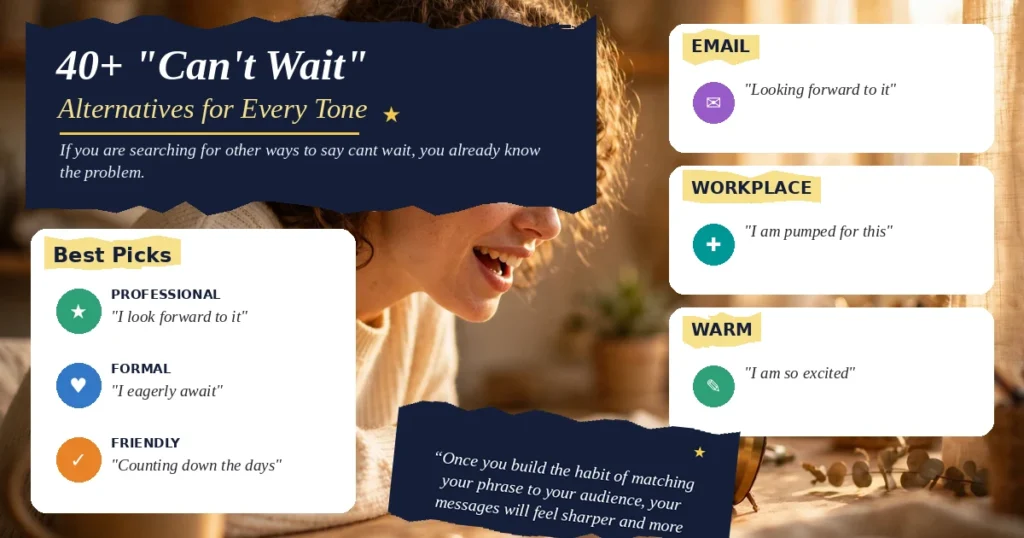
If you need a quick decision, here are the safest best picks. For professional settings, use “I look forward to it” or “I am excited about this.” For formal writing, choose “I await it with anticipation” or “I am greatly looking forward to it.” For friendly messages, “I am so excited” and “Counting down the days” always work. In emails, rely on “Looking forward to it” or “Eagerly awaiting your reply.” At work, “Ready when you are” and “I am excited to kick things off” strike the right balance.
Excitement is a strength in communication, and the only skill is aiming it well. The Cambridge Dictionary defines the word “eager” as wanting very much to do something, which captures exactly what these phrases are really saying. If a task is stuck on your side while you wait, it can help to ask for help directly instead of just expressing anticipation.
Once you build the habit of matching your phrase to your audience, your messages will feel sharper and more thoughtful without any extra effort. Keep this list nearby, rotate through your favorites, and let your enthusiasm come through in words that always fit the moment.