Introduction
Every December, people reach for the same familiar greeting. They write “Merry Christmas” on cards, emails, and text messages without thinking twice. But what if you want your message to stand out? Learning other ways to say merry christmas helps you sound warmer, more personal, and more thoughtful. A fresh greeting catches the reader’s attention and makes them feel truly seen. It shows you took the time to craft something special just for them.
This guide gives you more than 40 alternatives you can use right away. You will find classic lines for cards, polite phrases for work emails, short greetings for texts, and joyful wishes for friends and family. Whether you write to a client, a teacher, or your best friend, you will find the perfect words here. Each alternative comes with a note on tone and a short example so you can use it with confidence.
Read on, pick your favorites, and make this year’s greetings the most memorable ones yet.
Meaning
“Merry Christmas” is a traditional English greeting used to wish someone happiness on Christmas Day, which falls on December 25. The word “merry” means cheerful and full of joy. So the phrase simply means “have a cheerful Christmas.” People have used this greeting for centuries. It appears in letters, songs, and holiday cards around the world.
The alternatives to “Merry Christmas” carry the same core wish. They ask for happiness, warmth, and good cheer for the reader. Some focus on the joy of the season. Others focus on family, peace, or new beginnings. A few skip the holiday name completely and just wish the person well. When you choose a different greeting, you keep the same warm meaning while adding your own voice. That is the real point of finding other ways to say merry christmas. You express the same kindness, but in words that fit the person you write to.
Professional usage
At work, Christmas greetings need care. A simple “Merry Christmas” can work, but it may feel too casual or too religious for some offices. Many companies prefer inclusive greetings that respect every background. The safest choice for a mixed workplace is a phrase that celebrates the season without assuming the reader’s beliefs.
Use professional alternatives in emails to clients, messages to your team, and cards for business partners. Keep the tone warm but respectful. A short line at the end of a December email feels thoughtful without crossing boundaries. For example, you can close with “Wishing you and your family a joyful holiday season” before your signature. That line works for almost anyone.
Timing matters too. Send work greetings during the last two weeks of December. Avoid sending them too early, since that can look pushy. And always check the name spelling before you hit send. A well-chosen professional greeting builds goodwill and ends the year on a positive note.
Alternatives
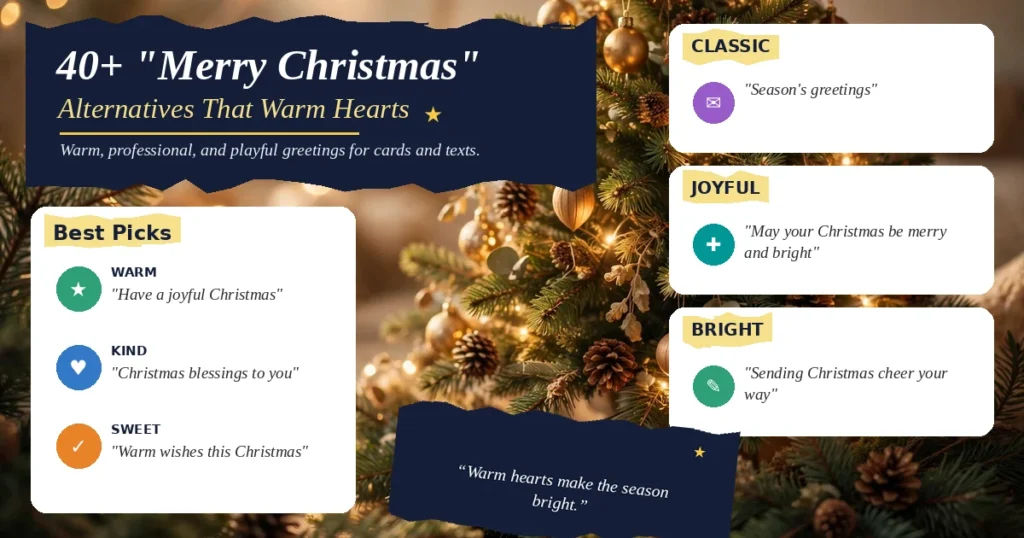
Here are 40 handpicked alternatives, sorted into five tone groups. Each one includes a short note on when to use it and a sample sentence.
Warm and classic
These sound like the greetings in old holiday cards. They are safe, sweet, and perfect for family and close friends.
- Happy Christmas – A classic British-style greeting, soft and friendly. Use it when “Merry Christmas” feels overused. “Happy Christmas, and I hope we see you soon.”
- Wishing you a wonderful Christmas – Warm and personal, great for cards. It sounds sincere without being fancy. “Wishing you a wonderful Christmas filled with love.”
- Have a joyful Christmas – Simple and bright, ideal for anyone. The word “joyful” adds extra warmth. “Have a joyful Christmas with your loved ones.”
- Christmas blessings to you – Gentle and caring, good for relatives. It carries a soft spiritual touch. “Christmas blessings to you and your family.”
- May your Christmas be merry and bright – Lyrical and festive, perfect for a card. It echoes the famous carol. “May your Christmas be merry and bright.”
- Warm wishes this Christmas – Friendly and short, works in any card. It feels like a hug in words. “Warm wishes this Christmas, from all of us.”
- Sending Christmas cheer your way – Cheerful and upbeat, great for friends. It feels playful but still sweet. “Sending Christmas cheer your way across the miles.”
- Merry and bright to you – Short and musical, nice for a text. It keeps the spirit without the full phrase. “Merry and bright to you, my friend.”
Professional and polite
These fit work emails, LinkedIn messages, and cards for clients. They stay respectful and inclusive.
- Season’s greetings – The classic business greeting, neutral and safe. Use it in any professional email. “Season’s greetings, and thank you for a great year.”
- Happy holidays – Inclusive and widely used at work. It covers every December holiday. “Happy holidays to you and your team.”
- Wishing you a joyful holiday season – Warm yet formal, great for clients. It shows care without assuming beliefs. “Wishing you a joyful holiday season.”
- Best wishes for the holidays – Polite and simple, ideal for short emails. It never sounds wrong. “Best wishes for the holidays, and see you in January.”
- Warmest holiday wishes – Slightly warmer, good for close work contacts. It feels personal but still professional. “Warmest holiday wishes to you and yours.”
- Enjoy the holiday season – Casual-professional, great for Slack or Teams. It feels relaxed and kind. “Enjoy the holiday season, and recharge well.”
- Wishing you peace this holiday season – Calm and thoughtful, suits formal letters. It focuses on peace, not parties. “Wishing you peace this holiday season.”
- Thank you for a wonderful year, and happy holidays – Combines thanks with a greeting. Perfect for a final email of the year. “Thank you for a wonderful year, and happy holidays.”
Short and textable
These are quick greetings for text messages, captions, and chat apps. They get straight to the point.
- Merry Xmas – A quick casual version, fine for friends. It saves a few letters. “Merry Xmas! See you at dinner?”
- Have a great Christmas – Simple and natural, works in any text. It sounds like spoken English. “Have a great Christmas, enjoy every bite.”
- Cheers to Christmas – Fun and casual, great for captions. It feels like raising a glass. “Cheers to Christmas, and to friends like you.”
- Enjoy Christmas Day – Friendly and direct, good for a quick note. It focuses on the day itself. “Enjoy Christmas Day with your family.”
- Christmas joy to you – Short and sweet, nice for a card or text. It packs warmth into four words. “Christmas joy to you, always.”
- Joyeux Noel – The French greeting, charming and worldly. Use it for someone who loves languages. “Joyeux Noel, mon ami.”
- Merry everything – Playful and inclusive, great for group chats. It covers all December holidays. “Merry everything, enjoy the break.”
- Happy merry Christmas – Doubly cheerful, silly and fun. Best for close friends who get your humor. “Happy merry Christmas, you legend.”
Religious and reverent
These honor the spiritual meaning of Christmas. Use them with people who share your faith.
- Blessed Christmas – Simple and sincere, ideal for church friends. It carries real meaning. “Blessed Christmas to you and your family.”
- Rejoice, Christ is born – A joyful biblical phrase, great for cards. It celebrates the true reason. “Rejoice, Christ is born, and peace is here.”
- Peace on earth, goodwill to all – From the Christmas story, warm and universal. It works for almost any reader. “Peace on earth, goodwill to all.”
- May the Christ child bless you – Tender and prayerful, perfect for a card. It feels deeply personal. “May the Christ child bless you this Christmas.”
- Glory to the newborn King – Festive and worshipful, great for carol lovers. It sounds like a hymn. “Glory to the newborn King this Christmas.”
- Wishing you the hope of Christmas – Gentle and faith-filled, good for cards. It focuses on hope, not gifts. “Wishing you the hope of Christmas.”
- Christ’s peace be with you – Calm and spiritual, nice for a note. It feels like a blessing. “Christ’s peace be with you this season.”
- Emmanuel, God with us – A beautiful biblical name, great for believers. It adds depth to any card. “Emmanuel, God with us, this Christmas.”
Playful and fun
These are silly, modern, and full of personality. Save them for friends who love a laugh.
- Have yourself a merry little Christmas – From the famous song, nostalgic and sweet. It feels like a warm movie scene. “Have yourself a merry little Christmas.”
- Merry Christ-Mas-ter – A playful pun, fun for texts. It turns the greeting into a joke. “Merry Christ-Mas-ter, enjoy the feast.”
- All I want for Christmas is you (to have a great day) – A song joke, cute and flirty. Great for a partner. “All I want for Christmas is you (to have a great day).”
- Santa called, he approves this message – Silly and modern, perfect for kids. It adds a little magic. “Santa called, he approves this message.”
- Merry Christmas, you filthy animal – From the famous movie, hilarious for best friends. Use it only with people who know the joke. “Merry Christmas, you filthy animal.”
- Hope your Christmas is lit (like the tree) – Modern slang, fun for teens. It feels fresh and current. “Hope your Christmas is lit (like the tree).”
- Tis the season to eat too many cookies – Honest and funny, great for captions. Everyone relates to it. “Tis the season to eat too many cookies.”
- Merry merry, happy happy – Bouncy and cheerful, nice for a card. It sounds like a song. “Merry merry, happy happy, enjoy it all.”
Quick comparison
Not sure which greeting fits? Use this table to pick fast.
| Greeting | Tone | Best for | Avoid when |
|---|---|---|---|
| Happy Christmas | Warm | Family cards | You want something new |
| Season’s greetings | Neutral | Work emails | Writing to close friends |
| Merry Xmas | Casual | Texts | Formal letters |
| Blessed Christmas | Religious | Church friends | Mixed-belief audiences |
| Cheers to Christmas | Playful | Social captions | Business partners |
| Wishing you a joyful holiday season | Polite | Client emails | Quick chats |
| Peace on earth, goodwill to all | Spiritual | Holiday cards | Funny group chats |
| Merry Christmas, you filthy animal | Humorous | Best friends | Anyone who might not get it |
Email examples
Here are five ready-to-use email examples. Copy them, adjust the names, and send.
Example 1: To a client
Subject: Happy holidays
Hi Sarah,
I wanted to thank you for a great year of working together. Your team made every project smooth and fun. Wishing you and your family a joyful holiday season. I look forward to more success in the new year.
Best regards,
James
Example 2: To a coworker
Subject: Season’s greetings
Hi Tom,
Season’s greetings! Thanks for all your help this year. I really learned a lot from working with you. Enjoy the holiday season, and let us grab coffee in January.
Cheers,
Anna
Example 3: To your boss
Subject: Thank you and happy holidays
Dear Mr. Lee,
Thank you for your guidance this year. I grew so much under your leadership. Wishing you a peaceful holiday season with your loved ones.
Respectfully,
Maria
Example 4: To a job applicant or new hire
Subject: Welcome, and happy holidays
Hi Alex,
We are excited to have you on the team. Your first week showed real promise. Happy holidays, and we will see you fresh in the new year.
Warmly,
Priya
Example 5: To a business partner
Subject: Best wishes for the holidays
Hello David,
This year brought great results for both our teams. Thank you for your trust and hard work. Best wishes for the holidays, and here is to an even better year ahead.
Sincerely,
Karen
Notice how each email keeps the greeting short and places it near the end. That keeps the focus on the message, not the holiday. When you say “thank you for taking care of this” to a colleague after a tough project before the break, a holiday line feels even warmer. And if you reach out to a new contact in December, pair it with “season’s greetings” to set a friendly tone.
Common mistakes
People make the same mistakes with Christmas greetings every year. Avoid these.
Mistake 1: Using the same greeting for everyone. Your boss and your best friend do not need the same message. Match the tone to the person. A playful joke works for friends, but not for clients.
Mistake 2: Forgetting to check spelling. A misspelled name ruins a perfect greeting. Always double-check the spelling of names before you send a card or email.
Mistake 3: Sending holiday jokes to the whole office. A funny line like “Merry Christmas, you filthy animal” can offend someone. Keep humor for people who know your style. At work, stay neutral.
Mistake 4: Writing too much. A greeting should be short. One or two lines is enough. Long holiday messages lose the reader’s interest. Say it warmly, then stop.
Mistake 5: Ignoring cultural differences. Not everyone celebrates Christmas. In mixed groups, choose inclusive phrases like “happy holidays.” This small choice shows respect and care. It also keeps you safe from awkward moments.
Mistake 6: Sending greetings too late. A Christmas card that arrives in January feels careless. Plan ahead and send cards in early to mid-December. For emails, the last work week before Christmas is ideal.
Mistake 7: Using ALL CAPS. “MERRY CHRISTMAS!!!!” looks like shouting. Use normal capitalization and at most one exclamation mark. Your warmth comes from the words, not the punctuation.
Related phrases
Christmas greetings connect to other useful phrases. Learn these to expand your vocabulary.
- Happy holidays – The most common inclusive greeting. Use it when you do not know someone’s traditions.
- Season’s greetings – A formal classic for cards and emails. It sounds polished and safe.
- New Year wishes – Greetings for January 1. Many people pair them with Christmas wishes.
- Holiday cheer – The happy feeling of the season. You can “send” or “share” holiday cheer.
- Tidings of comfort and joy – An old phrase from a carol. It means news of peace and happiness.
- Christmas spirit – The warm feeling of kindness in December. People “catch” the Christmas spirit.
- Holiday season – The weeks from late November to early January. A safe neutral term.
- Festive greetings – A modern alternative for cards. It focuses on celebration, not religion.
- Winter wishes – A cozy seasonal phrase. It works even where Christmas is not celebrated.
- Peace and joy – A short warm wish. It fits cards, emails, and texts.
If someone says they understand when you explain your holiday plans, reply with warm Christmas wishes of your own. Small exchanges like these build real warmth.
Phrase comparison
How do the top greetings compare side by side? This table breaks them down.
| Feature | Merry Christmas | Happy Holidays | Season’s Greetings |
|---|---|---|---|
| Tone | Warm, traditional | Friendly, inclusive | Formal, polite |
| Religious link | Strong | None | None |
| Best channel | Cards, family | Work, public | Business letters |
| Length | Short | Short | Short |
| Risk level | Low with family | Very low | Very low |
| Works in texts | Yes | Yes | Feels stiff |
Use “Merry Christmas” with people who celebrate it. Use “Happy Holidays” in public or mixed settings. Use “Season’s Greetings” when you want a formal touch. None of these choices are wrong. The best one is the one that fits your reader.
Cultural usage
Christmas greetings change around the world, and that makes them fun. In the United States, “Merry Christmas” is the standard. Store clerks, friends, and family use it freely all December. In the United Kingdom, many people say “Happy Christmas” instead. King Charles uses “Happy Christmas” in his annual message, and the habit spreads from there.
In Australia, Christmas falls in summer, so greetings often mention the beach. You might hear “Have a sunny Christmas” or see cards with Santa in shorts. In the Philippines, where Christmas starts in September, people greet each other with “Maligayang Pasko,” which means “Merry Christmas” in Filipino.
In many European offices, “Merry Christmas” and “Happy New Year” travel together. A card might read “Merry Christmas and a Happy New Year” as one phrase. In Japan, Christmas is more of a fun couples’ holiday, and “Meri Kurisumasu” appears on cakes and ads.
Knowing these differences helps you pick the right greeting. When you write to someone abroad, a small local touch shows thoughtfulness. And when friends thank you for reaching out to them with holiday plans from another country, you can answer in their style. That is how showing someone they are important to you becomes real. You show care through words that fit their world.
Frequently asked questions
What is the most polite way to say Merry Christmas at work?
The most polite option is “Season’s greetings” or “Happy holidays.” Both are neutral and respectful of all beliefs. They work in emails, cards, and chat messages. Save “Merry Christmas” for colleagues you know celebrate it.
Can I say “Happy Christmas” instead of “Merry Christmas”?
Yes, you absolutely can. “Happy Christmas” is common in the UK and sounds a little softer. Both phrases mean the same thing. Pick the one that feels natural to you.
Is “Merry Xmas” rude?
No, it is not rude. “Xmas” comes from the Greek letter Chi, the first letter of Christ’s name in Greek. Still, some people dislike it in formal writing. Use it in texts and casual notes, not in business letters.
What should I write in a Christmas card for my boss?
Keep it short and professional. Try “Wishing you and your family a joyful holiday season.” Thank them for the year if you like. Avoid jokes, slang, or anything too personal.
How do I wish someone Merry Christmas in a text?
Keep it short. “Merry Christmas! Hope you have an amazing day” works well. Add an emoji if that fits your friendship. For closer friends, try a playful line from the list above.
What is a good non-religious Christmas greeting?
“Happy holidays” and “Season’s greetings” are the safest choices. “Wishing you a joyful holiday season” also works. These greetings celebrate the season without referencing faith.
When should I send Christmas greetings?
Send cards in early to mid-December so they arrive on time. Send work emails during the last full week before Christmas. Avoid sending greetings on Christmas Day itself unless it is a quick text.
Can I combine Christmas and New Year wishes?
Yes, that is very common. Write “Merry Christmas and a Happy New Year” on one card. In emails, you can say “Wishing you a wonderful holiday season and a happy new year.” It saves time and covers both events.
What do I write if I do not know whether someone celebrates Christmas?
Choose an inclusive greeting like “Happy holidays.” It works for everyone. You avoid guessing wrong, and the reader still feels your warmth. This is the safest choice for clients and new contacts.
Is it okay to say Merry Christmas on social media?
Yes, it is fine. Social media is casual and personal. Pair your greeting with a photo or a short story for more likes. Just remember that your audience is mixed, so keep the tone friendly.
What is a funny alternative to Merry Christmas?
Try “Merry Christmas, you filthy animal” from the famous movie. Or use “Tis the season to eat too many cookies.” Save funny lines for friends who share your humor. Never send jokes to your boss or clients.
How do I say Merry Christmas in a professional email sign-off?
Place the greeting right before your closing line. For example: “Wishing you a joyful holiday season. Best regards, James.” Keep it to one line. Then add your normal signature below it.
What should children write in Christmas cards?
Children can keep it simple and sweet. “Merry Christmas, Grandma! Love you lots” is perfect. Let them draw a picture or add stickers. Adults treasure handmade cards more than perfect words.
Can I use Christmas greetings after December 25?
Yes, but keep them brief. “Hope you had a wonderful Christmas” works between Christmas and New Year. After January 1, switch to New Year wishes. Late greetings are better than none, but timely ones feel warmer.
What is the difference between “Merry Christmas” and “Happy Christmas”?
They mean the same thing. “Merry” suggests cheerful fun, while “happy” suggests quiet contentment. Americans favor “Merry Christmas,” and Brits often say “Happy Christmas.” Use whichever sounds right to your ear.
Conclusion
Now you know more than 40 other ways to say merry christmas, from warm classics to playful jokes. The best greeting is the one that fits your reader. Pick a classic line for family, a polite phrase for work, and a fun one for friends. Small words create real warmth when you choose them with care.
Before you send your next card or email, pause for ten seconds. Think about the person reading it. Then pick the greeting that would make them smile. That small effort turns an ordinary message into a memory. For the exact dictionary meaning of the holiday, see Christmas.
Happy writing, and may your words bring joy this season.