Introduction
You sent an email that matters. Maybe it was a job application, a price quote for a client, or an important question for your manager. Two days pass, then three, and there is no reply. You start to wonder if the message even arrived. This is when you need other ways to ask did you receive my email that sound polite instead of pushy.
Asking the same blunt question again and again can annoy the reader. It can make you look impatient, even when you are simply worried that your message got lost. But a soft, well-worded follow-up can restart the conversation and get you the answer you need. The good news is that small changes in wording make a big difference.
Many people never reply because they are busy, not because they are ignoring you. Your email may sit unread under fifty newer messages. It may have landed in a spam folder. The reader may have opened it, planned to reply later, and then forgotten. A gentle check-in helps all of these situations without creating tension.
When you reach out to a busy person, your tone matters more than your words. A kind follow-up shows that you are professional, patient, and easy to work with. These are qualities that managers, clients, and hiring teams notice. In this guide, you will learn what the question really means, when to use it at work, and more than 30 gentle alternatives you can copy today. You will also see real email examples, common mistakes to avoid, and answers to the questions readers ask most. By the end, you will know exactly how to check on an unanswered email without hurting your professional image.
Meaning
The question “did you receive my email” has a simple meaning. You are asking the other person to confirm that your message arrived in their inbox. It is a request for confirmation, not a demand for an answer. This difference matters, because it sets the tone of your whole follow-up.
It helps to understand three separate ideas. “Received” means the email reached the inbox. “Read” means the person opened and saw it. “Replied” means they answered it. Your follow-up only asks about the first one. You are not asking why they have not replied. You are simply checking whether the message arrived safely.
People ask this question for many reasons. Sometimes an email contains a file or a link, and the sender wants to be sure it came through. Sometimes the message is time sensitive, like an invoice or a meeting invite. Sometimes the sender got a bounce message or a delivery warning and feels unsure. In all these cases, the goal is the same: remove doubt and move forward.
The phrase also carries an unspoken message. It says, “I care about this, and I want to make sure we are on the same page.” When you word it well, it sounds caring and professional. When you word it poorly, it can sound like an accusation. That is why learning softer versions of the question is so useful for your career.
Professional usage
In the workplace, timing is everything. The standard rule is to wait two to three business days before you follow up on a normal email. For urgent matters, one business day is fine. For job applications, wait five to seven business days. Following up too early can make you look impatient. Waiting too long can make the matter go cold.
Always reply inside the same email thread when you follow up. This keeps the full history in one place and reminds the reader what you are talking about. A brand new email with no context forces the reader to search their memory, which slows them down. When you reply in the thread, your original message sits right below your follow-up, ready to read.
Your subject line deserves care too. If the old subject line still fits, keep it and add a short marker like “Following up:” at the start. Clear subject lines get opened faster. Avoid vague subjects like “Checking in” with no context, because busy readers may skip them.
The best professional follow-ups share three traits. They are short, they restate the key point in one line, and they end with one clear question. Respect the reader’s time by keeping your message under 100 words. Long follow-ups feel like extra work, and tired readers put them aside for later. There are also other ways to say I know you are busy that can soften your message when you write to someone with a packed schedule.
Choose your tone based on the relationship. With a close colleague, a short and warm note is perfect. With a senior manager or a new client, choose more formal wording. When in doubt, pick the more polite version. It is always safer to sound a little too formal than a little too casual.
Alternatives
Below are 40 ready-to-use alternatives, grouped by tone. Pick the group that matches your reader, then copy the phrase that feels most natural to you. Each one comes with a short note about when to use it and a sample sentence.
Polite follow-ups
“I wanted to follow up on my email below.”
Use this as a safe default in almost any work situation. It is neutral, polite, and clear. Example: “Hi Sara, I wanted to follow up on my email below about the project timeline.”
“Just checking in on my last email.”
This is warm and casual. It works well with colleagues you already know. Example: “Hi Tom, just checking in on my last email about Friday’s meeting.”
“I wanted to make sure my email reached you.”
This version focuses on delivery, not on the missing reply. It sounds caring rather than demanding. Example: “I wanted to make sure my email reached you before the deadline passes.”
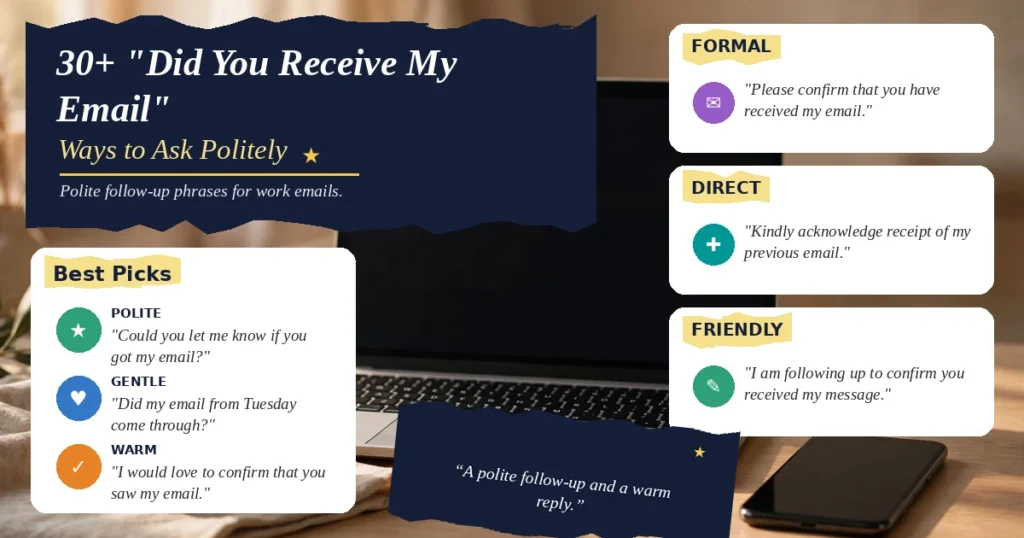
“Did my email from Tuesday come through?”
Naming the day adds helpful context. The reader can search their inbox faster. Example: “Hi, did my email from Tuesday come through? It had the invoice attached.”
“I am following up to confirm you received my message.”
This is clear and professional. It works for first follow-ups with clients. Example: “I am following up to confirm you received my message about the contract.”
“I wanted to check that my email did not land in your spam folder.”
This gives the reader a graceful excuse. Nobody feels blamed when spam is the suspect. Example: “I wanted to check that my email did not land in your spam folder, since it had several links.”
“Could you let me know if you got my email?”
This is a soft request that is easy to answer with one word. Busy people appreciate simple asks. Example: “Could you let me know if you got my email? A quick yes is enough.”
“I would love to confirm that you saw my email.”
This sounds warm and slightly personal. It fits well with partners and friendly clients. Example: “I would love to confirm that you saw my email about the event details.”
Professional and formal
“I am writing to confirm receipt of my email dated May 4.”
Use this for official matters like legal, finance, or HR topics. It sounds precise and serious. Example: “I am writing to confirm receipt of my email dated May 4 regarding the policy update.”
“Please confirm that you have received my email.”
This is direct but still polite. It works when you need a clear yes or no. Example: “Please confirm that you have received my email with the signed forms.”
“Kindly acknowledge receipt of my previous email.”
This is formal language for senior readers or official requests. It signals respect. Example: “Kindly acknowledge receipt of my previous email at your earliest convenience.”
“I would appreciate confirmation that my email arrived safely.”
This is gracious and professional. It works well with new business contacts. Example: “I would appreciate confirmation that my email arrived safely with the proposal attached.”
“May I confirm that you received my email of May 4?”
This is very polite and slightly traditional. It suits formal industries like law and banking. Example: “May I confirm that you received my email of May 4 about the account change?”
“This is a gentle follow-up to my email below.”
The word “gentle” softens the nudge. It tells the reader you mean no pressure. Example: “This is a gentle follow-up to my email below about the delivery schedule.”
“I am checking whether my email reached the right person.”
Use this when you are unsure about the recipient. It avoids blaming anyone. Example: “I am checking whether my email reached the right person for vendor approvals.”
“Please let me know if my earlier email needs to be resent.”
This offers a helpful next step. It shows you are ready to fix the problem. Example: “Please let me know if my earlier email needs to be resent with smaller attachments.”
Short and direct
“Did you get my email?”
This is the simplest version. Save it for colleagues and people you know well. Example: “Hi Ana, did you get my email about the room change?”
“Checking you saw my email.”
This is brief and modern. It works in fast-moving teams and chats. Example: “Checking you saw my email. The client moved the call to 3 p.m.”
“Did my last email reach you?”
This is short but still polite. It fits a quick second message. Example: “Hi, did my last email reach you? I sent the updated slides.”
“Quick check: did you receive it?”
This signals that you will not take much of their time. Busy readers like that promise. Example: “Quick check: did you receive it? I want to close this today.”
“Confirming you got my email.”
This is crisp and confident. It works when the matter is routine. Example: “Confirming you got my email with the login details.”
“Did it land in your inbox?”
This is casual and friendly. It works well with teammates. Example: “Did it land in your inbox? I sent the draft ten minutes ago.”
“Just making sure you saw this.”
This is warm and low pressure. It pairs well with a forwarded message. Example: “Just making sure you saw this. The deadline moved to Friday.”
“Following up. Did you get it?”
This is direct and efficient. Use it when time is short and the relationship is solid. Example: “Following up. Did you get it? I need your sign-off by noon.”
Gentle nudges
“Bumping this to the top of your inbox.”
This is a light, friendly nudge. It works with colleagues and warm contacts. Example: “Bumping this to the top of your inbox in case the week got busy.”
“I know you are busy, so here is a quick nudge.”
This shows respect for their time. People respond well to empathy. Example: “I know you are busy, so here is a quick nudge on the budget approval.”
“Just floating this back up in case it got buried.”
This is casual and kind. It blames the busy inbox, not the person. Example: “Just floating this back up in case it got buried under Monday’s emails.”
“A friendly reminder about my email below.”
This is warm and clear. It works for first reminders to clients. Example: “A friendly reminder about my email below with the meeting agenda.”
“Circling back on this.”
This is a classic business phrase. It is short and everyone understands it. Example: “Circling back on this. Do you have feedback on the draft?”
“In case my email slipped through the cracks.”
This gives the reader an easy excuse. It keeps the tone friendly. Example: “In case my email slipped through the cracks, I have attached the form again.”
“Giving this a gentle bump.”
This is soft and slightly playful. It suits friendly work cultures. Example: “Giving this a gentle bump. Let me know what you think of the plan.”
“I understand things get busy. Just checking in.”
This leads with empathy. It is perfect for senior or very busy readers. Example: “I understand things get busy. Just checking in on the invoice from last week.”
Formal for clients and managers
“I would be grateful if you could confirm receipt.”
This is elegant and respectful. It works for executives and important clients. Example: “I would be grateful if you could confirm receipt of the proposal.”
“Please advise if you have received my email.”
This is formal business language. It suits official correspondence. Example: “Please advise if you have received my email regarding the shipment.”
“I trust my email reached you without issue.”
This sounds confident and courteous. It fits well with long-term clients. Example: “I trust my email reached you without issue. I look forward to your thoughts.”
“I am writing to ensure my previous email came to your attention.”
This is formal and careful. It works when the matter is important. Example: “I am writing to ensure my previous email came to your attention before the board meeting.”
“Your confirmation of receipt would be appreciated.”
This is polite and professional. It clearly states what you need. Example: “Your confirmation of receipt would be appreciated so we can proceed.”
“I hope my email of May 4 reached you.”
This is warm but still formal. It works for first follow-ups with senior people. Example: “I hope my email of May 4 reached you. I have included the summary again below.”
“Kindly let me know if the email did not reach you.”
This is courteous and helpful. It focuses on solving the problem. Example: “Kindly let me know if the email did not reach you, and I will resend it right away.”
“I wanted to verify that my message was delivered.”
This is neutral and professional. It works in almost any formal setting. Example: “I wanted to verify that my message was delivered before we move to the next step.”
Quick comparison
With so many options, it helps to compare the top choices side by side. The table below shows eight strong alternatives, their tone, the best situation for each, and how formal they sound. Use it as a quick picker when you are in a hurry.
| Phrase | Tone | Best use | Formality |
|---|---|---|---|
| I wanted to follow up on my email below. | Neutral and safe | First follow-up at work | Medium |
| I wanted to make sure my email reached you. | Caring | When delivery is uncertain | Medium |
| Please confirm that you have received my email. | Direct | When you need a clear answer | Medium-high |
| Kindly acknowledge receipt of my previous email. | Formal | Senior readers, official matters | High |
| Did you get my email? | Casual | Close colleagues only | Low |
| Bumping this to the top of your inbox. | Friendly | Warm contacts, busy weeks | Low-medium |
| I know you are busy, so here is a quick nudge. | Empathetic | Very busy readers | Medium |
| I would be grateful if you could confirm receipt. | Gracious | Executives and key clients | High |
If you only remember three, remember these. For everyday work, “I wanted to follow up on my email below” never fails. When you worry about delivery, “I wanted to make sure my email reached you” sounds kind. For senior readers, “I would be grateful if you could confirm receipt” shows full respect. Match the phrase to the person, and your follow-up will always land well.
Email examples
Real examples make everything clearer. Below are five short follow-up emails you can copy and adjust. Each one keeps the message brief, restates the key point in one line, and ends with one clear question. When you promise an update in your note, you can borrow phrasing from our guide on other ways to say I will let you know to sound smooth and professional.
Example 1: Job application follow-up
Subject: Following up: Application for Content Writer role
Hi Ms. Lee,
I applied for the Content Writer role last Tuesday and wanted to make sure my application reached you. I am very excited about the position and would love the chance to discuss it.
Could you confirm that you received my application?
Best regards,
Najma
Example 2: Client quote follow-up
Subject: Following up: Quote sent on May 4
Hi David,
I am following up to confirm you received my message with the project quote. The pricing is valid until the end of the month, so I wanted to be sure it arrived safely.
Please let me know if you got it, and I will be happy to answer any questions.
Kind regards,
Najma
Example 3: Internal team follow-up
Subject: Quick check: Slides for Friday
Hi team,
Just checking in on my last email with the slide deck for Friday’s review. Did it land in your inbox? I want to make sure everyone has the latest version before we meet.
Thanks,
Najma
Example 4: Sales follow-up
Subject: Bumping this up: Demo invite
Hi Alex,
I know you are busy, so here is a quick nudge. Did my email about the product demo come through? I would love to find a time that works for you next week.
Just reply with a day that suits you.
Best,
Najma
Example 5: Second follow-up
Subject: Second check: Contract for signature
Hi Ms. Chen,
This is a gentle follow-up to my email below with the contract. I wanted to verify that my message was delivered, since I have not heard back yet.
Kindly let me know if the email did not reach you, and I will resend it right away.
Warm regards,
Najma
Notice what these examples have in common. They are all under 100 words. They each restate the topic in one line so the reader does not have to dig. They end with a single clear question that is easy to answer. Copy this structure every time, and your follow-ups will feel light instead of heavy.
Common mistakes
Even good writers make these mistakes when they follow up. Avoid them, and your emails will stand out for the right reasons.
Following up too soon. Sending a check-in two hours after your first email looks impatient. Give people time to breathe. Wait at least two business days for normal emails. A little patience builds trust, so please be patient and let the reader respond on a normal schedule.
Sounding like an accusation. “Why haven’t you replied to my email?” puts the reader on defense at once. It sounds like blame, even if you did not mean it that way. Always assume a good reason for the silence, like a busy week or a full inbox.
Using ALL CAPS or many exclamation marks. “DID YOU GET MY EMAIL?!!” looks like shouting. It can frighten the reader and hurt your image. One calm sentence works far better than loud formatting.
Sending too many follow-ups. Three unanswered follow-ups is usually the limit. After that, try a different channel, like a short call, or accept the silence and move on. More emails will not help and may harm the relationship.
Writing a vague subject line. A subject like “Checking in” tells the reader nothing. They may skip it during a busy morning. Always include the topic, such as “Following up: Invoice #2041.”
Forgetting to include context. “Did you see it?” leaves the reader guessing what “it” means. Restate the topic in one line or reply in the same thread. Make it easy for them to remember.
Blaming the spam folder in a rude way. “Your spam filter probably ate it again” sounds sarcastic. If you mention spam, do it kindly: “I wanted to check that my email did not land in your spam folder.”
Demanding a read receipt. Read receipts feel like surveillance to many people. They can damage trust, especially with clients. A polite written question gets better results and keeps the relationship warm.
Related phrases
The phrase “did you receive my email” belongs to a large family of follow-up language. Learning the relatives helps you vary your wording and sound more natural. Here are the most useful ones.
“Did you get my message” is the casual cousin. It works for chats, texts, and quick notes to colleagues. It is too informal for first emails to executives.
“Confirming receipt” is the formal sibling. You will see it in business letters and official emails. It sounds serious and precise, which is perfect for contracts and payments.
“Just following up” is the all-purpose helper. It fits almost any situation and never sounds rude. Pair it with the topic for best results, like “Just following up on the invoice.”
“Circling back” is the modern office favorite. It is short, friendly, and widely understood in business English. It works best with people you have already spoken to.
“Bumping this up” comes from forum culture and now lives in email too. It is casual and light. Save it for colleagues and warm contacts, not for formal first messages.
“Touching base” is the all-purpose helper. It is softer than asking about one specific email. Use it when you want to reconnect in general, not just check delivery.
“Checking in” is warm and human. It works when you care about the person as well as the task. It is a good choice for long-term clients and partners.
When your follow-up needs extra detail, it also helps to know other ways to say just to clarify so your restated point stays crystal clear. Mixing these phrases across your emails keeps your writing fresh and shows strong communication skills.
Phrase comparison
Let us compare three popular choices head to head so you can feel the difference in tone.
“Did you get my email?” versus “I wanted to make sure my email reached you.” The first is short and casual. It is fine for a teammate you chat with daily. The second is warmer and more careful. It focuses on delivery instead of the missing reply, which removes any hint of blame. For anyone outside your close circle, the second wins every time.
“I wanted to make sure my email reached you.” versus “Kindly acknowledge receipt of my previous email.” The first sounds like a helpful colleague. The second sounds like official correspondence. Use the first for everyday business. Use the second for legal matters, formal requests, or very senior readers who expect traditional language.
“Bumping this to the top of your inbox.” versus “I would be grateful if you could confirm receipt.” The first is playful and modern. It can make a busy colleague smile. The second is gracious and serious. It shows deep respect. Never swap them by accident. A playful nudge to a CEO can look unprofessional, while a stiff formal line to a close teammate can feel cold.
The lesson is simple. Short and casual fits friends at work. Warm and careful fits most business situations. Formal and gracious fits senior readers and official matters. Pick the level that matches your reader, and you will always strike the right note.
Cultural usage
Email culture changes from country to country, and a good follow-up respects those differences. What sounds friendly in one place can sound rude in another.
In the United States, direct language is normal. Short phrases like “Did you get my email?” are common between colleagues. Americans value speed, so a quick follow-up after two days is expected, not rude. Still, keep it polite with clients you do not know well.
In the United Kingdom, politeness runs deeper. British readers prefer softer openers like “I wanted to make sure my email reached you.” They also appreciate a touch of understatement. A phrase like “Just a gentle nudge” fits British office culture perfectly.
In many Asian and Middle Eastern business cultures, indirect language shows respect. Asking bluntly can feel confrontational. Softer phrases like “I trust my email reached you without issue” work better. Showing patience is also a sign of respect in these cultures, so allow extra time before you follow up.
With senior leaders everywhere, formality is the safest choice. Titles, polite requests, and gracious closings never offend. A warm close that shows you value the relationship, such as saying you are looking forward to your call, can leave a kind final impression across cultures.
When you write to someone from a culture you do not know well, choose the more formal option. It is easy to become more casual later as the relationship grows. It is much harder to repair a first impression that felt too blunt.
Frequently asked questions
How long should I wait before asking if someone received my email?
Wait two to three business days for a normal email. For urgent matters, one business day is enough. For job applications, wait five to seven business days before you check in. Following up at the right time shows that you are both keen and respectful.
Is it rude to ask “did you receive my email”?
The plain question is not rude, but it can sound blunt in writing. Tone is hard to read in email, so softening the words helps a lot. Phrases like “I wanted to make sure my email reached you” ask the same thing in a kinder way.
Should I reply to my original email or send a new one?
Reply inside the original thread whenever you can. This keeps the full history together and reminds the reader of the context. A new email forces the reader to search for the old one, which wastes their time.
What is the best subject line for a follow-up email?
Keep the original subject and add a short marker at the start, like “Following up: Quote sent on May 4.” This tells the reader exactly what the email is about before they open it. Avoid vague subjects like “Checking in” with no detail.
How many times can I follow up without being annoying?
Two to three follow-ups is the normal limit. Space them a few days apart and keep each one short. If there is still no reply, try a phone call or move on gracefully.
What if they still do not reply after two follow-ups?
Try a different channel, such as a brief phone call or a message on a work chat app. Sometimes emails get buried no matter how well you write. If that fails too, accept the silence politely and focus your energy elsewhere.
Can I ask for a read receipt instead?
You can, but it is often a poor choice. Many people find read receipts intrusive, and some email apps block them. A polite written question builds more trust and usually gets a warmer response.
Should I call instead of sending another email?
A call works well after two unanswered emails, especially for urgent matters. Keep the call short and friendly, and mention the email by topic. For non-urgent topics, one more email is usually enough.
How do I ask my boss if they received my email?
Use respectful, formal language and keep it very short. Try “I wanted to make sure my email reached you before the deadline.” Reply in the same thread so your boss sees the context at once. Never sound demanding with a superior.
How do I ask a client if they received my proposal?
Be gracious and professional. A good choice is “I would be grateful if you could confirm receipt of the proposal.” Mention the date you sent it and offer to resend it. This shows care without pressure.
What should I do if my email went to spam?
Resend it with a simpler subject line and fewer links, since these often trigger spam filters. Mention kindly that the first copy may have landed in spam. Ask the reader to add your address to their contacts to prevent it happening again.
Is “just bumping this” too casual for work?
It depends on the reader. With close colleagues and friendly teams, it is perfectly fine and even charming. With senior managers, new clients, or formal industries, choose a more polished phrase instead.
Can I use these phrases for text messages too?
Yes, the short and casual ones work well in texts and chat apps. Phrases like “Did you get my email?” fit a quick message. Save the formal versions for email, where a serious tone matters more.
What is the most polite way to ask?
“I would be grateful if you could confirm receipt” is one of the most polite options. It is gracious, formal, and respectful. For everyday use, “I wanted to make sure my email reached you” is politely warm without sounding stiff.
How do I follow up on a job application email?
Wait five to seven business days, then send a short, warm note. Restate the role name and the date you applied. End with one clear question, such as “Could you confirm that you received my application?” Keep the whole email under 100 words.
Conclusion
Checking on an unanswered email does not have to feel awkward. With the right words, your follow-up becomes a sign of care, not pressure. You now have more than 30 polite alternatives, from quick casual nudges to formal requests for senior readers. You also know when to send them, how to structure them, and which mistakes to avoid.
Remember the simple rules. Wait two to three business days before your first check-in. Reply inside the same thread so the context stays visible. Keep your message under 100 words and end with one clear question. Match your tone to your reader: casual for close colleagues, warm for most business contacts, and formal for executives and official matters.
The next time silence makes you nervous, do not stare at your inbox and worry. Pick one phrase from this guide, add one line of context, and send your follow-up with confidence. If you want to master the basics of online messages, you can also review the dictionary definition of email to sharpen your understanding of the term.
A thoughtful follow-up keeps conversations alive and projects moving. Start with kindness, stay brief, and always give the reader an easy way to reply. Your professionalism will shine through every time.