Introduction
Finding other ways to say you are important to me can change a relationship for the better. The original sentence is honest and kind. It says exactly what you feel. But when you say it often, it can start to feel small, like a line you say out of habit instead of a truth you mean from the heart.
Think about the last time someone told you that you mattered. Did they say it plainly, or did they choose words that made you stop and really feel it? The right words land deeper. A mentor who hears “your guidance means the world to me” feels something different than a quick “you are important to me” at the end of a busy day. Both are true. One stays with them longer.
This guide gives you 40 heartfelt alternatives grouped by tone, so you can match your words to the person and the moment. You will find lines for mentors, teams, close friends, and family. You will also get email examples, quick tables, common mistakes to avoid, and answers to the questions people ask most. By the end, you will have the perfect way to tell anyone how much they matter to you.
Meaning
To say “you are important to me” means to tell someone that they hold real value in your life. It is a direct statement of worth. You are telling the other person that your days are better because they exist in them, and that losing them would leave a real gap.
People use this sentence with partners, friends, family members, mentors, and even close colleagues. It shows up in birthday cards, thank-you notes, goodbye messages, and quiet late-night talks. It is simple, but it carries weight because it answers a question everyone asks silently: do I matter to the people around me?
The phrase also does something powerful for the listener. Studies on gratitude and connection show again and again that people thrive when they feel valued. A sincere message of appreciation can lift someone’s mood for days. It can strengthen a friendship, repair a strained bond, or give a tired coworker a reason to keep going. Words like these are never wasted.
There is one thing to remember. The sentence works best when it feels specific and true. If you pair it with a small detail, like what the person did or who they are to you, it becomes much stronger. “You are important to me because you always listen” beats the bare sentence every time. The alternatives in this guide help you add that warmth and detail naturally.
Professional usage
At work, telling someone they matter is a leadership skill. Managers who express genuine appreciation build teams that stay longer and work harder. You do not need grand speeches. A short, sincere line in a note or email can do more than a bonus nobody remembers.
Use these phrases with mentors who shaped your career. A mentor invests time and wisdom in you, often without being asked. Telling them they made a real difference is one of the best thank-yous you can give. It costs nothing, and it means everything. Many professionals say a single heartfelt note from a mentee stayed on their desk for years.
Use them with teams and colleagues too. When a project succeeds, people remember who noticed their effort. Saying “this team would not be the same without you” after a hard launch tells each person that their late nights counted. This kind of recognition builds loyalty that money cannot buy. It also sets a culture where people look out for each other.
A few rules keep these messages professional. Keep the tone warm but not overly personal with people you do not know well. In writing, match the formality of your workplace. A quick note of thanks to someone who took care of a task for you can carry this warmth perfectly. And always be specific. “You matter because your calm saved the client meeting” is ten times stronger than a vague compliment.
Alternatives
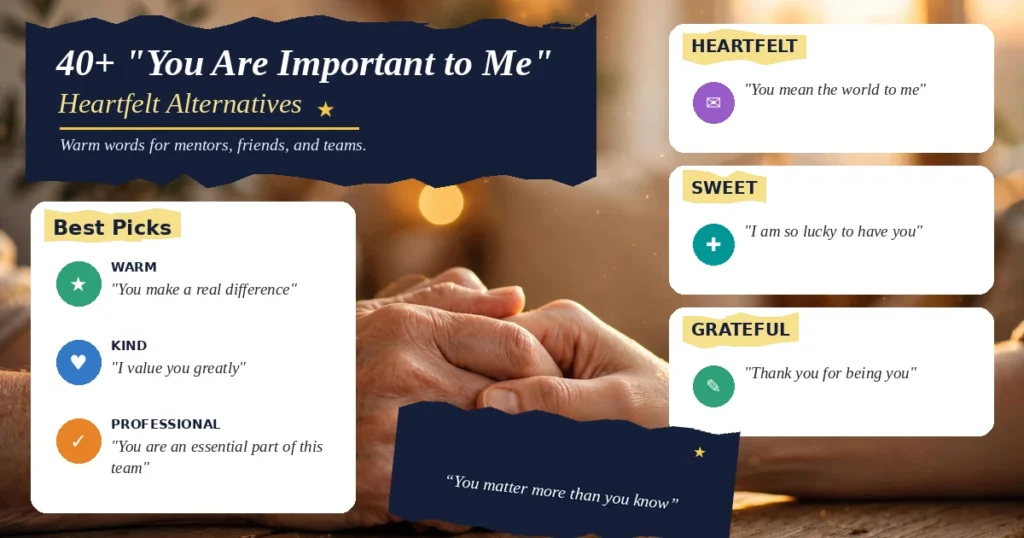
Here are 40 heartfelt ways to replace “you are important to me,” grouped by tone. Each entry shows the best setting for the line and a short example so you can see it in action. Choose the group that fits your person, then pick the words that feel most like you.
Professional
These work for mentors, managers, advisors, and valued colleagues. They sound warm without crossing into overly personal territory.
You make a real difference, – Warm and professional, perfect for a mentor or senior who shaped your work. Example: “You make a real difference, and I notice it every single day.”
I value you greatly, – Calm and sincere, ideal for thank-you notes to colleagues. Example: “I value you greatly, both as a teammate and as a friend.”
Your guidance means the world to me, – Deep respect, best for mentors and coaches. Example: “Your guidance means the world to me, especially this past year.”
You are an essential part of this team, – Strong workplace praise for a key colleague. Example: “You are an essential part of this team, and our results prove it.”
I am grateful to have you in my corner, – Professional warmth for allies and advisors. Example: “I am grateful to have you in my corner during this project.”
Your support has been invaluable, – Polished and graceful, fits formal thank-you messages. Example: “Your support has been invaluable throughout the launch.”
I hold you in the highest regard, – Formal respect for leaders and mentors. Example: “I hold you in the highest regard for everything you have taught me.”
You matter more than you know, – Warm and personal while staying professional. Example: “You matter more than you know to everyone on this floor.”
Formal
Reach for these in letters, speeches, milestone messages, and notes to respected elders or leaders.
You hold a special place in my life, – Formal and heartfelt, suits written letters. Example: “You hold a special place in my life, and I am better for knowing you.”
I cherish your presence, – Elegant and sincere, works in formal notes. Example: “I cherish your presence at every family gathering.”
You are deeply valued, – Short and dignified, fits formal occasions. Example: “You are deeply valued by this entire organization.”
My life is richer because of you, – Poetic but controlled, good for milestone messages. Example: “My life is richer because of you, and I mean every word.”
I treasure what you bring into my life, – Thoughtful, ideal for long-standing relationships. Example: “I treasure what you bring into my life every single day.”
You are irreplaceable to me, – Strong and formal, use when sincerity matters most. Example: “You are irreplaceable to me, both at work and beyond it.”
I am honored to know you, – Gracious formality for respected figures. Example: “I am honored to know you and to learn from you.”
Your friendship is one of my greatest gifts, – Deep and formal, best for lifelong bonds. Example: “Your friendship is one of my greatest gifts, and I do not say that lightly.”
Friendly
These feel natural with close friends, family, and people you talk to every day.
You mean the world to me, – Warm and classic, perfect for close friends and family. Example: “You mean the world to me, and I hope you always know that.”
Life is better with you in it, – Light and loving, suits casual notes. Example: “Life is better with you in it, seriously.”
I do not know what I would do without you, – Honest and warm, best for best friends. Example: “I do not know what I would do without you, honestly.”
You are my favorite person, – Playful and sweet, great for partners and close friends. Example: “You are my favorite person to share good news with.”
Everything is more fun with you, – Cheerful, ideal for friends and siblings. Example: “Everything is more fun with you around, even errands.”
You make my days brighter, – Gentle and kind, works for anyone you care about. Example: “You make my days brighter just by being yourself.”
I am so lucky to have you, – Simple and heartfelt, fits cards and texts. Example: “I am so lucky to have you in my life.”
You are a treasure, – Short and sweet, great for warm compliments. Example: “You are a treasure, and I tell everyone that.”
Email ready
These are built for inboxes and notes. They are short, warm, and easy to read on a screen.
Just wanted you to know how much you mean to me, – Soft opener for heartfelt emails. Example: “Just wanted you to know how much you mean to me, especially after this week.”
Thank you for being you, – Short and powerful, closes any note beautifully. Example: “Thank you for being you. I mean that.”
I appreciate you more than words can say, – Warm email line for mentors and friends. Example: “I appreciate you more than words can say, truly.”
Your kindness has not gone unnoticed, – Polite and observant, fits workplace thank-yous. Example: “Your kindness has not gone unnoticed, and it means a lot to me.”
You have my whole heart, – Deep and personal, best for partners and family. Example: “You have my whole heart, now and always.”
I am thinking of you and smiling, – Light and warm, lovely for a quick check-in. Example: “I am thinking of you and smiling. Hope your day is kind to you.”
This note is just to say you matter, – Direct and tender, perfect subject-line energy. Example: “This note is just to say you matter to me more than you know.”
I wanted to put this in writing: you count, – Earnest, great for people who need to hear it. Example: “I wanted to put this in writing: you count, and you always will.”
Workplace
These keep the warmth while staying safe for office settings, team chats, and farewell messages.
This team would not be the same without you, – Team-focused praise for colleagues. Example: “This team would not be the same without you, and we all feel it.”
Your work lifts everyone around you, – Professional compliment with heart. Example: “Your work lifts everyone around you, so keep shining.”
You bring out the best in this team, – Manager-friendly praise for a star member. Example: “You bring out the best in this team, and I see it daily.”
We are lucky to have you here, – Warm and simple, fits any workplace. Example: “We are lucky to have you here, truly.”
Your effort does not go unnoticed, – Encouraging, ideal for hardworking staff. Example: “Your effort does not go unnoticed, and I thank you for it.”
You set the standard around here, – High praise for top performers. Example: “You set the standard around here, and we all aim to match it.”
I trust you completely, – Deep professional respect for a trusted colleague. Example: “I trust you completely, and that trust is well earned.”
You make this place better, – Casual and warm, works across every role. Example: “You make this place better just by showing up as you.”
Quick comparison
In a hurry? Here are the top picks at a glance. Choose one based on your tone and setting.
| Alternative | Tone | Best use |
|---|---|---|
| Your guidance means the world to me | Professional | Thanking a mentor |
| I value you greatly | Professional | Thanking a mentor |
| You hold a special place in my life | Formal | Letters and milestone messages |
| I cherish your presence | Formal | Notes to respected elders |
| You mean the world to me | Friendly | Close friends and family |
| You make my days brighter | Friendly | Warm everyday compliments |
| I appreciate you more than words can say | Email ready | Heartfelt emails |
| This note is just to say you matter | Email ready | Direct subject-line style notes |
| This team would not be the same without you | Workplace | Team and colleague praise |
| Your effort does not go unnoticed | Workplace | Encouraging hardworking staff |
Email examples
See how these phrases work in real notes and emails. Copy the style, change the details, and make each one your own.
To a mentor
Subject: Thank you
Dear Ms. Carter,
I wanted to write this properly because a quick thanks in the hallway never feels like enough. Your guidance means the world to me. You taught me how to think, not just how to work, and I carry that lesson into every project.
I value you greatly, and I hope I make you proud.
With gratitude,
Ayesha
To a colleague
Subject: You made the difference
Hi Omar,
I just wanted to say this out loud. You are an essential part of this team. When the deadline moved up, your calm plan saved the whole launch. We are lucky to have you here.
Thanks for everything,
Lena
To a friend
Subject: Just because
Hey Maya,
This note is just to say you matter. Life is better with you in it, and I do not say that lightly. Thanks for every late-night talk and every bad joke that made me laugh anyway.
Love,
Sara
To a team
Subject: We did it
Hi team,
We did it. This team would not be the same without each of you. Your effort does not go unnoticed, and I want every one of you to know how much I appreciate what you gave this month.
Proud of us all,
David
Appreciation note
Subject: A small note of thanks
Hi Mr. Bennett,
I wanted to put this in writing: you count. I am honored to know you, and your support has been invaluable to me this year. People like you are rare, and I never forget that.
Warmly,
Nadia
Notice how each note stays short and puts the warmest line near the top. That is the same idea behind showing you understand someone – lead with feeling, then add the detail. When distance makes you miss someone, a line like I miss you says it simply, and these alternatives help you say even more.
Common mistakes
1. Saying it so often it loses meaning
Repeating any sweet phrase turns it into background noise. If you say it every day, save the special lines for moments that matter.
2. Choosing the wrong tone for the person
“You have my whole heart” fits a partner, not your manager. Match the line to the relationship, or the message can feel awkward.
3. Choosing the wrong tone for the person – “You have my whole heart” fits a partner, not your manager. Match the line to the relationship, or the message can feel awkward.
4. Writing a long message with no real point
Long notes are fine, but they need one clear feeling. If your message rambles, the reader misses the love inside it.
5. Only saying it when something is wrong
Do not wait for a crisis or a goodbye. Say it on ordinary days. That is when it means the most.
6. Sending it as a group text and nothing more
A group message is nice, but a personal note hits deeper. Send the group thanks, then message the one person who needs to hear it.
7. Forgetting to say why
People believe specific praise more than general praise. Tell them exactly what they do, who they are to you, or a moment you remember.
8. Making it about you instead of them
“I am so glad I have you” centers you. “You make every room better” centers them. Keep the spotlight on the person you are praising.
9. Using humor that hides the feeling
A joke can soften the moment, but it can also bury the message. Say the sincere part first, then add the laugh.
10. Never saying it at all
The biggest mistake is silence. Many people never hear these words until it is too late. Send the note today.
Related phrases
These expressions live in the same family as “you are important to me.” Learn them and your English will sound warmer and more natural.
I appreciate you – A simple, powerful thank-you for someone’s presence. Example: “I appreciate you more than you know.” (See I appreciate it for more ways to express gratitude.)
You matter – The shortest version of the whole idea. Example: “You matter, and never doubt that.”
I am grateful for you – Warm and direct, perfect for thank-you notes. Example: “I am grateful for you every single day.”
You are loved – Gentle and deep, often used with family. Example: “You are loved more than you realize.”
I care about you – Honest and steady, works in any close relationship. Example: “I care about you, and I always will.”
You mean a lot to me – A softer cousin of the main phrase. Example: “You mean a lot to me, especially lately.”
I value our friendship – Specific and warm, great for friends. Example: “I value our friendship more than I can say.”
Thank you for being in my life – A full-hearted thank-you. Example: “Thank you for being in my life through all of it.”
You are special to me – Sweet and personal, fits cards and texts. Example: “You are special to me, and you always will be.”
I am lucky to know you – Humble and warm, good for mentors and friends. Example: “I am lucky to know someone like you.”
You inspire me – Praise with admiration, ideal for mentors. Example: “You inspire me to do better every day.”
I look up to you – Deep respect, best for role models. Example: “I look up to you more than you know.”
You make a difference – Short praise for someone’s impact. Example: “You make a difference everywhere you go.”
I am here for you – Support paired with care. Example: “I am here for you, no matter what.”
You are not alone – Comforting, perfect in hard times. Example: “You are not alone. I am right here.”
My pleasure to help – A warm reply when someone thanks you. Example: “It was my pleasure to help you move.” (See my pleasure to help for more uses.)
Phrase comparison
“You are important to me” sits right in the middle of the warmth scale. It is direct, honest, and safe for almost any relationship. But the middle is not always the most powerful choice. With a mentor or a respected elder, a slightly deeper line like “your guidance means the world to me” or “I hold you in the highest regard” shows that you thought about your words. These phrases slow the reader down and signal that this message is not routine. They carry a weight that the plain original cannot reach on its own.
With close friends and family, the original can actually feel a little flat. “You mean the world to me” or “life is better with you in it” sounds warmer and more alive. These lines feel like they come from a real moment, not from a greeting card template. The difference is small, but people feel it. One sounds like a fact you are reporting. The other sounds like a feeling you could not hold in.
Workplace notes reward the lines that praise impact, not just feelings. “You are an essential part of this team” and “your effort does not go unnoticed” work because they connect the person’s worth to something real: their work, their calm, their results. Emails and messages reward brevity. “This note is just to say you matter” fits a subject line or a short text perfectly. If you only remember one rule, make it this: match the line to the person and the moment, not just to the meaning.
Cultural usage
US English
Americans say these things out loud and often. “You mean the world to me” and “I am so lucky to have you” are common in birthday cards, texts, and toasts. US culture values open emotion, so people do not hide warm feelings at work either. A manager might end a team email with “we are lucky to have you here,” and nobody finds it strange. Directness is a virtue here, so say it plainly and say it often.
UK English
British speakers often wrap warm feelings in gentle understatement. Instead of “you mean the world to me,” a Brit might say “you matter more than you know” or “I am lucky to know you.” The feeling is the same, but the volume is lower. In UK workplaces, praise tends to be specific and modest: “your effort does not go unnoticed” fits perfectly. If a British friend says something warm, listen closely, because the quiet words usually carry the most.
Workplace culture
Across cultures, telling colleagues they matter has become a core part of good management. Many companies now train leaders to give regular, specific praise. The trick is to keep it genuine. A copy-pasted “great job” fools nobody. But a specific line like “your calm saved the client meeting” builds real trust. In global teams, written notes work best because they cross time zones and language barriers cleanly. A short message of appreciation, sent at the right moment, can turn a struggling employee’s whole quarter around.
Family and friendship
In families and close friendships, these words are the glue. Some cultures say them daily, others save them for big moments, but every culture has a version. What matters is not the occasion but the habit. A quick text that says “thinking of you and smiling” can brighten an ordinary Tuesday. And when someone is going through a hard time, knowing they matter to you can be the thing that keeps them going. Never assume people know. Say it, write it, and say it again.
Frequently asked questions
What does “you are important to me” mean?
It means someone holds real value in your life and your days are better because they are in them. It is a direct statement of worth and care. People say it to partners, friends, family, and mentors to answer the quiet question everyone asks: do I matter?
Is it okay to say “you are important to me” at work?
Yes, with the right tone and the right person. Keep it warm but professional, and pair it with something specific like their work or support. Lines like “you are an essential part of this team” fit workplaces perfectly without feeling too personal.
What is a deeper way to say “you are important to me”?
“Your guidance means the world to me” and “you hold a special place in my life” go deeper than the original. They add weight and thoughtfulness. Use them for mentors, elders, and people who shaped who you are.
How do you tell a friend they are important to you?
Be direct and warm. “You mean the world to me” or “life is better with you in it” work beautifully with close friends. Add one memory or detail to make it personal. A short text on an ordinary day often means more than a long speech on a big one.
What should I write in a thank-you note to a mentor?
Thank them for something specific, then add a line about their worth. For example: “Your advice on the project changed how I work. Your guidance means the world to me.” Specific praise plus warm feeling is the perfect formula.
Is “you mean the world to me” too strong?
Not for close relationships. Partners, best friends, and family hear it as deep love, which is the point. For coworkers or acquaintances, choose a lighter line like “I value you greatly” or “we are lucky to have you here.”
How often should you tell people they matter?
More often than you think. Most people hear it far less than they need to. A short note every few weeks to someone you value builds strong bonds. Do not wait for birthdays or farewells to say what you feel.
What is the difference between “I appreciate you” and “you are important to me”?
“I appreciate you” thanks someone for what they do or who they are in a general way. “You are important to me” says they hold a valued place in your life. The first is gratitude, the second is closeness. Both matter, and they work well together.
Can I say this to someone I just met?
Keep it light with new people. “I am glad we met” or “I enjoyed talking with you” fits better than deep lines about importance. Save the heartfelt versions for relationships with real history behind them.
What is a short text version of “you are important to me”?
“You matter” is the shortest strong version. “Thinking of you and smiling” works as a warm check-in. For a text, keep it under one line and let the simplicity carry the feeling.
How do you say it without sounding awkward?
Add a reason. “You are important to me because you always listen” sounds natural, while the bare sentence can feel stiff. A small detail gives the listener something to hold onto, and it shows you mean it.
What do you say when someone says “you are important to me”?
Say thank you and return the warmth. “That means so much to me” or “you are important to me too” both work. Do not brush it off with a joke. The person took a risk to be open, so honor that with a sincere reply.
Is it better to say it in person or in writing?
Both work, but writing lasts. A spoken line can fade from memory, while a note or email can be reread on hard days. If the person matters deeply to you, put it in writing so they can keep it.
What is a formal way to say “you are important to me”?
“I cherish your presence” and “you are deeply valued” are excellent formal choices. They suit letters, speeches, and notes to respected leaders or elders. They carry dignity without losing warmth.
How do I tell my team they are important?
Be specific and name the impact. “This team would not be the same without you” works, but it is stronger with detail: “your calm saved the client meeting.” Send it in writing so the whole team can feel it, and say it while the win is fresh.
Conclusion
Here are the best lines to keep in your pocket, two per tone. For professional settings, use “your guidance means the world to me” and “I value you greatly.” In formal moments, reach for “you hold a special place in my life” and “I cherish your presence.” With close friends and family, “you mean the world to me” and “life is better with you in it” say it best. In emails and notes, “I appreciate you more than words can say” and “this note is just to say you matter” shine. At work, “this team would not be the same without you” and “your effort does not go unnoticed” build real loyalty.
The people around you are guessing how much they matter. Stop letting them guess. Pick one line from this guide, add one honest detail, and send it today. A few sincere words can change someone’s whole week, and the habit will change your relationships for good. When you need to put a name on this feeling of worth, the word value on Cambridge Dictionary captures it well: to value someone is to believe they are important, and saying so out loud is one of the kindest things you can do.