Introduction
Most people learn other ways to say social skills because the same two words start to feel flat. You write them on a resume, you say them in an interview, and you repeat them in a classroom, and soon they lose their force. A fresh phrase can show exactly what you mean. It can show that you listen well, work well in a team, or handle tough talks with care. This guide gives you clear options for work, school, and daily life.
You do not need fancy language to sound skilled. You need the right words for the moment. A job application calls for a different tone than a chat with a friend. A teacher needs a different phrase than a manager. This article walks through each setting, so you can pick a phrase that fits and still sounds like you. You will also find examples you can copy, adjust, and use right away.
The phrase social skills covers a wide range of habits. It covers how you speak, how you listen, and how you read a room. It covers how you solve a disagreement without making it worse. It also covers how you build trust over time. When you name the exact habit, people understand you faster. They can picture what you do, and they can trust what you promise.
Read the full list, then pick three or four phrases that match your strengths. Practice them in real sentences. Use one in your next email, one in your next meeting, and one in a friendly chat. Small changes like these build a strong impression, and they help you speak with more confidence in every part of your life.
Meaning
Social skills describe the abilities you use when you deal with other people. They include clear speech, active listening, patience, and respect. They also include teamwork, empathy, and calm problem solving. In short, they describe how well you connect, cooperate, and communicate with others in daily life.
People often use the term as a broad label. A teacher might say a student needs stronger social skills. A hiring manager might list social skills in a job post. A parent might praise a child for showing good social skills at a party. In each case, the speaker means something slightly different. The teacher may mean group work. The manager may mean client talks. The parent may mean polite manners and kind play.
That broad use creates a problem. The phrase tells people that you handle people well, but it does not tell them how. Do you lead a meeting with ease? Do you calm an upset customer? Do you help a shy teammate speak up? Each skill deserves its own words. Clear words remove guesswork, and they help the listener see your real strength.
Think of social skills as an umbrella term. Under that umbrella sit many smaller skills. Communication skills sit at the front. Listening skills, teamwork skills, and conflict skills sit beside them. Emotional awareness and cultural awareness sit at the back, and they shape how you use all the rest. When you pick a phrase from this guide, you point to one part of that umbrella, and your message grows sharper at once.
You can also use the term in a general sense when you lack detail. A short note to a friend may not need a precise term. A formal document, though, rewards precision. A resume, a cover letter, and a school report all gain strength when you name the exact skill. Your reader then knows what you offer, and you stand out from people who use only the same broad phrase.
Professional usage
Workplaces value social skills, but hiring teams want proof, not labels. A resume that says only “good social skills” tells a recruiter very little. A resume that says “strong client communication skills” or “proven teamwork and conflict resolution skills” tells a much clearer story. It names the skill, and it hints at the result you can bring to the team.
Use precise phrases in each part of a job application. In your summary, name two or three strengths that match the job post. In your work history, pair each phrase with a result. For example, you can write that you used clear client communication to keep a project on track. You can also write that you used active listening to solve a long-running complaint. Results turn a soft claim into a solid fact.
Interviews reward the same habit. When an interviewer asks about your people skills, answer with a short story. Name the skill, describe the moment, and share the outcome. You might say, “I used calm conflict resolution when two team members disagreed on a deadline, and we finished the project on time.” That answer sounds real because it shows the skill in action.
Managers also use these phrases in reviews and references. A manager might praise your teamwork, your clear updates, or your steady manner under pressure. If you know the exact terms, you can guide that praise. You can ask a manager to note your client communication or your mentoring skills. Those exact words then carry weight in your next role.
In emails and meetings, tone matters as much as word choice. A warm, direct tone builds trust fast. A vague or stiff tone can hide your strengths. When you thank a colleague, name the help you received. When you ask for support, state the need plainly. For example, you can say that you appreciate the clear guidance a teammate gave you, and that simple line shows both gratitude and strong people skills. Small, honest lines like that shape how others see you at work.
Alternatives
The phrases below give you a fresh way to say social skills in any setting. Each group fits a different tone. Pick the group that matches your moment, then pick the phrase that matches your exact strength.
Professional and workplace phrases
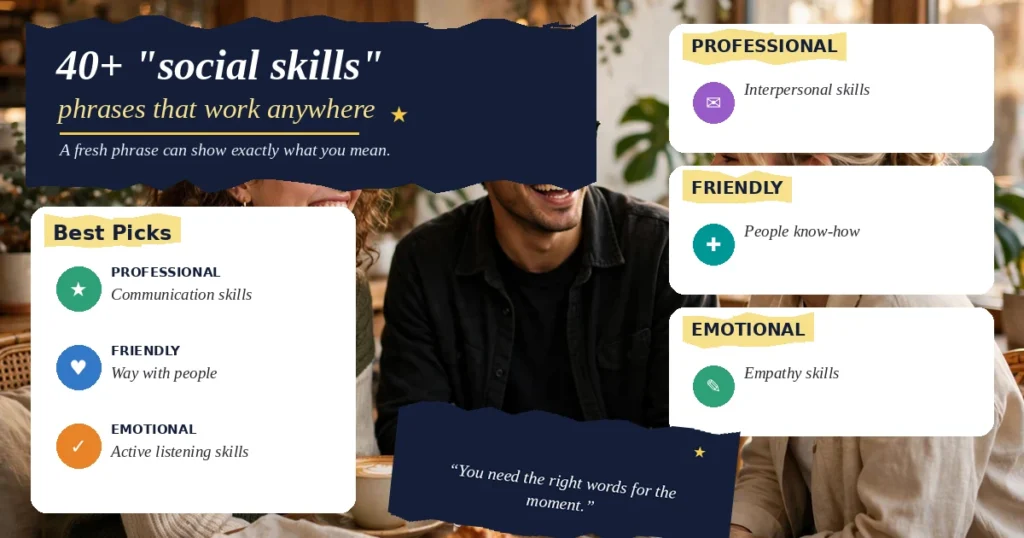
- Communication skills — formal and safe for resumes, job posts, and reviews. Example: “Her communication skills help the whole team stay on the same page.”
- Interpersonal skills — formal, and a common choice for job ads and cover letters. Example: “The role calls for strong interpersonal skills and a calm manner.”
- People skills — plain and warm, and it works well in interviews and team talks. Example: “His people skills make new clients feel welcome right away.”
- Client communication skills — specific, and best for sales, support, and service roles. Example: “Her client communication skills turn tough calls into loyal customers.”
- Teamwork skills — direct, and ideal when you stress group work over solo work. Example: “His teamwork skills helped our small team finish the launch early.”
- Collaboration skills — modern and workplace-ready, and it suits project roles. Example: “Her collaboration skills keep designers and writers moving together.”
- Leadership communication — strong and senior, and it fits managers and team leads. Example: “His leadership communication gives the team clear goals each week.”
- Stakeholder management skills — formal and senior, and it fits roles with many decision makers. Example: “Her stakeholder management skills keep every partner informed and calm.”
Friendly and everyday phrases
- People know-how — casual and warm, and it fits chats with friends and family. Example: “She has real people know-how, and guests always feel at ease around her.”
- Way with people — friendly and natural, and it suits praise in daily talk. Example: “He has a great way with people, and strangers open up to him fast.”
- Good with people — simple and honest, and it works in any casual setting. Example: “She is good with people, so the new class felt welcome on day one.”
- Easy to talk to — warm and personal, and it describes a welcoming manner. Example: “He is easy to talk to, and shy students ask him for help first.”
- Friendly manner — gentle and polite, and it fits school and community settings. Example: “Her friendly manner helps new neighbours settle in with ease.”
- Social ease — smooth and light, and it describes comfort in groups. Example: “His social ease shows at every party, and he talks with anyone.”
- Charm and warmth — soft and kind, and it suits personal praise. Example: “Her charm and warmth turn a short visit into a happy memory.”
- Gift of gab — playful and informal, and it fits fun, light talk only. Example: “He has the gift of gab, and long car rides fly past with him.”
Emotional and listening phrases
- Active listening skills — clear and respected, and it fits teaching, care work, and support roles. Example: “Her active listening skills help upset customers feel heard and calm.”
- Empathy skills — warm and modern, and it suits care, teaching, and team roles. Example: “His empathy skills help him spot when a teammate feels stressed.”
- Emotional intelligence — formal and widely known, and it fits resumes and reviews. Example: “Her emotional intelligence guides her through tense talks with care.”
- Patience with people — gentle and honest, and it fits parents, teachers, and carers. Example: “His patience with people makes hard lessons feel safe and slow.”
- Conflict resolution skills — formal and strong, and it fits managers and mediators. Example: “Her conflict resolution skills end disputes before they grow bigger.”
- Calm under pressure — steady and trusted, and it fits busy teams and service roles. Example: “He stays calm under pressure, and the team follows his steady lead.”
- Understanding others — plain and kind, and it fits school reports and references. Example: “She shows real skill in understanding others, and friends trust her advice.”
- Supportive nature — warm and caring, and it fits praise for helpers and mentors. Example: “His supportive nature lifts new staff through their first hard weeks.”
School and learning phrases
- Classroom communication — clear and school-ready, and it fits reports and teacher notes. Example: “Her classroom communication helps group projects run with less fuss.”
- Group work skills — direct and student-friendly, and it fits school and college use. Example: “His group work skills help every member share ideas and tasks fairly.”
- Peer relationship skills — formal and school-safe, and it fits reports and guidance notes. Example: “Her peer relationship skills help her build kind, steady friendships.”
- Respectful communication — polite and clear, and it fits school rules and values. Example: “His respectful communication keeps class debates fair and calm.”
- Listening and sharing skills — simple and young-learner friendly, and it fits primary school use. Example: “Her listening and sharing skills make circle time happy for all.”
- Friendship skills — warm and simple, and it fits young learners and parents. Example: “His friendship skills help him join games and include others with ease.”
- Presentation skills — clear and academic, and it fits talks, speeches, and class work. Example: “Her presentation skills make her class talks clear and fun to hear.”
- Discussion skills — plain and useful, and it fits essays, debates, and seminars. Example: “His discussion skills help the group reach fair answers together.”
Confident and persuasive phrases
- Networking skills — modern and career-ready, and it fits business events and job talks. Example: “Her networking skills turn short chats into lasting work contacts.”
- Persuasion skills — bold and direct, and it fits sales, debate, and leadership roles. Example: “His persuasion skills help the team agree on a plan without force.”
- Negotiation skills — formal and strong, and it fits business, sales, and legal talks. Example: “Her negotiation skills win fair deals that both sides can accept.”
- Public speaking skills — clear and respected, and it fits talks, teaching, and leadership. Example: “His public speaking skills hold a large room with ease and humour.”
- Relationship building skills — warm and professional, and it fits long-term client work. Example: “Her relationship building skills keep clients loyal year after year.”
- Influence skills — modern and bold, and it fits leaders and change makers. Example: “His influence skills move a whole team toward a better plan.”
- Diplomatic skills — formal and polished, and it fits sensitive talks and senior roles. Example: “Her diplomatic skills settle tense talks without bruising feelings.”
- Rapport building — smooth and professional, and it fits sales, care, and service work. Example: “His rapport building turns a first meeting into easy trust.”
That list gives you 40 phrases, and each one points to a real habit. Keep the full list close when you write. You can swap a broad phrase for a sharp one in seconds, and your message will sound clearer at once.
Quick comparison
A short table helps you pick fast. Match your setting to the tone, then use the phrase that fits best.
| Setting | Best tone | Try this phrase | Avoid this phrase |
|---|---|---|---|
| Job application | Formal | Interpersonal skills | Gift of gab |
| Interview answer | Warm and confident | People skills | Social ease |
| School report | Clear and kind | Peer relationship skills | Persuasion skills |
| Friendly chat | Casual | Good with people | Stakeholder management skills |
| Client email | Polite and direct | Client communication skills | Charm and warmth |
| Team review | Professional | Collaboration skills | Gift of gab |
The table shows a simple rule. Formal settings need formal words. Friendly settings need warm words. When the tone matches the setting, your message lands well. When the tone clashes, even a true claim can sound odd. A manager may smile at “gift of gab” in a chat, but the same phrase looks weak on a resume.
Use the table as a starting point, not a strict rule. Your own voice matters too. If a phrase feels stiff when you say it, pick a softer one. If a phrase feels too light for a formal note, pick a firmer one. The best phrase is the one that sounds true, fits the reader, and names your real strength.
Email examples
Emails show social skills in action. The words you pick set the tone, and the tone shapes the reply you get. Use warm, direct lines, and name the skill only when it helps the reader.
A short note to a new colleague can sound like this: “Hello Sara, I wanted to welcome you to the team. I look forward to working with you, and I hope we can share ideas often. Please tell me how you like to work, so I can support you well.” That note shows warmth, teamwork, and respect in just a few lines.
A note to a client needs a firmer tone: “Dear Mr. Ahmed, thank you for your message. I understand your concern, and I will check the order today. I will send you a clear update by 5 p.m.” That note shows client communication, calm problem solving, and care. It gives facts, not vague comfort.
When you need help, ask plainly. You can write, “Hello team, I need your help with the Friday report, and I want to make sure the numbers are right.” A direct ask like that shows trust and teamwork. If you want softer wording for the same ask, you can learn other ways to say I need your help and pick the tone that fits your team.
When a talk grows tense, slow down and name what you hear. You can write, “Thank you for explaining the issue so clearly. I understand your view, and I want to find a fair fix.” Lines like that show active listening and calm conflict skills. For more wording ideas, see other ways to say I understand and choose a line that sounds like you.
End emails with warmth and a clear next step. You can write, “Please let me know if you need anything else from me.” You can also write, “Thank you for your time, and I look forward to your reply.” A kind close leaves the reader with a good feeling, and it shows the same people skills you claim in your resume.
Common mistakes
Many people weaken their message with small word mistakes. The first mistake is vagueness. A line like “I have great social skills” says little. A line like “I build strong client relationships through clear weekly updates” says much more. Name the habit, name the action, and name the result when you can.
The second mistake is tone mismatch. A playful phrase in a formal letter looks careless. A stiff phrase in a friendly chat looks cold. Read your line as the reader would read it. Ask yourself if the tone fits the setting. If it does not, swap the phrase for one from the matching group in this guide.
The third mistake is overclaiming. A claim like “I never upset anyone” sounds false, and it invites doubt. A claim like “I handle tough talks with care and patience” sounds honest. Strong people skills include honesty about limits. Readers trust a modest, true claim far more than a grand one.
The fourth mistake is piling up buzzwords. A sentence packed with “synergy, stakeholder engagement, and interpersonal excellence” hides your meaning. One clear phrase beats five fancy ones. Pick the strongest term, use it once, and let your example do the rest of the work.
The fifth mistake is forgetting the listener. Social skills serve the other person, not the speaker. A message that only praises you can feel hollow. A message that thanks, listens, or offers help feels real. When you write, ask what the reader needs to hear. When you speak, watch for signs that they feel heard.
The sixth mistake is using the same phrase everywhere. A resume, a speech, and a text to a friend each need their own words. Repeating one phrase in all three settings dulls its force. Keep a small set of favourite phrases, and rotate them with care. Variety shows range, and range is the heart of strong social skills.
Related phrases
Social skills connect with many nearby phrases, and each one adds a useful shade of meaning. Communication skills cover how you speak and write. Listening skills cover how you hear and respond. Teamwork skills cover how you share work and credit. Together, these three form the core of most people-skill claims.
Empathy and emotional intelligence cover the feeling side. They describe how you notice moods, respect feelings, and respond with care. Patience covers the time side. It describes how you stay calm when progress runs slow. When you thank a colleague for waiting, you can use other ways to say please be patient to keep your tone warm and polite.
Confidence phrases cover the bold side. Networking skills, persuasion skills, and public speaking skills all show courage in groups. Kindness phrases cover the gentle side. A supportive nature, a friendly manner, and a warm welcome all show care. A strong person often shows both sides at different times, and wise word choice lets you show the right side in each moment.
Gratitude phrases also belong in this family. When you thank someone well, you show respect and awareness. You can say that it was my pleasure to help when a colleague thanks you, and that short reply shows grace and warmth. You can also thank a person for a clear note with other ways to say thank you for the clarification when their message cleared up confusion. Small thanks like these build trust day by day.
Learn these nearby phrases as a set. When one phrase feels too broad, swap in a nearer one. When one phrase feels too narrow, step back to a broader one. This flexible habit keeps your language fresh, and it helps you describe your strengths with care in every setting.
Phrase comparison
Two phrases can look alike yet carry a different weight. “People skills” sounds warm and general. “Interpersonal skills” sounds formal and job-ready. Both describe how you deal with others, but the second fits a resume better, and the first fits a chat better. Pick the one that matches your reader.
“Communication skills” and “public speaking skills” differ in scope. Communication covers writing, listening, and speaking in any size of group. Public speaking covers talks to a larger audience only. If you shine in small talks but fear large stages, claim communication skills, not public speaking skills. Honest scope builds trust.
“Empathy skills” and “emotional intelligence” also differ. Empathy stresses feeling with others and caring for their view. Emotional intelligence stresses noticing, naming, and managing feelings, including your own, in a useful way. A care worker may stress empathy. A manager may stress emotional intelligence. Both are strong, but each suits a different role.
“Teamwork skills” and “collaboration skills” sit close together too. Teamwork stresses shared effort inside one group. Collaboration stresses joint work across groups, teams, or firms. A person who links two departments shows collaboration. A person who lifts one team shows teamwork. Name the one you truly do, and your claim grows stronger.
“Social ease” and “confidence” differ in feel. Social ease stresses comfort and flow in groups. Confidence stresses belief in your own ability. A quiet person can show social ease without loud confidence. A bold person can show confidence without ease. Match the word to the trait you truly hold, and readers will believe you.
When two phrases compete, test them in a sentence. Say each one aloud, then ask which one fits the moment. The right phrase feels natural, not forced. It also survives a follow-up question. If a reader asked, “Can you show me?”, you could answer with a real example. That test keeps your language honest and strong.
Cultural usage
Social skills look different across cultures, and wise speakers adjust with care. In some cultures, direct eye contact shows respect. In others, a softer gaze shows respect. In some places, a firm handshake opens a talk. In others, a bow or a warm greeting opens it. Learn the norms of the people around you, and adapt without losing your own warmth.
Words also shift across cultures. “People skills” travels well in English workplaces around the world. “Gift of gab” may confuse a listener who learned English as a second language, because the idiom hides its meaning. In mixed groups, pick plain phrases first. Save playful idioms for friends who share your sense of humour and your language background.
Formality levels shift too. Some workplaces prize first names and quick chats. Others prize titles and careful greetings. Watch how senior people speak, and match their level until you know the group well. A polite, flexible tone rarely offends. It shows awareness, and awareness is itself a social skill.
Online talks add a new layer. Tone is harder to read in text, so short messages can sound blunt by mistake. Add a warm greeting, a clear point, and a kind close. Use emoji sparingly at work, and never use them to soften a serious point. Clear words, not symbols, carry respect in professional messages.
Across all cultures, a few habits win everywhere. Listen fully before you reply. Thank people by name when you can. Apologise plainly when you err. Keep promises small and keep them well. These habits need no translation, and they show social skill in any language, any office, and any home.
Frequently asked questions
What are social skills in simple words?
Social skills are the abilities you use to talk, listen, and work well with other people. They include clear speech, patience, kindness, and teamwork. You use them at home, at school, and at work every day.
What is another word for social skills?
People skills is the closest simple swap, and interpersonal skills is the closest formal swap. Communication skills works well when you mean speaking and listening most of all. Pick the word that names your exact strength.
How do I say social skills on a resume?
Name the exact skill and pair it with a result. Write “client communication skills” or “teamwork and conflict resolution skills” instead of the broad phrase alone. Add one short example that proves the claim.
What are good social skills for a job interview?
Clear speech, active listening, calm answers, and friendly confidence help most in interviews. Answer with a short story that names the skill and shares the outcome. Keep your tone warm and honest throughout.
How can I improve my social skills fast?
Practice one habit at a time, such as listening fully before you reply. Join a group, a club, or a team where you must talk and cooperate often. Ask a trusted friend for honest feedback after real talks.
Are social skills the same as communication skills?
No, communication skills form one part of social skills. Social skills also cover teamwork, empathy, patience, and conflict handling. Think of communication as one room inside a larger house.
What are examples of social skills at work?
Examples include clear updates, kind feedback, calm conflict talks, and steady teamwork. Helping a new colleague settle in also shows strong social skill. So does thanking a client by name after a good meeting.
How do children learn social skills?
Children learn them through play, group work, and kind guidance from adults. Games that need sharing and turn-taking teach patience and fairness. Adults help most when they model calm speech and polite listening.
Can shy people have strong social skills?
Yes, shy people can listen well, speak kindly, and build deep trust with others. Social skill means quality of connection, not loudness or constant talk. Many quiet people show excellent patience and empathy.
What phrase should I use in a formal letter?
Use interpersonal skills or communication skills in a formal letter. Both sound professional and clear to any reader. Avoid playful idioms such as gift of gab in formal writing.
What phrase should I use with friends?
Use good with people, way with people, or easy to talk to with friends. These phrases sound warm and natural in daily chat. They praise a person without sounding stiff or formal.
How do I describe social skills without bragging?
Pair the skill with a fact or a story, and keep your tone modest. Say what you did and what happened, rather than praising yourself in grand terms. Let the example carry the praise for you.
Do social skills matter for remote work?
Yes, they matter even more when teams work apart and rely on written words. Clear messages, prompt replies, and kind video manners build trust across distance. Remote teams need extra care because tone is harder to read online.
What is the difference between social skills and emotional intelligence?
Social skills cover how you act with others, while emotional intelligence covers how you notice and manage feelings. Emotional intelligence guides your social actions, so the two work together. A person with both listens well and responds with care.
How many social skill phrases should I learn?
Learn a small set of five or six phrases that match your real strengths. Practice them until they feel natural in speech and writing. A small, honest set beats a long list you never use.
Conclusion
You now hold 40 fresh ways to say social skills, plus clear guidance for work, school, and daily life. The best phrase is the one that names your exact strength and fits your reader. Use formal words for job papers, warm words for friends, and plain words when your reader may not share your idioms.
Start small. Pick three phrases from this guide that match what you truly do well. Use one in your next email, one in your next meeting, and one in a friendly chat. Notice how people respond, and keep the phrases that feel natural. Over time, this habit sharpens your language and builds a stronger impression.
Strong social skills grow through practice, not through fancy words alone. Listen fully, speak kindly, thank people by name, and keep small promises well. Pair those habits with the right phrase, and your words will show your strengths clearly. For a clear dictionary view of the word behind this topic, see the Cambridge entry for social, and keep building your people skills one honest conversation at a time.