
Introduction
If you need other ways to say simply put formal, you have come to the right place. The phrase “simply put” works well in casual conversation, but it can sound too relaxed for a board report, a client proposal, or a formal email to a senior manager. A more polished phrase keeps your meaning clear while it lifts the tone of your message.
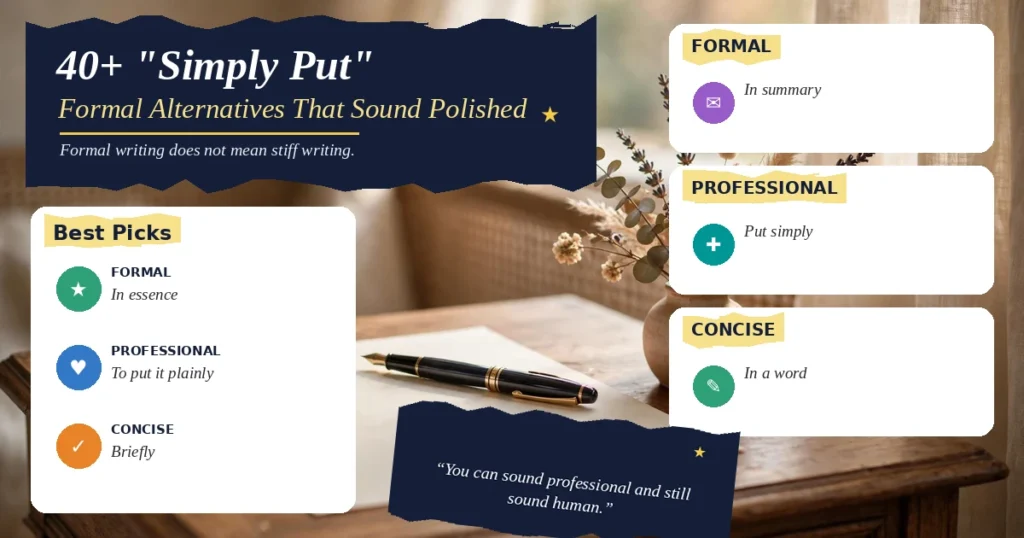
Formal writing does not mean stiff writing. You can sound professional and still sound human. The right alternative states your point in plain words, shows respect for your reader, and keeps your sentence short enough to follow on the first read. That balance matters most when you explain a decision, summarise a result, or restate a complex idea for a busy reader.
This guide gives you 40 formal alternatives to “simply put”, grouped by tone so you can pick the right one in seconds. You will also find email examples, a quick comparison table, common mistakes to avoid, and answers to the questions writers ask most often about this phrase. By the end, you will know exactly which phrase fits a report, which one fits a client email, and which one to leave for casual chat.
Meaning
“Simply put” means “to state something in a clear and direct way”. Writers use it before a short summary of a longer or more complex idea. It signals to the reader that a plain version of the point follows. For example, a manager might write, “Simply put, we need more time to finish the project.” The phrase prepares the reader for the core message without extra detail.
The phrase carries a friendly, conversational tone. That tone works well in blog posts, talks, and everyday messages. It feels less at home in formal documents because it sounds like spoken language. In a formal setting, readers expect measured language that matches the seriousness of the subject. A phrase like “in essence” or “in summary” delivers the same signal with a more professional feel.
“Simply put” also does quiet work inside a sentence. It tells the reader that you are about to simplify, not add new information. That promise matters. If you use the phrase and then follow it with another long, complex sentence, you break the promise and confuse your reader. The formal alternatives in this guide work the same way. Each one introduces a short, clear restatement of your point.
The phrase has two parts. “Simply” points to clarity and ease. “Put” refers to the way you express the idea. Together, they promise a plain statement. Formal alternatives keep that promise but change the register. They suit reports, proposals, academic writing, legal summaries, and executive emails where tone shapes how readers judge your message.
Professional usage
Professional writers reach for a formal version of “simply put” when the audience, the document, or the stakes demand a higher register. A project update to a client, a policy memo, a grant application, and an annual report all call for measured language. In these documents, a casual phrase can undercut an otherwise strong argument. Readers may still understand your point, but they may judge your message as less careful than it deserves.
Use a formal alternative when you summarise findings for senior leaders. Leaders read fast, and they value a sentence that states the bottom line without delay. A phrase like “in short” or “in essence” opens that sentence cleanly. It tells a busy executive that the key point follows, and it does so without sounding chatty. The same approach works in a cover letter, where every sentence shapes a first impression.
Formal alternatives also help when you write to someone you do not know well. A new client, a government office, or an academic reviewer expects a respectful tone. A polished phrase shows that you took the message seriously. It costs you nothing, yet it can change how the reader receives your whole email. Small word choices build trust across a message.
You can also use these phrases to soften a difficult message. When you must explain a delay, a budget cut, or a changed deadline, a calm and formal phrase keeps the tone steady. For example, “In essence, the timeline has shifted by two weeks” sounds composed and factual. It states the news plainly without drama. Writers who manage difficult conversations with care often pair a formal summary phrase with an empathetic opening, and the combination keeps the message professional.
Keep one rule in mind. Use a summary phrase only when a summary truly follows. If your next sentence adds new detail, a new argument, or a long explanation, skip the phrase and state the point directly. Formal writing rewards sentences that do exactly what they promise. A summary phrase earns its place when it introduces a shorter, clearer version of what came before it.
Alternatives
The 40 alternatives below fall into five tone groups. Each group suits a different formal setting. Read the tone note before you pick a phrase, and use the example sentence as a model for your own writing. You can mix phrases across groups, but stay consistent within one document so your tone stays steady from start to finish.
Formal and boardroom-ready
These phrases suit executive summaries, board papers, and official reports. They sound measured, confident, and free of casual colour.
- In essence — Highly formal; best for summaries of complex findings. Example: In essence, the new policy reduces costs without cutting services.
- In summary — Classic formal choice; best for closing a section or a report. Example: In summary, the pilot program met all three of its targets.
- To summarise — Direct and formal; best for executive updates. Example: To summarise, sales grew in every region last quarter.
- In short — Brief and formal; best when the summary fits in one sentence. Example: In short, the merger will close by the end of March.
- Stated plainly — Firm and formal; best for policy or legal summaries. Example: Stated plainly, the contract requires payment within 30 days.
- Put succinctly — Polished and formal; best for academic or corporate writing. Example: Put succinctly, demand rose faster than supply all year.
- In brief — Compact and formal; best for memos and minutes. Example: In brief, the committee approved the revised budget.
- The key point is — Authoritative and formal; best for presentations to leaders. Example: The key point is that safety improved in every department.
Professional but warm
These phrases keep a formal tone while they sound friendly and approachable. They suit client emails, team updates, and messages to partners.
- To put it plainly — Warm yet professional; best for client explanations. Example: To put it plainly, your account will move to the new system on Monday.
- In plain terms — Clear and respectful; best for explaining a process to a client. Example: In plain terms, we will handle the transfer and confirm it by email.
- Put simply — The closest formal cousin of “simply put”; best for general business writing. Example: Put simply, the new schedule gives every team one extra day.
- In other words — Smooth and professional; best for restating a point for clarity. Example: In other words, the deadline moves from Friday to the following Monday.
- That is to say — Refined and professional; best for careful restatements. Example: That is to say, the fee covers all three training sessions.
- To be clear — Direct and courteous; best for confirming an agreement. Example: To be clear, the quoted price includes delivery and setup.
- In simple terms — Gentle and professional; best for non-expert readers. Example: In simple terms, the software sorts your files automatically.
- The bottom line is — Confident and businesslike; best for results-focused updates. Example: The bottom line is that revenue grew by 12 percent this year.
Concise and direct
These phrases suit readers who value speed. They work well in short emails, status updates, and action lists where every word must earn its place.
- Briefly — Very concise; best for opening a one-sentence summary. Example: Briefly, the project needs two more weeks to finish testing.
- In a word — Extremely short; best for a single-word or short-phrase summary. Example: In a word, the launch succeeded.
- In one sentence — Explicit and direct; best when you promise a single-sentence summary. Example: In one sentence, the survey shows that customers want faster delivery.
- To be brief — Polite and concise; best for busy readers. Example: To be brief, we recommend the second proposal.
- At its core — Sharp and direct; best for stating the heart of an issue. Example: At its core, the dispute concerns delivery dates, not price.
- Fundamentally — Strong and direct; best for root-cause statements. Example: Fundamentally, the plan depends on hiring two more engineers.
- Essentially — Compact and formal; best for quick summaries in reports. Example: Essentially, the two systems will share one database.
- In sum — Short and formal; best for closing remarks in a memo. Example: In sum, the evidence supports the new approach.
Academic and report-ready
These phrases suit research papers, formal reports, and technical documents. They sound precise and they pair well with evidence and data.
- In essence, therefore — Formal and logical; best for conclusions drawn from evidence. Example: In essence, therefore, the data support a change in strategy.
- It follows that — Logical and academic; best for conclusions that flow from stated facts. Example: It follows that the new method saves both time and cost.
- In conclusion — Standard academic closer; best for final sections. Example: In conclusion, the study confirms the value of early intervention.
- To conclude — Formal and tidy; best for the final paragraph of a report. Example: To conclude, the program delivered measurable gains in all schools.
- The evidence suggests — Cautious and academic; best when findings point to, but do not prove, a result. Example: The evidence suggests that shorter meetings improve focus.
- In substance — Precise and formal; best for legal or technical summaries. Example: In substance, the two agreements cover the same obligations.
- In effect — Measured and formal; best for describing practical outcomes. Example: In effect, the change gives managers more control over scheduling.
- Summarily stated — Highly formal; best for official or legal documents. Example: Summarily stated, the claim rests on a single missed payment.
Diplomatic and softening
These phrases help you restate a point gently. They suit sensitive topics, feedback, and negotiations where tone matters as much as content.
- In gentler terms — Soft and diplomatic; best for sensitive feedback. Example: In gentler terms, the draft needs a clearer structure before it goes out.
- To put it diplomatically — Careful and formal; best for delicate negotiations. Example: To put it diplomatically, the timeline may need more room.
- In kinder terms — Warm and tactful; best for feedback to colleagues. Example: In kinder terms, the presentation would benefit from fewer slides.
- Put another way — Neutral and helpful; best for rephrasing without pressure. Example: Put another way, the team needs clearer roles to move faster.
- Looked at differently — Thoughtful and diplomatic; best for offering a fresh view. Example: Looked at differently, the delay gives us time to test properly.
- From another angle — Open and tactful; best for reframing a disagreement. Example: From another angle, the higher cost buys a much longer warranty.
- To rephrase — Polite and clear; best for restating your own earlier point. Example: To rephrase, we can deliver in June if the order arrives this week.
- If I may summarise — Courteous and formal; best for meetings and formal letters. Example: If I may summarise, both sides agree on the price and the date.
Quick comparison
Use this table to pick a phrase fast. Match the setting in the left column to the tone you need, then choose a phrase from that group.
| Setting | Best tone group | Example phrases |
|---|---|---|
| Board report or executive summary | Formal and boardroom-ready | In essence, In summary, To summarise |
| Client email | Professional but warm | To put it plainly, In plain terms, Put simply |
| Short status update | Concise and direct | Briefly, In short, Essentially |
| Research paper or technical report | Academic and report-ready | In conclusion, It follows that, In substance |
| Sensitive feedback or negotiation | Diplomatic and softening | Put another way, To rephrase, If I may summarise |
A phrase can fit more than one setting, so treat the table as a starting point rather than a strict rule. Your reader and your purpose matter more than any label. When you feel unsure, choose the plainer phrase. Clear writing always beats an impressive-sounding phrase that muddies your point.
Email examples
Formal alternatives work best when you see them inside real messages. The examples below show how each phrase sounds in a complete email sentence. Notice how the phrase opens the summary and how a short sentence follows it. That pattern keeps business emails easy to scan.
Example 1: Project update to a client
Subject: Project update — testing phase
Dear Ms. Carter,
Thank you for your patience during the testing phase. In summary, the system passed all core tests, and we will move to final checks on Monday. I will share the full report once the team signs off on the results.
Kind regards,
Alex Morgan
Example 2: Budget message to a manager
Subject: Revised budget for approval
Dear Mr. Patel,
I have reviewed the revised figures with the finance team. In essence, the plan stays within budget if we delay the equipment purchase until next quarter. Please let me know if you would like a detailed breakdown before you approve it.
Best regards,
Sara Khan
Example 3: Clarifying a process for a new client
Subject: How your transfer works
Dear Dr. Ahmed,
Thank you for choosing our service. In plain terms, we will move your records, verify each file, and send you a confirmation email when the transfer is complete. The whole process usually takes three working days.
Warm regards,
Emma Lewis
Example 4: Confirming an agreement
Subject: Confirmation of delivery dates
Dear Ms. Brown,
Thank you for confirming the order. To be clear, delivery will take place on 12 May, and our team will install the equipment on the same day. Please reply to confirm that this schedule suits your team.
Kind regards,
David Chen
Example 5: Softening a delay notice
Subject: Revised timeline
Dear Mr. Thompson,
I am writing with an update on the delivery schedule. To put it diplomatically, the supplier needs one extra week to complete quality checks. We will confirm the new date by Friday, and I appreciate your understanding while we finish this step.
Best regards,
Laura Hughes
When you write your own version, keep the summary sentence short and place it near the start of the paragraph. Readers who skim your email should grasp the main point even if they read nothing else. If you need to explain a point again for clarity, a formal restatement phrase gives you a clean way to do it without sounding repetitive.
Common mistakes
Writers make a handful of repeated mistakes with “simply put” and its formal alternatives. Avoid these errors and your writing will sound sharper at once.
Using a summary phrase without a summary. The most common mistake is to open with “in essence” and then add new information instead of restating the point. Readers expect a shorter version of what they just read. Give them that version, or drop the phrase entirely.
Stacking two summary phrases together. Phrases like “in short, simply put” or “in essence, to summarise” sound clumsy and unsure. Pick one phrase and trust it to do the job. One clear signal beats two competing ones.
Choosing a phrase that is too grand for the point. A phrase like “summarily stated” suits a legal document, not a note about lunch plans. When the phrase outranks the message, readers notice the mismatch and the sentence feels forced. Match the weight of the phrase to the weight of the point.
Following the phrase with a long sentence. A summary phrase promises brevity. If the sentence that follows runs for four lines, the promise breaks. Keep the summary sentence under 25 words when you can. Short sentences also help readers who skim.
Repeating the same phrase in every paragraph. Even a good phrase tires readers when it appears five times on one page. Vary your choices across a document. The 40 alternatives in this guide exist so you never need to repeat one phrase too often.
Sounding cold when warmth would help. Formal does not mean distant. When you write to a client who feels frustrated, a bare summary can sound dismissive. A short courteous line before the summary changes the tone. Writers who show understanding before they summarise keep the relationship strong while they stay professional.
Hiding the main point behind the phrase. Some writers use a summary phrase to delay bad news or bury a decision. Readers see through that tactic fast. State the point plainly right after the phrase. Honesty paired with a formal tone builds more trust than careful avoidance.
Related phrases
“Simply put” belongs to a family of phrases that help writers clarify, restate, and summarise. Knowing the neighbours helps you choose the right tool for each job.
“That is to say” restates a point with more precision. Use it when your first version left room for doubt. “In other words” does similar work with a slightly warmer tone. Both phrases suit formal writing, and both appear in the alternatives list above.
“To clarify” opens a correction or an explanation. It suits messages where you fix a misunderstanding. If you want more options for that job, our guide to other ways to say just to clarify gives you a full set of choices. “To confirm” works when you repeat an agreed fact rather than explain it.
“For example” introduces an illustration, not a summary. Writers sometimes confuse the two jobs. A summary restates the same point in fewer words. An example proves the point with a case. Keep the two jobs apart and your paragraphs will stay logical.
“As a result” shows a consequence. It follows from evidence rather than restating it. “Therefore” does the same work in a more formal register. Both phrases suit reports where you move from findings to actions.
“All in all” closes a discussion with a general judgement. It sounds slightly informal, so formal writers often prefer “overall” or “in summary” instead. “On the whole” sits in the same informal zone. Save those two for relaxed writing.
When you thank someone for an explanation before you summarise it, you build goodwill and you show that you listened. That small courtesy costs one sentence and it often makes the rest of your message land better.
Phrase comparison
Some formal alternatives look similar but behave differently. This section compares the closest pairs so you can pick with confidence.
“In essence” vs “in short”. Both phrases summarise, but “in essence” points to the core nature of a thing, while “in short” points to brevity. Use “in essence” when you strip an idea down to its nature. Use “in short” when you strip a long explanation down to a few words. A scientific finding suits “in essence”. A meeting recap suits “in short”.
“To summarise” vs “in summary”. The two phrases mean almost the same thing, but their grammar differs. “To summarise” opens with a verb and feels active. “In summary” opens with a noun phrase and feels slightly more formal. Either one works in a report. Pick one and use it consistently in the same document.
“Put simply” vs “simply put”. These two phrases share the same words in a different order, yet readers hear them differently. “Put simply” sounds a touch more formal because it leads with the verb. “Simply put” sounds more conversational. In a formal email, “put simply” is the safer choice of the two.
“The bottom line is” vs “in conclusion”. “The bottom line is” suits business writing because it promises a result or a decision. “In conclusion” suits academic writing because it signals the end of an argument. A sales report fits the first phrase. A research paper fits the second.
“In other words” vs “that is to say”. “In other words” feels smooth and modern. “That is to say” feels refined and slightly old-fashioned. Both restate a point. Choose “in other words” for client emails and “that is to say” for formal letters and legal summaries.
“Essentially” vs “fundamentally”. “Essentially” softens a summary and admits small exceptions. “Fundamentally” claims a deeper truth about the nature of a thing. Use “essentially” when the summary holds in most cases. Use “fundamentally” when the point goes to the root of the matter.
“To be clear” vs “to clarify”. “To be clear” confirms a point you already stated. “To clarify” corrects or explains a point that caused confusion. The first phrase reassures. The second phrase repairs. Knowing the difference keeps your message honest about its job.
Cultural usage
English speakers around the world use summary phrases, but the level of formality they expect can shift with culture and setting. In British business writing, phrases like “in essence” and “to summarise” appear often in formal letters and reports. British readers tend to value understatement, so a calm summary phrase fits well. Overly bold phrases can sound pushy in that setting.
In American business writing, “the bottom line is” and “in short” appear more often. American readers often value directness and speed. A short summary phrase matches that preference. Still, American formal reports use “in summary” and “in conclusion” just as British reports do. The setting matters more than the country.
In international teams, plain summary phrases prevent misunderstandings. Readers who speak English as a second language follow short, standard phrases more easily than idioms or rare words. “In short”, “in summary”, and “in other words” travel well across cultures because their meaning stays close to their literal words. Avoid wordplay or culture-bound idioms when your readers come from many countries.
Formal phrases also vary by industry. Law firms and government offices favour the most formal end of the list, including “in substance” and “summarily stated”. Technology firms accept a slightly lighter tone, so “put simply” and “in plain terms” fit well there. Universities expect academic phrases such as “in conclusion” and “it follows that”. When you join a new workplace, read a few recent documents first and match the phrases your colleagues already use.
Tone also shifts with the relationship. A first email to a senior official calls for the most formal choice. A tenth email to the same person can relax slightly, though it should stay professional. Let the relationship warm up slowly. Dropping to a casual tone too fast can feel presumptuous, while staying overly formal for years can feel distant. Adjust in small steps.
Finally, remember that clarity outranks formality in every culture. A formal phrase that confuses your reader fails at its job. If a simpler phrase states your point better, use the simpler phrase. Good formal writing serves the reader first and impresses second. When you express appreciation for help you received in the same message, you add warmth without losing professionalism.
Frequently asked questions
Is “simply put” formal enough for a business email?
“Simply put” sits on the informal side of business English, so it suits relaxed internal messages better than formal client emails. For a formal message, choose “in summary”, “in essence”, or “to put it plainly” instead. Those phrases carry the same meaning with a more professional tone. Save “simply put” for colleagues you know well and for casual updates.
What is the most formal alternative to “simply put”?
“Summarily stated” and “in substance” rank among the most formal options, and both suit legal and official documents. “In essence” also counts as highly formal while it stays readable for general readers. For most business reports, “in summary” or “to summarise” gives you full formality without sounding stiff. Pick the phrase that matches your document rather than the grandest one on the list.
Can I use “in short” in an academic paper?
Yes, you can use “in short” in an academic paper, though “in summary” and “in conclusion” appear more often in that setting. “In short” works best in a short recap inside a section rather than as the final closer of the whole paper. Keep it for moments when brevity matters most. Your supervisor or journal style guide may prefer one phrase over another, so check that guide first.
Does “put simply” sound more formal than “simply put”?
Yes, “put simply” sounds slightly more formal because it leads with the verb and reads like a deliberate instruction to the reader. “Simply put” sounds more like everyday speech. The difference is small, but formal writers often choose “put simply” for reports and client emails. Either phrase stays clear, so the choice comes down to tone rather than meaning.
How many summary phrases should I use in one document?
Use a summary phrase only when a real summary follows, which usually means once or twice in a short email and a handful of times in a long report. Repeating the same phrase in every paragraph tires readers and weakens its signal. Vary your choices from the list in this guide. If you cannot find a fresh phrase, consider dropping the phrase and stating the point directly.
What phrase should I use to summarise bad news formally?
“In essence” and “to summarise” both suit bad news because they sound calm, factual, and free of drama. Pair the phrase with a short, honest sentence that states the news plainly. Avoid softening phrases that hide the point, since readers trust direct news more than vague news. Add a brief next step after the summary so the reader knows what happens now.
Is “the bottom line is” too casual for a formal report?
“The bottom line is” suits business reports, executive summaries, and results-focused memos, but it feels slightly casual for academic papers and legal documents. For those settings, choose “in summary” or “in conclusion” instead. In a business report, the phrase works well because it promises a result. Match the phrase to the document type and you will stay on safe ground.
Can I start a sentence with “essentially” in formal writing?
Yes, you can start a sentence with “essentially” in formal writing, and many reports do so. The word signals that a simplified version of a complex point follows. Keep the sentence that follows short, since “essentially” promises brevity. Avoid stacking it with another summary word in the same sentence, such as “essentially, in short”, because the pair sounds unsure.
What is the difference between “in other words” and “in summary”?
“In other words” restates the same point with different words, often at the same length, while “in summary” shortens the point into a briefer version. Use “in other words” when your reader needs the point said differently. Use “in summary” when your reader needs the point said shorter. The two phrases solve different problems, so pick the one that matches your reader’s need.
Should I use a summary phrase in a cover letter?
A summary phrase can work well in a cover letter when you restate your strongest qualification in one line. For example, “In short, I bring five years of experience in client onboarding” gives the hiring manager a fast takeaway. Use the phrase once at most in a cover letter. Overuse makes the letter feel formulaic rather than personal.
Is “to be clear” rude in a formal email?
“To be clear” is not rude when you use it to confirm a shared agreement or to prevent a misunderstanding. It turns rude only when it sounds like a correction aimed at the reader, especially after a disagreement. Soften it with a courteous opening when the topic feels sensitive. Writers who offer further help in the same message keep the tone warm while they stay precise.
What formal phrase works best in a meeting?
“If I may summarise” works best in a meeting because it sounds courteous and it asks for the floor politely. “In summary” and “the key point is” also work well when you already hold the floor. Avoid overly written phrases like “summarily stated” in speech, since they sound stiff when spoken aloud. Speak the summary in short sentences and pause so listeners can absorb it.
Can I use these phrases in a presentation?
Yes, these phrases work well in presentations because they signal a summary and help listeners follow your argument. “The key point is” and “in short” suit slides and spoken delivery especially well. Keep the summary to one sentence per slide so the audience can read it at a glance. A spoken summary phrase also gives listeners a clear cue that the main idea follows.
Does “in essence” work for a scientific summary?
Yes, “in essence” works well for a scientific summary because it points to the core nature of a finding rather than to every detail. Pair it with the key result in one sentence, then follow with the evidence in the next sentences. Avoid using it to hide uncertainty, since scientific readers value honest limits. When the evidence stays mixed, “the evidence suggests” states the position more fairly.
How do I choose between 40 alternatives quickly?
Start with your setting, then pick from the matching tone group in this guide. A board report points to the formal group, a client email points to the warm group, and a short update points to the concise group. If two phrases still tie, choose the plainer one, since clarity beats elegance in formal writing. With practice, you will reach for the right phrase without checking the list.
Conclusion
Formal writing rewards clarity, and a good summary phrase delivers clarity in a single breath. The 40 alternatives in this guide give you a polished option for every formal setting, from board reports to client emails to academic papers. Pick the phrase that matches your reader, keep the summary sentence short, and use each phrase only when a true summary follows.
Start with one or two favourites and add more as you write. “In summary” covers most reports, “to put it plainly” covers most client emails, and “in short” covers most quick updates. Over time, your range will grow and your tone will stay steady without effort. When you confirm a detail before you close, you add one more layer of care to a message that already sounds professional.
For the dictionary sense of the word behind this phrase, see simply in the Cambridge Dictionary. A strong formal vocabulary grows one phrase at a time, and each careful choice makes your next message easier to trust.