Introduction
You probably know the feeling. You sit down to write an email, and you want to get to the main idea fast. You do not want to waste the reader’s time, and you do not want to sound rude either. That is exactly why so many people search for other ways to say straight to the point. The phrase itself works well, but it can sound blunt in a work email, too casual in a formal report, or simply overused when you write it for the tenth time in one week.
Good news: English gives you plenty of choices. You can sound direct and confident, polite and warm, or short and punchy, depending on the person you talk to and the setting you write in. This guide collects more than 35 alternatives to “straight to the point,” grouped by tone, so you can pick the right one in seconds. You will also find email examples, a quick comparison table, common mistakes, and answers to the questions people ask most often about this phrase.
Learning a few strong alternatives does more than freshen up your writing. It helps you control your tone. A manager reads “to be direct” very differently from “let me cut to the chase,” even though both phrases carry the same core message. The first sounds measured and professional. The second sounds relaxed and fast. When you match your words to your audience, people listen more closely, reply faster, and trust your message more. That skill matters in emails, meetings, presentations, and everyday conversation, and it only takes a little practice to build.
Meaning
The phrase “straight to the point” describes communication that goes directly to the main idea without extra detail, long introductions, or unrelated stories. When someone speaks straight to the point, they say what matters first and skip the filler. The phrase works as both praise and a simple description. A boss might thank you for getting straight to the point in a report, and a friend might ask you to get straight to the point when a story runs too long.
The phrase comes from the image of a straight line. A straight line takes the shortest path between two places, and direct speech takes the shortest path between an idea and the listener. People use the phrase in three common ways. First, they describe their own style: “Let me get straight to the point.” Second, they describe someone else: “She always gets straight to the point.” Third, they make a request: “Please get straight to the point.” Each use signals the same value: respect for the listener’s time.
Direct speech carries a clear benefit. It reduces confusion, speeds up decisions, and shows confidence. It also carries a risk. If you skip every softener and every bit of context, your message can sound cold or pushy. The best communicators balance directness with warmth. They state the main idea early, then add just enough background to help the listener act. The alternatives in this guide help you strike that balance in any setting.
Professional usage
Workplaces reward clear communication, but they also reward tact. The phrase “straight to the point” fits many work settings, yet it can feel too blunt when you talk to a senior leader, a new client, or a colleague who expects a warmer tone. Smart professionals keep several versions ready and pick one based on the relationship and the stakes.
Use direct phrases when you share updates, make requests, or report problems. A project update works well when you open with the result, then give the details. A request works well when you state what you need in the first sentence. A problem report works well when you name the issue before you explain the background. In each case, direct language saves time and prevents misunderstanding.
Avoid overly blunt phrasing when you deliver bad news, disagree with a decision, or talk to someone for the first time. In those moments, add a short polite frame before the main idea. For example, say “To be clear about our timeline” instead of “Let me be blunt.” The first version sounds professional. The second version can sound aggressive. Small word choices like these shape how people receive your message, and they cost you nothing.
Leaders also use direct language to set a tone for their teams. When a manager opens a meeting with the key decision, the team learns that meetings stay focused. When a manager buries the decision under ten minutes of background, the team learns that meetings drift. Your words teach people how to work with you, so choose them with care.
Alternatives
This section gives you 40 alternatives in five tone groups. Each entry shows the phrase in bold, a short note on tone and best use, and a short example sentence. Pick the group that matches your situation, then pick the phrase that sounds most like you.
Direct and professional
These phrases suit work emails, reports, meetings, and formal messages. They sound confident and clear without sounding harsh.
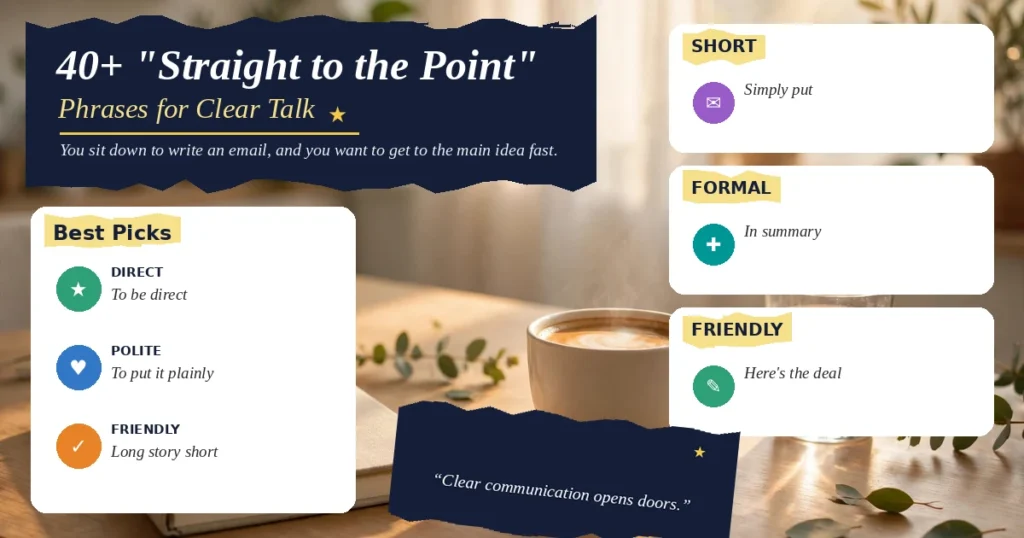
- To be direct — Professional and neutral; works in almost any work message. Example: “To be direct, we need the final numbers by Friday.”
- To get straight to it — Clean and businesslike; a close cousin of the original phrase. Example: “To get straight to it, the budget needs your approval today.”
- In short — Brief and tidy; best when you summarize a longer message. Example: “In short, the launch moves to next Monday.”
- The bottom line is — Strong and results-focused; great for decisions and summaries. Example: “The bottom line is that we need two more weeks.”
- To be clear — Calm and precise; perfect when you want to prevent confusion. Example: “To be clear, the offer covers travel costs only.”
- Put simply — Plain and helpful; works well when you explain something complex. Example: “Put simply, the new system saves us one hour a day.”
- Let me be straightforward — Honest and professional; signals openness. Example: “Let me be straightforward: the timeline is tight, but we can meet it.”
- Without further delay — Formal and polite; suits announcements and meeting openings. Example: “Without further delay, here is the plan for next quarter.”
Polite and diplomatic
These phrases soften directness without hiding the message. Use them with senior leaders, clients, and anyone you want to treat with extra care.
- To put it plainly — Gentle and honest; keeps the message clear while sounding kind. Example: “To put it plainly, we need more time to finish the report well.”
- If I may be frank — Courteous and open; asks permission before a direct statement. Example: “If I may be frank, the current plan will not meet the deadline.”
- To be candid — Warm and trustworthy; shows respect for the listener. Example: “To be candid, I think we should test the idea before we commit.”
- In all honesty — Sincere and calm; suits sensitive feedback. Example: “In all honesty, the design needs one more round of changes.”
- To cut a long story short — Friendly and conversational; great when you shorten a long explanation. Example: “To cut a long story short, the client approved the proposal.”
- The key point is — Focused and polite; draws attention without pressure. Example: “The key point is that we still need approval from legal.”
- What it comes down to is — Thoughtful and clear; works well in discussions. Example: “What it comes down to is whether we hire now or wait.”
- To summarize briefly — Courteous and efficient; ideal for email openings. Example: “To summarize briefly, we hit every target except one.”
Friendly and casual
These phrases fit friends, close coworkers, and relaxed chats. They keep the message direct while sounding warm and easy.
- Long story short — Relaxed and popular; perfect for everyday conversation. Example: “Long story short, we got the tickets.”
- Here’s the deal — Casual and confident; works with friends and teammates. Example: “Here’s the deal: we leave at six, no exceptions.”
- Cutting to the chase — Lively and informal; best with people who know you well. Example: “Cutting to the chase, can you cover my shift on Friday?”
- The short version is — Easy and clear; great when you shorten a story. Example: “The short version is that the car broke down again.”
- No beating around the bush — Playful and direct; suits close relationships. Example: “No beating around the bush: I need your help this weekend.”
- In a nutshell — Light and vivid; works in speech and casual writing. Example: “In a nutshell, the trip was amazing but exhausting.”
- Here’s the thing — Natural and conversational; opens a direct point gently. Example: “Here’s the thing: I already booked the venue.”
- Straight up — Very casual and honest; best for friends, not formal email. Example: “Straight up, that movie was the best one this year.”
Short and punchy
These phrases work best in texts, chats, subject lines, and fast messages. They carry the full meaning in very few words.
- Simply put — Crisp and clean; fits any short message. Example: “Simply put, we need more volunteers.”
- Bottom line — Bold and fast; great for decisions. Example: “Bottom line: the deal closes on Monday.”
- In brief — Neat and formal enough for short emails. Example: “In brief, the meeting moved to Thursday.”
- Short version — Friendly and quick; works in chats and notes. Example: “Short version: it worked, and we ship tomorrow.”
- TL;DR — Internet shorthand for “too long; didn’t read”; best for casual online writing. Example: “TL;DR: the update fixed the bug.”
- The gist is — Compact and clear; suits spoken and written summaries. Example: “The gist is that we won the contract.”
- Cut to it — Very short and direct; use with close teammates only. Example: “Cut to it: do we have the budget or not?”
- Plain and simple — Firm and memorable; adds emphasis to a short point. Example: “Plain and simple, safety comes first.”
Formal and executive
These phrases suit board reports, executive summaries, official letters, and senior audiences. They sound measured, confident, and polished.
- In summary — Classic and formal; opens or closes executive messages well. Example: “In summary, revenue grew in every region this quarter.”
- To state it plainly — Dignified and direct; suits official communication. Example: “To state it plainly, the policy takes effect on January 1.”
- The essence is — Refined and thoughtful; works in speeches and reports. Example: “The essence is that trust drives every partnership we build.”
- In essence — Elegant and concise; fits formal writing. Example: “In essence, the strategy focuses on three markets.”
- To be precise — Careful and exact; ideal when numbers and facts matter. Example: “To be precise, costs fell by twelve percent, not ten.”
- The central point is — Authoritative and clear; suits presentations. Example: “The central point is that demand keeps rising.”
- Succinctly put — Polished and brief; adds a formal touch. Example: “Succinctly put, the plan works and the timing is right.”
- In a word — Sharp and dramatic; best when one word can carry the message. Example: “In a word: outstanding.”
Quick comparison
Not every alternative fits every situation. This table helps you compare the most useful options at a glance, so you can choose fast and with confidence.
| Phrase | Tone | Best for | Avoid when |
|---|---|---|---|
| To be direct | Professional | Work emails and meetings | You deliver sensitive bad news |
| To put it plainly | Polite | Feedback and client messages | You need a very short text |
| Long story short | Casual | Friends and relaxed chats | You write a formal report |
| Bottom line | Punchy | Decisions and summaries | The topic needs gentle handling |
| In summary | Formal | Executive reports | You chat with close friends |
| Cutting to the chase | Casual | Teammates you know well | You address a senior leader |
| To be clear | Professional | Instructions and clarifications | You want a warm, soft tone |
| In a nutshell | Friendly | Stories and spoken updates | You write legal or official text |
Use this table as a starting point, not a strict rule. Your relationship with the reader matters more than any label. A phrase that sounds fine to a close colleague can sound cold to a new client, so always picture the reader before you pick your words.
Email examples
Examples make the difference between knowing a phrase and using it well. Read the samples below and notice how each opening states the main idea early, then adds only the detail the reader needs.
Example 1: Project update
Subject: Website launch date confirmed
“To be direct, the website launches on March 10. The design team finished the final pages yesterday, and testing starts on Monday. Please send any last changes by Friday so we stay on schedule.”
This email works because the reader learns the key fact in the first sentence. The rest of the message supports that fact without burying it.
Example 2: Polite request to a client
Subject: Quick question about the contract
“To summarize briefly, we need one signature to move forward. The contract sits ready in your inbox, and the rest of the terms match what we agreed last week. Please let me know if anything looks unclear.”
This version sounds respectful and efficient. It states the need early, then gives helpful context without pressure.
Example 3: Meeting opening
“Without further delay, here is the decision we need today. We must choose between two vendors by Friday, and both quotes expire next week. I will share the comparison now, and then we can vote.”
A strong meeting opening saves everyone time. It names the decision, explains the deadline, and tells people what happens next.
Example 4: Friendly message to a teammate
“Long story short, the client loved the pitch. They asked for a revised timeline, and I told them we would send it by Thursday. Can you help me draft it tomorrow morning?”
This message sounds warm and natural. It shares good news fast, then moves straight to the request.
Example 5: Gentle feedback
“If I may be frank, the draft needs a clearer opening. Readers should learn the main benefit in the first two sentences. I marked two spots where a short rewrite would help, and I am happy to review the next version.”
Feedback lands better when honesty comes with kindness. This example states the problem clearly, gives a fix, and offers support.
When you write your own emails, try this simple structure. Open with your main point. Add one or two supporting details. Close with a clear next step. This pattern keeps your message direct, and it also keeps it kind. If you often open emails with a long greeting, you may also like our guide on other ways to say I am reaching out to you, which offers warmer ways to start a message.
Common mistakes
Even good writers make mistakes with direct language. Watch for these five traps, and your messages will sound clearer and kinder.
Mistake 1: Confusing direct with rude. Direct language states facts. Rude language attacks people. “The report is late” states a fact. “You always ruin deadlines” attacks a person. Keep your words on the work, not on the person, and directness stays professional.
Mistake 2: Skipping all context. A bare statement can confuse the reader. “We move it to Monday” leaves the reader guessing about what “it” means. Add one short clause: “We move the launch to Monday.” That small detail prevents a round of follow-up questions.
Mistake 3: Overusing one phrase. If every email opens with “To be direct,” the phrase loses power and starts to sound like a habit. Rotate through the alternatives in this guide. Variety keeps your writing fresh and shows range.
Mistake 4: Using casual phrases in formal settings. “Cutting to the chase” charms a teammate, but it can sound careless in a letter to a senior executive. Match your phrase to the setting, and save casual options for casual audiences.
Mistake 5: Hiding behind soft language. Some writers pad every message with “I just wanted to” and “Sorry to bother you.” Over-softening buries the point and wastes time. Aim for a middle path: one polite frame, then the main idea. If you often soften requests too much, our guide on other ways to say I just want to make sure can help you sound confident without sounding pushy.
One more habit helps more than any single phrase. Read your message once before you send it, and ask yourself one question: “Could a busy stranger understand my main point in five seconds?” If the answer is yes, your message works. If the answer is no, move the main point higher.
Related phrases
“Straight to the point” belongs to a family of phrases about clarity and honesty. Learning its neighbors helps you express fine shades of meaning.
- Get to the point — A request for directness. Example: “Please get to the point; we have five minutes left.”
- Beat around the bush — The opposite of direct speech. Example: “Stop beating around the bush and tell me the price.”
- Call a spade a spade — Speak plainly about an unpleasant truth. Example: “Let us call a spade a spade: the plan failed.”
- Tell it like it is — Describe a situation honestly, without softening. Example: “She always tells it like it is, and people respect her for it.”
- Cut through the noise — Focus on what matters and ignore distractions. Example: “This summary cuts through the noise and shows the real numbers.”
- No-nonsense — A style that skips fuss and focuses on results. Example: “He runs a no-nonsense meeting that always ends on time.”
- Say what you mean — Speak honestly instead of hinting. Example: “Say what you mean, and people will trust your word.”
- Minced words — Used in the negative: “not mince words” means speak bluntly. Example: “The review did not mince words about the delay.”
Notice how each phrase carries a slightly different charge. “Get to the point” can sound impatient, while “cut through the noise” sounds admiring. Choose the phrase whose feeling matches your intent, not just its dictionary meaning.
When a conversation needs understanding before directness, softer phrases help. For instance, when a colleague explains a problem at length, you can acknowledge them first with other ways to say I understand before you steer the talk back to the main point. That small step keeps the relationship strong while you keep the discussion focused.
Phrase comparison
People often mix up “straight to the point” with similar phrases. This section clears up the most common confusions so you use each phrase correctly.
“Straight to the point” vs. “to the point.” Both phrases praise brevity, but “to the point” often describes a comment that fits the topic well. A remark can be “to the point” without being short. “Straight to the point” stresses the direct path: no detours, no filler. Use “straight to the point” when you praise speed and clarity together.
“Straight to the point” vs. “blunt.” Blunt speech can hurt feelings because it skips tact. Direct speech skips filler but keeps respect. A direct message says, “The budget needs revision.” A blunt message says, “Your budget is a mess.” The difference lies in tone, not in honesty.
“Straight to the point” vs. “concise.” Concise describes writing that uses few words. Direct describes writing that reaches the main idea fast. A long report can still get straight to the point if it opens with the conclusion. A short note can fail to be direct if it circles the main idea. Aim for both qualities when you can.
“Straight to the point” vs. “frank.” Frank speech stresses honesty, especially about hard truths. Direct speech stresses speed and clarity. You can be frank without being fast, and fast without being frank. In feedback, combine them: be frank about the problem and direct about the fix.
“Straight to the point” vs. “brief.” Brief describes length. A brief email has few words. A direct email puts the main idea first. A brief email can still bury its point in the last line, so brevity alone does not guarantee clarity.
Understanding these shades helps you pick the right word for the right moment. It also helps you read other people’s messages with more care. When a manager calls your report “to the point,” they praise relevance. When they call it “straight to the point,” they praise both relevance and speed.
Cultural usage
Directness carries different weight in different cultures, and wise communicators adjust their style when they work across borders.
In the United States, Germany, the Netherlands, and Scandinavia, direct speech often signals honesty, efficiency, and respect for time. Business meetings in these cultures tend to open with the main topic, and people expect clear yes-or-no answers. A phrase like “to be direct” sounds normal and professional there.
In Japan, China, India, and many Middle Eastern and Southeast Asian cultures, indirect speech often signals politeness and respect. People may open with context, build rapport, and approach the main point gradually. A very blunt opening can feel rude, even when the speaker means well. In these settings, polite frames like “to put it plainly” or “the key point is” soften directness while keeping the message clear.
In the United Kingdom and Australia, directness often comes wrapped in humor or understatement. A British colleague might say “to cut a long story short” with a smile, and an Australian colleague might say “long story short” before a quick summary. The words sound casual, but the message stays clear.
None of these patterns describe every person in a culture. Individuals differ, and many workplaces blend styles. The useful rule stays simple: watch how your audience communicates, and match their level of directness. When you write to someone from another culture for the first time, choose a polite version of directness. You can always become more direct as trust grows, but you cannot easily undo a first impression of rudeness.
Remote work adds another layer. In chats and emails, readers cannot hear your tone of voice or see your face, so blunt words can read harsher than you intend. A short polite frame, a thank-you, or a warm closing can balance a direct message. If you want to thank someone before a direct request, our guide on other ways to say I appreciate it offers phrases that keep the tone warm.
Frequently asked questions
Is “straight to the point” rude?
No, the phrase itself is not rude. It describes clear, efficient communication, and most workplaces value it. It only sounds rude when the speaker pairs it with harsh words, a sharp tone, or a complete lack of context. Add a polite frame and focus on facts, and the phrase stays professional.
What is a polite way to say “straight to the point”?
“To put it plainly,” “to be candid,” and “the key point is” all sound polite while keeping the message direct. These phrases work well with clients, senior leaders, and new contacts. They signal honesty without pressure, and they suit emails, meetings, and formal letters.
Can I use “straight to the point” in a formal email?
Yes, you can use it in a formal email, but a softer option often works better. “To be direct” or “in summary” sounds more polished in formal writing. Save the exact phrase “straight to the point” for semi-formal emails and spoken updates, where a conversational tone fits.
What does “get straight to the point” mean?
It means to go directly to the main idea without delay or extra detail. People use it as a request (“Please get straight to the point”) or as a description of their own style (“Let me get straight to the point”). In both cases, it asks the speaker to respect the listener’s time.
Is “cut to the chase” the same as “straight to the point”?
The two phrases share a similar meaning, but “cut to the chase” sounds more casual and lively. It comes from old films, where editors cut to the exciting chase scene. Use it with friends and close teammates, and choose “straight to the point” or “to be direct” for formal settings.
How do I tell someone to get to the point politely?
Try “Could you share the main takeaway first?” or “To help us stay on time, what is the key decision here?” These questions guide the speaker without sounding impatient. You can also model the behavior yourself by opening your own points clearly and briefly.
What is the opposite of “straight to the point”?
Common opposites include “beat around the bush,” “ramble,” and “go off on a tangent.” Each describes speech that delays or avoids the main idea. Writers also use “long-winded” for speech that takes too many words to reach a simple point.
Does “straight to the point” work in academic writing?
It works in spoken academic settings, like presentations and seminars, but formal academic papers prefer phrases like “in summary” or “in essence.” Academic writing values precise, measured language, so choose a formal alternative when you write essays, theses, or journal articles.
How can I sound direct without sounding cold?
Pair your main point with one warm element: a thank-you, a brief acknowledgment, or a friendly closing. For example, say “Thank you for the update. To be direct, we need the revised draft by Thursday.” The thanks softens the message, and the direct sentence keeps it clear.
Is “long story short” formal or informal?
“Long story short” is informal. It suits friends, family, and relaxed coworkers, and it works well in spoken stories. Avoid it in formal reports, legal writing, and first emails to senior executives, where “in summary” or “to summarize briefly” fits better.
What short phrase means the same as “straight to the point”?
“Simply put,” “in short,” and “bottom line” all carry the same core meaning in very few words. “Simply put” sounds neutral, “in short” sounds tidy, and “bottom line” sounds bold. Pick the one that matches your tone and your audience.
Can children use “straight to the point”?
Yes, children and students can use it, and teachers often praise clear, direct answers. The phrase suits classroom discussions, short essays, and presentations. Younger learners may prefer simpler options like “in short” or “the main idea is,” which carry the same meaning with easier words.
Why do people overuse “straight to the point”?
People overuse it because it feels safe and clear. It signals confidence, and it works in many settings, so writers reach for it again and again. The fix is simple: keep a short list of alternatives on hand, like the groups in this guide, and rotate through them.
What is a one-word alternative to “straight to the point”?
“Directly” and “plainly” come closest in a single word. You can say “Let me speak plainly” or “Tell me directly.” Single words carry less warmth than full phrases, so pair them with a polite frame when the topic feels sensitive.
How do I practice being more direct in writing?
Start with one habit: write your main point as the first sentence of every email for one week. Then remove any opening lines that delay that point. Over time, the habit becomes automatic, and your messages grow shorter and clearer. Reading your draft aloud also helps, because rambling sentences sound obvious when you hear them.
Conclusion
Clear communication opens doors. It saves time, prevents confusion, and builds trust with everyone you write to or speak with. The phrase “straight to the point” serves you well, but you now own a much larger toolkit. You can sound direct and professional with “to be direct,” polite and thoughtful with “to put it plainly,” warm and casual with “long story short,” or sharp and fast with “bottom line.” Each choice shapes how people hear your message, so pick the phrase that fits your reader, your setting, and your goal.
Practice makes the skill stick. Try one new alternative each day this week. Use a polite version with a client, a punchy version in a team chat, and a formal version in a report. Notice how people respond, and keep the phrases that feel natural to you. Over time, you will stop searching for the right words and start choosing them without thinking.
If you need to clarify a point before you state it directly, our guide on other ways to say just to clarify pairs well with this one. And when someone helps you sharpen a message, a quick note with other ways to say thank you for the clarification keeps the relationship warm. For the dictionary sense of direct speech, see the entry for direct, which defines the word as honest and to the point.