Introduction
If you want to talk about other ways to say soft skills, you have come to the right place. The phrase “soft skills” shows up in almost every job post, resume guide, and performance review, yet it can start to feel flat when you use it again and again. Recruiters read it hundreds of times a week, and hiring managers often skim past it because it tells them very little about what you actually do well. That is why learning stronger, more specific alternatives matters so much for your career.
When you replace a vague label with a precise phrase, you give the reader a clear picture of your strengths. Instead of saying you have “good soft skills,” you can say you build trust with clients, lead calm meetings, or solve problems under pressure. Each of those phrases paints a scene, and scenes stick in a reader’s mind far longer than a generic term. This guide helps you make that switch with confidence.
You will find 40 alternatives grouped by tone, so you can pick the right wording for a resume, a cover letter, a work email, or a casual chat with a colleague. You will also find email examples, a quick comparison table, common mistakes to avoid, and answers to the questions people ask most often about this phrase. By the end, you will know exactly which alternative fits each situation, and you will never have to repeat “soft skills” five times in one document again.
The best part is that you do not need to change what you are good at. You only need to describe it better. A nurse who calms worried families, a teacher who manages a busy classroom, and a sales rep who wins back unhappy customers all use soft skills every day. They just sound far more impressive when they name the skill itself. Let us look at what the term really means, and then build your new vocabulary one group at a time.
Meaning
Soft skills are the personal and social abilities that help you work well with other people and handle the ups and downs of a job. They include how you communicate, how you manage your time, how you lead a team, and how you respond when plans change. Unlike technical skills, which you can often prove with a certificate or a test, soft skills show up in your daily behavior. People notice them in meetings, in emails, and in the way you treat customers and coworkers.
Employers value soft skills because they affect almost everything else at work. A brilliant coder who cannot explain ideas clearly may struggle on a team project. A talented designer who misses deadlines can slow down a whole launch. On the other hand, a worker who listens well, stays calm under pressure, and adapts fast can lift the performance of everyone around them. That is why job posts list traits like teamwork, communication, and problem solving right next to technical requirements.
It helps to think of soft skills in a few broad groups. Communication skills cover speaking, writing, and listening. Interpersonal skills cover teamwork, empathy, and conflict resolution. Self-management skills cover time management, adaptability, and stress control. Leadership skills cover decision making, motivation, and delegation. When you name the group that fits your strength, your message becomes sharper at once. Saying “strong communication skills” already beats “good soft skills,” and saying “clear client communication” beats both.
One common misunderstanding is that soft skills are fixed traits you either have or lack. In truth, you can build them with practice, just like any other skill. You can learn to run better meetings, give kinder feedback, and handle difficult conversations with more grace. You can also gather proof as you go, such as a thank-you note from a client or a project you rescued from a tight deadline. That proof turns a claim into a story, and stories persuade hiring managers.
Another misunderstanding is that soft skills matter only for managers or customer-facing roles. In fact, they matter in every job. A warehouse worker who coordinates smoothly with a shift team, a freelancer who sets clear expectations with clients, and a developer who writes helpful code reviews all rely on soft skills. The term covers a wide range, so the smartest move is to get specific about which ones you bring.
Professional usage
In professional writing, “soft skills” works best as a category label, not as a repeated claim. You can use it once in a resume summary or a job post to set the topic, and then switch to precise phrases for the rest of the document. For example, a resume summary might say, “Marketing coordinator with strong people skills and a record of running smooth product launches.” The first phrase sets the theme, and the second gives proof. That balance keeps your writing clear and credible.
Recruiters also scan resumes for keywords, so you should match the wording of the job post where it fits honestly. If a posting asks for “collaboration” and “stakeholder communication,” use those exact words in your resume instead of only writing “soft skills.” Applicant tracking systems often search for the posting’s own terms, and a human reader also finds the match reassuring. Just make sure every claim you make is true and backed by a real example you can share in an interview.
In emails and cover letters, precise phrases build trust faster than general ones. A cover letter that says, “I build lasting client relationships and turn feedback into better service,” tells a hiring manager far more than “I have excellent soft skills.” The first version shows action and results. The second version asks the reader to take your word for it. Whenever you can, pair a skill phrase with a short result, such as a faster delivery, a happier client, or a smoother launch.
Performance reviews and LinkedIn profiles follow the same rule. A manager who writes, “Aisha shows strong conflict resolution and keeps our team steady during busy periods,” gives useful feedback. A profile headline that says, “Project lead | Clear communicator | Calm under pressure,” draws more interest than one that says, “Soft skills expert.” Specific language also helps colleagues endorse you for real strengths rather than guessing what you mean.
One more professional tip: adjust the formality of your phrase to the document. A resume calls for crisp noun phrases like “team leadership” or “client relationship management.” A cover letter allows full sentences like “I lead cross-functional teams through tight deadlines.” A recommendation letter can be warmer, with phrases like “a natural mentor who lifts new hires.” The same strength can wear many outfits, and picking the right one shows professional judgment in itself.
Alternatives
The alternatives below fall into five tone groups. Pick from the first group for formal documents, the second for warm professional messages, the third for resumes and LinkedIn, the fourth for everyday work chats, and the fifth when you need a short, sharp phrase. Each entry gives you the phrase, a note on tone and best use, and a short example sentence you can adapt.
Professional and formal alternatives
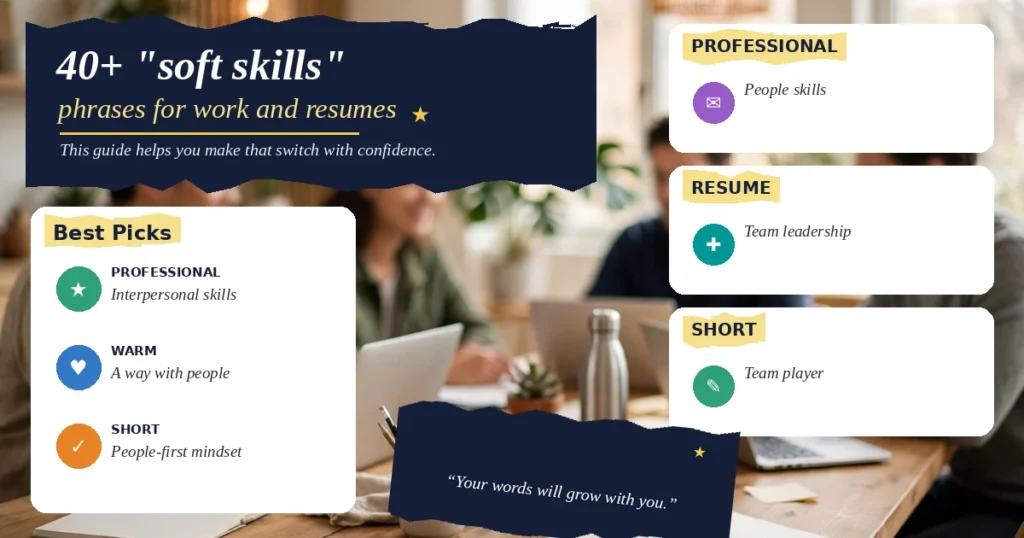
- Interpersonal skills — formal and safe for resumes, job posts, and HR documents. Example: “Her interpersonal skills help her build trust with clients from the first meeting.”
- People skills — plain and professional, widely understood in every industry. Example: “Strong people skills let him guide new hires through their first month with ease.”
- Communication skills — formal and precise when your strength is speaking, writing, or listening. Example: “Her communication skills keep remote teams aligned across three time zones.”
- Leadership abilities — formal and strong for managers and team leads. Example: “His leadership abilities turned a struggling shift team into the top-performing unit.”
- Team collaboration skills — formal and modern, ideal for job posts and resumes. Example: “Her team collaboration skills keep design and engineering moving as one unit.”
- Client relationship management — formal and business-ready for sales and service roles. Example: “His client relationship management wins repeat orders from accounts other reps lost.”
- Conflict resolution skills — formal and specific for HR, management, and service jobs. Example: “Her conflict resolution skills settle billing disputes before they reach a manager.”
- Emotional intelligence — formal and current, valued in leadership and coaching roles. Example: “His emotional intelligence helps him read a room and respond with the right tone.”
Warm and friendly alternatives
- A way with people — warm and natural, great for cover letters and recommendations. Example: “She has a real way with people, and nervous clients relax within minutes of meeting her.”
- A gift for teamwork — warm and upbeat, ideal for references and personal profiles. Example: “He has a gift for teamwork, and every group project runs smoother with him on it.”
- A talent for listening — warm and specific, perfect when listening is your standout strength. Example: “Her talent for listening helps customers feel heard, even when the answer is no.”
- A calm, steady presence — warm and reassuring, strong for care, teaching, and support roles. Example: “He brings a calm, steady presence to night shifts when the ward gets busy.”
- A knack for bringing people together — warm and vivid, good for community and team roles. Example: “She has a knack for bringing people together, and her events always feel welcoming.”
- A friendly, helpful manner — warm and simple, ideal for service and front-desk roles. Example: “His friendly, helpful manner earns praise in nearly every customer review.”
- A genuine interest in others — warm and sincere, strong for mentoring and care work. Example: “Her genuine interest in others makes new team members feel at home fast.”
- A positive team spirit — warm and encouraging, good for references and team bios. Example: “He brings a positive team spirit that lifts morale during long, hard weeks.”
Resume and LinkedIn ready alternatives
- Cross-functional collaboration — sharp resume language for work across departments. Example: “Led cross-functional collaboration between sales, product, and support teams.”
- Stakeholder communication — strong resume phrasing for client and management roles. Example: “Managed stakeholder communication for a six-month system rollout.”
- Team leadership — direct and powerful for any role where you guide others. Example: “Provided team leadership for a crew of twelve during peak season.”
- Adaptability and problem solving — a classic resume pair that covers change and challenges. Example: “Showed adaptability and problem solving when supply delays hit our launch.”
- Time management and organization — concrete and measurable for busy, deadline-driven roles. Example: “Improved time management and organization across a caseload of forty clients.”
- Mentoring and coaching — ideal when you train, guide, or develop other people. Example: “Led mentoring and coaching for five junior staff, all promoted within a year.”
- Customer service excellence — results-focused phrasing for service and retail roles. Example: “Delivered customer service excellence across 200-plus support chats each week.”
- Negotiation and persuasion — strong for sales, buying, and partnership roles. Example: “Used negotiation and persuasion to renew three major contracts on better terms.”
Casual and conversational alternatives
- Getting along with people — casual and honest, fine for chats and informal bios. Example: “I am good at getting along with people, even in tense project meetings.”
- Working well under pressure — casual and direct, strong in interviews and team chats. Example: “She works well under pressure, and deadlines seem to sharpen her focus.”
- Thinking on your feet — casual and vivid, great for fast-paced jobs. Example: “He thinks on his feet, so last-minute changes never slow his team down.”
- Keeping cool when things go wrong — casual and relatable, ideal for support and event roles. Example: “She keeps cool when things go wrong, which steadies the whole team.”
- Knowing how to talk to people — casual and plain, perfect for everyday speech. Example: “He knows how to talk to people, from upset customers to senior directors.”
- Being easy to work with — casual and warm, a phrase managers love to hear. Example: “Teammates say she is easy to work with and quick to share credit.”
- Handling tricky conversations — casual yet professional, good for interviews. Example: “I am comfortable handling tricky conversations about delays and budgets.”
- Juggling tasks without dropping any — casual and visual, strong for busy office roles. Example: “She juggles tasks without dropping any, even during audit week.”
Short and punchy alternatives
- People-first mindset — short and modern, strong for headlines and summaries. Example: “Known for a people-first mindset that keeps clients coming back.”
- Team player — short and classic, best with proof right after it. Example: “A true team player, he covered two extra shifts during the holiday rush.”
- Quick learner — short and confident, ideal for career changers. Example: “A quick learner, she mastered the new booking system in one week.”
- Great communicator — short and bold, strong for profiles and intros. Example: “A great communicator, he turns complex updates into clear action steps.”
- Natural leader — short and warm, good for recommendations and bios. Example: “A natural leader, she guides new volunteers without ever raising her voice.”
- Cool-headed — short and vivid, strong for high-pressure roles. Example: “Cool-headed in a crisis, he kept the event running when the power failed.”
- Empathetic listener — short and specific, ideal for care and support roles. Example: “An empathetic listener, she helps callers feel understood from the first minute.”
- Reliable team member — short and trustworthy, strong for any application. Example: “A reliable team member, she has never missed a deadline in three years.”
Quick comparison
The right phrase depends on where you write it and who reads it. A resume rewards short noun phrases that match job posts. A cover letter rewards full sentences with proof. A casual chat rewards plain, human wording. Use this table to pick fast, then adjust the example to your own story.
| Situation | Best choice | Why it works |
|---|---|---|
| Resume summary | Interpersonal skills, team leadership | Short, searchable, and professional |
| Cover letter | A way with people, client relationship management | Warm yet specific, with room for proof |
| LinkedIn headline | People-first mindset, great communicator | Punchy and easy to scan |
| Work email | Communication skills, stakeholder communication | Clear and formal without sounding stiff |
| Job interview | Working well under pressure, thinking on your feet | Natural in speech and easy to prove with stories |
| Recommendation letter | A gift for teamwork, natural leader | Warm and personal, with strong praise |
| Casual team chat | Being easy to work with, getting along with people | Friendly and honest, never overblown |
One more rule helps in every situation: follow the phrase with proof as soon as you can. A claim like “strong team leadership” gains weight when you add “for a crew of twelve during peak season.” A claim like “great communicator” gains weight when you add “who turns complex updates into clear action steps.” Proof does not need to be long. One clause with a number, a result, or a real situation is enough to make your reader believe you.
Also watch the length of your list. A resume that names two or three well-chosen strengths looks focused. A resume that lists ten soft-skill phrases looks unsure. Pick the strengths that match the job post most closely, and save the rest for the interview, where you can tell the stories behind them.
Email examples
The examples below show how to use these alternatives in real work emails. Notice how each one names a specific skill instead of leaning on the vague term, and how each one pairs the skill with a helpful action or result.
Example 1: Introducing yourself to a new client
Subject: Kickoff for the spring campaign
Hi Sarah,
I am Aisha, and I will lead your account from our side. I focus on clear client communication, so you will always know what happens next, who owns each step, and when to expect updates. I have shared the kickoff plan below, and I welcome your notes before our call on Thursday.
Thank you for choosing our team. I look forward to working with you.
Best regards,
Aisha
Example 2: Asking for help with a delay
Subject: Update on the delivery schedule
Hi James,
I wanted to give you an honest update on the delivery schedule. A supplier delay has pushed our timeline by three days, and I know this affects your launch plan. I am working with the warehouse team on a partial shipment so your top-selling items still arrive on time. When I am reaching out to you with a problem like this, my goal is always to bring a plan, not just bad news. I will confirm the new dates by tomorrow morning.
Thank you for your patience, and please tell me if the partial shipment helps.
Best regards,
Priya
Example 3: Thanking a colleague after a tough week
Subject: Thank you for your support this week
Hi Daniel,
Thank you for stepping in during the busiest week of our quarter. Your calm, steady presence kept the team focused, and your clear handover notes saved us hours on Friday. If you ever need cover during a busy period, I will happily return the favor. I also want to say I appreciate it more than a short email can show, because your help changed the outcome for our clients.
Warm regards,
Maria
Example 4: Following up after an interview
Subject: Thank you for today’s conversation
Dear Ms. Lopez,
Thank you for taking the time to speak with me today about the customer success role. Our talk confirmed that my strengths in team collaboration and stakeholder communication fit the role well. In my current job, I lead weekly check-ins with sales and support, and I turn customer feedback into fixes the product team can act on. I would welcome the chance to bring that same approach to your team.
Thank you again for your time and kind guidance.
Sincerely,
Tom
Example 5: Clarifying a point with a manager
Subject: Quick check on the report format
Hi Elena,
Thank you for sharing the new report template. I want to confirm one detail before I send the draft. Should the summary table sit at the top, or would you prefer it after the regional breakdown? I ask because I want to make sure the final version matches what the directors expect. Once you confirm, I will send it the same day.
Thank you for the clarification on the deadline as well. It helped me plan the week.
Best regards,
Noor
Each example keeps the tone polite and the message short. That is the real secret of professional writing: name the skill, show the action, and respect the reader’s time. If you need more phrasing ideas for polite follow-ups, you can also learn other ways to say I understand and other ways to say I will let you know to keep your emails fresh.
Common mistakes
The most common mistake is repeating “soft skills” in every paragraph of a resume or cover letter. Repetition makes your writing feel thin, and it wastes space you could use for proof. Use the term once to set the topic if you must, then switch to specific phrases. Your reader will thank you for the variety, and your application will sound far more confident.
A second mistake is claiming a skill without any proof. Phrases like “excellent leadership” or “amazing people skills” sound empty on their own. Always add a short result, a number, or a real situation. Even a small detail helps, such as “led a team of six” or “handled 40 customer chats a day.” Proof turns a boast into evidence, and evidence wins interviews.
A third mistake is using a phrase that does not match the job. A data entry role may value accuracy and time management more than public speaking. A teaching role may value patience and classroom management more than negotiation. Read the job post twice, underline the traits it names, and choose alternatives that mirror those traits honestly. A perfect match beats a long list every time.
A fourth mistake is sounding too grand for the role. Words like “visionary leader” or “world-class communicator” can feel overblown for an entry-level job, and they raise doubts instead of trust. Match your language to your level. A new graduate can say “quick learner” and “reliable team member” with full honesty. A senior manager can say “stakeholder communication” and “team leadership” with the record to back it up.
A fifth mistake is mixing tones in one document. A resume that jumps from “a gift for teamwork” to “cross-functional collaboration” to “being easy to work with” feels uneven. Pick one tone for each document and stay with it. Formal documents call for formal phrases. Warm letters allow warm phrases. Casual chats allow casual phrases. Consistency shows care, and care shows professionalism.
A sixth mistake is forgetting the human side of the skill. Soft skills are about people, so cold, robotic phrasing can work against you. A sentence like “utilized interpersonal competencies to optimize stakeholder synergy” says very little in very fancy words. Plain, human language wins. Say “built trust with clients” instead. Your reader should feel your warmth, not wade through jargon.
A final mistake is copying a phrase list straight into your resume without adapting it. Readers can tell when a phrase does not sound like you. Take each alternative, test it in a sentence about your own work, and keep only the ones that feel true. Your resume should sound like you on your best day, not like a template.
Related phrases
Several phrases sit close to “soft skills” in meaning, and knowing the differences helps you choose with care. “People skills” is the closest everyday synonym, and it works in almost any setting. “Interpersonal skills” is the more formal cousin, best for resumes and HR documents. “Emotional intelligence” is narrower: it points to self-awareness, empathy, and control of emotions, rather than the full range of social abilities.
“Transferable skills” is a wider term. It covers any ability you can carry from one job to another, including both soft skills and some technical skills, such as writing reports or using spreadsheets. Use it when you change careers and want to show that your strengths still apply. “Professional skills” is another broad term, and it often appears in course titles and training programs. It can cover soft skills plus workplace habits like punctuality and dress code.
“Communication skills” is narrower than “soft skills,” since it covers only speaking, writing, and listening. Use it when your strength is truly about messages, not about leadership or teamwork. “Leadership skills” is also narrower, since it covers guiding, motivating, and deciding. Use it when you actually lead people or projects, not just when you work well in a group.
“Character traits” and “personal qualities” sound similar, but they describe who you are rather than what you can do. A trait like “honest” or “patient” is part of your nature. A skill like “conflict resolution” is something you practice and improve. Employers usually prefer skill language, because skills suggest growth and training, while traits can sound fixed.
Other useful neighbors include “teamwork,” “adaptability,” “work ethic,” and “problem solving.” Each one names a single strength, so each one works well as a precise alternative. When you write, try this test: if you can replace “soft skills” with a narrower phrase and your sentence gets clearer, make the swap. Clearer almost always means stronger.
Phrase comparison
Not every alternative fits every moment, so it helps to compare the leading options side by side. The table below weighs the most popular choices on formality, clarity, and best setting. Use it when you hesitate between two good phrases.
| Phrase | Formality | Clarity | Best setting |
|---|---|---|---|
| Soft skills | Medium | Low | General talk, course titles |
| Interpersonal skills | High | Medium | Resumes, job posts, HR |
| People skills | Medium | High | Everyday work talk, bios |
| Emotional intelligence | High | Medium | Leadership, coaching, training |
| Communication skills | High | High | Writing, speaking, client roles |
| Team leadership | High | High | Management, project roles |
| People-first mindset | Medium | Medium | LinkedIn, company profiles |
| Team player | Low | Medium | Casual references, team bios |
| Transferable skills | High | Low | Career change, training |
As the table shows, clarity matters as much as formality. “People skills” beats “soft skills” for clarity in almost every setting, because every reader knows at once that it means working well with people. “Communication skills” beats both when your strength is truly about messages. The best phrase is the one that leaves the least guessing.
Formality matters too. A job post from a law firm may favor “interpersonal skills” and “stakeholder communication.” A startup job post may favor “team player” and “people-first mindset.” Match the culture of the reader, not just the dictionary meaning. When you are unsure, choose the middle ground: “communication skills” and “team collaboration” sound right almost everywhere.
Length also plays a role. Short phrases suit headlines, summaries, and bullet points. Longer phrases suit full sentences, where you have room to add proof. “Great communicator” works in a headline. “Clear client communication across three time zones” works in a cover letter sentence. Let the space decide the shape, and let the job post decide the words.
Cultural usage
The phrase “soft skills” travels well across English-speaking workplaces, but its weight changes by culture and country. In the United States and the United Kingdom, job posts use it freely, and most hiring managers know it at once. In international teams, however, some readers may find it vague, since the word “soft” can sound like “weak” or “less important” in some languages. In those settings, a concrete phrase like “team leadership” or “client communication” avoids confusion and sounds stronger.
In American workplaces, direct self-praise is normal in resumes. Phrases like “strong negotiator” or “natural leader” read as confident. In British workplaces, the same claims can feel a little bold, so softer phrasing like “good with people” or “a steady team member” may land better. In both cultures, proof matters more than adjectives. A result or a story beats a superlative every time.
In many Asian workplaces, including Pakistan, India, and the Philippines, respect and harmony shape how soft skills are described. Phrases like “respectful team member,” “patient listener,” and “helpful colleague” carry real weight, because they reflect values the workplace honors. A candidate who says “I build trust with elders and juniors alike” may impress more than one who says “I am a dynamic leader.” Know your audience, and let their values guide your wording.
Remote and global teams add another layer. When colleagues work across time zones and cultures, written clarity becomes a prized soft skill in itself. Phrases like “clear written communication” and “reliable async collaboration” speak directly to remote hiring managers. If you work remotely, name those strengths plainly, since remote employers scan for them first.
One final cultural note: humor and slang do not travel as safely as plain language. A phrase like “people person” works in casual American speech, but it may confuse a formal reader abroad. When you write for a global audience, choose the clearest, most neutral phrase on your list. Save the playful wording for teams you know well.
Frequently asked questions
What are other ways to say soft skills on a resume?
The best resume alternatives are interpersonal skills, communication skills, team leadership, and cross-functional collaboration. These phrases are short, searchable, and professional, so both hiring software and human readers grasp them fast. Pair each phrase with a short result, such as a team size, a project, or an outcome, to turn a claim into proof.
What is the most professional synonym for soft skills?
Interpersonal skills is the most professional and widely accepted synonym, especially in HR documents, job posts, and formal resumes. It covers the full range of working with people, from teamwork to client relations, without sounding vague. For leadership roles, stakeholder communication and team leadership are equally professional and more specific.
Can I say people skills instead of soft skills?
Yes, people skills is a fine everyday substitute, and most readers understand it at once. It sounds warmer and plainer than soft skills, which makes it ideal for cover letters, bios, and interviews. For very formal resumes, you may prefer interpersonal skills, but people skills is never wrong in general use.
How do I describe soft skills in a job interview?
Describe them through short stories, not lists. Start with a precise phrase, such as “I stay calm under pressure,” then tell what happened, what you did, and what changed. A story like guiding a team through a last-minute venue change proves far more than repeating a phrase. End with the result, so the interviewer remembers the impact.
What are soft skills examples for a cover letter?
Strong cover letter examples include clear client communication, team collaboration, conflict resolution, and mentoring new staff. Each one names a real ability and leaves room for a proof sentence right after it. Avoid listing more than three in one letter, and choose the ones that match the job post most closely.
Are soft skills the same as interpersonal skills?
Not quite, though the two overlap a lot. Interpersonal skills cover how you relate to other people, such as teamwork, empathy, and listening. Soft skills is a wider umbrella that also covers self-management traits like time management, adaptability, and stress control. Use interpersonal skills when your point is about people, and soft skills when your point covers the whole range.
How many soft skills should I list on a resume?
List two or three that match the job post, and prove each one with a result or a short detail. A short, focused list looks confident, while a long list of ten phrases looks unsure and wastes space. Save your other strengths for the interview, where you can tell the stories behind them.
What is a better phrase than soft skills for LinkedIn?
People-first mindset and great communicator work well in LinkedIn headlines because they are short, warm, and easy to scan. In the About section, switch to fuller phrases like stakeholder communication and cross-functional collaboration, and add proof for each. A headline catches attention, and the About section earns trust.
Do employers still search for the term soft skills?
Yes, many job posts and training programs still use the exact term, so it helps to include it once in a resume or profile for keyword matching. Use it as a category label near the top, then switch to precise alternatives for the rest of the document. That way you satisfy both the search software and the human reader.
How do I show soft skills without just naming them?
Show them through actions and results in your bullet points. Instead of writing “good teamwork,” write “coordinated a five-person rota that cut missed shifts by half.” Instead of writing “strong communication,” write “wrote weekly updates that cut client questions by a third.” Actions prove skills far better than adjectives do.
What soft skills do employers value most in 2026?
Employers in 2026 value communication, adaptability, teamwork, problem solving, and emotional intelligence most highly, especially in remote and hybrid teams. Clear written communication and reliable async collaboration have grown fast as remote work has spread. Leadership and mentoring also rank high, since companies need people who can guide others through change.
Can soft skills be learned, or are they natural traits?
Soft skills can absolutely be learned and improved with practice, feedback, and reflection. You can train yourself to listen better, run clearer meetings, and handle difficult talks with more grace. Courses, mentoring, and real workplace practice all help, and every improvement shows up in your results and your references.
What is the difference between soft skills and hard skills?
Hard skills are technical abilities you can teach and test, such as coding, accounting, or driving a forklift. Soft skills are personal and social abilities, such as communication, teamwork, and adaptability, that shape how you use your hard skills at work. Most jobs need both, and the strongest candidates show a clear mix of each.
How do I talk about soft skills if I am shy or introverted?
Focus on written strengths and one-to-one strengths, such as thoughtful listening, careful written updates, and steady one-to-one mentoring. Introverts often excel at deep focus, clear writing, and calm problem solving, and those are real soft skills. Name them plainly, and let your results speak for your quiet confidence.
Should I use the phrase soft skills in a job post?
Yes, you can use it once as a clear category label, then list the exact traits you need, such as teamwork, patience, and clear communication. Candidates respond better to specific traits, because they can judge whether they truly fit. A post that names five precise traits attracts stronger applicants than one that only says “good soft skills required.”
Conclusion
Learning other ways to say soft skills gives you a real edge in every part of your career. A precise phrase tells a hiring manager what you actually do, while a vague label only asks them to guess. Whether you choose interpersonal skills for a resume, a way with people for a cover letter, or working well under pressure for an interview, the right words make your strengths visible and believable.
Start small. Pick two or three alternatives from this guide that truly match your strengths, and rewrite one resume bullet and one email with them this week. Add a short result to each phrase, and notice how much stronger your writing feels. Over time, build a personal bank of phrases that fit your voice, and update it as your career grows. Your words will grow with you.
Remember that skills grow with practice. Every meeting you run well, every upset customer you calm, and every teammate you help is fresh proof of your strengths. Keep notes on those moments, so your next application writes itself from real stories. If you ever feel stuck for the right word, return to this guide, pick the tone group that fits, and adapt an example to your own story.
For a clear dictionary definition of the word behind this phrase, see skill. With sharper language and honest proof, you will present yourself as the capable, people-focused professional you already are, and you will stand out in every inbox, interview, and hiring shortlist.