Introduction
Learning other ways to say standing up for yourself gives you the words to protect your time, your work, and your peace of mind. Many people stay quiet when they feel uncomfortable, not because they agree, but because they cannot find the right words in the moment. A clear phrase can change that. It can turn a tense meeting, a pushy request, or an unfair comment into a calm and respectful conversation.
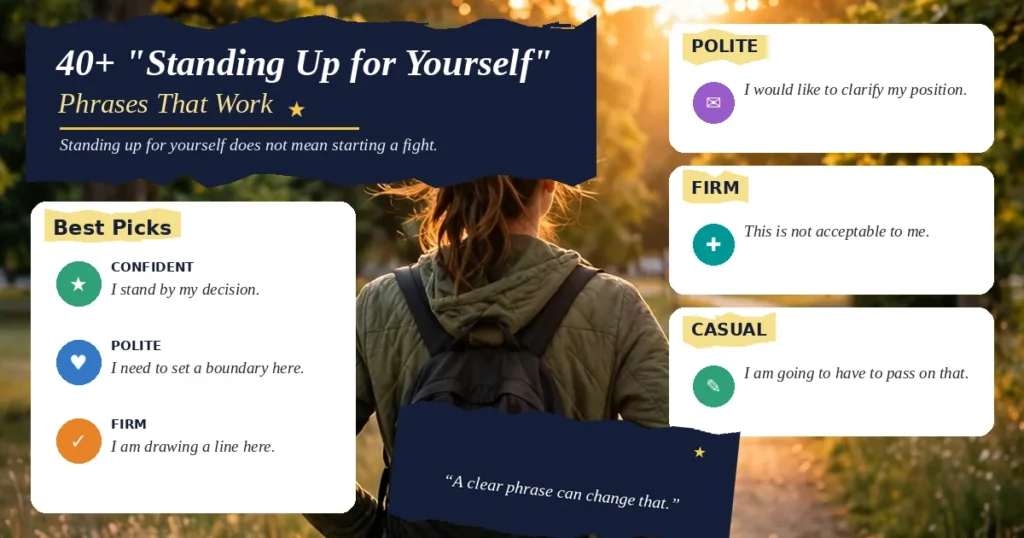
Standing up for yourself does not mean starting a fight. It means saying what you need, what you believe, and what you will not accept, in a way that other people can hear. You can do it kindly. You can do it firmly. You can do it without raising your voice or damaging the relationship. The key is to choose words that match the situation and speak them with steady confidence.
This guide gives you 40 practical alternatives, grouped by tone, so you always have the right phrase ready. You will also find email examples, a quick comparison table, common mistakes to avoid, and answers to the questions people ask most about self-advocacy. Whether you need to speak up at work, set a boundary with a friend, or say no to an unfair request, you will find language here that fits.
Meaning
Standing up for yourself means defending your rights, needs, opinions, and boundaries in a clear and respectful way. It is the middle ground between staying silent and becoming aggressive. When you stay silent, other people may not know that something bothers you, so nothing changes. When you react with anger, people stop listening and focus on your tone instead of your point. Assertive language sits in between: it states the facts, names your feelings, and asks for a fair result.
The phrase itself comes from a simple image. To “stand up” means to rise to your feet, to become visible, and to hold your ground. When you apply it to yourself, you choose to be visible about what matters to you. You stop shrinking your needs to keep everyone else comfortable.
Self-advocacy shows up in small daily moments. It is telling a coworker that you cannot take on extra work this week. It is telling a friend that a joke hurt your feelings. It is asking a manager for the credit you earned. It is saying no to plans that drain you. None of these moments require a speech. Each one needs only one honest sentence, delivered calmly.
People sometimes confuse standing up for yourself with selfishness. The two are very different. Selfish behavior ignores other people’s needs. Assertive behavior respects both sides. You can say, “I understand your deadline, and I need more time to do this well,” and honor both the project and your own limits. That balance is what makes assertive language so powerful.
Professional usage
At work, standing up for yourself protects your career, your workload, and your reputation. Managers and coworkers often respect people who communicate limits clearly, because clear limits make planning easier. A team member who says yes to everything and then misses deadlines helps no one. A team member who says, “I can take this on next week, but not today,” gives the team honest information to work with.
Use professional language when you raise an issue with a boss or a client. Start with the facts, not with blame. For example, say, “I completed the report on Friday, and I noticed my name was missing from the credits,” instead of, “You stole my work.” The first version invites a fix. The second version starts a conflict. Keep your sentences short, specific, and focused on the outcome you want.
Timing matters as much as wording. Raise concerns in private when the issue involves one person. A quiet conversation with a manager usually works better than a public correction in a meeting. If you need to speak up in a group setting, keep it brief and solution-focused: “I want to add one point to that plan before we move on.”
When a conversation gets tense at work, it helps to name the other person’s concern before you state your own. You might say, “I understand your frustration with the delay, and I want to walk you through what happened so we can fix it.” If you want more phrases for that kind of moment, you can explore other ways to say I understand your frustration. Pairing empathy with a clear boundary keeps the conversation professional and productive.
You can also protect your workload with simple, direct sentences. Try, “I am at capacity this week, so I need to pass on this task,” or, “I can help with the first part, but I cannot own the whole project.” If you need to ask for support, a clear request works better than a hint. For example, you can say, “I need your help reviewing this draft before Thursday,” rather than hoping someone notices you are struggling. For more ideas on that wording, see other ways to say I need your help.
Standing up for yourself at work also includes asking for what you deserve. You can request a raise, a better schedule, or a role that fits your skills. Prepare your facts, choose a calm moment, and state your case plainly: “Based on my results this year, I would like to discuss a salary review.” Confidence grows with practice, and every professional conversation like this makes the next one easier.
Alternatives
The phrases below cover 40 alternatives in five tone groups. Pick the group that fits your situation, then pick the phrase that sounds most like you. Each entry gives you a tone note and a short example so you can use it right away.
Confident and direct
These phrases work best when you need to be clear and leave no room for doubt.
- I stand by my decision. — Tone: firm and final. Best use: when someone keeps pushing you to change your mind. Example: “I stand by my decision to move the deadline, and I have already informed the team.”
- I am not willing to accept that. — Tone: direct and serious. Best use: when someone treats you unfairly. Example: “I am not willing to accept that tone in our meetings, so let us reset and speak respectfully.”
- That does not work for me. — Tone: calm and clear. Best use: when you need to decline a plan or request. Example: “That does not work for me, but I can meet on Thursday morning instead.”
- I deserve to be treated with respect. — Tone: dignified and steady. Best use: when someone speaks down to you. Example: “I deserve to be treated with respect, just as I treat everyone on this team.”
- I will not change my position on this. — Tone: resolute. Best use: when you have made a final call. Example: “I will not change my position on this budget, because the numbers support it.”
- My answer is no. — Tone: short and complete. Best use: when a longer explanation invites pressure. Example: “My answer is no, and I appreciate you asking before assuming.”
- I have a right to my opinion. — Tone: assertive and fair. Best use: when someone dismisses your view. Example: “I have a right to my opinion, even when the group disagrees with me.”
- I am speaking up because this matters. — Tone: honest and purposeful. Best use: when you need to explain why you raised an issue. Example: “I am speaking up because this matters to our customers and to our team.”
Polite and professional
These phrases keep the relationship warm while they protect your boundaries.
- I appreciate your input, and I see it differently. — Tone: respectful and confident. Best use: meetings and reviews. Example: “I appreciate your input, and I see it differently, so let us compare both options.”
- I would like to clarify my position. — Tone: calm and businesslike. Best use: when others misread your stance. Example: “I would like to clarify my position before we vote on the proposal.”
- I need to set a boundary here. — Tone: professional and honest. Best use: workload and availability. Example: “I need to set a boundary here, because I cannot answer messages after 8 p.m.”
- Let us find a solution that works for both of us. — Tone: cooperative and firm. Best use: negotiations. Example: “Let us find a solution that works for both of us, starting with the delivery date.”
- I value our working relationship, and I must be honest. — Tone: warm and direct. Best use: difficult feedback. Example: “I value our working relationship, and I must be honest about the delay.”
- I am happy to help within these limits. — Tone: helpful and bounded. Best use: requests that exceed your role. Example: “I am happy to help within these limits, so I can review the draft but not rewrite it.”
- Could we revisit this decision together? — Tone: polite and assertive. Best use: when a decision feels unfair. Example: “Could we revisit this decision together, now that we have the new data?”
- I want to make sure my perspective is heard. — Tone: gentle and determined. Best use: quiet voices in group settings. Example: “I want to make sure my perspective is heard before we close this topic.”
Warm and friendly
These phrases suit friends, family, and close relationships, where kindness matters as much as honesty.
- I care about you, and I need to be honest. — Tone: loving and open. Best use: close relationships. Example: “I care about you, and I need to be honest about how that comment made me feel.”
- I love spending time with you, but I need some space this weekend. — Tone: affectionate and clear. Best use: personal boundaries. Example: “I love spending time with you, but I need some space this weekend to rest.”
- That hurt my feelings, and I wanted you to know. — Tone: vulnerable and brave. Best use: repairing a friendship. Example: “That hurt my feelings, and I wanted you to know so we can move past it.”
- I am not comfortable with that. — Tone: soft and firm. Best use: everyday boundaries. Example: “I am not comfortable with that plan, so let us pick something we both enjoy.”
- I need to look after myself right now. — Tone: kind and self-aware. Best use: saying no to social plans. Example: “I need to look after myself right now, so I will skip the party and rest instead.”
- Let us talk about this calmly. — Tone: peaceful and steady. Best use: disagreements with loved ones. Example: “Let us talk about this calmly, because I want us to understand each other.”
- I hear you, and I feel differently. — Tone: respectful and honest. Best use: family debates. Example: “I hear you, and I feel differently about how we should handle the holiday plans.”
- I am going to be kind to myself and say no. — Tone: gentle and strong. Best use: self-care decisions. Example: “I am going to be kind to myself and say no to extra shifts this month.”
Firm and boundary-setting
These phrases draw a clear line when softer language has not worked.
- This is not acceptable to me. — Tone: serious and final. Best use: repeated disrespect. Example: “This is not acceptable to me, and I need it to stop.”
- I will not be spoken to that way. — Tone: strong and dignified. Best use: rude or aggressive language. Example: “I will not be spoken to that way, so we can continue when the tone changes.”
- I am drawing a line here. — Tone: clear and decisive. Best use: firm limits. Example: “I am drawing a line here, because my weekends are for my family.”
- No is a complete sentence. — Tone: blunt and freeing. Best use: when explanations invite arguments. Example: “No is a complete sentence, and I do not owe a long reason for this choice.”
- I refuse to agree to something unfair. — Tone: principled and bold. Best use: unfair deals or terms. Example: “I refuse to agree to something unfair, so let us rewrite that clause.”
- I will walk away if this continues. — Tone: serious and consequential. Best use: last-resort boundaries. Example: “I will walk away if this continues, because I will not accept threats.”
- My boundaries are not negotiable on this point. — Tone: absolute and calm. Best use: safety and health limits. Example: “My boundaries are not negotiable on this point, and I trust you to respect them.”
- I expect the same respect I give. — Tone: fair and steady. Best use: one-sided relationships. Example: “I expect the same respect I give, especially after all the support I offered.”
Casual and everyday
These phrases fit relaxed settings, where you want to sound natural rather than formal.
- Hey, that is not cool with me. — Tone: relaxed and honest. Best use: friends and peers. Example: “Hey, that is not cool with me, so let us not joke about that topic.”
- I am going to have to pass on that. — Tone: easy and clear. Best use: casual invitations. Example: “I am going to have to pass on that road trip, but have fun.”
- Not gonna lie, I disagree. — Tone: casual and direct. Best use: informal chats. Example: “Not gonna lie, I disagree with that plan, and here is why.”
- I have got to look out for myself here. — Tone: friendly and frank. Best use: everyday choices. Example: “I have got to look out for myself here, so I am leaving early tonight.”
- That is a hard no from me. — Tone: playful and firm. Best use: lighthearted refusals. Example: “That is a hard no from me, but thanks for thinking of me.”
- I am not feeling that, to be honest. — Tone: relaxed and truthful. Best use: opinions with friends. Example: “I am not feeling that restaurant, to be honest, so can we try another place?”
- I need to put myself first this time. — Tone: warm and honest. Best use: self-care with friends. Example: “I need to put myself first this time, so I am staying home and recharging.”
- Thanks, but I will do it my way. — Tone: polite and independent. Best use: unwanted advice. Example: “Thanks, but I will do it my way, because this method works for me.”
Quick comparison
The right phrase depends on your goal, your audience, and the tone you want to set. The table below matches common situations with the strongest option from each group.
| Situation | Best phrase type | Example phrase |
|---|---|---|
| A coworker takes credit for your work | Confident and direct | I stand by my record on this project |
| A manager adds work to a full week | Polite and professional | I need to set a boundary here |
| A friend makes a hurtful joke | Warm and friendly | That hurt my feelings, and I wanted you to know |
| Someone keeps ignoring your no | Firm and boundary-setting | My boundaries are not negotiable on this point |
| A casual invite you want to skip | Casual and everyday | I am going to have to pass on that |
| A family debate gets heated | Warm and friendly | Let us talk about this calmly |
| A client demands an unfair term | Firm and boundary-setting | I refuse to agree to something unfair |
Read the situation first, then pick the tone. A firm phrase in a casual setting can sound harsh, while a casual phrase in a serious meeting can sound weak. When you feel unsure, choose the polite and professional group. It works in almost every setting, and you can always become firmer later if the other person does not listen.
Email examples
Email gives you time to choose your words, which makes it a great place to practice self-advocacy. Keep your message short, state the facts, and end with a clear next step. Avoid long apologies, because they weaken your point. A single “thanks for understanding” at the end is enough.
Example 1: Declining extra work
Subject: Capacity this week
Hi Sarah,
Thank you for thinking of me for the client report. I am at full capacity this week with the product launch, so I cannot take it on before Friday. I can review the draft on Monday if that helps, or we can assign it to someone with open time this week.
Thanks for understanding,
Alex
Example 2: Asking for credit
Subject: Credit for the March campaign
Hi James,
I wanted to raise one point about the March campaign summary. I led the research and wrote the first draft, but my name did not appear in the credits. Could you add it in the next version? I appreciate the team effort, and I want the record to reflect each person’s contribution.
Best regards,
Priya
Example 3: Setting an availability boundary
Subject: My working hours
Hi team,
I am writing to clarify my working hours going forward. I am available from 9 a.m. to 6 p.m., and I will respond to messages outside those hours the next working day. This change helps me deliver better work during the day. Thank you for respecting this boundary.
Kind regards,
Daniel
Example 4: Responding to an unfair request
Subject: Re: Weekend coverage
Hi Mark,
I understand the team needs weekend coverage, and I covered the last two weekends. I am not available this weekend, so I need to pass on this rotation. I am happy to help find a fair schedule for the next month.
Thank you,
Emma
When you open a difficult email, a warm first line can keep the tone respectful. For instance, you might start with a phrase like I am reaching out to you to frame the message as a conversation rather than a complaint. If the reply runs late or the thread gets tense, a patient line also helps. You can borrow wording from other ways to say please be patient to ask for time without sounding pushy. Small touches like these keep your boundary firm and your relationship intact.
Common mistakes
Many people try to stand up for themselves and then undo their own message with a few common mistakes. The first mistake is over-apologizing. Starting with “I am so sorry, but…” tells the other person that your need is a problem. A simple “thank you for understanding” works better than three apologies. Save apologies for real mistakes, not for having needs.
The second mistake is explaining too much. A long list of reasons gives the other person more points to argue with. If you say no to a request, one short reason is enough, and sometimes no reason is needed at all. “I cannot take that on this week” is a complete message. You do not need to list your calendar to prove it.
The third mistake is using “you always” or “you never” statements. These words turn a specific issue into a character attack, and the other person will defend themselves instead of hearing your point. Replace “You never listen to me” with “I felt unheard in yesterday’s meeting, and I want to share my view.” Specific facts keep the conversation focused on the issue.
The fourth mistake is raising your voice or using sarcasm. A sharp tone can feel powerful in the moment, but it usually costs you the result you wanted. People remember how you made them feel, and a calm voice makes your words easier to accept. If you feel anger rising, pause, breathe, and lower your voice before you continue.
The fifth mistake is waiting too long. Small frustrations grow when you stay silent, and by the time you speak, the emotion can explode over a minor trigger. Raise issues early, while they are still small and easy to fix. A quick, calm sentence today prevents a big argument next month.
The sixth mistake is expecting one conversation to fix everything. Some people need time to adjust to a new boundary. State your position clearly, repeat it calmly if needed, and judge the result over a few weeks rather than a single talk. Consistency matters more than perfection.
Related phrases
Standing up for yourself connects closely with several other useful expressions. Learning them together gives you a fuller toolkit for honest communication.
- Speak your mind means saying what you truly think, even when it feels uncomfortable. Example: “She decided to speak her mind in the meeting, and the team thanked her for it.”
- Hold your ground means refusing to change your position under pressure. Example: “He held his ground on the price, and the client eventually agreed.”
- Set boundaries means defining what you will and will not accept. Example: “Setting boundaries around her evenings helped her sleep better.”
- Advocate for yourself means actively supporting your own interests and needs. Example: “Advocating for yourself at work starts with tracking your own results.”
- Stand your ground is a close cousin of holding your ground, with a slightly more physical image. Example: “She stood her ground when the group tried to change the plan.”
- Assert yourself is the formal term for expressing your needs confidently. Example: “Learning to assert yourself takes practice, but it changes how people treat you.”
- Say your piece means sharing your opinion fully before a decision is made. Example: “He said his piece, and then he accepted the group’s vote.”
- Push back means resisting a request or idea you disagree with. Example: “She pushed back on the extra hours, and her manager respected it.”
Gratitude also plays a role in self-advocacy. When someone respects your boundary, acknowledging it strengthens the relationship. A simple line like I appreciate it shows warmth without weakening your position. Likewise, when someone supports you after you speak up, you can respond with my pleasure to help in return, keeping the exchange balanced and kind.
Phrase comparison
Some phrases sound similar but carry different weight. Choosing between them depends on how firm you need to be and how close the relationship is.
| Phrase | Tone | Strength | Best setting |
|---|---|---|---|
| That does not work for me | Neutral | Medium | Work and social plans |
| I am not willing to accept that | Serious | High | Unfair treatment |
| I am not comfortable with that | Gentle | Medium | Friends and family |
| This is not acceptable to me | Firm | Very high | Repeated disrespect |
| I need to set a boundary here | Professional | Medium-high | Workplace limits |
| Hey, that is not cool with me | Casual | Low-medium | Peer conversations |
| I stand by my decision | Confident | High | Decisions under pressure |
| I appreciate your input, and I see it differently | Diplomatic | Medium | Meetings and debates |
Notice how the strongest phrases name the problem directly, while the gentler ones protect the other person’s feelings. Neither style is better in every case. A gentle phrase suits a friend who made an honest mistake. A strong phrase suits a person who keeps crossing a line you already stated. Match the strength to the situation, and increase it only if the first attempt does not work.
Cultural usage
Culture shapes how people hear assertive language. In the United States and much of Western Europe, direct speech is often praised as honesty. A clear “no” or a plain statement of needs usually earns respect in workplaces there. In the United Kingdom, people often soften directness with polite framing, such as “I am afraid that does not work for me,” which keeps the message firm while sounding courteous.
In many East Asian cultures, including Japan and South Korea, indirect language protects harmony and saves face. A direct refusal can feel rude, so people often decline through soft wording, such as “That might be difficult,” which listeners understand as a polite no. Standing up for yourself in these settings still matters, but the phrasing leans on context, tone, and timing rather than blunt statements.
In Latin American and Middle Eastern cultures, warmth and personal connection often come first. A boundary lands better when it follows a friendly greeting and an acknowledgment of the relationship. For example, “I value our friendship, and I need to be honest about this” works well, because it honors the bond before it states the limit.
In South Asian cultures, respect for elders and senior colleagues can make direct disagreement feel uncomfortable. Younger professionals often use respectful framing, such as “With respect, I see it differently,” to raise a point without sounding rude. The goal stays the same: clear communication, delivered in a way the listener can accept.
When you speak across cultures, watch the other person’s reaction and adjust. If a direct phrase causes visible discomfort, try a softer version of the same message. If a soft phrase gets ignored, try a clearer one. Flexibility is not weakness. It is a skill that lets your message land in any room.
Frequently asked questions
What does standing up for yourself really mean?
Standing up for yourself means expressing your needs, opinions, and limits clearly and respectfully, without aggression or silence. It includes saying no to unfair requests, asking for credit you earned, and naming behavior that hurts you. The goal is a fair outcome for both sides, not a victory over the other person.
Is standing up for yourself the same as being rude?
No, the two are very different. Rudeness dismisses other people’s feelings and aims to win an argument. Assertiveness respects both sides and aims for a fair result. You can be firm and kind at the same time, for example by saying, “I understand your view, and I need to be honest about mine.”
How can I stand up for myself without starting a fight?
Use “I” statements, stick to facts, and name the outcome you want instead of attacking the person. Say, “I felt overlooked when my name was missing,” rather than, “You ignored me.” Keep your voice calm, choose a private moment when possible, and end with a solution, such as, “Could we fix the credits in the next version?”
What should I say when someone pressures me to say yes?
A short, complete refusal works best, such as, “That does not work for me,” or, “My answer is no.” You do not owe a long explanation, and extra reasons give the other person more to argue against. If the pressure continues, repeat the same sentence calmly instead of inventing new reasons.
How do I stand up to my boss without risking my job?
Prepare your facts, choose a calm and private moment, and frame your point around shared goals. For example, say, “I want to deliver strong results, and my current workload makes that hard, so I would like to discuss priorities.” Document the conversation briefly afterward, and keep your tone professional throughout.
What if I freeze and cannot find the words in the moment?
Freezing is common, and it does not mean you failed. You can return to the topic later with a sentence like, “I have been thinking about our conversation, and I want to add something.” You can also prepare two or three go-to phrases in advance, so you have ready language when pressure hits.
How do I set boundaries with family members?
Start with warmth, then state the limit plainly. For example, say, “I love our family time, and I need Sundays for rest, so I will skip this week.” Repeat the boundary calmly if it gets tested, and avoid long justifications. Consistency over time teaches people to respect the new limit.
Can standing up for yourself damage a friendship?
Honest communication usually strengthens a friendship, because hidden resentment causes more damage than a kind truth. A friend may feel surprised at first, especially if you stayed quiet before, but most friendships grow stronger when both people can speak openly. If a friendship ends because you stated a fair boundary, that ending reveals a problem that already existed.
What is the difference between assertive and aggressive language?
Assertive language respects both people’s rights and focuses on facts and solutions. Aggressive language attacks, threatens, or humiliates the other person to force a result. For example, “I need us to speak respectfully” is assertive, while “You are a terrible person” is aggressive. The first invites change, while the second invites conflict.
How can shy people practice standing up for themselves?
Start small and low-risk. Practice one phrase with a safe person, such as a close friend, before using it at work. Write your key sentence down before a difficult conversation, and rehearse it aloud. Each small success builds confidence, and over time the bigger conversations feel easier.
Should I stand up for myself over text or in person?
In-person conversations usually work better for sensitive topics, because tone and body language prevent misunderstandings. Text and email suit simple boundaries, such as declining an invitation or clarifying a schedule. For emotional or complex issues, ask for a call or meeting instead of sending a long message.
What do I do if someone ignores my boundary?
Repeat the boundary calmly and add a consequence if needed. For example, say, “I have said I cannot work weekends, so I will not answer weekend messages.” Then follow through consistently. If the behavior continues at work, raise it with a manager or human resources, with a clear record of dates and messages.
Is it selfish to put myself first sometimes?
No, protecting your health, time, and energy is responsible, not selfish. You cannot support others well when you are exhausted or resentful. Saying no to one request often means saying yes to your work, your family, or your rest, and that balance helps everyone around you.
How do I teach my child to stand up for themselves?
Model calm, clear language at home, and praise your child when they express a need respectfully. Teach simple phrases like, “Please stop, I do not like that,” and role-play common situations, such as a classmate taking a toy. Encourage them to tell a trusted adult when a problem continues.
When should I ask for help instead of handling it alone?
Ask for help when the other person holds power over you, when the behavior repeats after clear boundaries, or when you feel unsafe. A manager, a mediator, human resources, or a counselor can support you. Seeking help is not a failure of self-advocacy. It is a smart use of the resources around you.
Conclusion
Standing up for yourself is a skill, not a personality trait, which means anyone can learn it with practice. Start with one phrase from this guide, use it in a low-risk situation, and notice how it feels. Over time, add more phrases, try firmer language when needed, and watch your confidence grow. The people around you will adjust, and many will respect you more for your honesty.
Remember that assertiveness protects both sides of a relationship. It gives other people clear information about your needs, so they can respond fairly instead of guessing. It prevents resentment from building in silence, and it keeps small problems from becoming big conflicts. A calm, honest sentence today can save weeks of frustration later.
Keep this list close, and return to it before a difficult conversation. Pick the tone that fits, speak plainly, and trust that your needs deserve a voice. For a deeper look at the language of confident communication, see the Cambridge definition of assertive, which describes expressing opinions and needs in a direct and confident way.