Introduction
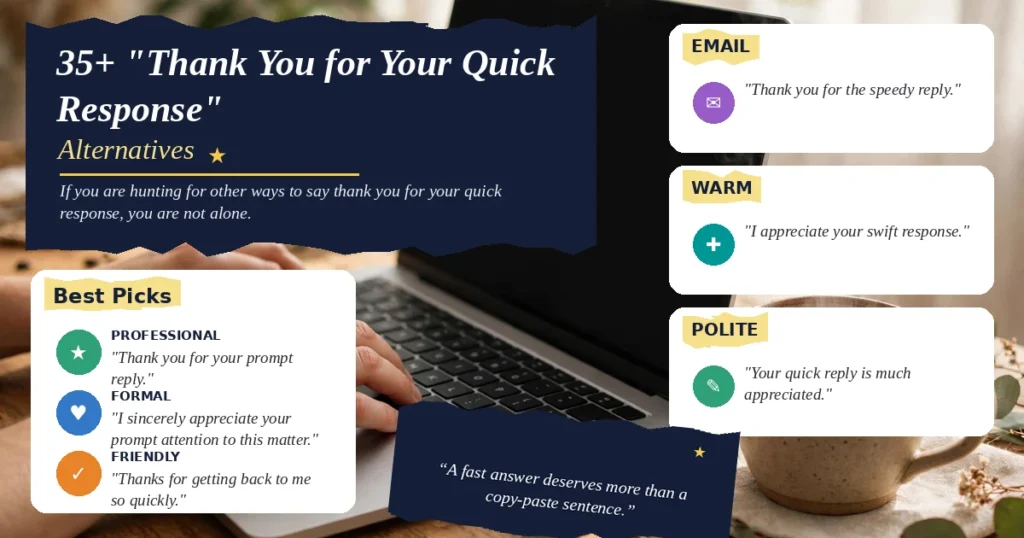
If you are hunting for other ways to say thank you for your quick response, you are not alone. This small sentence shows up in thousands of business emails every day, and it works fine — but using it every single time can make your writing sound flat and repetitive. A little variety keeps your emails warm, human, and professional, and it shows the reader you actually thought about your message instead of copying a template.
This guide gives you 35 fresh alternatives grouped by tone, so you can match the right line to the right person. You will find options for clients, managers, colleagues, and customer service, plus ready-to-paste email examples, a comparison table, the mistakes to avoid, and answers to the questions people ask most. Whether you want to sound formal in a proposal or friendly in a team chat, you will find a line here that fits.
By the end, you will never be stuck repeating the same sentence again. Let us look at what this phrase really means first, and then dig into the alternatives.
Meaning
“Thank you for your quick response” is a polite way to tell someone you noticed and appreciated how fast they answered you. It combines thanks with recognition of their speed, which makes the other person feel valued and encourages them to keep helping you. People use it in emails, messages, and letters whenever someone replies faster than expected, confirms something, or resolves an issue without delay. A prompt reply paired with a real thank-you builds trust, and that trust makes every future conversation with that person easier.
Professional usage
This phrase belongs in work settings where tone matters. The right delivery depends on who you are writing to and what the stakes are. Below are the situations where it fits best.
Emails to clients
Clients pay for your attention, so thanking them for speed shows respect for their time. When a client sends documents, answers your question, or approves a draft quickly, a short thank-you keeps the relationship warm. Keep it crisp — one line is enough. Pair it with the next step, like “Thanks for your quick reply — I will have the draft back to you by Thursday.”
Emails to managers
With managers, this line shows you value their attention in a busy schedule. Thank a manager for a fast decision, a quick sign-off, or a rapid answer to your question. Keep the tone slightly formal, and avoid sounding overly casual. It also signals that you are organized and on top of your work.
Customer service replies
Support teams use this phrase to acknowledge customers who respond fast with the details needed to solve a case. It turns a cold ticket into a human conversation. For example: “Thank you for your quick response with the screenshots — I can see the issue now and I am working on a fix.” It reassures the customer that their effort was noticed.
Internal team messages
With colleagues, you can be lighter. A quick “Thanks for the fast reply!” in Slack or Teams keeps things moving without sounding stiff. Save the fuller versions for emails and formal requests, and use the short ones where speed matters more than polish.
Alternatives
Here are 35 alternatives to “thank you for your quick response,” sorted into five tone groups. Pick the group that matches your reader, then pick the line that matches the moment.
Professional
These work for most business emails — polished, neutral, and safe with anyone.
- Thank you for your prompt reply. — The classic one-word upgrade: “prompt” sounds sharper than “quick.” Best for first emails to clients. Example: “Thank you for your prompt reply — I have updated the proposal accordingly.”
- I appreciate your swift response. — Slightly warmer than the original, with a smooth, professional feel. Good for vendors and partners. Example: “I appreciate your swift response to my quote request.”
- Thanks for getting back to me so quickly. — Natural and conversational while staying professional. Works in most emails. Example: “Thanks for getting back to me so quickly; the timeline looks good.”
- I am grateful for your fast response. — A touch more personal thanks to “grateful.” Best when someone helped you out of a jam. Example: “I am grateful for your fast response — you saved me a lot of rework.”
- Thank you for the speedy reply. — Light, modern, and professional. Fits tech teams and startups. Example: “Thank you for the speedy reply; I have forwarded the files to legal.”
- Your quick reply is much appreciated. — Turns the thanks around with a confident, calm tone. Good in follow-up emails. Example: “Your quick reply is much appreciated — we can keep the project on schedule.”
- Thanks for turning this around so fast. — Great when someone completed a task, not just replied. Best for project work. Example: “Thanks for turning this around so fast; the mockups look great.”
Formal
Use these with executives, senior clients, and official correspondence where respect is the priority.
- I sincerely appreciate your prompt attention to this matter. — Formal and complete, ideal for official requests. Best for legal, HR, or compliance topics. Example: “I sincerely appreciate your prompt attention to this matter.”
- Thank you for your immediate attention. — Strong and respectful, used when the issue was urgent. Works after escalations. Example: “Thank you for your immediate attention to the billing error.”
- I am very grateful for your timely response. — Measured and dignified. Best for first contact with senior stakeholders. Example: “I am very grateful for your timely response to our proposal.”
- Please accept my thanks for your swift reply. — Polite and old-fashioned in the best way. Good for formal letters. Example: “Please accept my thanks for your swift reply regarding the contract.”
- I value your prompt response greatly. — Emphasizes respect for the reader. Best when addressing leadership. Example: “I value your prompt response greatly — it helped us decide today.”
- Thank you for prioritizing this. — Acknowledges that they moved you up their list. Perfect after urgent requests. Example: “Thank you for prioritizing this; the client is happy with the outcome.”
- Your promptness is greatly appreciated. — Short, formal, and gracious. Works as a closing line. Example: “Your promptness is greatly appreciated. I will send the summary shortly.”
Friendly
Warm and human for people you know well or want to build a rapport with.
- Thanks for the lightning-fast reply! — Playful and upbeat. Best for friendly colleagues. Example: “Thanks for the lightning-fast reply! That answers everything.”
- Wow, thanks for getting back to me so fast! — Shows real surprise and delight. Good in team chats. Example: “Wow, thanks for getting back to me so fast — I was still writing the question!”
- You are a star — thanks for the quick answer! — Adds a genuine compliment. Best when someone went out of their way. Example: “You are a star — thanks for the quick answer on the budget.”
- Thanks a bunch for the speedy response! — Casual and cheerful. Works with peers you message often. Example: “Thanks a bunch for the speedy response; I owe you a coffee.”
- I really appreciate how quickly you jumped on this. — Warm and specific. Good when someone acted, not just replied. Example: “I really appreciate how quickly you jumped on this ticket.”
- So fast — thank you! — Minimal and breezy. Best for chat apps and quick threads. Example: “So fast — thank you! I will update the board now.”
- Thanks for the super-quick reply! — Friendly with a touch of energy. Good for internal emails. Example: “Thanks for the super-quick reply; the design team has what it needs.”
Email-ready
Plug-and-play openers and closers built for the inbox.
- Appreciate the quick turnaround on this. — Professional shorthand for email bodies. Best mid-email. Example: “Appreciate the quick turnaround on this — the deck is approved.”
- Thanks for your fast feedback. — Perfect after reviews and comments. Good for creative work. Example: “Thanks for your fast feedback on the homepage copy.”
- Grateful for the quick confirmation. — Ideal when they confirmed details or dates. Example: “Grateful for the quick confirmation — I have locked in the meeting room.”
- Thank you for responding so promptly. — A smooth, slightly formal opener. Best at the start of a reply. Example: “Thank you for responding so promptly. Here are the revised figures.”
- Thanks for the rapid response. — Short and businesslike. Works in subject-adjacent lines. Example: “Thanks for the rapid response; I will share this with the team.”
- I appreciate you getting back to me promptly. — Polite and complete. Good for external emails. Example: “I appreciate you getting back to me promptly — let us move to the next step.”
- Thanks for the quick answer — exactly what I needed. — Adds warmth by confirming the value. Best after clear, useful replies. Example: “Thanks for the quick answer — exactly what I needed to finish the report.”
Workplace
Short, natural lines for daily work communication — Slack, Teams, and quick notes.
- Appreciate the fast reply! — The go-to workplace short form. Works anywhere informal. Example: “Appreciate the fast reply! Noted and updated.”
- Thanks for jumping on this so quickly. — Acknowledges action, not just words. Best after fixes. Example: “Thanks for jumping on this so quickly — the bug is gone.”
- Quick reply noted — thank you! — Calm and businesslike. Good for status updates. Example: “Quick reply noted — thank you! I will close the loop with the client.”
- Thanks for the swift turnaround. — Suits teams that work in sprints. Example: “Thanks for the swift turnaround on the QA notes.”
- Got it — thanks for the fast response! — Confirms receipt and thanks in one breath. Best in chat. Example: “Got it — thanks for the fast response! Moving ahead.”
- Thank you for the timely update. — Great when their reply included news or progress. Example: “Thank you for the timely update; the dashboard looks current now.”
- Speedy as always — thanks! — Friendly nod to a reliable colleague. Best with repeat helpers. Example: “Speedy as always — thanks! Let me know if you need anything from me.”
Quick comparison
| Alternative | Tone | Best Use |
|---|---|---|
| Thank you for your prompt reply | Professional | First emails to new clients |
| I appreciate your swift response | Professional | Vendors and partners |
| I sincerely appreciate your prompt attention to this matter | Formal | Official or legal correspondence |
| Thank you for your immediate attention | Formal | After urgent escalations |
| Thanks for the lightning-fast reply! | Friendly | Colleagues in chat |
| I really appreciate how quickly you jumped on this | Friendly | When someone fixed something |
| Appreciate the quick turnaround on this | Email-ready | Mid-email, project updates |
| Grateful for the quick confirmation | Email-ready | Confirming dates or details |
| Appreciate the fast reply! | Workplace | Slack, Teams, quick threads |
| Thanks for jumping on this so quickly | Workplace | Acknowledging quick action |
Email examples
Real templates you can copy. Adjust the names and details to fit your situation.
To a client
Subject: Re: Q3 report draft
Hi Sarah,
Thank you for your prompt reply — and for the clear notes on section two. I have made the changes and attached the updated draft.
Could you take one more look when you get a chance? Once you approve, I will send it to the full team.
Best regards,
Dan
To a manager
Subject: Re: Budget approval
Hi Mr. Chen,
I sincerely appreciate your prompt attention to this matter. With your approval, we can start the vendor setup this week and stay on schedule.
I will keep you posted on progress and flag anything that needs your input.
Kind regards,
Priya
To a colleague
Subject: Re: Design files
Hi Alex,
Thanks for the speedy reply — the files are exactly what I needed. I have shared them with the copy team, and we are good to move ahead.
Let me know if you want a look at the final layout before it ships.
Thanks again,
Jordan
To a customer
Subject: Re: Your support ticket #4821
Hi Maya,
Thank you for responding so promptly with the order number — that was the missing piece. I have located your shipment, and it is now scheduled for delivery on Friday.
If anything else comes up, just reply to this email and I will help right away.
Warm regards,
The Support Team
When a customer takes time to help you solve their own problem, showing real appreciation keeps the tone friendly and builds loyalty for the next issue.
To a vendor
Subject: Re: Updated quote
Hello James,
I appreciate your swift response to my quote request. Your pricing is clear, and I can present it to our finance team today.
I will follow up with our decision by the end of the week. In the meantime, please hold the current rates if you can.
Best,
Nina
Follow-up after no reply, then a fast one
Subject: Re: Meeting notes
Hi Tom,
Thanks for getting back to me so quickly — I know your week has been packed, so this really helped.
I have added your points to the notes. If anything else comes to mind, just send it over and I will fold it in.
Best,
Lena
If someone finally replies after a delay, pair your thanks with a gentle note about what happens next so the thread stays clear.
Common mistakes
Short, honest warnings. Avoid these and your thank-you will always land well.
1. Thanking someone for speed when they were actually slow
Do not write “thanks for the quick reply” after waiting a week. It reads as sarcasm, even if you do not mean it. If the reply was late, thank them for getting back to you without mentioning speed.
2. Using a friendly line with a formal reader
“Thanks a bunch!” to a senior executive can feel careless. Match the tone to the relationship — formal with leaders, friendly with peers.
3. Stacking three thank-yous in one email
One sincere thanks beats three weak ones. Say it once, clearly, and move on to your point.
4. Forgetting to say what the reply helped with
“Thanks for your quick response” on its own is fine, but adding one clause — “you saved me a rewrite” — makes it feel genuine. Specificity is the difference between a template and a thank-you.
5. Using the exact same line with the same person every week
Repetition trains people to skim past it. Rotate through a few alternatives so each thanks feels fresh, especially with people you email often.
6. Putting the thanks in the wrong place
Burying your thank-you at the end of a long complaint confuses the reader. Open with the thanks, then get to the issue. Order shapes tone.
7. Over-thanking in customer service replies
When you clarify a support detail, thank the customer once and solve the problem fast. Customers value a quick fix more than five lines of gratitude.
8. Using humor with a brand-new contact
“Lightning-fast!” is fun with a teammate, but a stranger may read it as unprofessional. Earn the casual tone before you use it.
Related phrases
These expressions orbit the same idea — thanks plus speed, effort, or helpfulness. Each comes with a one-line meaning and a short example.
- Thanks for getting back to me. — A general thank-you for any reply. Example: “Thanks for getting back to me — the update helps a lot.”
- I appreciate your help. — Thanks focused on effort rather than speed. Example: “I appreciate your help with the data cleanup.”
- Thank you for your time. — Acknowledges the time someone spent on you. Example: “Thank you for your time on the call today.”
- Thanks for the update. — Used when the reply contained news or progress. Example: “Thanks for the update — the numbers look better now.”
- I appreciate your cooperation. — Formal thanks for working with you on a task. Example: “I appreciate your cooperation during the audit.”
- Thank you for your understanding. — Thanks given when asking for patience or flexibility. Example: “Thank you for your understanding about the delay.”
- Thanks for your input. — Thanks for opinions, feedback, or advice. Example: “Thanks for your input on the pricing slide.”
- I am grateful for your support. — Warmer, deeper thanks for ongoing help. Example: “I am grateful for your support throughout this project.”
- Thank you for your attention to this. — Formal thanks for focusing on your matter. Example: “Thank you for your attention to this request.”
- Thanks for keeping me posted. — Thanks for regular updates over time. Example: “Thanks for keeping me posted on the shipment.”
- I value your feedback. — Thanks that highlights respect for their opinion. Example: “I value your feedback on the draft proposal.”
- Thank you for your patience. — Thanks given when the other person waited or stayed calm. Example: “Thank you for your patience while we fixed the error.”
- Much appreciated. — A short, confident thank-you for casual work chats. Example: “Files received — much appreciated!”
- Thanks for clarifying. — Thanks for making something clearer. Example: “Thanks for clarifying the deadline — all good now.”
- I owe you one. — Playful thanks that promises a favor back. Example: “I owe you one for covering my shift.”
- Thank you for your diligence. — Formal thanks for careful, thorough work. Example: “Thank you for your diligence on the compliance review.”
- Thanks for taking care of this. — Thanks for handling a task or problem. Example: “Thanks for taking care of this so quickly.”
- I appreciate your flexibility. — Thanks for adjusting plans or schedules. Example: “I appreciate your flexibility on the meeting time.”
Phrase comparison
The main phrase — “thank you for your quick response” — is neutral, safe, and slightly plain. It works everywhere but impresses nowhere, which is exactly why alternatives exist. Against “I sincerely appreciate your prompt attention to this matter,” the original feels light: the longer version carries more weight and suits executives, contracts, and official requests, while the original fits ordinary emails where formality would feel stiff. Compared with “thanks for the lightning-fast reply!,” the original sounds more guarded: the friendly version brings warmth and personality, so it wins with teammates and chats, while the original stays the safer pick for strangers and first contacts. “Appreciate the quick turnaround on this” beats the original inside project emails because it points at the work, not just the reply — it tells the reader their speed moved the project forward. Finally, “thanks for jumping on this so quickly” fits action better than the original: when someone fixed a bug or solved a problem, thanking the action feels more genuine than thanking the message. The rule is simple — keep the original as your default, and swap in a sharper line when the person, the channel, or the moment deserves it. If a colleague is juggling a heavy load and still replies fast, a kind word about their time makes the thanks land even better.
Cultural usage
US English
American business writing favors direct, upbeat thanks. “Thanks for the quick reply!” and “Appreciate the fast response!” are standard even with people you do not know well. Americans often add warmth — exclamation marks, first names, and short compliments — without it feeling unprofessional. In most US offices, the casual-professional zone is the default.
UK English
British business writing leans a little more formal and understated. “Thank you for your prompt reply” and “I am grateful for your swift response” fit naturally. Brits tend to avoid exclamation marks with new contacts and may soften thanks with phrases like “much appreciated.” Warmth comes through politeness rather than energy.
Corporate communication
Inside large companies, consistency matters more than flair. Most corporate teams settle on two or three approved tones — usually “Thank you for your prompt response” for external mail and “Thanks for the quick reply” internally. The safest move is to mirror the tone your company already uses. When in doubt, go slightly more formal than your instinct says.
Customer service
Support writing has its own rules: thank the customer by name, name what they did, and connect it to the solution. “Thank you for your quick response with the screenshots — I found the issue” beats a bare thanks every time. Customers judge support on speed and clarity, so keep the gratitude short and the next step clear. One warm line plus one action sentence is the formula.
Frequently asked questions
1. What is the most professional way to say “thank you for your quick response”?
“Thank you for your prompt reply” is the most widely accepted professional version. It sounds polished, works with any reader, and never feels too casual. For very formal situations, use “I sincerely appreciate your prompt attention to this matter.”
2. Can I say “thanks for your quick response” to my boss?
Yes, but match the tone. With a manager, “Thank you for your prompt reply” or “I appreciate your swift response” sounds more respectful than a casual “thanks!” Keep it clean and pair it with a clear next step so your email stays sharp.
3. Is “thank you for your quick response” grammatically correct?
Yes, it is fully correct. “Quick” describes the speed of the response, and the sentence structure is standard English. If you want a slightly more formal adjective, swap “quick” for “prompt” or “swift” — all three are correct.
4. What is a shorter way to thank someone for a fast reply?
Try “Appreciate the fast reply!” or “Thanks for the quick reply!” Both are natural, professional enough for most workplaces, and perfect for chat apps like Slack or Teams where long sentences feel heavy.
5. How do I thank a client for responding quickly?
Use a polished line plus a next step: “Thank you for your prompt reply — I have updated the proposal and will send it today.” Clients like thanks that show their speed moved the work forward. Keep the tone warm and the message short.
6. Is it rude to thank someone for a quick response when they were slow?
It can read as sarcasm, so avoid mentioning speed if the reply was late. Instead, thank them for getting back to you: “Thanks for getting back to me — this helps.” You stay polite without pointing at the delay.
7. What should I say instead of “thank you for your quick response” in a formal letter?
Use “Please accept my thanks for your swift reply” or “I sincerely appreciate your prompt attention to this matter.” Both carry the right weight for letters to executives, officials, or legal contacts. Avoid exclamation marks in formal letters.
8. Can I use these alternatives in text messages?
The short ones, yes. “So fast — thank you!” and “Appreciate the fast reply!” fit texts and chats perfectly. Skip the long formal versions in messages — they feel stiff on a phone screen. Match the line length to the channel.
9. How do I thank someone who answered my question really fast?
Name the value: “Thanks for the quick answer — exactly what I needed.” Adding what their speed gave you makes the thanks feel real instead of automatic. It also encourages them to keep helping you quickly.
10. Should I thank a customer for a quick response in support emails?
Yes — one line is enough. “Thank you for responding so promptly with the details — I can see the issue now.” Customers who help you solve their problem faster deserve recognition, and it keeps the conversation friendly.
11. What is the difference between “quick response” and “prompt reply”?
They mean the same thing, but “prompt” sounds more formal and polished while “quick” feels plain and everyday. In business emails, “prompt reply” is the safer, more professional choice. In casual chats, “quick reply” is perfectly fine.
12. How do I thank a vendor for a fast quote?
Write: “I appreciate your swift response to my quote request — I can present this to our team today.” Vendors value thanks that show their speed helped your timeline. It also strengthens the relationship for future negotiations.
13. Is “thanks for getting back to me so quickly” professional?
Yes, it is professional and widely used. It sounds natural without being stiff, which makes it a great default for everyday business emails. For very formal readers, choose “Thank you for your prompt reply” instead.
14. What if I need to thank someone and also apologize for the rush?
Combine both honestly: “Thank you for prioritizing this on such short notice — I really appreciate it.” Acknowledge the pressure they were under, and the thanks feels genuine rather than demanding. People remember this kind of honesty.
15. How often can I use the same thank-you line with one person?
Rotate through at least three or four versions if you email someone weekly. Repeating the identical sentence trains people to skim past it. Variety keeps your gratitude believable — and it takes almost no extra effort.
Conclusion
Keep two or three favorites from each tone group and you will always have the right line ready. From the professional group, thank you for your prompt reply and I appreciate your swift response cover almost any business email. From the formal set, I sincerely appreciate your prompt attention to this matter handles executives and official letters. For warmth, thanks for the lightning-fast reply! and I really appreciate how quickly you jumped on this bring real personality. In the inbox, appreciate the quick turnaround on this and grateful for the quick confirmation slide into any thread, while appreciate the fast reply! and thanks for jumping on this so quickly keep workplace chats moving.
A fast answer deserves more than a copy-paste sentence. Small upgrades in how you say thanks make your emails feel human, build stronger work relationships, and quietly set you apart — because most people never bother to vary their words at all. Speed matters in communication, and the Cambridge Dictionary definition of quick reminds us why: it is about acting fast, with energy, and without delay. When someone gives you that gift, saying so well is one of the easiest professional habits you can build.