Introduction
When someone asks you a question you cannot answer right away, you need a polite way to buy time. That is why so many people search for other ways to say i will let you know. The phrase works, but it can sound flat or overused when you repeat it in every email and meeting. A small change in wording can make you sound more confident, more caring, and more professional.
You say “I will let you know” when you need to check a fact, talk to your manager, or wait for new information. The meaning stays the same in every version. What changes is the tone. A client email needs a different tone than a quick chat with a coworker. The right alternative shows respect for the other person’s time.
This guide gives you 35 ready-to-use alternatives in five tone groups. You will find professional options for reports and leadership, formal lines for official letters, friendly versions for everyday chats, email-ready sentences you can copy and paste, and casual workplace phrases for your team. You also get email samples, a quick comparison table, common mistakes to avoid, and answers to the most asked questions about this phrase. Pick the one that fits your moment, and you will never sound robotic again.
Meaning
Definition: “I will let you know” means you will share information or a decision with someone later, once you have it. People use it to promise a future update when they cannot give a full answer right now. It is a promise of a later message, not an answer itself.
The phrase has two parts. “Let you know” is the promise part. It tells the listener that you will contact them. The hidden part is the timing. You do not say exactly when the answer will come. That is both the strength and the weakness of the phrase. It buys you time, but it can also leave the other person guessing.
Use it when you need to confirm a date, check with another team, or wait for approval. Do not use it as a way to avoid answering. If you never follow up, the phrase loses its meaning and your trust takes a hit. A good alternative fixes the weak timing part by adding a clear deadline or a next step.
Professional usage
At work, “I will let you know” appears in emails, meetings, and project chats every day. It sounds safe because it is polite and short. But leaders and clients read tone carefully. A vague promise can sound like you are not in control of the task. A clear alternative shows that you own the next step.
In a client email, pair the phrase with a deadline. “I will confirm this with our finance team and update you by Thursday” sounds stronger than “I will let you know.” The client sees a plan, not just a promise. In meetings, add what you will do next. “I will check the timeline and share an update after lunch” keeps the discussion moving.
For managers, the best alternatives name the action. “I will review the report and send my feedback tomorrow” tells your manager exactly what happens next. It also sets a clear expectation. If the deadline slips, send a short note before the deadline passes. People forgive delays when you communicate early. They lose trust when they have to chase you.
With colleagues, you can keep it simple and warm. A quick “I will check and get back to you this afternoon” works in chat. It sounds human and responsible. Avoid stacking vague phrases in one message. One clear promise beats three soft ones. When you follow up on time, every alternative you use builds your reputation as someone who keeps their word.
Alternatives
Professional
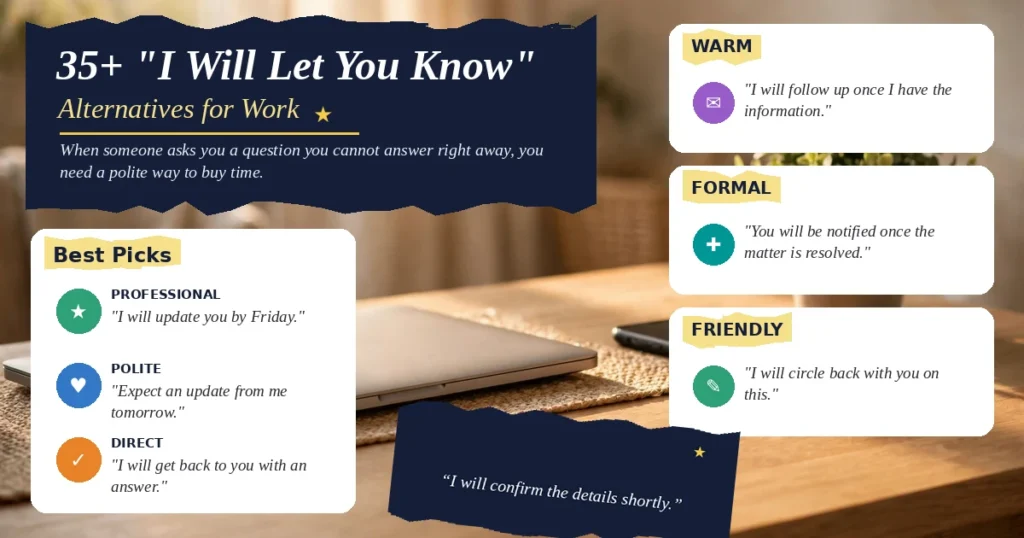
I will update you by Friday. Best for client emails when you can name a real deadline. Example: “I will update you by Friday once the design team sends the mockups.”
I will confirm the details shortly. Works when you need a quick check before answering. Example: “I will confirm the details shortly with our logistics partner.”
I will get back to you with an answer. A polished classic for formal business talk. Example: “I will get back to you with an answer after I speak with the legal team.”
I will follow up once I have the information. Shows you are actively working on it. Example: “I will follow up once I have the information from the supplier.”
I will share the outcome as soon as I can. Good for decisions that depend on other people. Example: “I will share the outcome as soon as I can after the board meeting.”
Expect an update from me tomorrow. Confident and direct for managers and clients. Example: “Expect an update from me tomorrow after the system test.”
I will circle back with you on this. A modern business phrase for ongoing topics. Example: “I will circle back with you on this after I review the budget.”
Formal
I will inform you of the decision in due course. Best for official letters and legal matters. Example: “I will inform you of the decision in due course, once the review is complete.”
You will be notified once the matter is resolved. Passive and official, suits policies and HR. Example: “You will be notified once the matter is resolved by the committee.”
I will communicate the outcome at the earliest opportunity. Strong for senior leadership updates. Example: “I will communicate the outcome at the earliest opportunity after the audit.”
A formal response will follow shortly. Useful when a full written reply takes time. Example: “A formal response will follow shortly from our office.”
I will keep you apprised of any developments. Elegant choice for long-running projects. Example: “I will keep you apprised of any developments in the merger talks.”
I shall advise you of the results in writing. Very formal, fits contracts and official notices. Example: “I shall advise you of the results in writing within ten working days.”
Kindly allow me time to verify, and I will respond accordingly. Polite and careful for sensitive requests. Example: “Kindly allow me time to verify, and I will respond accordingly.”
Friendly
I will give you a shout once I know more. Warm and casual for people you know well. Example: “I will give you a shout once I know more about the schedule.”
I will drop you a message when I hear back. Perfect for everyday chats and texts. Example: “I will drop you a message when I hear back from the venue.”
Hang tight, I will let you in on it soon. Playful and reassuring for close coworkers. Example: “Hang tight, I will let you in on it soon after my call.”
I will fill you in as soon as I find out. Honest and open, great for friends at work. Example: “I will fill you in as soon as I find out what the manager said.”
Stay tuned, I will have news for you. Light and upbeat for team updates. Example: “Stay tuned, I will have news for you about the launch date.”
I will ping you the moment I know. Quick and natural for chat apps. Example: “I will ping you the moment I know whether the room is free.”
Leave it with me and I will sort it out. Reassuring and confident for small favors. Example: “Leave it with me and I will sort it out by this evening.”
Email-ready
I will revert with a confirmed date by end of day. Clear action plus deadline, ready to paste. Example: “I will revert with a confirmed date by end of day tomorrow.”
I will check with the team and update this thread. Ideal for group email chains. Example: “I will check with the team and update this thread before noon.”
I will send you the details once they are finalized. Professional for proposals and quotes. Example: “I will send you the details once they are finalized next week.”
Please allow me until Thursday to confirm. Polite request for time, with a firm date. Example: “Please allow me until Thursday to confirm the pricing.”
I will respond with a full update in the morning. Works for end-of-day emails. Example: “I will respond with a full update in the morning after the data sync.”
I will keep you posted on the progress. Short and friendly for ongoing work. Example: “I will keep you posted on the progress of your request.”
I will write back as soon as I have clarity. Honest about needing more information. Example: “I will write back as soon as I have clarity from the vendor.”
Casual and workplace
I will holler when I know something. Relaxed and fun for tight teams. Example: “I will holler when I know something about the new roster.”
Give me a bit and I will get back to you. Honest and easy for busy workdays. Example: “Give me a bit and I will get back to you after this call.”
I will figure it out and loop you in. Shows ownership in a casual way. Example: “I will figure it out and loop you in before the standup.”
On it, I will update you soon. Short and energetic for chat messages. Example: “On it, I will update you soon with the file.”
I will check and buzz you back. Playful, suits quick desk chats. Example: “I will check and buzz you back in ten minutes.”
I got you, I will confirm later today. Warm reassurance for teammates. Example: “I got you, I will confirm later today after lunch.”
Let me look into it and I will report back. Casual but responsible for team tasks. Example: “Let me look into it and I will report back at the meeting.”
Quick comparison
Use this table when you need one fast pick. It lists the strongest options from each tone group with their best use.
| Alternative | Tone | Best use |
|---|---|---|
| I will update you by Friday | Professional | Client emails with a firm deadline |
| I will confirm the details shortly | Professional | Quick checks before answering |
| I will inform you of the decision in due course | Formal | Official letters and legal matters |
| I will keep you apprised of any developments | Formal | Long projects and senior updates |
| I will give you a shout once I know more | Friendly | Coworkers and everyday chats |
| I will fill you in as soon as I find out | Friendly | Friends at work and team talk |
| I will revert with a confirmed date by end of day | Email-ready | Group threads and proposals |
| I will keep you posted on the progress | Email-ready | Ongoing requests and tickets |
| Give me a bit and I will get back to you | Casual | Busy workdays and desk chats |
| On it, I will update you soon | Casual | Chat apps and quick messages |
Email examples
Client
Subject: Re: Delivery timeline for your order
Hi Sarah,
Thanks for asking. I will confirm the details shortly with our warehouse team and update you by Thursday. I appreciate your patience while we check the stock.
Best,
Daniel
Manager
Subject: Update on the quarterly report
Hi Mark,
I have started the review. I will share the outcome as soon as I can after I finish the data check this afternoon. If anything changes, please be patient while I verify the numbers with finance.
Thanks,
Priya
Colleague
Subject: Re: Meeting room booking
Hey Alex,
Good question. Let me look into it and I will report back before lunch. I am reaching out to you here first so you know I saw your message.
Cheers,
Tom
Customer
Subject: Re: Refund request #4821
Hello James,
Thank you for the clarification on your order number. I will follow up once I have the information from our payments team, no later than Monday. We value your business.
Kind regards,
Lisa
Meeting follow-up
Subject: Action items from today’s call
Hi team,
As discussed, I will circle back with you on this after I review the budget figures. Looking forward to your call on Friday to finalize the plan. Please send any extra data by Wednesday.
Thanks,
Nadia
Common mistakes
1. Promising an update and never sending one
“I will let you know” is a promise. If you never follow up, people stop trusting your word. Set a reminder and send the update, even if the news is “still waiting.”
2. Using it to dodge a hard question
Saying it to avoid an uncomfortable answer only delays the problem. Give what you can now, and name what you will confirm later.
3. Repeating it three times in one email
One clear promise is enough. Repeating the phrase makes your message sound unsure. Pick your best line and use it once.
4. Forgetting to add a deadline
Without a time frame, the other person has no idea when to expect news. Add a day or a time, like “by Thursday,” to keep everyone calm.
5. Using a casual version with a formal client
“Give me a bit” sounds fine with teammates but sloppy with clients. Match your tone to your reader, not your mood.
6. Writing it in all caps or with no greeting
“I WILL LET YOU KNOW” looks rude in text. A short greeting and a warm tone keep the same message polite.
7. Saying it when you already know the answer
If you have the answer, share it. Hiding behind the phrase wastes everyone’s time and can look dishonest.
8. Never explaining what you will do next
“I will let you know” alone says nothing about your next step. Add the action: “I will check the file and update you by 3 PM.”
Related phrases
I will keep you posted. You will send regular updates as things change. Example: “I will keep you posted on the shipment.”
I will be in touch. You will contact the person again soon. Example: “I will be in touch after the interview round.”
I will follow up. You will take the next step in a process. Example: “I will follow up with the vendor tomorrow.”
I will get back to you. You will return with an answer later. Example: “I will get back to you by end of day.”
Stay tuned. You ask someone to wait for news in a light way. Example: “Stay tuned for the launch date.”
I will touch base soon. You will reconnect after some time. Example: “I will touch base soon about the contract.”I will touch base soon. You will reconnect after some time. Example: “I will touch base soon about the contract.”
Watch this space. You hint that news is coming. Example: “Watch this space for the new menu.”
I will revert shortly. Common in business email, means you will reply soon. Example: “I will revert shortly with the quote.”
Expect news from me. A confident way to promise an update. Example: “Expect news from me after the meeting.”
I will brief you later. You will explain the details at another time. Example: “I will brief you later on the client feedback.”
Updates to follow. Short note that more information is coming. Example: “Updates to follow once the test ends.”
I will circle back. You will return to the topic later. Example: “I will circle back after I speak with HR.”
More on this soon. A casual promise of future details. Example: “More on this soon, I am checking the dates.”
I will drop you a line. You will send a short message later. Example: “I will drop you a line when the tickets arrive.”
You will hear from me. A firm promise that you will contact them. Example: “You will hear from me by Friday.”
I will keep you in the loop. You will share updates as the work moves forward. Example: “I will keep you in the loop on the project.”
Phrase comparison
“I will let you know” is the safest all-round choice. It fits almost any situation, but it tells the listener nothing about when the answer will arrive. That vagueness is its main weakness. If you want a stronger professional image, pick an alternative that names the action or the deadline.
“I will update you by Friday” beats the original in business settings because it adds a clear time frame. The client relaxes because they know when to expect news. Use it when you control the timeline. “I will confirm the details shortly” works better when you need a fast fact check. It sounds active and quick, while the original can sound slow.
For formal writing, “I will inform you of the decision in due course” carries more weight. It suits letters, policies, and official notices where a casual tone would look wrong. But never use it in a friendly chat. It would sound stiff and distant. In casual team talk, “Give me a bit and I will get back to you” feels honest and human. It admits you are busy without sounding rude.
The key rule is simple. Match the phrase to the relationship and the channel. Clients and senior leaders deserve deadlines and formal care. Friends and close teammates respond better to warm, short lines. At the end of the day, every version means the same thing. The winner is the one that makes the other person feel respected and calm.
Cultural usage
US English
Americans favor direct, upbeat lines like “I will circle back with you on this” and “Expect an update from me tomorrow.” In US workplaces, naming a deadline is expected. A vague promise without a date can look unprofessional. Casual versions like “I will ping you the moment I know” are normal in startups and tech teams.
UK English
British speakers often soften the promise with polite forms. “I will revert shortly” and “I will keep you apprised of any developments” are common in London offices. “I shall advise you of the results in writing” still appears in legal and government letters. In everyday talk, Brits say “I will give you a shout” just like Americans do.
Corporate communication
Large companies train staff to give clear timelines. The best corporate lines pair the promise with an owner and a date: “I will check with the team and update this thread before noon.” Vague phrases get flagged in customer emails. If you lead a team, teach them to add the next step every time they promise an update.
Customer service
Support agents use these phrases hundreds of times a day. The kindest pattern is empathy plus action plus timing. For example: “I understand this is urgent. I will follow up once I have the information from our payments team, no later than Monday.” I understand your frustration pairs well here when a customer is upset. Never leave a ticket with only “I will let you know” and no date.
Frequently asked questions
What does “I will let you know” actually mean?
It means you will share information or a decision later, once you have it. You use it when you cannot give a full answer right now. It is a promise of a future update, not an answer itself.
Is “I will let you know” polite enough for work emails?
Yes, it is polite, but it can sound vague on its own. Add a deadline or a next step to make it stronger. “I will update you by Friday” sounds more professional than the plain phrase.
What is a more professional way to say “I will let you know”?
Try “I will confirm the details shortly” or “I will update you by [day].” Both name the action and sound confident. For very formal writing, use “I will inform you of the decision in due course.”
Can I say “I will let you know” to my boss?
Yes, but give it more shape. Say what you will do and when: “I will review the report and send my feedback tomorrow.” Your manager will trust a clear plan more than a vague promise.
How do I say it in a casual way to a friend?
Use “I will give you a shout once I know more” or “I will drop you a message when I hear back.” Both sound warm and natural. Save the formal versions for work.
What should I write instead in a client email?
Clients want a date. Write “I will revert with a confirmed date by end of day” or “Please allow me until Thursday to confirm.” These lines show respect for the client’s schedule.
Is “I will revert back” correct English?
No. “Revert” already means to return or reply, so “back” repeats the idea. Say “I will revert shortly” instead. This small fix makes your emails sound sharper.
How do I buy time without sounding rude?
Be honest and specific. Try “Give me a bit and I will get back to you after this call.” Naming a short time frame keeps the other person calm. Rudeness comes from silence, not from asking for time.
Should I give a deadline every time?
Whenever you can, yes. A deadline turns a soft promise into a real commitment. If you truly do not know the date, say when you will check again, like “I will look into this and update you tomorrow.”
What if I cannot find the answer at all?
Be honest instead of repeating the phrase. Say “I checked, and I do not have a clear answer yet. I will keep digging and update you by Wednesday.” People respect honesty more than delay tactics.
How is “I will keep you posted” different?
“I will keep you posted” promises ongoing updates as things change. “I will let you know” usually promises one future answer. Use the first for long projects and the second for single questions.
Can I use these phrases in text messages?
Yes. Short ones like “On it, I will update you soon” fit texts perfectly. Skip the formal versions in messages. They will sound stiff on a phone screen.
What is the best reply when someone says “let me know”?
Thank them and set the next step. Try “Thanks, I appreciate it. I will wait for your update by Friday.” This keeps the ball in their court without pressure.
Does “I will let you know” work in job interviews?
It works if you use it well. Say “I will follow up with the details after I check my calendar” instead of a bare promise. Interviewers notice clear, confident language.
How do I follow up after saying it?
Send the update on time, even if the answer is not ready. A quick “Still waiting on the vendor, I will update you again tomorrow” keeps trust alive. Silence is the only real mistake.
Conclusion
If you only remember a few, keep these. For professional emails, promise a dated follow-through like a Thursday status note or a morning recap after your checks. For formal writing, choose an official notification line or a written-results promise. For friendly chats, go with a quick shout or a casual drop-you-a-line message. For email-ready copy-paste lines, use an end-of-day confirmation or a progress-update note. For casual workplace talk, pick an honest give-me-a-bit line or a short on-it update.
The real skill is not the phrase you pick. It is the follow-up you send. Add a date, name your next step, and deliver on time. Do that, and even the simplest version of “I will let you know” will sound like a promise people can trust. For the exact dictionary sense of the verb behind these phrases, see notify.