Introduction
Learning other ways to say is it ok for you can change how people respond to you at work and in daily life. The question itself is polite and clear, but saying it the same way every time can start to sound flat, hesitant, or even a little uncertain. When you vary your wording, you sound more confident, and you show that you chose your words on purpose.
Think about the last time you asked someone for approval. Maybe you wrote an email that ended with “is it ok for you?” and got no reply. Or maybe you said it in a meeting and everyone just nodded without really agreeing. The words were fine, but the delivery lacked weight. A stronger phrase could have earned a clearer answer.
In this guide, you will find 35 alternatives to “is it ok for you,” sorted into five tone groups: professional, formal, friendly, email-ready, and workplace. You will also get real email examples, comparison tables, common mistakes to avoid, and answers to the fifteen questions readers ask most. By the end, you will know exactly which phrase to use with a client, your manager, or a friend.
Meaning
“Is it ok for you” is a short way of asking whether another person accepts, agrees with, or feels comfortable about something. It hands the power to the other person. It says: I have an idea, a plan, or a request, and I want your honest answer before I move forward.
People use this question in many settings. You hear it in offices (“Is it ok for you if we move the meeting to Tuesday?”), in customer service (“Is it ok for you if I put you on hold for a moment?”), and in everyday life (“Is it ok for you if I open the window?”). In each case, the speaker checks for agreement before acting.
The phrase carries three layers of meaning at once. First, it requests permission. Second, it shows respect for the other person’s time or feelings. Third, it protects the speaker from blame if the plan goes wrong, because the other person agreed to it. That is why it appears so often in professional settings.
Why does this small question matter? Because the way you ask shapes the answer you get. A weak question earns a weak answer, like a shrug or a delayed reply. A clear, well-chosen question earns a clear yes or no. Mastering this one question will make your requests smoother, your emails more effective, and your working relationships stronger.
Professional usage
At work, asking for agreement is not just polite. It is a skill. Every plan, deadline, and decision moves faster when everyone has clearly said yes. Vague nods and silent replies cause delays, rework, and blame. A good question cuts through all of that.
Use a polished version of this question before finalizing plans. Deadlines, budgets, meeting times, and deliverables all deserve a clear check. For example, “Would this timeline work for you?” forces a real answer in a way that a plain “is it ok for you?” sometimes does not. It names the thing you need agreement on, and that makes it harder to dodge.
Use it when you need something from someone who outranks you. Asking your manager “May I proceed with this?” sounds respectful and confident. It shows you take ownership while still honoring their authority. Compare that with a timid “is it ok for you?” which can sound like you doubt your own plan.
Use it gently with clients and customers. Clients pay for good service, and part of that service is making them feel heard. A phrase like “Would this be acceptable to you?” shows care without sounding stiff. When a client is already tense, the same calm tone helps, just as a kind approach helps when you need to acknowledge how they feel before asking them to agree to something.
One caution: do not use a weak version of this question to avoid responsibility. Asking “is it ok for you?” and then blaming the other person when things fail is a bad habit. Ask clearly, record the answer, and own the outcome. Strong communicators ask with confidence and follow through with action.
Alternatives
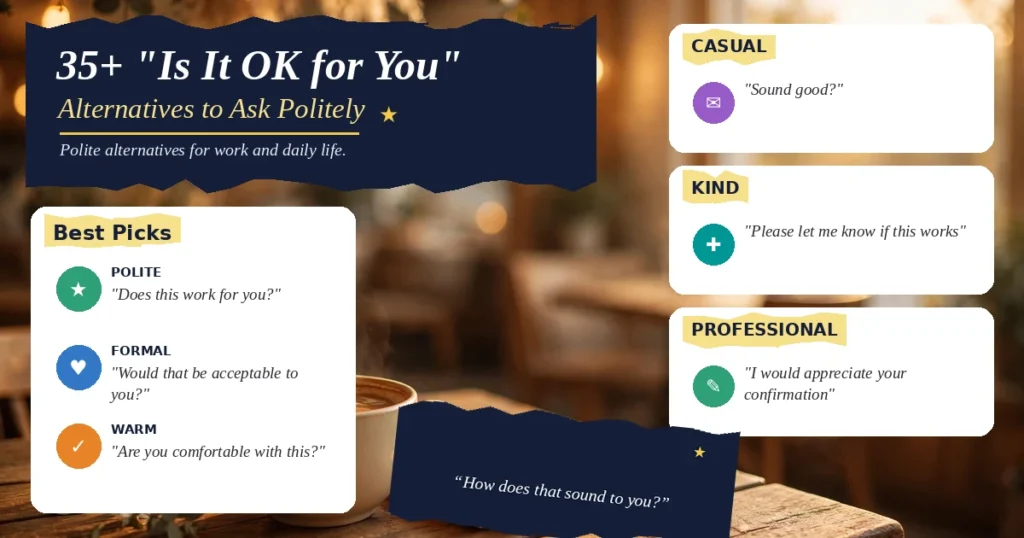
Here are 35 fresh alternatives to “is it ok for you,” grouped by tone. Each entry explains the best setting for the phrase and gives a short example so you can see it in action. Pick the group that fits your situation, then choose the line that sounds most like you.
Professional
These work in meetings, presentations, and business calls. They sound confident and respectful.
Does this work for you?: A clean, direct question for professional settings when you want a straight answer. Example: “Does this work for you, or should we look at other options?”
Would that be acceptable to you?: Slightly more careful, good when the request involves effort or cost. Example: “Would that be acceptable to you as a final delivery date?”
Is this agreeable to you?: Polished and even, fits well in written proposals and formal talks. Example: “Is this agreeable to you before we sign the contract?”
Are you comfortable with this?: Warm and human, best when the topic touches on workload or feelings. Example: “Are you comfortable with this schedule for the next two weeks?”
Would you be fine with this?: Relaxed but still professional, good for quick checks between colleagues. Example: “Would you be fine with this version going to the client?”
Is this convenient for you?: Ideal when the question is about time, dates, or meetings. Example: “Is this convenient for you, or would Thursday be better?”
Does that suit you?: Short and smooth, works in speech and writing alike. Example: “Does that suit you, or do you need more time to review?”
Formal
Reach for these with senior leaders, in official letters, or in sensitive negotiations.
Would this be acceptable?: Classic and neutral, keeps the focus on the matter, not the person. Example: “Would this be acceptable as a revised payment plan?”
Might I ask for your approval?: Very courteous, shows respect for the other person’s authority. Example: “Might I ask for your approval before I share this with the team?”
Do I have your consent?: Firm and clear, used when agreement must be explicit. Example: “Do I have your consent to use your feedback in the report?”
Would you be amenable to this?: Elegant and diplomatic, great for negotiations. Example: “Would you be amenable to this compromise on the pricing?”
Is this arrangement satisfactory?: Formal and complete, fits contracts and official emails. Example: “Is this arrangement satisfactory for both departments?”
May I proceed with this?: Short, respectful, and action-focused. Example: “May I proceed with this once you give the green light?”
Would you kindly confirm?: Polite request for a clear written answer. Example: “Would you kindly confirm that the details are correct?”
Friendly
These keep things warm with coworkers you know and people you see often.
Is that cool with you?: Casual and easy, best with teammates and peers. Example: “Is that cool with you, or should we change the time?”
Sound good?: Quick and light, perfect for short chats and messages. Example: “I can send the file tonight. Sound good?”
Are you okay with that?: Gentle and caring, good when someone might have concerns. Example: “Are you okay with that, or do you need more details first?”
How does that sound to you?: Inviting and open, encourages an honest opinion. Example: “How does that sound to you? Be honest.”
Fine by you?: Very short, works in fast-moving chats and texts. Example: “Moving our call to Friday. Fine by you?”
All good on your end?: Friendly check-in style, great for remote teams. Example: “All good on your end with the new plan?”
Happy with that?: Warm and simple, shows you care about their answer. Example: “I swapped the slides around. Happy with that?”
Email-ready
These are built for inboxes. They are clear, scannable, and easy to reply to.
Please let me know if this works.: A strong email closer that invites a reply. Example: “The draft is attached. Please let me know if this works.”
Kindly confirm if this suits you.: Formal email tone, perfect for clients and vendors. Example: “Kindly confirm if this suits you by Friday.”
I would appreciate your confirmation.: Polite and firm, good when you need a written yes. Example: “I would appreciate your confirmation before we go live.”
Please advise if this is acceptable.: Classic business email phrasing for requests. Example: “Please advise if this is acceptable, or suggest a change.”
Let me know if you are comfortable.: Softer email style for sensitive topics. Example: “Let me know if you are comfortable with the new terms.”
Confirming this works on your end.: A gentle nudge for follow-up emails. Example: “Just confirming this works on your end before I book the room.”
Happy to adjust if needed.: Warm and flexible, lowers the pressure on the reader. Example: “I proposed Tuesday at ten. Happy to adjust if needed.”
Workplace
These fit team talks, stand-ups, and day-to-day office life.
Are we aligned on this?: Team-focused, checks that everyone shares the same view. Example: “Are we aligned on this before we tell the client?”
Does this timeline work for you?: Specific and practical, names the exact thing you need. Example: “Does this timeline work for you, or is it too tight?”
Any objections to this plan?: Direct and efficient, great for quick team decisions. Example: “Any objections to this plan? If not, we move ahead.”
Shall we go ahead with this?: Confident and forward-moving, fits meetings well. Example: “Shall we go ahead with this and review in a week?”
Does this fit your schedule?: Considerate, shows respect for the other person’s time. Example: “Does this fit your schedule, or should we push it back?”
Are you on board with this?: Energetic and team-spirited, good for rallying support. Example: “Are you on board with this new process?”
Works for you?: Short and casual, perfect for internal chats. Example: “Sending the notes over now. Works for you?”
Quick comparison
In a hurry? Here are the top picks at a glance. Choose one based on your tone and setting.
| Alternative | Tone | Best use |
|---|---|---|
| Does this work for you? | Professional | Meetings, calls, and proposals |
| Would that be acceptable to you? | Professional | Requests involving effort or cost |
| Might I ask for your approval? | Formal | Messages to senior leaders |
| Do I have your consent? | Formal | Situations needing explicit agreement |
| Is that cool with you? | Friendly | Chats with teammates and peers |
| How does that sound to you? | Friendly | Inviting honest opinions |
| Please let me know if this works | Email ready | Closing a request email |
| Kindly confirm if this suits you | Email ready | Formal client emails |
| Are we aligned on this? | Workplace | Team decisions and meetings |
| Shall we go ahead with this? | Workplace | Moving plans forward quickly |
Email examples
See how these phrases work in real emails. Copy the style, change the details, and make each one your own.
To a client
Subject: Proposal for your review
Hi Sarah,
I have attached the revised proposal for the March campaign. The budget and timeline are on page two. Would that be acceptable to you as a final version?
If anything needs a change, I am happy to help revise it today. Please let me know if this works by Thursday so we can stay on schedule.
Best,
Najma
To your manager
Subject: Request to proceed
Hi Mr. Ahmed,
The design team finished the mockups this morning. I reviewed them twice, and I think they are ready for the client. May I proceed with this once you give the green light?
Kindly confirm if this suits you, and I will send the files over this afternoon.
Thanks,
Najma
To a colleague
Subject: Quick check on Friday plan
Hi Ali,
I am thinking we finish the report by Friday and send it together. Does this timeline work for you, or is it too tight?
Just letting you know where I stand on my end: my part will be done by Thursday noon. Happy to adjust if needed.
Cheers,
Najma
To a customer
Subject: Confirming your request
Hi John,
Thanks for your message. I can move your appointment to Monday at 11 AM. Is this convenient for you?
If that time does not work, please advise if another slot is better. I appreciate your patience, and I will send a new confirmation once you reply.
Warm regards,
Najma
Meeting follow-up
Subject: Action items from today’s meeting
Hi team,
Thanks for joining today. Based on our talk, we agreed to launch the new page next Monday. Are we aligned on this before I update the calendar?
Also, I will share the summary by tomorrow morning. Please let me know if this works for everyone.
Best,
Najma
Common mistakes
Using this question badly can undo all the politeness of the words. Here are the mistakes people make most, and how to fix each one.
Asking without naming the thing. “Is it ok for you?” with no context forces the reader to guess. Always name the plan, date, or request. “Is it ok for you if we move the deadline to Friday?” works ten times better.
Sounding unsure when you need to lead. If you are the project owner, a timid question can confuse your team. They look to you for direction. Use a confident version like “Shall we go ahead with this?” instead of a shaky “Is it ok for you?”
Asking too many people at once. Sending the question to a group often leads to silence because everyone assumes someone else will answer. Address one person by name when you need a real decision.
Forgetting to follow up. If you get no reply, the question dies. Send a polite nudge after two or three days. A simple “Just following up to see if this works for you” keeps things moving without pressure.
Using a casual version with a senior leader. “Is that cool with you?” might be fine with a teammate, but it can sound sloppy to a director or client. Match your tone to your reader, every time.
Accepting a vague yes. “Sure, whatever” is not a real agreement. When the answer is unclear, confirm it: “Just to be sure, that is a yes to the Friday launch, correct?” This small step prevents big misunderstandings later.
Asking after you already decided. If the plan is final, do not ask for agreement. That feels fake and frustrates people. Announce instead: “We are moving the meeting to Tuesday,” not “Is it ok for you if we move it?” Honesty beats fake politeness.
Related phrases
English has many questions that do a similar job but fit different moments. Knowing them gives you even more control over your tone.
“Would you mind if…” softens a request by making it sound optional. “Would you mind if I closed the window?” feels gentler than a direct ask. Use it when you are not sure the answer will be yes.
“Do you mind…” works the same way in casual speech. “Do you mind switching seats with me?” is common among friends and coworkers. It is friendly, but a little too informal for senior leaders.
“May I…” asks for permission in the most direct and formal way. “May I leave early today?” shows respect and works with managers and teachers. It puts the focus on you, not on the other person’s comfort.
“Could you let me know if…” turns the question into a request for a reply. “Could you let me know if Tuesday works?” is a favorite in emails because it clearly asks for an answer. Pairing it with a forward-looking line, like saying you are looking forward to their call, keeps the tone warm and professional.
“If it is not too much trouble…” adds extra humility. Use it for bigger favors: “If it is not too much trouble, could you review this today?” It signals that you know you are asking a lot.
“Would it be alright if…” sits between casual and formal. It works almost anywhere, which makes it a safe backup when you are unsure about tone.
Notice how each of these shifts the weight of the question. Some emphasize the other person’s feelings, some emphasize your need, and some stay perfectly neutral. The best speakers mix them on purpose.
Phrase comparison
These three look similar, but they send different signals. Picking the right one shows real language skill.
| Phrase | Tone | When to use it |
|---|---|---|
| Is it ok for you? | Neutral, slightly casual | Everyday chats and quick checks |
| Would that be acceptable to you? | Professional | Business requests and proposals |
| Do I have your consent? | Formal and serious | Legal matters or explicit agreement |
“Is it ok for you?” is the friendly default. It works with coworkers, friends, and service staff. Its weakness is vagueness. In writing, it can look lazy if you never vary it.
“Would that be acceptable to you?” adds weight. The word “acceptable” suggests a real decision, not a casual nod. Use it in emails where you need a clear yes, especially with clients. It takes a few more words, but it earns more respect.
“Do I have your consent?” is the strongest of the three. “Consent” means formal, recorded agreement. Save it for contracts, permissions, and situations where you need proof later. Using it for small things sounds oddly dramatic, so keep it for moments that matter.
A good rule: the bigger the decision, the stronger the phrase. Small favors get casual words. Big commitments get formal ones.
Cultural usage
How people ask for agreement changes around the world, and it helps to know the difference.
In the United States, directness is normal. “Does this work for you?” is standard in American offices, and a quick “sounds good” often counts as agreement. Americans value speed, so short versions like “Works for you?” are common in chats.
In the United Kingdom, people soften questions more. “Would that be alright?” and “Would you mind?” appear often. A British colleague might say “I suppose that is fine” when they actually disagree, so listen for tone, not just words.
In South Asia, including Pakistan and India, respect shapes the wording. Junior staff often use longer, more formal phrases with seniors, such as “Kindly confirm if this suits you.” Direct questions to a boss can feel rude, so softer forms like “Would it be possible?” are popular. If you are asking someone for help or agreement, extra politeness goes a long way in these cultures.
In Japan and many East Asian cultures, a direct “Is it ok for you?” can put people on the spot. Agreement is often given indirectly, through silence, nods, or phrases like “I will think about it.” If you work with colleagues from these cultures, give them time and a private way to respond.
In the Middle East, relationship matters as much as the request. A warm greeting before the question shows respect. Jumping straight to business can feel cold, even in email.
The lesson is simple: the same words land differently in different places. When in doubt, choose the slightly more formal version, and watch how locals phrase the same question.
Frequently asked questions
Is “is it ok for you” grammatically correct?
Yes, it is grammatically correct in everyday English. “Ok” works as an adjective meaning acceptable, and the question form is standard. In formal writing, spell it as “okay” or “OK” instead of “ok” for a cleaner look. Most style guides accept all three forms in casual use.
What is the most polite way to say “is it ok for you”?
“Would that be acceptable to you?” is one of the most polite options for professional settings. For formal situations, “Might I ask for your approval?” sounds even more respectful. The best choice depends on your reader, so match the formality to the relationship.
Can I use “is it ok for you” in a formal email?
You can, but stronger options exist. In formal emails, “Kindly confirm if this suits you” or “Please advise if this is acceptable” sound more professional. Save the casual version for internal messages and people you know well.
How do I ask my boss if something is okay?
Use a confident, respectful phrase like “May I proceed with this?” or “Would you kindly confirm?” These show that you value their authority while also showing ownership of your work. Avoid timid wording like “Is it ok for you??” with double question marks, which looks unsure.
What should I say instead of “is it ok” in a meeting?
“Does this work for everyone?” or “Are we aligned on this?” fit meetings well because they address the whole group. For a one-on-one, “How does that sound to you?” invites an honest answer. Pick the version that matches the size of your audience.
Is “are you okay with that” rude?
No, it is not rude, but it is casual. It works with friends, teammates, and peers. With clients or senior leaders, choose a more polished option like “Are you comfortable with this?” Tone matters more than the exact words, so keep your voice warm.
How do I ask for agreement without sounding pushy?
Soften your question with flexible endings. Add “or would you prefer something else?” or “happy to adjust if needed.” These phrases show that a “no” is truly welcome. People agree more easily when they do not feel trapped.
What is the difference between “is it ok for you” and “does it work for you”?
“Is it ok for you” asks about feelings and comfort, while “does it work for you” asks about practical fit, like schedules and logistics. “Does this timeline work for you?” sounds more professional for work matters. Use the feelings version for personal or sensitive topics.
How do I follow up when someone does not answer?
Send a gentle reminder after two or three days. Try “Just following up to see if this works for you” or “Checking in on my last email.” Keep it short and kind. If they still do not reply, a brief call or message often works better than another email.
Can I say “is that cool with you” at work?
Yes, with coworkers you know well and in casual settings. It is too informal for clients, senior leaders, or official emails. When you are unsure about the setting, pick the safer option: “Does that suit you?” is casual but still professional.
What is a formal alternative for legal documents?
“Do I have your consent?” or “Is this arrangement satisfactory?” fit legal and official documents. These phrases ask for explicit, recordable agreement. For extra formality, pair them with a written confirmation request so you have proof.
How do I ask a client to approve a plan politely?
Try “Would that be acceptable to you as a final version?” or “Kindly confirm if this suits you.” These sound professional without being stiff. Always give a clear deadline, like “by Thursday,” so the client knows when you need the answer. If the client had questions before, start by thanking them for the clarification they shared, then ask for approval.
Should I use “please” in these questions?
Yes, when it fits naturally. “Please let me know if this works” sounds polite and complete. Forcing “please” into every sentence sounds stiff, so use it once per email, usually in the key request. One sincere “please” beats three forced ones.
How do I say no politely when someone asks me this?
Mirror their politeness back. Try “Thanks for checking, but that does not work for me. Would Thursday be possible instead?” Always offer an alternative when you can. A “no” with a new suggestion keeps the conversation moving forward.
What if I already asked twice and got no answer?
Change your approach instead of repeating the same question. Try a call, a shorter message, or a new angle: “I need your answer by Friday to stay on schedule.” Adding a clear deadline often breaks the silence. If it is urgent, walk over or call instead of sending a third email.
Conclusion
You now have 35 ways to ask for agreement, and each one fits a different moment. Small changes in wording can turn a weak question into a confident one, and confident questions earn clearer answers. The next time you type “is it ok for you,” pause and pick the version that matches your reader, your setting, and the size of the decision.
Start small. This week, try “Does this work for you?” in one meeting and “Please let me know if this works” in one email. Notice how people respond. Clear questions earn clear answers, and clear answers move your work forward faster.
True politeness is not just about soft words. It is about respecting the other person’s time, giving them a real choice, and following through on what they decide. When you ask well and act on the answer, people trust you more. For a deeper look at what respectful asking means, check the Cambridge definition of permission and keep building your communication skills one phrase at a time.