Introduction
We all need other ways to say if I can be of any help, because the original line gets tired fast. Maybe you type it at the end of every email. Maybe you say it to every new client you meet. After a while, it stops sounding like a real offer and starts sounding like a reflex, and that small shift changes how people hear you.
The phrase itself is polite and well meant. It tells the other person that you care and that you are willing to step in. The problem is repetition. When the same sentence appears in every message, it blends into the background like fine print. A fresh way of offering help catches the eye, and it makes your offer feel personal instead of automatic.
In this guide, you will learn 30 kind alternatives grouped by tone, plus real email examples, quick tables, and answers to the questions people ask most. Whether you are writing to a client, talking to your manager, or helping a coworker, you will find the right line for the moment. You will also learn when to offer help and when to hold back, so your kindness always lands well.
Meaning
To say “if I can be of any help” means to offer your time, skill, or support to another person. It is an open door. You are not doing the task yet, you are simply telling the other person that the door is open and they can walk through it whenever they need to.
People use this line in emails, meetings, phone calls, and everyday chats. A manager might say it to a new hire on their first day. A freelancer might write it at the end of a project proposal. A friend might text it after hearing bad news. In every case, the message is the same: you are not alone, and I am willing to help.
Why does such a simple offer matter? Because asking for help is hard for most people. Many feel shy or awkward about admitting they need support, so they stay silent instead. When you offer first, you remove that barrier. You give them permission to say yes. That small act of kindness can change a whole working relationship, and it costs you nothing but a sentence.
The phrase also builds trust over time. When you offer help and then follow through, people remember. They start to see you as someone reliable and generous. Even when they never take you up on the offer, the fact that you made it leaves a warm impression. And knowing how to ask for help yourself makes you even better at offering it, because you understand both sides of the exchange.
Professional usage
At work, offering help is a quiet form of leadership. You do not need a big title to support the people around you. A well timed offer can lift a stressed coworker, reassure a nervous client, and show your manager that you think like a team player.
Offer help at the start of something new. When a project kicks off or a colleague joins your team, an early offer sets a friendly tone. Try a line like “please let me know if I can help with anything as you settle in.” It costs you nothing, and it makes the other person feel welcome from day one.
Offer help when someone looks overwhelmed. You do not need to wait for them to ask. If a teammate is buried in work, say “let me know if I can ease your workload this week.” This kind of offer shows emotional intelligence, which managers notice and value.
Offer help at the end of emails and calls. A closing offer is a natural way to finish a business message. It leaves the reader with a good feeling and keeps the door open for follow up questions. Just keep it short. One sentence is enough, and two starts to sound like you are trying too hard.
But do not offer help you cannot give. An empty offer is worse than no offer at all. If you tell a client “I am here to support you through the launch” and then disappear, you damage your own reputation. Only promise what you can deliver. A smaller, honest offer always beats a grand, empty one.
One more tip: follow through with warmth. When someone does accept your help, deliver it with a good attitude. A quick “it was my pleasure to help” after the task is done turns a small favor into a lasting good impression.
Alternatives
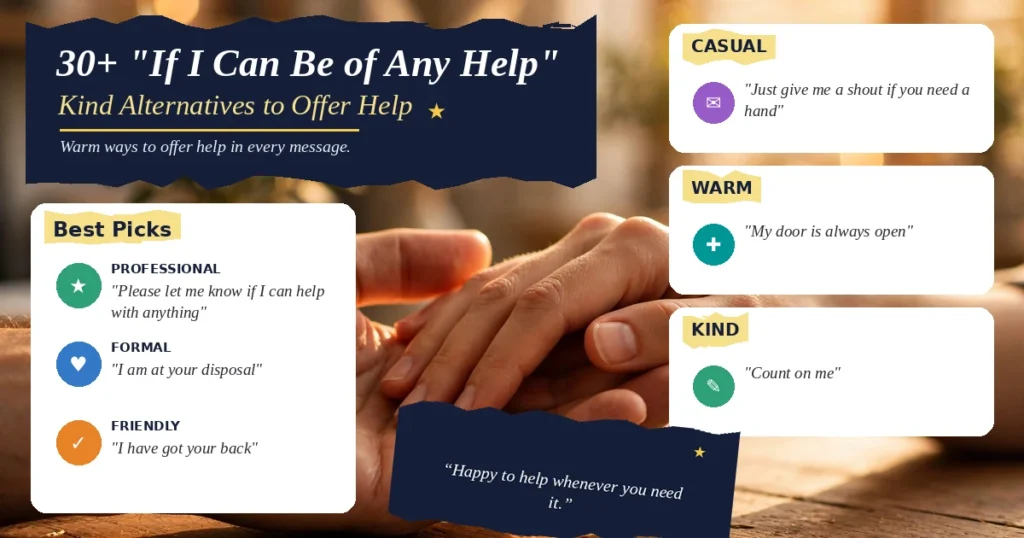
Here are 30 fresh ways to replace “if I can be of any help,” grouped by tone. Each entry shows the best setting for the phrase and a short example so you can see it in action. Pick the group that matches your situation, then choose the line that feels most natural to you.
Professional
These fit emails, meetings, and client calls. They sound confident without sounding stiff.
Please let me know if I can help with anything – A classic open offer that works in almost any professional message. Example: “Please let me know if I can help with anything before the deadline.”
I am here to support you – Warm and direct, great for client facing roles and managers. Example: “I am here to support you through the launch next week.”
Do not hesitate to reach out if you need anything – A polite standard for formal business letters and emails. Example: “Do not hesitate to reach out if you need anything further.”
I am happy to help in any way I can – Shows real willingness without sounding forced or stiff. Example: “I am happy to help in any way I can while you settle into the role.”
Feel free to contact me with any questions – Best at the end of emails that explain something complex. Example: “Feel free to contact me with any questions about the report.”
I am at your disposal – Short and polished, common in service roles and client work. Example: “I am at your disposal until the project wraps up.”
Formal
Reach for these in sensitive talks, official letters, or messages to senior leaders.
Should you require any assistance, please do not hesitate to ask – Very formal, suits letters to executives and official bodies. Example: “Should you require any assistance, please do not hesitate to ask.”
I remain available should you need further support – An elegant closing line for official emails and reports. Example: “I remain available should you need further support.”
Please consider me at your service – Gracious and a little old fashioned, in a charming way. Example: “Please consider me at your service throughout the negotiations.”
I would be glad to assist you in any capacity – Shows readiness with quiet formal respect. Example: “I would be glad to assist you in any capacity.”
You may rely on me for any help you may need – Reassuring and solid, works in formal notes and contracts. Example: “You may rely on me for any help you may need during the audit.”
Allow me to offer my assistance – A courteous opener for formal introductions and first meetings. Example: “Allow me to offer my assistance with the paperwork.”
Friendly
These keep the mood warm while still sounding genuine and sincere.
Happy to help whenever you need it – Warm and natural, perfect for peers and friends. Example: “Happy to help whenever you need it, just send me a message.”
I have got your back – Casual and supportive, best with close coworkers you trust. Example: “I have got your back if the demo gets tricky.”
Just give me a shout if you need a hand – A relaxed offer that feels honest and real. Example: “Just give me a shout if you need a hand with the slides.”
I am only a message away – Friendly reassurance for long or ongoing projects. Example: “I am only a message away if questions come up.”
Count me in if you need help – Enthusiastic and team spirited, great for group efforts. Example: “Count me in if you need help with the testing.”
No problem at all, I am here for you – Combines reassurance with real warmth and care. Example: “No problem at all, I am here for you through the move.”
Email ready
These are built for inboxes. They are short, clear, and easy to scan.
Let me know how I can support you – Short and direct, perfect for busy inboxes and quick notes. Example: “Let me know how I can support you this week.”
If you need anything else, just reply to this email – Keeps the thread open and makes the next step obvious. Example: “If you need anything else, just reply to this email.”
I am happy to jump in if needed – Light and flexible, ideal for team email threads. Example: “I am happy to jump in if needed before Friday.”
Send any questions my way – Brief and approachable, works for updates and reports. Example: “Send any questions my way and I will answer them today.”
I can take that off your plate if you like – Great when you are offering real, concrete task help. Example: “I can take that off your plate if you like.”
Ping me anytime you need a hand – Casual but professional, best for internal team email. Example: “Ping me anytime you need a hand with the data.”
Workplace
These sound natural in offices, on calls, and in team conversations.
My door is always open – A classic office line that signals real approachability. Example: “My door is always open if you want to talk it through.”
I am available to help with anything that comes up – A broad offer, good for new team leads and managers. Example: “I am available to help with anything that comes up this quarter.”
Let me know if I can ease your workload – Thoughtful and kind when someone looks swamped. Example: “Let me know if I can ease your workload this week.”
I am here if you need an extra pair of hands – Practical and team minded, perfect for busy periods. Example: “I am here if you need an extra pair of hands on Thursday.”
You can always loop me in – Shows readiness without putting on any pressure. Example: “You can always loop me in if the client changes the brief.”
Just say the word and I will help – Simple, confident, and straight to the point. Example: “Just say the word and I will help with the rollout.”
Quick comparison
In a hurry? Here are the top picks at a glance. Choose one based on your tone and setting.
| Alternative | Tone | Best use |
|---|---|---|
| Please let me know if I can help with anything | Professional | General emails and first offers |
| Do not hesitate to reach out if you need anything | Professional | Formal business letters |
| Should you require any assistance, please do not hesitate to ask | Formal | Messages to senior leaders |
| I am here to support you | Professional | Client facing roles and managers |
| Happy to help whenever you need it | Friendly | Peers, friends, and close coworkers |
| I have got your back | Friendly | Casual team chats and support |
| Let me know how I can support you | Email ready | Short, scannable email closings |
| Send any questions my way | Email ready | Updates, reports, and announcements |
| My door is always open | Workplace | Offices and team conversations |
| Let me know if I can ease your workload | Workplace | Helping an overwhelmed colleague |
Email examples
See how these offers work in real emails. Copy the style, change the details, and make each one your own.
To a client
Subject: Kickoff call recap
Hi Anna,
Thanks for a great kickoff call today. I am here to support you through the full project, so please share anything you need from my side. I will send the first draft by Wednesday, and we can adjust the plane together after you review it.
Do not hesitate to reach out if you need anything before then.
Best regards,
Sam
To a manager
Subject: Help with the quarterly report
Hi Mr. Lee,
I finished my part of the quarterly report this morning. I am available to help with anything that comes up on the remaining sections, including the charts and the summary page. Just say the word and I will help.
Thank you for guiding the team through this busy month.
Kind regards,
Nadia
To a colleague
Subject: New software rollout
Hi Chris,
I know the new software feels like a lot at first. I went through the same training last month, so I am only a message away if questions come up. We can also sit together for an hour tomorrow if that would help you get comfortable faster.
Happy to help whenever you need it.
Best,
Tom
To a customer
Subject: Your account setup
Hi Jessica,
Your account is now fully set up and ready to use. If you need anything else, just reply to this email and my team will take care of it right away. You can also book a free walkthrough call if you want someone to show you the main features.
We want your first week to feel easy, so please lean on us.
Warm regards,
Support team
Meeting follow up
Subject: Notes and next steps
Hi team,
Thanks for a productive meeting. Here is what we agreed: Priya owns the timeline, Omar drafts the budget, and I will prepare the client slides. If anyone feels overloaded, let me know if I can ease your workload. We will check in again on Friday morning.
Appreciate you all.
Best,
Rachel
Notice how each email places the offer near the end, right where the reader is deciding what to do next. That placement is the real secret of reaching out well: lead with value, then open the door for the next step.
Common mistakes
1. Offering help in every single email
If every message ends with the same offer, people stop reading it. Save your offers for moments when they matter, like the start of a project or after a big change.
2. Making an offer you cannot keep
An empty promise hurts your reputation. Only offer what you truly have time and skill to deliver. A small honest offer beats a big hollow one.
3. Sounding like a robot
Copy pasted offers feel cold. Add one small personal detail, like the project name or the person’s name, so your words feel real.
4. Offering help too late
If you wait until someone is drowning, your offer feels like an afterthought. Watch for early signs of stress and step in sooner.
5. Being too vague
“If I can be of any help” tells people nothing about what you can actually do. Be specific: “I can help with the slides” is ten times stronger.
6. Forcing help on someone
Some people prefer to handle things alone. Offer once, then respect a polite “no thanks.” Pushing help on someone can feel controlling.
7. Using formal offers with close friends
“Should you require any assistance” sounds strange in a text to your best friend. Match your tone to the relationship, not just the grammar.
8. Forgetting to follow through
The offer is only the first half. If someone says yes, act fast. Slow follow up makes even a kind offer feel hollow.
9. Helping without being asked, then complaining
If you volunteer, do it gladly. Helping and then sighing about the extra work leaves a worse impression than never offering at all.
10. Ignoring the power of a simple check in
Sometimes the best offer is not a grand promise but a small question: “How is the project going?” That opens the door naturally.
Related phrases
These expressions live in the same family as “if I can be of any help.” Learn them and your English will sound richer and more natural.
Let me know if you need anything – The short casual cousin of the original. Example: “Let me know if you need anything before the trip.”
I am here for you – Warm and personal, works in work and in life. Example: “I am here for you during this tough week.”
How can I help – Turns the offer into a direct question. Example: “How can I help with the launch?”
What can I do for you – Friendly and open, great in customer service. Example: “What can I do for you today?”
At your service – Short, charming, and a little playful. Example: “At your service, just tell me what you need.”
Do not hesitate to ask – A firm but kind push for shy people. Example: “Do not hesitate to ask if the instructions confuse you.”
I would be happy to help – Soft and polite, perfect for first meetings. Example: “I would be happy to help with the presentation.”
Count on me – Strong and confident, shows real commitment. Example: “Count on me for the Friday deadline.”
I have got you covered – Casual promise that nothing will slip. Example: “I have got you covered on the travel bookings.”
Let me take care of that – Moves from offering to doing in one step. Example: “Let me take care of that call for you.”
Is there anything I can do – A gentle question that invites a yes. Example: “Is there anything I can do to make this easier?”
I understand – Sometimes the best help starts with simply hearing someone out. Knowing other ways to say you understand pairs beautifully with any offer of help.
I appreciate you telling me – Thanks the person for sharing their problem, which makes future offers easier to accept. Example: “I appreciate you telling me, now let us fix it together.”
Glad to be of service – A warm, slightly formal way to close after helping. Example: “Glad to be of service, enjoy your event.”
Anytime – The shortest possible answer after someone thanks you. Example: “Anytime, that is what teammates are for.”
Phrase comparison
“If I can be of any help” sits on the formal side of the scale, which is why it feels safe in business emails. But safe is not always the best choice. In a first message to a senior executive, a line like “should you require any assistance, please do not hesitate to ask” shows extra polish and care. The slightly longer form slows the reader down and signals that you take the relationship seriously.
In everyday office life, the original can sound a little distant. With a coworker you see every day, “I have got your back” or “happy to help whenever you need it” feels warmer and more human. These phrases sound like they come from a person, not a template. The difference is small, but people feel it: one sounds like a policy, the other like a friend.
Email rewards the shortest offers. “Send any questions my way” and “let me know how I can support you” win because busy readers scan instead of reading every word. They take up almost no space and still do the full job. Spoken conversation rewards warmer lines like “my door is always open” and “just say the word and I will help.” These invite a real reply instead of a polite nod. If you only remember one rule, make it this: match the offer to the relationship, not just to the occasion. And when someone explains their problem clearly before you step in, a quick thanks for the clarification keeps the whole exchange warm.
Cultural usage
US English
Americans like direct, upbeat offers of help. “I have got your back,” “happy to help,” and “just give me a shout” are common in offices across the country. US work culture values action, so offers often come with a specific next step, like “I can take that off your plate if you like.” People expect a friendly tone, and they take offers at face value, so only say what you mean.
UK English
British speakers often soften offers with extra politeness. “Do not hesitate to reach out” and “I would be glad to assist” fit well in UK workplaces. Brits also tend to understate, so a quiet “let me know if I can help” can carry real weight. In writing, UK English favors “should you require any assistance” in formal settings. The key difference is modesty: British offers of help tend to sound smaller than the effort behind them.
Corporate communication
Big companies treat offers of help as part of professional service. In corporate emails, “I am here to support you” and “please let me know if I can help with anything” are standard closers because they reassure clients and partners. Many firms train account managers to end every update with an offer, since it keeps relationships warm between meetings. In internal memos, “my door is always open” is the classic line from leaders who want to sound approachable. The offer also creates a paper trail of goodwill, which matters in long partnerships.
Customer service
In customer service, an offer of help must come with real empathy. Support agents often say “what can I do for you” before the customer even explains the problem, which sets a caring tone from the start. When a customer is upset, agents are trained to show they understand the frustration first, and only then offer a solution. Lines like “I am here if you need an extra pair of hands” do not fit here, but “let me take care of that for you” works perfectly. The golden rule is simple: hear the person, then help the person.
Frequently asked questions
What does “if I can be of any help” mean?
It is a polite way to offer your support to someone. You are telling them that you are willing to help if they need it. People use it in emails, meetings, and everyday conversations to show kindness and teamwork.
Is “if I can be of any help” too formal?
It leans formal, but it is not too formal for most workplaces. It fits business emails, client messages, and professional meetings well. For casual chats with friends, a warmer line like “happy to help whenever you need it” sounds more natural.
What is a professional way to say “if I can be of any help”?
“Please let me know if I can help with anything” and “I am here to support you” are strong professional choices. They sound confident and clear. For very formal settings, try “should you require any assistance, please do not hesitate to ask.”
How do you offer help in an email without sounding pushy?
Keep the offer short and place it near the end of the email. Use soft language like “let me know how I can support you” instead of demanding lines. Offer once, and let the reader decide whether to accept.
Should I say “if I can be of any help” to my boss?
You can, but a more specific offer works better. Instead of a general line, say what you can actually do, like “I am available to help with the charts if you need.” Bosses appreciate concrete offers more than polite formulas.
What is the difference between “if I can be of any help” and “let me know if you need anything”?
They mean almost the same thing, but the second one is shorter and more casual. “If I can be of any help” sounds a bit more formal and old fashioned. Choose based on your audience and the tone of the conversation.
Is it okay to offer help to a client you just met?
Yes, and it is often smart. An early offer builds trust and shows confidence. Keep it simple and professional, like “do not hesitate to reach out if you need anything.” Just make sure you can deliver on the promise.
How do you politely decline an offer of help?
Say thank you first, then decline kindly. Try “thanks so much for offering, but I have got this one.” This respects their kindness while keeping your independence. You can add “I will let you know if that changes” to keep the door open.
What should I say after someone helps me?
A sincere thank you goes a long way. Try “I really appreciate your help” or “thanks so much, you saved me a lot of time.” If it was a big favor, follow up later and tell them how things turned out.
Can offering help too often hurt your career?
It can, if you overcommit and burn out. Saying yes to everything leaves no time for your own work. Offer help where it counts, protect your calendar, and learn to say a kind no when you are at capacity.
What is a casual way to say “if I can be of any help”?
“I have got your back” and “just give me a shout if you need a hand” are great casual options. They sound friendly and real. Save these for coworkers and friends, not for formal client emails.
How do you offer help to someone who seems stressed?
Be gentle and specific. Instead of a broad offer, try “let me know if I can ease your workload this week.” Naming a concrete task makes it easier for them to say yes. A calm tone matters as much as the words.
Is “my door is always open” still appropriate at work?
Yes, it is a classic and people still love it. It signals that you are approachable and willing to listen. It works best from managers and team leads. Just make sure you actually welcome people when they walk in.
What is the best closing line for a customer service email?
“If you need anything else, just reply to this email” is one of the best. It is clear, short, and tells the customer exactly what to do next. Pair it with a warm sign off like “warm regards” for the full effect.
How can I sound more genuine when offering help?
Add one specific detail instead of using a generic line. Say “I can help with the slides on Thursday” rather than “if I can be of any help.” Specific offers prove you are paying attention, and that is what makes them feel genuine.
Conclusion
Here are the best picks to remember, two per tone so you never run out of options. For professional settings, reach for “please let me know if I can help with anything” and “I am here to support you.” In formal moments, use “should you require any assistance, please do not hesitate to ask” and “I remain available should you need further support.” With friends and close coworkers, “happy to help whenever you need it” and “I have got your back” keep things warm. For emails, “let me know how I can support you” and “send any questions my way” scan beautifully. At the office, “my door is always open” and “let me know if I can ease your workload” show real leadership.
A good offer of help is one of the simplest ways to build strong relationships. It costs you a single sentence, but it can change how people see you for years. Start with one or two new phrases from this guide, use them this week, and watch your messages grow warmer and more human. People remember those who offer help, and they remember even more those who follow through. For the exact dictionary sense of the word behind all of this, see assist on Cambridge Dictionary.