
Introduction
Is it “cancelation or cancellation”? If you have ever paused mid-email wondering which spelling is correct, you are not alone. This is one of the most searched spelling questions in English, and the answer surprises many people — especially Americans. In this guide, you will learn the correct spelling, why the confusion exists, how US and UK usage differ, and how to never get it wrong again. A spelling slip in a business email can cost you credibility, the same way reaching out with the wrong tone can cost you a reply.
Which spelling is correct
“Cancellation” with two L’s is the correct standard spelling of the noun in both American and British English. “Cancelation” with one L is a rare variant that most dictionaries list as nonstandard or far less common. In professional writing, emails, contracts, and published text, always use “cancellation.”
That is the whole answer in one paragraph: cancellation (double L) is correct everywhere. “Cancelation” (single L) is not the American version of the word — it is simply the uncommon variant, and most readers will read it as a typo.
Why the confusion exists
The confusion comes from the verb “cancel,” which behaves differently on each side of the Atlantic.
In American English, the past tense and -ing forms of “cancel” use one L: canceled, canceling. In British English, they use two: cancelled, cancelling. So far, so logical.
The trap is that people assume the noun follows the same pattern. Americans reason: “we write canceled with one L, so the noun must be cancelation with one L.” That logic feels right — but it is wrong. The noun cancellation keeps its double L in both American and British English. It is the exception to the pattern, and exceptions are exactly what trip people up.
Two more things feed the confusion. First, some dictionaries list “cancelation” as a recognized variant, so spellcheckers occasionally let it through instead of flagging it. Second, the single-L version looks cleaner to American eyes trained on “canceled” — which makes the wrong spelling feel right.
US vs UK usage
Here is the full picture, side by side:
American English
- Verb: cancel → canceled, canceling (one L)
- Noun: cancellation (two L’s — the exception)
British English
- Verb: cancel → cancelled, cancelling (two L’s)
- Noun: cancellation (two L’s)
Notice the key point: the noun is identical in both varieties. “Cancelation” with one L is rare and nonstandard everywhere — it is not “the American spelling.” If you remember one rule from this article, make it this: the noun always doubles the L, no matter which English you write.
Example sentences
Seeing the correct spelling in real sentences cements it. Note how “cancellation” appears in each one:
- The airline announced the flight’s cancellation, and I had to ask for help rebooking my connection.
- Please review our cancellation policy before you confirm the booking.
- The hotel charged a fee for the late cancellation of our reservation.
- After the meeting was cancelled, I took a moment to show I understand the client’s disappointment.
- She received an email confirming the cancellation of her subscription.
- The event’s cancellation disappointed hundreds of fans who had bought tickets.
- If the airline cancels your flight, be patient while the agent rebooks you — and check the spelling on the voucher.
- The contract includes a 30-day cancellation clause for both parties.
- Once the refund was processed, I wrote to thank them for taking care of it.
- A sudden cancellation left the team scrambling to reschedule the launch.
Common mistakes
1. Writing “cancelation” in professional emails
This is the most common mistake, and the most costly. In a job application, client email, or contract, “cancelation” reads as a typo even if a dictionary technically lists it. Recruiters and clients notice. Always write “cancellation.”
2. Copying the verb’s spelling onto the noun
Americans write “canceled,” so they write “cancelation.” The logic is understandable but wrong. The noun does not follow the verb’s American simplification — it keeps the double L. Treat “cancellation” as its own word with its own rule.
3. Mixing patterns inconsistently
Some writers use “cancelled” (British verb) in one paragraph and “cancelation” (rare noun) in the next. Pick one variety of English and stay consistent: American gives you “canceled / cancellation”; British gives you “cancelled / cancellation.” The noun never changes.
4. Trusting autocorrect blindly
Because “cancelation” appears in some dictionaries as a variant, weaker spellcheckers may not flag it. Do not assume that “no red underline” means “correct.” When in doubt, check a major dictionary — every one of them lists “cancellation” first.
5. Using the short spelling in formal documents
Contracts, policies, and terms of service need the standard spelling. “Cancellation policy” is the universal phrase — in US law, UK law, and international business. When support handles your cancellation well, a quick “I appreciate it” goes a long way, but the paperwork should always say “cancellation.”
Related confused spellings
The cancel family is not the only one with a US/UK double-letter split. Watch out for these:
- Canceled / cancelled — US uses one L (“canceled”), UK uses two (“cancelled”). Example: “They canceled the show.” (US)
- Canceling / cancelling — same split as above. Example: “She is cancelling her order.” (UK)
- Traveler / traveller — US “traveler” (one L), UK “traveller” (two L’s). Example: “The traveller reached London at dawn.” (UK)
- Traveling / travelling — US “traveling,” UK “travelling.” Example: “We were traveling light.” (US)
- Labeled / labelled — US “labeled” (one L), UK “labelled” (two L’s). Example: “The box was labelled fragile.” (UK)
- Labeling / labelling — US “labeling,” UK “labelling.” Example: “She is labeling the folders.” (US)
- Modeled / modelled — US “modeled” (one L), UK “modelled” (two L’s). Example: “He modelled the behavior on his mentor.” (UK)
- Signaling / signalling — US “signaling,” UK “signalling.” Example: “The company is signaling a price cut.” (US)
Notice the pattern: in every pair, the British form doubles the consonant. “Cancellation” is unusual because the noun doubles the L even in American English — which is exactly why it confuses people.
Frequently asked questions
Is “cancelation” a real word?
It appears in some dictionaries as a rare variant, but it is not the standard spelling. “Cancellation” with two L’s is the correct form in both American and British English. Treat “cancelation” as a spelling to avoid, not a valid alternative.
Why does American English use “canceled” but “cancellation”?
History. American English simplified many doubled consonants in verbs (canceled, traveled, labeled), but the noun “cancellation” kept its double L. The noun is the exception to the simplification trend — which is why it catches so many writers off guard.
Is “cancellation” correct in British English?
Yes. British English uses the double L everywhere: “cancelled,” “cancelling,” and “cancellation.” There is no disagreement between the two varieties on the noun.
Which spelling will my spellchecker accept?
Every major spellchecker accepts “cancellation.” Some also accept “cancelation” because dictionaries list it as a variant — but acceptance is not the same as correctness. Your readers expect the double L.
Can I use “cancelation” in a casual email?
You could, and most people would understand you. But why risk it? The correct spelling costs you nothing, and the short version makes some readers pause. Build the habit once and use “cancellation” everywhere.
What is the difference between “canceled” and “cancelled”?
“Canceled” (one L) is the American past tense of “cancel”; “cancelled” (two L’s) is the British past tense. Both are correct within their own variety. Neither affects the noun, which is always “cancellation.”
Is it “cancellation policy” or “cancelation policy”?
“Cancellation policy” — always. This is the standard phrase in contracts, terms of service, and business documents worldwide, in both US and UK English.
Does the same double-L rule apply to “traveler”?
Not exactly. “Traveler/traveller” follows the normal pattern: one L in American English, two in British. “Cancellation” is special because the noun keeps the double L even in American English. Do not generalize from one to the other.
Why do some dictionaries list “cancelation” at all?
Dictionaries record how people actually write, including uncommon variants. A listing is a description of usage, not a recommendation. The usage notes in most dictionaries still point you to “cancellation” as the standard form.
How can I remember the correct spelling?
Remember this: the noun always doubles down. Cancel + lation = cancellation. Or think of it this way — the agent processed my refund and replied “my pleasure to help,” spelled correctly, of course. Two L’s, every time, in every country.
Conclusion
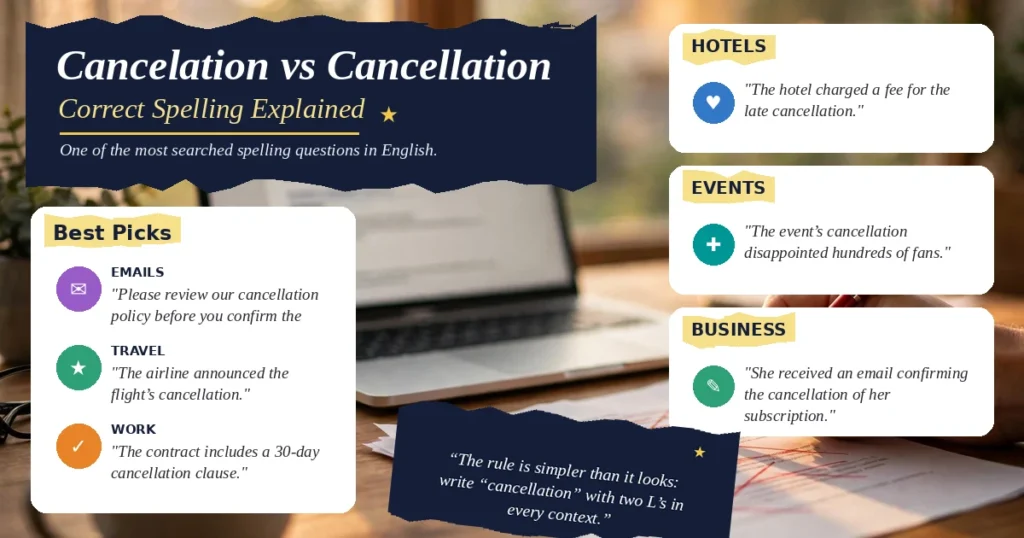
The rule is simpler than it looks: write “cancellation” with two L’s in every context, American or British, formal or casual. The single-L “cancelation” is a rare variant that most readers will mistake for a typo. The noun breaks the American one-L habit — and now that you know the exception, it will never trick you again.
For the full dictionary definition, see Merriam-Webster’s entry on “cancellation”.




