
Introduction
If you are searching for other ways to say token of appreciation, you have probably typed that exact phrase a hundred times and felt it go a little flat. It is polite, it is correct, and it sounds like a card everyone else signed. The good news is that English offers dozens of warmer, sharper, more personal ways to say the same thing — and picking the right one can turn a forgettable thank-you into a moment someone actually remembers.
This guide gives you 30 professional, formal, friendly, and email-tested alternatives to “token of appreciation.” Each one comes with a tone note and a short example, so you can match the words to the gift, the person, and the occasion. You will also find email examples, common mistakes to avoid, related phrases, and answers to the questions people ask most about expressing thanks.
Why does the wording matter? Because gratitude is only as strong as the words that carry it. A generic line makes even a generous gift feel routine, while the right phrase tells the person you actually thought about them. The same care you put into reaching out to the right person at the right time belongs in your thank-you notes too.
Meaning
“Token of appreciation” is a phrase that means a small gift or gesture given to show gratitude. The word “token” means something small that stands for a bigger feeling — the gift itself matters less than the thanks behind it. People use the phrase for farewell gifts, thank-you presents, employee awards, client gifts, and hostess offerings.
The tone of the phrase is polite and formal. It shows up in business emails, award letters, and retirement speeches. That formality is both its strength and its weakness. It never sounds wrong, but it rarely sounds personal. When a manager writes “Please accept this token of appreciation,” the recipient hears the gratitude — but they also hear the template.
Emotionally, the phrase sits in an interesting spot. The giver often feels genuinely thankful but does not know how to say it without sounding stiff. The receiver feels pleased but slightly distant from the words. A warmer alternative closes that gap. “A small thank-you for everything you have done” carries the same facts as “a token of our appreciation” — but it sounds like a person wrote it.
The phrase also carries a useful vagueness. It works when the gift is awkward to name, too small to describe, or given on behalf of a whole team. That flexibility is why companies love it. But flexibility is not the same as warmth, and when the relationship matters, a specific phrase beats a flexible one every time.
Professional usage
“Token of appreciation” lives mostly in professional settings. Here is where it fits — and where a stronger alternative wins.
Business thank-you gifts
Companies give gifts to clients, partners, and vendors to say thanks for business, cooperation, or patience. “Token of appreciation” works fine on the card, but it sounds like every other corporate gift. A line like “A small thank-you for a great partnership” feels written for the actual recipient. When a client has been waiting on a delayed delivery, pair the gift with words that ask them to be patient while you finish the job — then let the gift do the thanking.
Employee recognition
Managers hand out gift cards, plaques, and bonuses to recognize hard work. Here the phrase often sounds cold. An employee who stayed late for three weeks wants to feel seen, not processed. “In recognition of your outstanding work” or “A thank-you for going above and beyond” names the effort, which is exactly what recognition is supposed to do.
Client appreciation
Client gifts — holiday baskets, event invitations, branded items — keep relationships warm. The card matters as much as the gift. “We appreciate your business” is direct and honest. “With gratitude for your continued trust” is warmer and more formal. Both beat the generic token line because they name the relationship.
Awards and ceremonies
At award ceremonies, speeches and programs use formal language. “Token of appreciation” fits the occasion because ceremonies are supposed to sound official. Even here, though, a speaker can do better by naming what the person did. “This award honors ten years of mentorship” lands harder than “Please accept this token of our appreciation.”
Personal thank-you notes
In personal notes — to a host, a mentor, a friend who helped you move — the phrase almost always sounds too stiff. Nobody writes “token of appreciation” to their grandmother. Use warm, simple language instead: “A little something to say thank you” or “Just a small thank-you from my heart.” The casual tone is the point.
Alternatives
Here are 30 alternatives grouped by tone. Each entry gives the phrase, its tone and best use, and a short example.
Professional
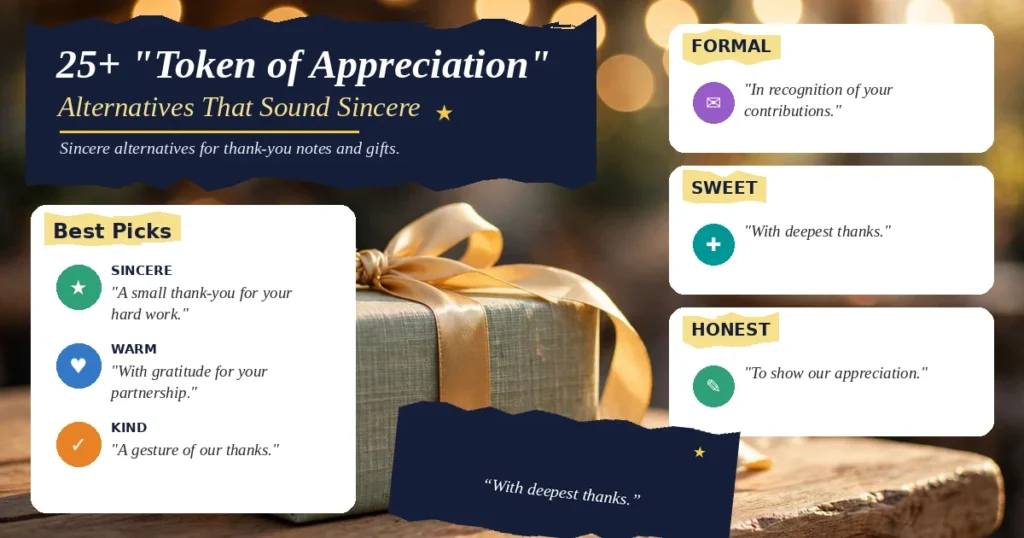
“A small thank-you for your hard work.” — Warm and direct; best for employee gifts. Example: “A small thank-you for your hard work on the launch — you earned it.”
“In recognition of your contributions.” — Formal-professional; best for awards and certificates. Example: “In recognition of your contributions this year, please accept this award.”
“With gratitude for your partnership.” — Polished; best for client and vendor gifts. Example: “With gratitude for your partnership, we would love you to join us for dinner.”
“A gesture of our thanks.” — Elegant; best for corporate gift cards. Example: “Please accept this hamper as a gesture of our thanks.”
“To show our appreciation.” — Simple and versatile; best for team gifts. Example: “We organized this lunch to show our appreciation for the whole team.”
“In honor of your dedication.” — Respectful; best for long-service awards. Example: “In honor of your dedication, the company presents this watch.”
Formal
“A symbol of our esteem.” — Very formal; best for official ceremonies. Example: “The mayor presented the medal as a symbol of our esteem.”
“In acknowledgment of your service.” — Official; best for retirement and farewell gifts. Example: “In acknowledgment of your service, please accept this plaque.”
“As a mark of our respect.” — Dignified; best for senior colleagues and dignitaries. Example: “As a mark of our respect, we present this gift to Professor Lane.”
“With deepest thanks.” — Formal and heartfelt; best for award letters. Example: “With deepest thanks for your leadership, the board offers this gift.”
“In testimony of our gratitude.” — Traditional; best for engraved awards. Example: “This trophy stands in testimony of our gratitude for your coaching.”
“A tribute to your commitment.” — Weighty; best for milestone celebrations. Example: “This dinner is a tribute to your commitment over twenty years.”
Friendly
“A little something to say thank you.” — Warm and casual; best for personal gifts. Example: “I brought you these flowers — just a little something to say thank you.”
“Just a small thank-you from me.” — Personal; best for friends and neighbors. Example: “Just a small thank-you from me for watching the kids last weekend.”
“A little gift to show I care.” — Sweet; best for hosts and helpers. Example: “Here is a little gift to show I care — you were amazing.”
“My way of saying thanks.” — Relaxed; best for informal thank-yous. Example: “These chocolates are my way of saying thanks for the ride.”
“A small treat for all your help.” — Cheerful; best for colleagues you know well. Example: “Coffee is on me — a small treat for all your help this week.”
“Something small, with big thanks.” — Playful; best for lighthearted occasions. Example: “Something small, with big thanks — enjoy the gift card!”
“Please accept this gift as a thank-you.” — Clear; best for email gift announcements. Example: “Please accept this gift as a thank-you for your guidance on the project.”
“We would like to thank you with this gift.” — Courteous; best for client emails. Example: “We would like to thank you with this gift for your continued business.”
“A thank-you gift is on its way to you.” — Practical; best for shipping notifications. Example: “A thank-you gift is on its way to you — it should arrive Friday.”
“This comes with our sincere thanks.” — Warm-professional; best for formal email notes. Example: “This comes with our sincere thanks for hosting the event.”
“Consider this a small thank-you.” — Direct; best for brief emails. Example: “Consider this a small thank-you for the referral.”
“We are sending this in appreciation.” — Smooth; best for company-wide thank-you emails. Example: “We are sending this in appreciation of everything the support team did.”
Workplace
“A thank-you for going above and beyond.” — Motivating; best for standout performance. Example: “A thank-you for going above and beyond on the client pitch.”
“In appreciation of your teamwork.” — Inclusive; best for group recognition. Example: “Pizza Friday is in appreciation of your teamwork this sprint.”
“To celebrate your achievement.” — Upbeat; best for promotions and wins. Example: “This bonus is to celebrate your achievement — well done!”
“A well-deserved thank-you.” — Affirming; best for peer recognition. Example: “This is a well-deserved thank-you for covering my shifts.”
“Our thanks for a job well done.” — Classic workplace; best for managers. Example: “Our thanks for a job well done — the client is thrilled.”
“Kudos — this one’s for you.” — Modern and casual; best for Slack and team chats. Example: “Kudos — this one’s for you, Priya, for fixing the bug overnight.”
Quick comparison
| Alternative | Tone | Best use |
|---|---|---|
| “A small thank-you for your hard work” | Warm, direct | Employee gifts |
| “In recognition of your contributions” | Formal-professional | Awards and certificates |
| “A gesture of our thanks” | Elegant | Corporate gift cards |
| “A symbol of our esteem” | Very formal | Official ceremonies |
| “In acknowledgment of your service” | Official | Retirement gifts |
| “A little something to say thank you” | Warm, casual | Personal gifts |
| “Just a small thank-you from me” | Personal | Friends and neighbors |
| “Please accept this gift as a thank-you” | Clear | Email announcements |
| “A thank-you for going above and beyond” | Motivating | Standout performance |
| “Kudos — this one’s for you” | Modern, casual | Team chats |
Email examples
Thanking a client
Subject: A small thank-you
Hi Daniel,
With gratitude for your partnership this year, we would like to send you a gift basket. It should arrive by Friday. We truly value working with you.
Best,
Anna
Recognizing an employee
Subject: Thank you!
Hi Sara,
This is a well-deserved thank-you for leading the migration project. Your calm focus kept the whole team steady. A gift card is on its way — please enjoy it.
Thanks,
Marcus
Thanking a vendor
Subject: With our thanks
Hello,
We are sending this in appreciation of your team’s fast turnaround on the order. Please accept this gift as a thank-you from all of us. We look forward to working together again.
Warm regards,
Lisa
Farewell email
Subject: Thank you and goodbye
Hi team,
In acknowledgment of your support over the past four years, I want to say a proper thank-you before I go. Lunch is on me this Friday — a gesture of my thanks to the best team I have worked with.
Cheers,
Tom
Thanking a mentor
Subject: Thank you
Hi Ms. Rivera,
This comes with my sincere thanks for your guidance during my first year. Your advice shaped how I work every day. I left a small gift with reception — just a little something to say thank you.
Gratefully,
Nina
Following up after receiving help
Subject: Thank you!
Hi James,
Consider this a small thank-you for the introduction to the design team — it made a real difference. If you ever need anything on my end, my pleasure to help anytime.
Best,
Rachel
Common mistakes
1. Using the stiff original everywhere
“Token of appreciation” fits formal ceremonies, not birthday cards. Match the phrase to the relationship. A friend deserves warmth; a board of directors deserves formality.
2. Giving the gift without naming the reason
A gift with no explanation feels random. Always connect the gift to the act: “for your help with the move,” “for ten years of leadership.” The reason is the real thank-you.
3. Making it about the company, not the person
“We are pleased to present” centers the giver. “Thank you for your hard work” centers the receiver. Gratitude should always point at the other person.
4. Waiting too long to say thanks
A thank-you gift loses power with delay. Send it within a week of the event or achievement. Late thanks still count, but prompt thanks feel sincere.
5. Choosing a generic gift with generic words
A bland gift plus a bland phrase doubles the problem. If the gift must be generic, let the words be specific. Name what the person did and why it mattered.
6. Forgetting to say thank you after they help again
Gratitude is a habit, not a one-time event. When someone keeps showing up for you, keep thanking them — and if you need to ask for their help again, do it with the same warmth you showed last time.
Related phrases
- Thank-you gift — A present given to express gratitude. Example: “She sent a thank-you gift after the interview.”
- Gift of gratitude — A gift motivated purely by thankfulness. Example: “The flowers were a gift of gratitude, nothing more.”
- Gesture of goodwill — A kind act meant to build good relations. Example: “The free upgrade was a gesture of goodwill.”
- Show of appreciation — A public or visible thank-you. Example: “The standing ovation was a show of appreciation.”
- Mark of respect — A gift or act honoring someone. Example: “The moment of silence was a mark of respect.”
- Sign of gratitude — Anything that signals thankfulness. Example: “His donation was a sign of gratitude to the hospital.”
- Expression of thanks — Words or gifts that convey thankfulness. Example: “The letter was a heartfelt expression of thanks.”
- Acknowledgment — Formal recognition of someone’s effort. Example: “She received an acknowledgment in the annual report.”
- Tribute — Something honoring a person’s achievements. Example: “The video was a tribute to retiring teachers.”
- Homage — Deep respect shown publicly. Example: “The award paid homage to her forty years of service.”
- Keepsake — A small item kept as a reminder. Example: “He kept the engraved pen as a keepsake.”
- Memento — An object that reminds you of a person or event. Example: “The photo was a memento of the project team.”
- Parting gift — A farewell present. Example: “They gave her a watch as a parting gift.”
- Welcome gift — A present for someone new. Example: “New hires receive a welcome gift on day one.”
- Gratuity — Money given for good service. Example: “He left a generous gratuity for the waiter.”
- Bonus — Extra payment as a reward. Example: “The holiday bonus surprised the whole staff.”
Phrase comparison
“Token of appreciation” is the safe default — polite, formal, and slightly distant. It works in every official setting but shines in none. It tells the recipient they are appreciated without telling them why, which is exactly its limit.
“A small thank-you for your hard work” keeps the same facts but adds warmth and specificity. The words “hard work” name the effort, so the recipient feels seen. It suits managers, team leads, and anyone thanking someone they actually know. Its only risk is sounding too casual for very formal ceremonies.
“In recognition of your contributions” sits a rung higher on the formality ladder. It sounds official enough for certificates, plaques, and award programs. The word “recognition” carries weight — it says the organization noticed. Use it when the setting is formal but you still want the person to feel valued.
“A little something to say thank you” does the opposite: it trades formality for warmth. It is perfect for personal gifts, hostess presents, and neighborly favors. It would sound out of place on an engraved corporate award, but that is the point — different relationships need different words.
The pattern is simple. The more official the setting, the more structure your phrase needs. The more personal the relationship, the more warmth it can carry. And when someone takes the time to explain something you got wrong, pairing your gift with a note that you appreciate the clarification makes the thanks feel genuine instead of routine.
Cultural usage
United States
Americans favor direct, upbeat thank-you language. “Thanks so much!” and “We really appreciate you” sound natural in US workplaces. Corporate gifts are common at holidays, and cards usually keep the message short. A simple note that you appreciate what they did often matters more than the gift itself.
United Kingdom
British thank-you culture leans slightly more formal and understated. “With many thanks” and “We are most grateful” land well, while big enthusiastic lines can feel overdone. Handwritten thank-you notes still carry real weight in the UK, especially after dinners and events.
Corporate culture
Large companies often run formal recognition programs — annual awards, service milestones, employee-of-the-month gifts. The language tends to be polished and consistent. If your company has a recognition program, match its tone. Personal additions, like a handwritten line from the manager, make the official gift feel human.
International business
Gift-giving rules change across borders. In Japan, the presentation matters as much as the gift. In many Middle Eastern cultures, generous hospitality is expected and gifts should not feel transactional. Research the norms before you send — a well-meant gift can confuse if the culture reads it differently.
Gift-giving etiquette
A few rules travel well everywhere. Give promptly, not months later. Match the gift’s size to the relationship — too grand feels awkward, too small feels careless. Always include a note; an unsigned gift confuses people. And when a client goes out of their way for you, thank them for taking care of it in the note so they know the effort landed.
Frequently asked questions
What does “token of appreciation” mean?
It means a small gift or gesture given to show gratitude. The word “token” signals that the gift is symbolic — the thanks behind it matter more than the item itself. People use it for farewell gifts, thank-you presents, employee awards, and client gifts.
Is “token of appreciation” too formal?
It depends on the setting. For award ceremonies, corporate gifts, and official letters, it fits perfectly. For personal thank-yous — a friend, a host, a neighbor — it usually sounds too stiff. Match the phrase to the relationship, not just the occasion.
What is a better way to say “token of appreciation” in an email?
Try “Please accept this gift as a thank-you” or “This comes with our sincere thanks.” Both are clear, warm, and professional. For casual emails, “Consider this a small thank-you” keeps it short and human.
How do you say “token of appreciation” for an employee?
Use “In recognition of your contributions” for formal awards or “A small thank-you for your hard work” for everyday recognition. Naming the effort — the project, the late nights, the result — makes the thanks feel real instead of routine.
Can I say “token of appreciation” to a friend?
You can, but it will sound oddly formal. Friends deserve warmer words: “A little something to say thank you” or “My way of saying thanks.” Save the formal phrase for workplaces and ceremonies.
What is the difference between “token of appreciation” and “thank-you gift”?
They describe the same thing, but “thank-you gift” is simpler and more direct. “Token of appreciation” sounds more formal and corporate. In most everyday situations, “thank-you gift” is the better choice because everyone understands it instantly.
How do you write a thank-you note with a gift?
Open with the thanks, name what the person did, and connect the gift to it. For example: “Thank you for mentoring me this year. This book is a small thank-you for all your advice.” Keep it short — three or four sentences is plenty.
Should a token of appreciation be expensive?
No. The phrase itself says the gift is symbolic. Thoughtfulness beats price every time. A small, well-chosen gift with a sincere note outperforms an expensive gift with a generic card.
When should you give a token of appreciation?
Give one after someone helps you, at farewells and retirements, during holidays, after successful projects, and when a client shows loyalty. The best time is soon after the event — prompt thanks feel sincere, delayed thanks feel dutiful.
Is it okay to give money as a token of appreciation?
In workplaces, bonuses and gift cards are normal. Between friends and in many cultures, cash can feel awkward. When in doubt, choose a gift card or a thoughtful item over an envelope of cash.
What do you write on a token of appreciation card?
Write who it is for, what you are thankful for, and one warm closing line. Example: “To Maria — thank you for five wonderful years of leadership. With deepest thanks, the team.” Avoid long paragraphs; sincerity fits in a few lines.
How do you thank a whole team?
Address the group, name the shared achievement, and make the gift shareable — a team lunch, a celebration, or individual small gifts. “In appreciation of your teamwork” works well. Public thanks in front of peers multiply the effect.
What is a formal alternative for an award ceremony?
“In acknowledgment of your service” or “A symbol of our esteem” suit engraved plaques and official presentations. They sound dignified without sounding cold. Pair them with the recipient’s name and achievement for full effect.
Can a token of appreciation be non-material?
Absolutely. Extra time off, public recognition, a heartfelt letter, or a team celebration all count. Sometimes the most appreciated “gift” is simply being noticed — a sincere public thank-you can outweigh any hamper.
How do you respond when you receive a token of appreciation?
Thank the giver warmly and specifically. “Thank you — this means a lot, especially after the tough quarter we had” beats a flat “thanks.” If it came from your team, share the credit. Gracious receiving completes the circle of gratitude.
Conclusion
The shortlist, if you only remember a few:
- Professional: “A small thank-you for your hard work” and “In recognition of your contributions”
- Formal: “A symbol of our esteem” and “In acknowledgment of your service”
- Friendly: “A little something to say thank you” and “Just a small thank-you from me”
- Email: “Please accept this gift as a thank-you” and “This comes with our sincere thanks”
- Workplace: “A thank-you for going above and beyond” and “Our thanks for a job well done”
Gratitude is a habit, not a ceremony. Pick the phrase that fits the person in front of you, name what they did, and say it soon. The gift is the symbol — your words are the message. Get the words right, and even the smallest token lands like it matters.
For the dictionary definition of the core word, see Cambridge Dictionary’s entry on “appreciation”.