Introduction
Everyone needs other ways to say I just want to make sure, because repeating one phrase makes any message sound weaker. You might say it twice in one meeting. You might type it into three emails before lunch. After a while, it stops sounding careful and starts sounding unsure, and your reader feels that doubt too.
The phrase is not wrong. It is honest and human. It tells the other person that you care about getting things right. The problem is only repetition. When you lean on the same line every time you check a detail, you sound like you lack confidence, even when you know exactly what you are doing.
English gives you plenty of better tools. Some alternatives sound more professional. Some feel warmer. Some fit perfectly into a short email subject line. In this guide, you will learn 40 polite alternatives grouped by tone, plus real email examples, comparison tables, common mistakes, and answers to the questions people ask most. Whether you are writing to a client, checking with your boss, or chatting with a friend, you will find the right words for the moment.
Meaning
To say “I just want to make sure” means you are pausing to check a fact before you act on it. People use it when they want to avoid mistakes, clear up confusion, or get a clear yes before moving forward. It is a small safety net you put under a conversation.
The phrase covers two situations. Sometimes you check your own understanding: “I just want to make sure, the meeting is at three?” Sometimes you ask the other person to back up what they said: “I just want to make sure I heard you right, the price is final?” Both uses share one goal. They stop small misunderstandings from growing into big problems.
This phrase shows up everywhere. You hear it in job interviews, business emails, customer service calls, classrooms, and family chats. It often comes right before numbers, dates, names, and decisions, because those are the details people get wrong most often. A quick check at the right moment can save hours of fixing later.
Why does such a simple line matter? Because confidence is not about knowing everything. It is about asking the right question at the right time. Strong communicators check details on purpose. They do not guess and hope. They ask, they confirm, and they move ahead with a clear plan.
Professional usage
At work, checking details is a sign of strength, not weakness. A professional who asks a sharp question before acting looks more careful than one who rushes and fixes mistakes later. Managers notice this habit, and they trust the people who show it.
Use this phrase before deadlines, prices, schedules, and responsibilities. These are the details that cause the most trouble when they go wrong. A short “let me confirm the delivery date before I promise the client” removes all doubt. It also creates a written record when it happens in email, which protects you if plans change later.
Use it at the start of a new task. When your manager hands you work, restate the key points back to them. This takes thirty seconds and prevents days of doing the wrong thing. It also shows that you listen carefully, which is one of the fastest ways to earn trust in any job.
Use it before you act on someone else’s instructions. Many workplace mistakes happen because a person reads an email too fast and misses the key line. Reading it twice and asking one clear question costs almost nothing. Guessing wrong can cost a client or a deadline.
One warning: do not check details to stall or to look busy. People can tell the difference between a real question and a delay tactic. Ask your question, get your answer, and move forward with energy. Also remember that asking well is part of a bigger skill – when you truly need help, knowing how to say you need help without sounding weak keeps the same careful tone working for you.
Alternatives
Here are 40 fresh ways to replace “I just want to make sure,” grouped by tone. Each entry shows the best setting for the phrase and a short example so you can see it in action. Choose the group that fits your situation, then pick the line that sounds most like you.
Professional
These fit meetings, client calls, and work emails. They sound confident without sounding stiff.
I want to confirm, – A polished opener for checking facts in meetings or emails. Example: “I want to confirm, the deadline is still Friday at noon.”
Let me confirm, – Shows initiative and care, great before important decisions. Example: “Let me confirm, are we sending the proposal today?”
To be sure, – Short and neutral, works in both speech and writing. Example: “To be sure, you need the files in PDF format?”
To double-check, – Casual but professional, perfect when verifying a detail one more time. Example: “To double-check, the client approved the new budget.”
Before I proceed, – Signals a smart pause before action, ideal at work. Example: “Before I proceed, I want to verify the shipping address.”
I want to make certain, – Slightly stronger than the original, good for high-stakes details. Example: “I want to make certain, this contract is the final version.”
Let me make certain, – Pairs initiative with precision, fits manager updates well. Example: “Let me make certain I have the right numbers first.”
I would like to verify, – Polite and proactive, excellent for client messages. Example: “I would like to verify the payment terms before we sign.”
Formal
Reach for these with senior leaders, in official letters, or in sensitive talks.
I would like to be certain, – Very courteous, suits conversations with executives. Example: “I would like to be certain the figures match our records.”
May I confirm, – Asks permission while checking, highly respectful. Example: “May I confirm the time of tomorrow’s meeting?”
I wish to confirm, – Formal and old-school polite, fits official letters. Example: “I wish to confirm my attendance at the ceremony.”
To eliminate any doubt, – Shows thoroughness, good for contracts and agreements. Example: “To eliminate any doubt, all refunds take seven business days.”
For the sake of accuracy, – Adds weight before numbers or legal points. Example: “For the sake of accuracy, let us review the invoice together.”
If I may be certain, – Careful and humble, ideal with senior leadership. Example: “If I may be certain, does this policy apply to all staff?”
I want to ensure we agree, – Diplomatic, fits negotiations between two sides. Example: “I want to ensure we agree on the delivery terms.”
Allow me to confirm, – Gracious and confident, works in formal meetings. Example: “Allow me to confirm the order details with the team.”
Friendly
These keep the mood light while still making your point clear.
Just want to be sure, – Warm and natural, perfect with coworkers you know well. Example: “Just want to be sure, are we still on for lunch at noon?”
I want to get this right, – Honest and humble, invites the other person to help. Example: “I want to get this right, so could you repeat the address?”
Let me just double-check, – Relaxed and friendly, great in quick chats. Example: “Let me just double-check, you wanted two tickets?”
I want to be on the same page, – A warm team phrase that builds connection. Example: “I want to be on the same page before we present.”
So I am clear, – Simple and direct, with no stiffness at all. Example: “So I am clear, the party starts at seven?”
I just want to be safe, – Casual and honest, fits everyday talk. Example: “I just want to be safe, so I am bringing an umbrella.”
Let me get this straight, – Lively and open, good when thinking out loud. Example: “Let me get this straight, the sale ends tonight?”
I want to have it right, – Gentle and personal, works well with friends. Example: “I want to have it right, how do you spell your last name?”
Email-ready
These are built for inboxes. They are short, clear, and easy to scan.
Confirming that, – Crisp and scannable, leads the email body well. Example: “Confirming that your appointment is set for Thursday.”
Just a quick check, – A soft opener for friendly follow-up emails. Example: “Just a quick check, did you get my last message?”
A quick confirmation, – Clean and subject-line friendly. Example: “A quick confirmation: the venue seats 200 guests.”
To confirm receipt, – Professional, pairs naturally with attachments. Example: “To confirm receipt, I have attached the signed form.”
Checking that, – Friendly and fast, suits short email threads. Example: “Checking that we are still good for Monday.”
Just verifying, – Light and modern, great for quick notes. Example: “Just verifying, the invoice total is 1,200 dollars?”
For confirmation, – Formal enough for client emails, still short. Example: “For confirmation, please reply with your approval.”
A brief check-in, – A warm nudge that never feels pushy. Example: “A brief check-in: is the report ready for review?”
Workplace
These sound natural in team talks, standups, and office chats.
Before we lock this in, – Team-friendly, great before final decisions. Example: “Before we lock this in, let us review the costs once more.”
So we are on the same page, – Builds shared understanding, ideal in meetings. Example: “So we are on the same page, Priya handles the slides.”
To rule out any mix-up, – Practical and direct, fits busy operations. Example: “To rule out any mix-up, which warehouse gets the stock?”
Let us sync on this, – Modern team language that keeps work moving. Example: “Let us sync on this before the client call.”
I want to cross-check, – Shows diligence, good when data is involved. Example: “I want to cross-check these numbers with finance.”
To avoid rework later, – Frames checking as smart planning. Example: “To avoid rework later, can you confirm the specs?”
Let me sanity-check, – Casual and honest, friendly in team chats. Example: “Let me sanity-check this plan with the team first.”
I would rather check twice, – Humble and careful, disarms any criticism. Example: “I would rather check twice than guess once.”
Quick comparison
In a hurry? Here are the top picks at a glance. Choose one based on your tone and setting.
| Alternative | Tone | Best use |
|---|---|---|
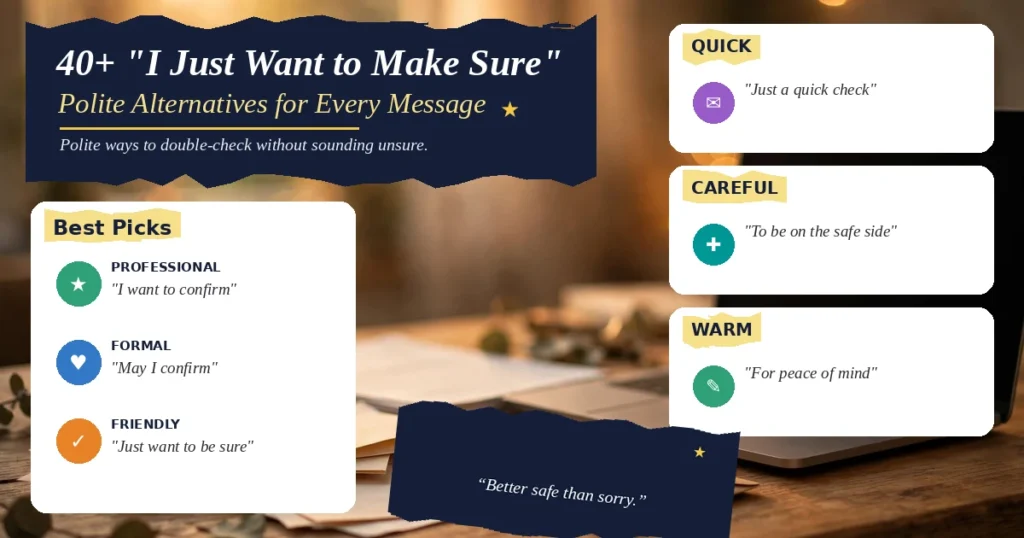
| I want to confirm | Professional | Meetings, calls, and key decisions |
| Let me confirm | Professional | Showing initiative before acting |
| To be sure | Professional | Short checks in speech or writing |
| May I confirm | Formal | Senior leaders and official talks |
| To eliminate any doubt | Formal | Contracts and sensitive details |
| Just want to be sure | Friendly | Coworkers and everyday chats |
| I want to get this right | Friendly | Honest checks that invite help |
| Confirming that | Email-ready | Leading the body of an email |
| Just verifying | Email-ready | Quick notes and short threads |
| Before we lock this in | Workplace | Team decisions before they are final |
Email examples
See how these phrases work in real emails. Copy the structure, change the details, and make each one your own.
To a client
Subject: Confirming the project scope
Hi Anna,
Thanks for the detailed brief. I want to confirm, we are building four landing pages, not six. The price we agreed on covers the smaller scope, so I wanted to check before my team starts.
Please let me know if your notes say something different.
Best regards,
Tom
To a manager
Subject: Checking tomorrow’s presentation slot
Hi Ms. Rivera,
Before I lock in the room booking, let me confirm the presentation is still set for 10 AM tomorrow. I want to make certain I have the right time before I tell the team.
Thank you for letting me know.
Kind regards,
Sofia
To a colleague
Subject: Quick check on the files
Hi David,
Just a quick check, did you send the updated slides or the older version? I want to be on the same page before I share them with the client.
Thanks a lot.
Best,
Nina
To a customer
Subject: Verifying your delivery address
Hi Marcus,
Thanks for placing your order. I would like to verify your delivery address before we ship, since the postcode looks different from your last order. Could you please reply with the correct one?
Once I have it, I will send your tracking number right away.
Warm regards,
Support team
Meeting follow-up
Subject: Notes and next steps
Hi team,
Thanks for a productive meeting. To rule out any mix-up, here is what we agreed: Kevin owns the budget sheet, Lena contacts the vendor by Wednesday, and I will send the updated timeline by Friday. If anything here looks wrong, please reply by end of day.
Appreciate you all.
Best,
Rachel
Notice how each email leads with the check and keeps it short. That is the real secret of writing a strong opening line – put the important question first, then add the friendly details around it.
Common mistakes
1. Saying it five times in one conversation
Repeating any phrase makes it lose meaning. If you catch yourself saying it twice, swap one for “to confirm” or “let me double-check.”
2. Checking details nobody asked about
Do not restate points that are already clear. This can sound like you do not trust the other person.
3. Sounding unsure when you mean to sound careful
Your tone changes everything. Say the phrase with steady confidence, not with a nervous question in your voice. Careful and doubtful are not the same thing.
4. Using it to delay instead of deciding
Some people hide behind checking to avoid hard choices. Ask your question, get the answer, and move forward. Stalling only slows the whole team.
5. Writing long checks in email
A check should be one or two sentences. If your confirmation email runs three paragraphs, the real problem was your first message, not their understanding.
6. Checking in a sharp or annoyed tone
A sharp voice turns a helpful phrase into an attack. Keep your words warm and calm, or the other person will feel blamed. The same gentle approach helps when you need to ask someone to wait a little longer during a delay.
7. Using casual versions with senior leaders
“Let me sanity-check” works with your team, not with a CEO. Match your phrase to your audience every time.
8. Checking without listening to the answer
Asking means little if you rush past the reply. Pause, listen, and write down the answer if it matters.
9. Over-checking simple points
Not every detail needs a follow-up question. Trust people on the easy stuff and save your checks for dates, numbers, and decisions that carry real cost.
10. Ignoring cultural differences
In some cultures, too many questions feel like doubt. Soften your wording and choose a private channel when you sense tension.
Related phrases
These expressions live in the same family as “I just want to make sure.” Learn them and your English will sound richer and more natural.
To be on the safe side – Means acting carefully to avoid risk. Example: “To be on the safe side, I saved a backup copy.”
Better safe than sorry – A classic saying about caution. Example: “Bring a jacket, better safe than sorry.”
Let me get this right – Checking your own understanding out loud. Example: “Let me get this right, you start on Monday?”
I want to be certain – A calm, steady way to check. Example: “I want to be certain about the date before I book.”
For peace of mind – Checking so you can relax afterward. Example: “I called the bank for peace of mind.”
To cover all bases – Checking every detail, leaving nothing out. Example: “Let us cover all bases before the launch.”
To play it safe – Choosing the careful option. Example: “I will play it safe and confirm with the manager.”
Just to be clear – A close cousin of the original phrase. Example: “Just to be clear, the store closes at nine.”
To dot the i’s – A fun phrase about finishing details. Example: “Let us dot the i’s before we send the contract.”
Leave nothing to chance – A strong line about full preparation. Example: “She leaves nothing to chance before big meetings.”
Measure twice, cut once – A wise saying about checking before acting. Example: “Measure twice, cut once, that is my rule for reports.”
To err on the side of caution – Choosing care over speed. Example: “I will err on the side of caution and call first.”
Cross the t’s – Pairs with “dot the i’s” for full detail work. Example: “We crossed the t’s and the deal closed smoothly.”
No stone unturned – Checking absolutely everything. Example: “The auditor left no stone unturned.”
To sleep on it – Waiting before deciding, a form of checking with time. Example: “I want to sleep on it before I sign.”
Trust but verify – A smart rule for business checks. Example: “Trust but verify, so I called the supplier.”
Phrase comparison
“I just want to make sure” sits in the warm middle of the formality scale. It sounds honest and human, which is why people reach for it so often. But the middle is not always the best seat. When you speak to a senior executive or a valued client, a slightly more formal line like “may I confirm” or “I would like to verify” shows extra care. These phrases slow the reader down just enough to signal that precision matters, and they carry a polish that the plain original lacks.
In friendly settings, the original can actually sound too careful. With a close coworker or a friend, “just want to be sure” or “I want to get this right” feels warmer and more human. These phrases invite the other person in instead of announcing a doubt. The difference is small, but people feel it. One sounds like a nervous checker, the other like a thoughtful friend.
Email rewards the shortest options. “Confirming that” and “just verifying” win because busy readers scan instead of reading. They take up almost no space and still do the full job. Team meetings, on the other hand, reward interactive phrases like “before we lock this in” and “so we are on the same page.” These turn a one-way check into a shared agreement, and that small shift keeps everyone engaged. If you only remember one rule, make it this: match the phrase to the person, not just to the point.
Cultural usage
US English
Americans like direct, upbeat checking phrases. “To double-check,” “before we lock this in,” and “let me sanity-check” are common in offices across the country. US business culture values speed, so short phrases win. People also expect a friendly tone, and a warm email goes a long way. When a US colleague says “I just want to make sure,” they usually want a fast yes or no, not a long debate.
UK English
British speakers often soften the phrase with extra politeness. “May I confirm” and “I would like to be certain” fit well in UK workplaces. Brits also use gentle understatement, so you might hear “I just want to be quite sure” said with a light smile. In writing, UK English favors “for confirmation” and “to be sure.” The key difference is softness: British checks tend to sound smaller than they are, so listen for the quiet emphasis.
Corporate communication
Big companies run on written records, so checking phrases carry extra weight here. In corporate emails, “I would like to verify” and “to eliminate any doubt” are popular because they create a clear paper trail. Many firms train managers to restate decisions at the end of meetings using “before we lock this in.” This habit cuts down on the classic problem of two people leaving the same meeting with two different plans. In reports and memos, “for the sake of accuracy” and “I want to ensure we agree” add the formal touch that official documents need.
Customer service
In customer service, checking must come with kindness. Support agents often say “I just want to make sure I understand” before repeating a customer’s problem back to them. This builds trust fast, because the customer feels heard. When a customer is upset, combining a check with empathy works best, and agents are trained to calm the situation before restating the issue. Phrases like “let me make certain I have this right” and “so I am clear” keep the tone soft while still moving toward a fix.
Frequently asked questions
What does “I just want to make sure” mean?
It means you are pausing to check a fact before you act on it. You might repeat a detail, ask a short question, or confirm your own understanding. It is a polite signal that getting things right matters to you.
Is it polite to say “I just want to make sure”?
Yes, it is polite and widely used. The phrase sounds honest and careful, not rude. It only lands badly if your tone is sharp or if you repeat it so often that it sounds like doubt.
What is a formal way to say “I just want to make sure”?
“May I confirm” and “I would like to verify” are excellent formal choices. They add courtesy and weight to your words. Use them with senior leaders, clients, and in official documents.
How do you say “I just want to make sure” in an email?
“Confirming that” is the strongest email option because it is short and scannable. “Just a quick check” works for friendly threads, and “for confirmation” fits formal messages. Put the phrase near the top so busy readers catch it fast.
Can I say “I just want to make sure” to my boss?
Yes, and it is often smart to do so. Restating a task or deadline shows care, not weakness. Just keep the tone respectful and the message short. Most managers appreciate employees who check instead of guess.
What is the shortest way to say it?
“To be sure” is one of the shortest strong options at just three words. “Just checking” is even shorter. Both fit chats, quick emails, and notes where space and time are tight.
Is “just checking” professional enough for work?
It depends on the setting. “Just checking” works in quick team chats and informal emails. For clients or formal messages, choose “confirming that” or “I would like to verify” instead.
How do I say it without sounding unsure?
Lead with confidence in your voice and keep the sentence short. Say “I want to confirm the time” instead of “I just wanted to maybe make sure about the time?” Strong verbs and fewer filler words change the whole feeling.
What is the difference between “make sure” and “ensure”?
They mean almost the same thing, but “ensure” sounds more formal. “Make sure” fits everyday talk and most emails. “Ensure” fits reports, contracts, and official documents. In casual business writing, “make sure” is the safer natural choice.
Can I say it to a client?
Yes, clients like careful partners. Use a polished version like “I would like to verify” or “I want to confirm” rather than the casual original. It shows professionalism and protects both sides from costly mistakes.
Is it okay to say it twice in one conversation?
Try not to. Repeating it weakens your message and can make you sound anxious. Swap the second one for “to be sure” or “let me double-check.” Variety keeps your words fresh and confident.
What can I say instead on a phone call?
“So I am clear” and “let me get this straight” sound natural on calls. They invite the other person to respond, which keeps the conversation alive. For a quick pause, “to double-check” works with almost anyone.
How do I check understanding without annoying people?
Ask once, listen fully, and thank them for the answer. People get annoyed by repeated checks, not by single clear ones. A short “thanks, that clears it up” after their reply shows respect for their time.
Is “to be sure” formal enough for business emails?
Yes, it works in most business emails because it is short and neutral. For very formal messages to executives, upgrade to “for confirmation” or “I would like to be certain.” Match the phrase to the reader.
How can I teach this phrase to English learners?
Start with the meaning, then give one simple example they can copy. Teach two or three alternatives at a time, not all forty. Role-play a short phone call or email so they can practice the tone, not just the words.
Conclusion
Here are the best picks to remember, two per tone so you never run out of options. For professional settings, reach for “I want to confirm” and “let me confirm.” In formal moments, use “may I confirm” and “I would like to verify.” With friends and close coworkers, “just want to be sure” and “I want to get this right” keep things warm. For emails, “confirming that” and “just verifying” scan beautifully. In team talks, “before we lock this in” and “so we are on the same page” build shared agreement.
Careful words build strong work. Every time you pause to check a detail, you save someone from a costly mistake and show that you value their time. Start with one or two new phrases from this guide, use them this week, and watch your messages get sharper. People notice careful communicators, and they remember them. When someone helps you reach that shared understanding, let them feel truly appreciated, and a note of thanks for the clarification goes a long way. If the roles reverse, knowing other ways to say you understand keeps the exchange smooth on both sides. For the exact dictionary sense of the word behind all of this, see confirm on Cambridge Dictionary.