Introduction
If you are looking for other ways to say strong skills, you have probably written that phrase on your resume or in a cover letter and felt it looked flat. You are not alone. Recruiters see “strong skills” thousands of times each week, and because the phrase is so common, it has lost its power. The good news is that a small vocabulary change can make your resume and your emails sound sharper and more confident.
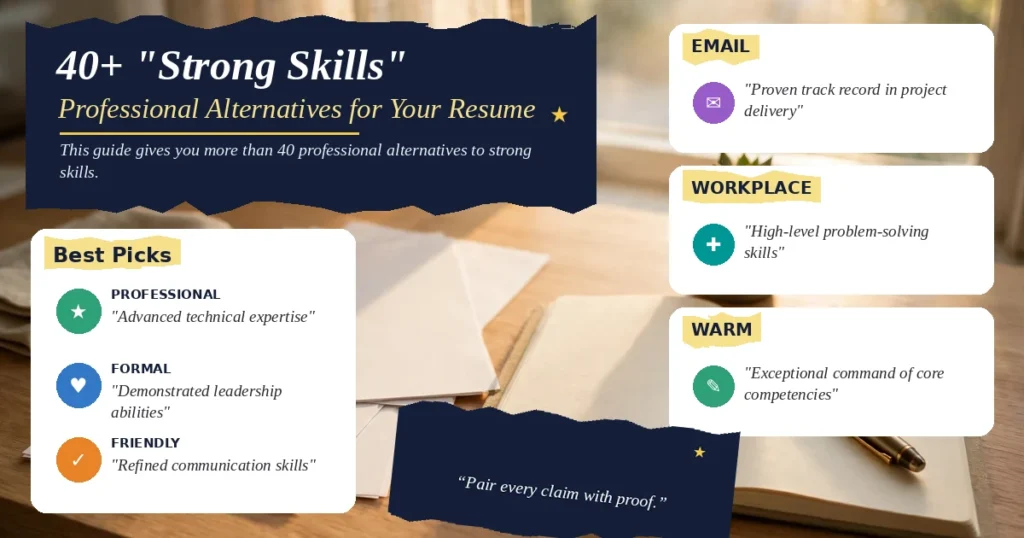
This guide gives you more than 40 professional alternatives to “strong skills.” You will learn what the phrase really means, when professionals use it, and how to replace it with wording that matches your exact situation. You will also find a quick comparison table, realistic email examples, common mistakes to avoid, related phrases, and answers to the 15 questions people ask most about this expression. Whether you are updating your resume, writing a cover letter, or polishing your LinkedIn profile, you will leave this page with stronger language for every line.
Meaning
“Strong skills” is a general phrase people use to describe abilities they have developed through training, education, or work experience. It usually appears on resumes, cover letters, and job profiles, where it tells a reader that the writer can perform certain tasks at a high level. The phrase covers both hard abilities, such as coding or data analysis, and soft abilities, such as leadership or time management. However, it is vague. It names no specific ability and proves nothing, which is why hiring managers often skim right past it. Specific alternatives carry more weight because they describe the actual capability and, often, the context in which it was used.
That vagueness is exactly why better wording matters. When you replace “strong skills” with a phrase like “advanced data modeling skills” or “proven leadership abilities,” you give the reader a concrete picture. Concrete language invites attention. General language invites a yawn.
Professional usage
Professionals use “strong skills” most often in three places: the resume summary, the cover letter, and the LinkedIn headline or About section. In a resume summary, it usually appears in an opening line such as “Marketing specialist with strong skills in content strategy.” In cover letters, candidates write sentences like “I bring strong skills in project coordination and team leadership.” On LinkedIn, the phrase sits in headlines like “Designer with strong skills in UX research.”
Hiring managers and recruiters read it as a placeholder. Because it says nothing specific, it does not help your application stand out from the other two hundred applications in the pile. Career coaches therefore advise replacing it with skill names, proficiency levels, and short proof of results. For example, “advanced Excel modeling skills” beats “strong computer skills” every time. The goal is not fancier vocabulary. The goal is precise vocabulary that helps a busy reader understand what you can actually do.
When the phrase works
The phrase works in casual conversation and quick self-descriptions, for instance when a friend asks what you do. It also works as a first draft line that you plan to sharpen later. In published resumes, cover letters, and portfolios, professionals almost always replace it.
When it hurts you
It hurts you when it replaces real detail. “Strong skills in communication” on a resume tells a hiring manager nothing about your presentations, your writing, or your client work. Vague claims can also raise quiet doubt. A reader may wonder whether you used a general phrase because you had no specific proof. If you want to learn how professionals handle a similar problem with gratitude language, read our guide on other ways to say thank you for the opportunity, which shows how swapping one tired phrase for a precise one changes the whole tone of a letter.
Alternatives
Below are 40 alternatives organized into five tone groups. Each entry shows the phrase in bold, then a one-line note on tone and best use, followed by a short example sentence. Pick the entry whose tone matches your document.
Professional
These phrases fit resumes, cover letters, and LinkedIn profiles. They sound confident without sounding boastful.
Advanced technical expertise
Tone: confident and specific; best use: engineering, IT, and science resumes where the reader expects depth.
Example: She lists advanced technical expertise in cloud architecture and network security.
Demonstrated leadership abilities
Tone: authoritative and calm; best use: management and supervisory roles where leading people matters.
Example: He highlights demonstrated leadership abilities across three regional sales teams.
Proven track record in project delivery
Tone: results-focused; best use: project management resumes and performance reviews.
Example: Her resume shows a proven track record in project delivery under tight deadlines.
Specialized industry knowledge
Tone: knowledgeable and mature; best use: finance, healthcare, and legal applications that reward sector depth.
Example: The candidate offers specialized industry knowledge of pharmaceutical regulations.
Robust analytical capabilities
Tone: precise and corporate; best use: data, finance, and consulting roles.
Example: His robust analytical capabilities helped the team cut reporting errors by half.
Refined communication skills
Tone: polished and modern; best use: client-facing, sales, and marketing roles.
Example: She brings refined communication skills to client presentations and negotiations.
Extensive operational experience
Tone: steady and reliable; best use: operations, logistics, and manufacturing resumes.
Example: He has extensive operational experience across five distribution centers.
High-level problem-solving skills
Tone: capable and direct; best use: general professional summaries that need a clear strength.
Example: Her high-level problem-solving skills resolved the backlog in two weeks.
Formal
These phrases fit executive resumes, academic applications, grant proposals, and official reports. They carry extra weight and distance.
Exceptional command of core competencies
Tone: elevated and measured; best use: executive and senior-level resumes.
Example: The director demonstrated exceptional command of core competencies in strategy and governance.
Considerable proficiency in relevant disciplines
Tone: academic and careful; best use: research posts, teaching roles, and grant applications.
Example: She holds considerable proficiency in relevant disciplines, including linguistics and pedagogy.
Distinguished record of professional achievement
Tone: grand and respectful; best use: award nominations, board applications, and senior profiles.
Example: His distinguished record of professional achievement spans four decades in medicine.
Substantial expertise in the field
Tone: solid and traditional; best use: formal cover letters to established institutions.
Example: The applicant brings substantial expertise in the field of environmental law.
Well-established professional competence
Tone: reassuring and formal; best use: consulting proposals and contractor applications.
Example: The firm cites well-established professional competence in risk assessment.
Notable strengths in strategic planning
Tone: distinguished; best use: senior strategy and leadership documents.
Example: She offers notable strengths in strategic planning for nonprofit growth.
Pronounced aptitude for complex analysis
Tone: scholarly; best use: academic CVs and research statements.
Example: His pronounced aptitude for complex analysis appears in every published paper.
Formidable depth of subject knowledge
Tone: powerful and respectful; best use: expert witness profiles and keynote bios.
Example: The speaker brings formidable depth of subject knowledge to the panel.
Friendly
These phrases fit networking messages, portfolio bios, and personal websites. They sound warm while staying professional.
Really solid skills in teamwork
Tone: warm and approachable; best use: personal bios and networking introductions.
Example: I have really solid skills in teamwork from years of volunteering.
A knack for creative thinking
Tone: light and confident; best use: creative portfolios and startup introductions.
Example: She has a knack for creative thinking that clients love.
Hands-on experience that delivers
Tone: practical and upbeat; best use: freelance profiles and small-business pitches.
Example: He offers hands-on experience that delivers real results for small teams.
A talent for making ideas clear
Tone: friendly and smart; best use: writing, teaching, and communication bios.
Example: She has a talent for making ideas clear for any audience.
Comfortable with fast-paced work
Tone: relaxed and honest; best use: startup applications and casual profiles.
Example: He is comfortable with fast-paced work and shifting priorities.
Great at keeping projects on track
Tone: cheerful and capable; best use: team pages and project bios.
Example: Maya is great at keeping projects on track without stress.
A natural eye for detail
Tone: warm and observant; best use: design, editing, and QA profiles.
Example: She has a natural eye for detail that catches every error.
People skills that build trust fast
Tone: open and personable; best use: sales, support, and community roles.
Example: His people skills build trust fast with new clients.
Email-ready
These phrases drop cleanly into cover letters, follow-up emails, and introduction messages.
A strong foundation in client service
Tone: professional and courteous; best use: the opening paragraph of a cover letter.
Example: With a strong foundation in client service, I am excited to apply for this role.
Practical experience in team coordination
Tone: modest and clear; best use: application emails where you want to sound grounded.
Example: My practical experience in team coordination includes scheduling and mentoring interns.
Reliable skills in daily operations
Tone: dependable; best use: follow-up emails after an interview for operations roles.
Example: As discussed, my reliable skills in daily operations would support your growing team.
Relevant experience in stakeholder communication
Tone: formal enough for email, still readable; best use: emails to senior managers.
Example: I bring relevant experience in stakeholder communication from my last two roles.
Solid working knowledge of the tools
Tone: plain and honest; best use: technical emails where hype would sound wrong.
Example: I have solid working knowledge of the tools your team uses daily.
Transferable strengths from volunteer work
Tone: sincere; best use: career-change emails where you connect past and future roles.
Example: I would like to apply my transferable strengths from volunteer work to this position.
Clear results in process improvement
Tone: confident and concise; best use: emails that reference measurable wins.
Example: My background shows clear results in process improvement across three departments.
Ready-to-use abilities from day one
Tone: eager and direct; best use: short pitch emails and LinkedIn messages to recruiters.
Example: I offer ready-to-use abilities from day one, so I can contribute immediately.
Workplace
These phrases fit performance reviews, internal memos, and team introductions. They describe how someone works day to day.
Consistent performance under pressure
Tone: steady and admired; best use: performance reviews and promotion nominations.
Example: Her consistent performance under pressure kept the launch on schedule.
Strong collaboration across departments
Tone: team-focused; best use: peer feedback and internal recommendations.
Example: He is known for strong collaboration across departments on every project.
Quick learning of new systems
Tone: agile and practical; best use: internal transfers and new-role announcements.
Example: Her quick learning of new systems made the software switch painless.
Clear ownership of assigned tasks
Tone: accountable; best use: manager notes and review summaries.
Example: He takes clear ownership of assigned tasks from start to finish.
Adaptable approach to changing goals
Tone: flexible and positive; best use: agile teams and startup environments.
Example: Her adaptable approach to changing goals helps the team pivot quickly.
Effective mentoring of junior staff
Tone: generous and professional; best use: senior team member profiles.
Example: His effective mentoring of junior staff raised the whole team.
Sharp attention to quality standards
Tone: precise; best use: QA, production, and service reviews.
Example: Her sharp attention to quality standards reduced defects last quarter.
Calm handling of client concerns
Tone: composed; best use: customer service and account management reviews.
Example: His calm handling of client concerns earned repeat business.
Quick comparison
The table below lists 12 top picks from the alternatives above so you can compare them at a glance. Pick the row whose tone and situation match yours.
| Alternative | Tone | Best use |
|---|---|---|
| Advanced technical expertise | Confident, specific | Engineering and IT resumes |
| Demonstrated leadership abilities | Authoritative, calm | Management applications |
| Robust analytical capabilities | Precise, corporate | Data and finance roles |
| Exceptional command of core competencies | Elevated, formal | Executive resumes |
| Substantial expertise in the field | Solid, traditional | Formal cover letters |
| Really solid skills in teamwork | Warm, approachable | Personal bios |
| A knack for creative thinking | Light, confident | Creative portfolios |
| A strong foundation in client service | Professional, courteous | Cover letter openings |
| Solid working knowledge of the tools | Plain, honest | Technical emails |
| Consistent performance under pressure | Steady, admired | Performance reviews |
| Strong collaboration across departments | Team-focused | Peer recommendations |
| Calm handling of client concerns | Composed | Client-facing reviews |
Email examples
The snippets below show how the alternatives work inside real messages. Copy the pattern, then change the details to fit your own experience.
Resume summary
Results-driven operations coordinator with advanced technical expertise in inventory software and consistent performance under pressure during peak seasons. Known for strong collaboration across departments and clear ownership of assigned tasks.
Cover letter
Dear Ms. Rivera,
I am applying for the project assistant position. I bring practical experience in team coordination and reliable skills in daily operations. In my current role, I schedule a team of twelve and track deliveries across two warehouses. I would welcome the chance to discuss how I can support your team. If a hiring manager later asks you to explain a decision in the interview, our guide on other ways to say I understand can help you answer with calm, professional wording.
Sincerely,
Daniel
Headline: Data Analyst | Robust analytical capabilities | Clear results in process improvement
About section: I turn messy data into clear decisions. My adaptable approach to changing goals helps teams pivot without losing momentum. Open to roles where data quality shapes strategy.
Manager
Hi team,
Please welcome Priya. She brings specialized industry knowledge from six years in logistics and a sharp attention to quality standards. Her quick learning of new systems will help us during the platform migration. Thanks for helping her settle in.
Best,
Sam
Colleague
Hey Jonas,
Can you review the client draft today? You have refined communication skills and a natural eye for detail, so your feedback would help a lot. I need it by Thursday afternoon. I really appreciate it and will return the favor next week.
Thanks,
Lena
Client
Dear Mr. Chen,
Thank you for your patience while we rebuilt the report. Our team applied high-level problem-solving skills to the data errors you flagged, and the corrected version is attached. Your calm handling of client concerns during the review call also made the process smooth, so we wanted to acknowledge that too. If anything else looks off, just let me know. I will review it personally and let you know by Friday.
Kind regards,
Amara
Common mistakes
Avoid these common errors when you replace “strong skills” in your documents.
1. Swapping in another vague phrase
Replacing “strong skills” with “great abilities” changes nothing. The new phrase must name the skill or the proof.
2. Listing skills without proof
A claim like “exceptional command of core competencies” needs one example beside it. One result sentence turns a claim into evidence.
3. Using executive language for junior roles
“Formidable depth of subject knowledge” on a first job application sounds inflated. Match the tone to your experience level.
4. Repeating the same phrase twice
Never use one alternative in the summary and the same one in the cover letter. Recruiters read both documents side by side.
5. Choosing a phrase that needs explanation
If the reader must pause to decode “pronounced aptitude for complex analysis,” you have lost them. Clear beats clever on resumes.
6. Forgetting to name the actual skill
“Consistent performance under pressure” works best when it sits next to a skill name, such as “payroll processing.” Always pair the claim with the craft.
7. Overstuffing every line with adjectives
One strong phrase per sentence is enough. Two or three adjectives in one line make the resume sound like an advertisement.
Related phrases
These related expressions help you describe abilities in resumes, emails, and interviews. Each line gives a short meaning and a quick example.
Core competencies: the central abilities a role requires. Example: Her core competencies include budgeting and staff training.
Key strengths: the abilities you rely on most. Example: My key strengths are clear writing and fast research.
Areas of expertise: subjects you know deeply. Example: His areas of expertise include tax law and compliance.
Professional strengths: abilities that matter at work. Example: Her professional strengths shine in client meetings.
Technical proficiencies: tools and systems you can use well. Example: My technical proficiencies include Python and SQL.
Transferable skills: abilities that move from one role to another. Example: Her transferable skills from teaching fit training roles perfectly.
Soft skills: people and thinking abilities like patience and teamwork. Example: His soft skills make him a calm team lead.
Hard skills: measurable technical abilities. Example: Her hard skills include CAD design and cost estimation.
Proven abilities: skills backed by results. Example: He lists proven abilities in fundraising and event planning.
Demonstrated capabilities: skills you have shown in real work. Example: Her demonstrated capabilities include crisis communication.
Specialized skills: abilities tied to one field. Example: His specialized skills in pediatric nursing set him apart.
Valuable experience: past work that helps in the new role. Example: Her valuable experience in retail fits this sales job.
Track record of success: a history of good results. Example: His track record of success includes three product launches.
Hands-on expertise: practical skill from doing the work. Example: She has hands-on expertise with restaurant management.
Working knowledge: enough skill to do the job without supervision. Example: He has working knowledge of basic bookkeeping.
Skill set: the full group of abilities you offer. Example: Her skill set covers design, coding, and client support.
Phrase comparison
The comparison table above lists phrases side by side, but real writing asks a different question: how do these phrases actually feel to a reader, and when does each one earn its place? “Strong skills” feels like a warm handshake with no grip. It is friendly, familiar, and instantly forgettable. It costs the writer nothing and tells the reader almost nothing, which is why it survives in drafts but should rarely survive in final documents.
Now compare that feeling with “advanced technical expertise.” That phrase walks into the room with a toolbox. It tells an engineering manager that the candidate speaks the language of the team. It would sound strange in a thank-you email to a volunteer coordinator, though, because its confidence assumes a technical audience. “Exceptional command of core competencies” takes the formality even further. It belongs in board applications and executive summaries, where distance and gravity are virtues. Put it in a friendly portfolio bio and it lands like a tuxedo at a beach picnic.
The workplace phrases work differently. “Consistent performance under pressure” does not describe a talent so much as a habit, and managers trust habits. A hiring manager reading it pictures someone who stayed late during the outage and fixed it. “Calm handling of client concerns” paints a similar scene on the customer side. These phrases win because they describe behavior a boss can verify with a reference call.
The friendly group takes the opposite risk. “A knack for creative thinking” and “people skills that build trust fast” sound human and likable, which helps on personal sites and networking messages. They would weaken a formal grant proposal, where warmth can read as vagueness. The lesson is simple: tone is not decoration. Tone is the message. A phrase that feels right in one document can feel wrong in another, so choose the alternative whose setting matches yours, and let “strong skills” retire to your first drafts.
Cultural usage
In the United States, resumes favor confident, active phrases such as “demonstrated leadership abilities” and “proven track record in project delivery.” American hiring culture rewards self-promotion, so direct language about results is expected. Understated phrases can read as a lack of confidence.
In the United Kingdom, a slightly more modest tone is common. Phrases like “solid working knowledge of the tools” and “considerable proficiency in relevant disciplines” fit well because British professional writing often softens claims with words like “considerable” and “solid.” Blunt superlatives can sound boastful.
In many Asian and Middle Eastern workplaces, including Pakistan, formal respect matters. Phrases from the formal group, such as “substantial expertise in the field” and “well-established professional competence,” match the tone of official applications. Adding a brief note of gratitude also helps. When you close a polite email, thanking the reader for their time with thank you for taking care of this keeps the tone warm and respectful.
In international remote teams, plain English wins. Team members from different countries read each other’s messages quickly, so simple phrases like “quick learning of new systems” travel better than ornate ones. If you are writing across cultures, choose the clearest alternative and skip the grandest one.
Frequently asked questions
What does “strong skills” mean on a resume?
It means the writer claims to have well-developed abilities, but it names no specific ability. Recruiters treat it as a vague placeholder. Replace it with the actual skill plus a short proof, such as “advanced Excel modeling skills used to build the monthly budget.”
Is “strong skills” grammatically correct?
Yes, it is grammatically correct. The problem is not grammar but vagueness. A correct phrase can still be weak writing. Choose wording that tells the reader exactly what you can do.
Why do recruiters dislike the phrase “strong skills”?
They see it hundreds of times, so it carries no information. It also raises doubt, because specific candidates usually name their skills. A phrase that everyone uses cannot help anyone stand out.
What is the best alternative for a resume summary?
“Demonstrated leadership abilities” works well for managers, and “advanced technical expertise” works well for specialists. Pick the one that matches your field, then add a result. A number or outcome makes any alternative twice as strong.
Can I use these alternatives in a cover letter?
Yes. Email-ready phrases like “a strong foundation in client service” and “practical experience in team coordination” were written for cover letters. Use one per paragraph so the letter does not sound repetitive.
How many alternatives should I use on one resume?
Use two or three at most, and never repeat one. One in the summary and one in the experience section is usually enough. Too many strong claims dilute each other.
What is a formal way to say “strong skills”?
“Exceptional command of core competencies” and “substantial expertise in the field” are the most formal options. Save them for executive resumes, academic applications, and official proposals where elevated language is expected.
What is a casual way to say “strong skills”?
“A knack for creative thinking” or “really solid skills in teamwork” sound natural and friendly. Use them in networking messages, personal bios, and portfolio sites, not in formal applications.
Should I write “strong skill set” instead?
“Strong skill set” is slightly better because it points to a group of abilities, but it is still vague. Name the skills instead. “A skill set covering payroll, scheduling, and vendor reconciliation” gives the reader something real.
Do these phrases work for LinkedIn profiles?
Yes. LinkedIn headlines reward short, confident phrases like “robust analytical capabilities.” The About section can hold one or two more. Keep each phrase next to a concrete example of your work.
How do I describe soft skills without sounding vague?
Pair the soft skill with a behavior. “Calm handling of client concerns” works because it describes an action. Add one short story, such as a complaint you resolved, and the soft skill becomes proof.
What should fresh graduates write instead of “strong skills”?
Use “transferable strengths from volunteer work” or “solid working knowledge of the tools.” Graduates can also name coursework, internships, and projects. Specific experience beats any adjective.
Is it okay to say “strong skills” in an interview?
Yes, in spoken answers the phrase is fine as a bridge sentence. Say “I have strong skills in data entry, for example,” then give the example. The spoken example does the real work, so the vague phrase matters less.
How do I avoid repeating skill phrases in my application?
Make a short list of your top three claims and assign one to each document section. Use a different alternative in the summary, the cover letter, and the interview. Our guide on other ways to say just to clarify shows the same habit applied to email wording, which helps you keep every message fresh.
What if the job ad itself says “strong skills required”?
Mirror the ad’s language once so the keyword matches, then immediately add specifics. Write “strong skills in inventory control, including cycle counts and vendor reconciliation.” You satisfy the keyword scan and still give the human reader detail.
Conclusion
The best replacement for “strong skills” is the one that names what you actually do. For resumes and cover letters, lead with a precise phrase from the professional group, such as “advanced technical expertise” or “demonstrated leadership abilities,” and follow it with one concrete result. For formal documents, choose the elevated wording of the formal group. For networking and personal sites, let the friendly group do the work. Whatever you pick, pair every claim with proof, because proof is what turns a phrase into a promise.
Language habits also grow with practice. When you catch yourself typing a vague claim, pause and ask what specific ability sits behind it. That one question will improve your resume faster than any template. If you want to study how professionals define the building blocks of ability, read the Cambridge dictionary entry for “skill”, which shows the word’s exact senses with examples. And when you write your next follow-up email, remember that a polite close matters too, so a line like my pleasure to help keeps the relationship warm after the deal is done.