Introduction
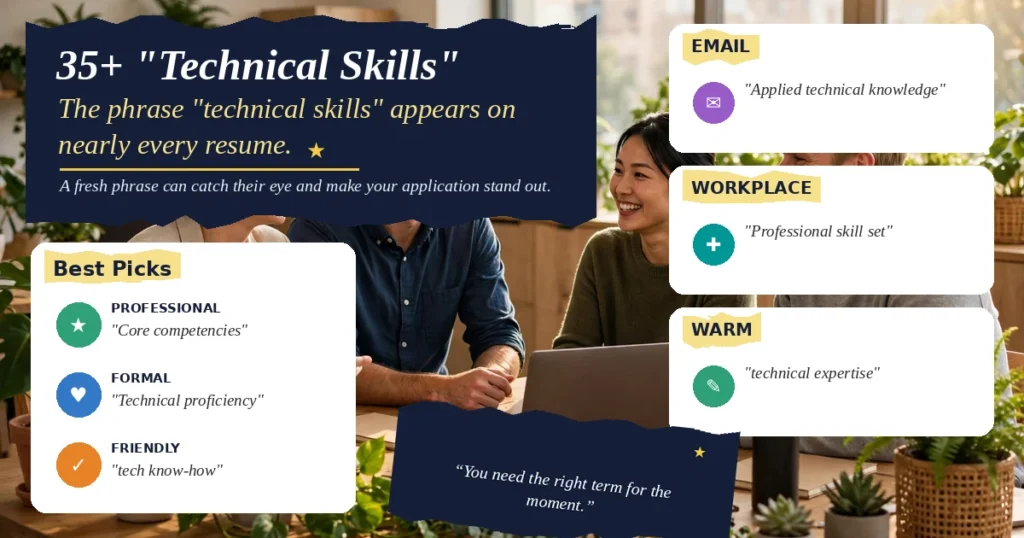
Finding other ways to say technical skills can transform how you present yourself at work. The phrase “technical skills” appears on nearly every resume. Hiring managers read it thousands of times. A fresh phrase can catch their eye and make your application stand out. The right wording also helps you sound more confident in emails and interviews.
Your skills deserve better than a tired label. When you describe them with precision, you show employers exactly what you can do. A software developer who writes “hands-on experience with Python and cloud deployment” sounds stronger than one who just lists “technical skills.” Small word choices shape big impressions.
This guide gives you 35 alternatives to the phrase “technical skills.” Each one fits a different situation. Some work best on resumes. Others suit emails, meetings, or casual conversations. You will learn when to use each phrase and what tone it carries. You will also see real examples you can copy and adapt.
Whether you are writing a cover letter, updating your LinkedIn profile, or answering an interview question, you will find the right words here. Let us help you describe your abilities with clarity and confidence.
Meaning
Definition: The phrase “technical skills” refers to the specific abilities you need to perform tasks that involve tools, software, machines, systems, or specialized knowledge. These skills come from training, education, or hands-on experience. They differ from soft skills, which involve communication and teamwork.
The literal meaning is simple. “Technical” means related to tools, machines, or specialized methods. “Skills” means the things you can do well. Together, they describe practical abilities tied to a specific field. Examples include coding, data analysis, operating machinery, and network setup.
The tone of the phrase is neutral and professional. It does not sound warm or cold. It works in formal documents like resumes and job postings. It can feel stiff in casual conversation, which is why many people look for softer alternatives.
The purpose of the phrase is to group job-related abilities under one label. Employers use it to list requirements. Job seekers use it to summarize qualifications. Recruiters scan for it when they review resumes. It saves space and signals that the abilities are work-related, not personal traits.
Common examples appear in job ads every day. A company may ask for “technical skills in Excel and SAP.” A resume may list “technical skills: HTML, CSS, JavaScript.” A manager may say, “We need someone with strong technical skills for this project.” The phrase is a shortcut that everyone in business understands.
Professional usage
In emails
Use alternatives to “technical skills” in emails to sound specific and confident. Vague phrases weaken your message. When you name the actual ability, your reader trusts you more. For example, write “my hands-on experience with Salesforce” instead of “my technical skills.” Specific words also help your email get noticed in a busy inbox. Recruiters prefer candidates who describe their strengths in detail.
In the workplace
At work, the phrase you choose shapes how colleagues see you. Saying “my core competencies include data modeling” sounds precise and professional. It tells your team exactly what you can deliver. When you ask a coworker to please be patient while you fix a system issue, pairing that request with a clear description of your abilities builds trust. Clear language about your skills helps managers assign the right tasks to the right people.
With clients
At work, the phrase you choose shapes how colleagues see you. Saying “my core competencies include data modeling” sounds precise and professional. It tells your team exactly what you can deliver. When you ask a coworker to please be patient while you fix a system issue, pairing that request with a clear description of your abilities builds trust. Clear language about your skills helps managers assign the right tasks to the right people.
In networking
Networking conversations need short, memorable phrases. You have seconds to make an impression. A phrase like “my tech toolkit includes automation and analytics” is more engaging than “I have technical skills.” When you need support from a contact, you can say you need your help with a referral and describe your abilities in one line. Memorable wording helps people remember you after the event ends.
In customer service
Customer service teams describe abilities differently. The goal is to reassure the customer, not impress a recruiter. Phrases like “practical problem-solving abilities” feel helpful and calm. They tell the customer you can fix the issue. Avoid jargon that customers may not understand. Simple, warm wording builds confidence and shortens the conversation.
Alternatives
Professional
- Technical expertise – Professional tone. Best use: resumes and job interviews. Example: “My technical expertise includes Python, SQL, and cloud deployment.”
- Core competencies – Professional tone. Best use: resume summary sections. Example: “My core competencies cover data analysis, reporting, and dashboard design.”
- Applied technical knowledge – Professional tone. Best use: cover letters and applications. Example: “I bring applied technical knowledge from six years in network administration.”
- Professional skill set – Professional tone. Best use: LinkedIn profiles and bios. Example: “My professional skill set spans project management and systems design.”
- Specialized abilities – Professional tone. Best use: job descriptions and resumes. Example: “Her specialized abilities include machine learning and statistical modeling.”
- Technical proficiency – Professional tone. Best use: formal resumes and CVs. Example: “Technical proficiency: advanced Excel, VBA, and Power BI.”
- Job-related expertise – Professional tone. Best use: interviews and performance reviews. Example: “His job-related expertise helped the team cut downtime by 30 percent.”
Formal
- Specialized technical qualifications – Formal tone. Best use: grant applications and official documents. Example: “Her specialized technical qualifications meet all certification requirements.”
- Certified technical capabilities – Formal tone. Best use: proposals and compliance documents. Example: “Our certified technical capabilities cover ISO security standards.”
- Demonstrable technical competence – Formal tone. Best use: performance evaluations. Example: “He showed demonstrable technical competence during the system migration.”
- Domain-specific proficiency – Formal tone. Best use: academic and research CVs. Example: “Her domain-specific proficiency in bioinformatics spans ten years.”
- Documented technical accomplishments – Formal tone. Best use: promotion packets and reviews. Example: “His documented technical accomplishments include three patent filings.”
- Formal technical training – Formal tone. Best use: academic and research CVs. Example: “My formal technical training includes an AWS solutions architect certification.”
- Accredited technical credentials – Formal tone. Best use: government and healthcare applications. Example: “She holds accredited technical credentials in laboratory science.”
Friendly
- Tech know-how – Friendly tone. Best use: casual conversations and team chats. Example: “I have the tech know-how to set up the new printer.”
- My hands-on skills – Friendly tone. Best use: informal interviews and meetups. Example: “My hands-on skills include video editing and basic coding.”
- The tools I work with – Friendly tone. Best use: team introductions. Example: “The tools I work with every day are Figma, Slack, and Notion.”
- Practical tech abilities – Friendly tone. Best use: mentoring and coaching. Example: “His practical tech abilities make him great at troubleshooting.”
- Things I build and fix – Friendly tone. Best use: casual networking. Example: “The things I build and fix range from websites to home networks.”
- My tech strengths – Friendly tone. Best use: peer feedback and self-reviews. Example: “My tech strengths are automation and quick problem solving.”
- Everyday technical skills – Friendly tone. Best use: onboarding and training talks. Example: “You will pick up the everyday technical skills within your first month.”
- Relevant technical background – Email tone. Best use: job application emails. Example: “I have a relevant technical background in front-end development.”
- Technical skills relevant to this role – Email tone. Best use: cover emails. Example: “My technical skills relevant to this role include API design and testing.”
- Skills that match the job description – Email tone. Best use: application follow-ups. Example: “I have skills that match the job description, including data visualization.”
- My technical qualifications – Email tone. Best use: formal introduction emails. Example: “My technical qualifications are outlined in the attached resume.”
- Hands-on experience with [tools] – Email tone. Best use: project pitch emails. Example: “I have hands-on experience with Docker and Kubernetes.”
- Demonstrated technical ability – Email tone. Best use: recommendation requests. Example: “She has demonstrated technical ability across three product launches.”
- A strong technical foundation – Email tone. Best use: recommendation requests. Example: “She has demonstrated technical ability across three product launches.”
Workplace
- Day-to-day technical capabilities – Workplace tone. Best use: team meetings and standups. Example: “Our day-to-day technical capabilities cover support and maintenance.”
- Operational technical skills – Workplace tone. Best use: operations and shift work. Example: “His operational technical skills keep the production line running.”
- Team technical strengths – Workplace tone. Best use: project planning. Example: “Our team technical strengths are backend development and QA testing.”
- On-the-job technical experience – Workplace tone. Best use: reviews and promotions. Example: “Her on-the-job technical experience shows in every deployment.”
- Applied problem-solving skills – Workplace tone. Best use: performance reviews. Example: “His applied problem-solving skills resolved the outage in one hour.”
- Technical toolkit – Workplace tone. Best use: project kickoffs. Example: “My technical toolkit includes scripting, monitoring, and incident response.”
- Cross-functional technical abilities – Workplace tone. Best use: large organizations. Example: “Her cross-functional technical abilities connect engineering and design.”
Quick comparison
The table below compares ten of the strongest alternatives. Use it to pick the right phrase fast. Match the tone column to your situation, then check the best use column for context.
| Alternative | Tone | Best Use |
|---|---|---|
| Technical expertise | Professional | Resumes and interviews |
| Core competencies | Professional | Resume summaries |
| Technical proficiency | Professional | Formal CVs |
| Demonstrable technical competence | Formal | Performance reviews |
| Specialized technical qualifications | Formal | Official documents |
| Tech know-how | Friendly | Casual team chats |
| Hands-on experience with [tools] | Job application emails | |
| Relevant technical background | Cover emails | |
| Technical toolkit | Workplace | Project kickoffs |
| Day-to-day technical capabilities | Workplace | Team meetings |
Email examples
To a client
Subject: Support for your system upgrade
Hi Maria,
Thank you for sharing the project timeline. My relevant technical background includes three enterprise system upgrades like yours. I can complete the migration with zero downtime for your team.
I will send a detailed plan by Friday. Please let me know if you have questions.
Best regards,
Daniel
To your manager
Subject: Request for new project assignment
Hi James,
I wanted to share that my applied technical knowledge has grown since I finished the cloud certification. I am ready for a larger role on the migration project. My demonstrated technical ability on the last release shows I can handle the extra work.
Can we discuss this in our next one-on-one?
Thanks,
Priya
To a colleague
Subject: Can you review my code?
Hi Sam,
I am working on the payment module and could use your eyes on it. Your tech know-how with secure transactions is stronger than mine. I have attached the branch for your review.
Let me know a good time to walk through it together.
Cheers,
Alex
To a customer
Subject: Your issue is resolved
Hi Lisa,
Good news. The connection problem is fixed. Our practical tech abilities helped us find the cause quickly. It was my pleasure to help you today.
If anything else comes up, just reply to this email.
Warm regards,
Support Team
Networking follow-up
Subject: Great meeting you at the tech summit
Hi Rachel,
I enjoyed our chat about automation. As I mentioned, my technical toolkit includes scripting and workflow design. I am reaching out to you now to keep the conversation going. Would you be open to a coffee next week?
Best,
Omar
Meeting follow-up
Subject: Thanks for today
Hi Team,
Thanks for a productive meeting. I appreciate it that everyone shared their timelines. Our team technical strengths will carry this project. I will circulate the action items by tomorrow morning.
Best,
Nina
Common mistakes
1. Listing the phrase with no proof
Many people write “technical skills” on a resume and list nothing specific. This tells the reader nothing. Always pair the phrase with concrete tools, years of experience, or results.
2. Using it in casual conversation
The phrase sounds stiff at lunch or in a chat. People may think you are reading from a resume. Switch to friendly wording like “tech know-how” in casual settings.
3. Mixing it up with soft skills
Some applicants list teamwork and communication under technical skills. This confuses hiring managers. Keep technical abilities and people abilities in separate sections.
4. Repeating it too many times
Repeating “technical skills” in every paragraph of a cover letter sounds robotic. Vary your wording. Use two or three alternatives across the whole letter.
5. Choosing a formal phrase for a startup
A phrase like “accredited technical credentials” can sound cold to a small startup. Match the tone to the company culture. Startups often prefer simple, direct language.
6. Forgetting the audience
Engineers like precise terms. Clients prefer plain words. Using the wrong level of detail can lose your reader. Adjust your phrase to the person you are addressing.
Related phrases
- Hard skills – Measurable abilities learned through training. Example: “Her hard skills include data entry and bookkeeping.”
- Core strengths – Your most reliable abilities. Example: “His core strengths are communication and teamwork.”
- Key qualifications – The abilities that make you fit for a role. Example: “Her key qualifications match every requirement in the posting.”
- Practical abilities – Skills you can use in real tasks. Example: “The course builds practical abilities through live projects.”
- Technical know-how – Informal term for technical understanding. Example: “His technical know-how saved the project twice.”
- Hands-on experience – Learning by doing real work. Example: “She has hands-on experience with CRM systems.”
- Subject matter expertise – Deep knowledge of one field. Example: “His subject matter expertise covers tax law.”
- Professional competencies – Abilities expected in a profession. Example: “Nurses build professional competencies through clinical hours.”
- Specialized knowledge – Deep understanding of a narrow topic. Example: “Her specialized knowledge covers marine biology.”
- Workplace skills – Abilities used on the job every day. Example: “Workplace skills include time management and safety awareness.”
- Digital skills – Abilities expected in a profession. Example: “Nurses build professional competencies through clinical hours.”
- Trade skills – Hands-on abilities learned in a trade. Example: “His trade skills include welding and pipefitting.”
- Analytical skills – The ability to study data and find patterns. Example: “Her analytical skills helped spot the budget error.”
Phrase comparison
“Technical skills” is the safe default. Everyone understands it. It works on resumes, in job ads, and in HR software that scans for keywords. But safe does not always mean effective. The phrase tells the reader almost nothing about what you can actually do. It is a label without a picture.
“Technical expertise” raises the bar. It suggests depth, not just basics. Use it when you have years of experience and can prove it. An entry-level applicant who claims expertise may sound overconfident. A senior engineer with a track record sounds accurate.
“Tech know-how” works in conversation. It sounds human and approachable. It would look out of place on a formal CV. Save it for team chats, networking events, and mentoring talks.
“Hands-on experience with [tools]” is the most persuasive option for emails. It names the actual tools and implies real practice. Recruiters prefer it because it is specific and honest. Fill in the bracket with the exact tools from the job description.
“Demonstrable technical competence” suits formal reviews. It stresses proof and measurement. It sounds stiff in everyday talk. Reserve it for evaluations, promotions, and official documents.
“Core competencies” fits resume summaries well. It groups several strengths under one professional heading. It is broader than “technical skills,” which can be a plus or a minus. Use it when your strengths mix technical and strategic abilities.
The key is to read the room. A client you just met deserves polish. A friend deserves warmth. A boss deserves respect with a light touch. When you pick the right level, the reader feels seen. That small choice can change how the whole message lands.
Cultural usage
US English
American workplaces favor direct, confident language. Phrases like “technical expertise” and “core competencies” are common on US resumes. Action words matter. Americans respond well to specifics like “hands-on experience with AWS.” Keep sentences short and results-focused.
UK English
British workplaces often prefer modest, precise wording. “Technical proficiency” and “specialized abilities” fit well. Overclaiming can backfire. A British CV might say “good working knowledge of Python” where an American one says “expert-level Python.” Adjust your confidence level to the audience.
Corporate communication
Large companies use formal, consistent language. “Demonstrable technical competence” and “accredited technical credentials” match corporate style. Internal memos favor neutral terms. When you understand your frustration with a slow system, corporate replies still keep the wording professional. Clarity and consistency matter more than creativity.
Customer service
Support teams need warm, simple phrases. “Practical tech abilities” reassures a worried customer. Avoid jargon. The customer does not care about your certifications. They care that you can fix the problem. Short sentences and plain words shorten calls and raise satisfaction scores.
Networking
Networking rewards memorable, human language. “My tech toolkit includes automation” is more interesting than “I have technical skills.” People remember phrases that paint a picture. Follow up quickly after events. A short email with one specific phrase about your abilities keeps the connection alive.
Frequently asked questions
What are the best other ways to say technical skills on a resume?
The best options are “technical expertise,” “core competencies,” and “technical proficiency.” These phrases sound professional and fit resume summaries. Always pair them with specific tools or results. A phrase alone is not enough. Add proof, such as “technical expertise in Python and SQL, 5 years.”
Is it okay to say “technical skills” on a resume?
Yes, it is completely fine. The phrase is clear and widely understood. Hiring software often scans for it. But consider adding a stronger alternative nearby. Variety makes your resume more interesting. Keep “technical skills” as a section heading and use alternatives in your summary.
What is a more formal way to say technical skills?
“Demonstrable technical competence” and “specialized technical qualifications” are strong formal options. They suit official documents and senior roles. “Accredited technical credentials” works when certifications matter. Choose the level of formality that matches the organization.
How do I describe technical skills in an email?
Name the specific tools or abilities. Write “hands-on experience with Salesforce” instead of a vague label. This builds trust fast. The reader can picture exactly what you offer. Keep the sentence short and confident.
What is the difference between technical skills and hard skills?
The terms overlap a lot. “Hard skills” is the broader category. It includes any measurable ability, like typing or bookkeeping. “Technical skills” usually involve tools, systems, or specialized methods. In practice, people often use them the same way.
Can I use “tech know-how” in a job interview?
It depends on the company culture. At a relaxed startup, it can sound friendly and confident. At a bank or law firm, it may sound too casual. When in doubt, choose “technical expertise.” You can always sound warmer later in the conversation.
How many technical skills should I list on a resume?
List six to ten of your strongest abilities. Focus on the ones the job posting mentions. Quality matters more than quantity. A long list without depth can look unfocused. Group related tools together to save space.
What is a good alternative to technical skills for entry-level applicants?
“A strong technical foundation” works well for beginners. It shows learning without overclaiming. “Relevant technical background” is another safe choice. Avoid “expertise” until you have the experience to back it up. Honesty builds more trust than big words.
Should technical skills go at the top of a resume?
For technical roles, yes. Place them near the top so hiring managers see them fast. Use a clear heading and bullet points. For non-technical roles, put them lower. Always match the order to what the employer cares about most.
What tone should I use when describing skills to a client?
Use a confident but simple tone. Clients want reassurance, not jargon. “My relevant technical background includes three upgrades like yours” works well. Avoid overly formal phrases. Plain language builds trust faster than fancy words.
How do I talk about technical skills in a performance review?
Use formal, measurable language. “Demonstrable technical competence” fits this setting. Pair it with numbers and examples. Show what you did, not just what you know. Reviews reward proof over promises.
Is “core competencies” better than “technical skills”?
It can be, in a resume summary. “Core competencies” sounds broader and more strategic. It covers both technical and professional strengths. But it is less specific. Use “technical skills” when you want to focus only on tools and methods.
What are some friendly ways to say technical skills?
“Tech know-how,” “my hands-on skills,” and “the tools I work with” all sound friendly. They fit team chats and casual talks. “My tech strengths” works in peer feedback. Save these for informal settings, not formal CVs.
How can I make my technical skills stand out in a cover letter?
Tell a short story with numbers. “My applied technical knowledge cut report time from two days to two hours” beats any label. Stories stick in the reader’s mind. One strong example is worth more than a long list.
Do recruiters prefer specific tools or general phrases?
Recruiters prefer specific tools. They search for exact terms like “Python” or “Salesforce.” General phrases help organize the resume, but specifics get interviews. Always include the exact tool names from the job description.
Conclusion
Here are the best picks for each tone group. For Professional writing, use technical expertise and core competencies. For Formal documents, choose demonstrable technical competence and specialized technical qualifications. For Friendly settings, try tech know-how and my hands-on skills. For Email, go with hands-on experience with [tools] and relevant technical background. For Workplace talk, pick technical toolkit and day-to-day technical capabilities.
The words you choose shape how the world sees your work. A precise phrase shows confidence and care. It tells employers, clients, and colleagues that you understand your own strengths. You do not need the fanciest term. You need the right term for the moment. Keep this list nearby. The next time you write a resume, an email, or a message, pick the phrase that fits. Your abilities deserve words that do them justice.
For a full definition of the core word behind this topic, see technical in the Cambridge Dictionary.