Introduction
If every email you send starts with “I kindly request,” you are not doing anything wrong — but you may be sounding more robotic than you intend. When you need other ways to say kindly request, a fresher phrase can make your message feel warmer, clearer, and far more likely to earn a yes. This guide gives you 45 polished alternatives for emails, client messages, job applications, and workplace notes, each with a tone note and a ready-to-use example. You will also learn what the phrase really signals, the mistakes that make requests fall flat, and how to match your wording to the reader — because a request is only as strong as the sentence carrying it.
Think about the last time you were on the receiving end. An email that opens with “I kindly request your approval” reads like a form letter. One that opens with “I’d really appreciate your approval on this” reads like a person. The facts are the same, but the feeling is different — and feeling is what decides whether your email gets answered today or buried until next week. That difference matters even more when you are reaching out to someone you have never met, where your first sentence is doing all the trust-building.
Meaning
“Kindly request” is a formal way to ask someone to do something. The word “kindly” is meant to soften the request — it adds politeness, like wrapping the ask in a small bow. In 40–60 words: the phrase tells the reader you want something, you are being polite about it, and you expect a response. Its tone is courteous but stiff, which is why it shows up in official letters, formal emails, and customer service replies. It works because it is clear and respectful — but its weakness is that it can sound cold and mechanical when overused.
The phrase comes from a simple idea: “kind” behavior is gentle behavior, so a “kindly request” is a request made in a kind manner. In practice, though, native speakers rarely say “kindly” in everyday speech. It survives mostly in writing, especially in business English in South Asia and the UK, where it became a standard politeness marker. That is why you see it so often in emails from banks, universities, and government offices.
Emotionally, the phrase sits in a neutral zone. The writer feels cautious — they want something but do not want to sound demanding. The reader feels… not much. “Kindly request” is so common in formal inboxes that most people skim right past it. That invisibility is the real problem: a request that blends into the background does not get answered quickly. The alternatives in this guide fix that by making the ask sound human again.
Professional usage
A request opener works anywhere you need something from someone. But the exact wording should shift with the setting. Here is how to match the phrase to the moment.
In business emails
Business emails are where “kindly request” lives most. It is safe, but safety is not the same as effectiveness. “Could you please send the report by Friday?” sounds like a colleague talking to a colleague. “I kindly request the report by Friday” sounds like a robot reading a script. Use the softer alternatives in this guide for anything you want answered fast — directness with warmth beats formal stiffness in almost every inbox.
With clients
Clients respond to confidence and courtesy together. “I’d be grateful for your help with this” respects their time while making the ask clear. Avoid stacking too many polite fillers — “kindly request” plus “at your earliest convenience” plus “highly appreciate” in one sentence makes you sound nervous, not polite. One clean phrase is enough. If a client sends extra details before you ask, thank them for the clarification first — it shows you actually read their message.
In job applications and interviews
Hiring managers read hundreds of cover letters, and “I kindly request an interview” appears in most of them. Stand out with “I would welcome the chance to discuss this role” or “I’d love to speak with you about the position.” Confident, human phrasing suggests a confident, human candidate. Recruiters notice the difference even if they cannot name it.
In networking
Networking runs on warmth. “Would you be open to a quick chat?” beats “I kindly request a meeting” every time, because networking is about relationships, not transactions. The goal is to sound like a person worth knowing, not a form worth filling out.
In customer service
Support agents use request language constantly — asking customers for details, screenshots, or order numbers. “Could you please share a screenshot?” keeps the customer comfortable. “I kindly request a screenshot” adds distance exactly when you need closeness. When a customer is already waiting, it also helps to ask them to be patient while you investigate — patience plus a human-sounding request keeps the exchange calm.
Alternatives
Here are 45 alternatives, grouped by tone. Each entry gives you the line, a note on when it fits, and a short example.
Professional
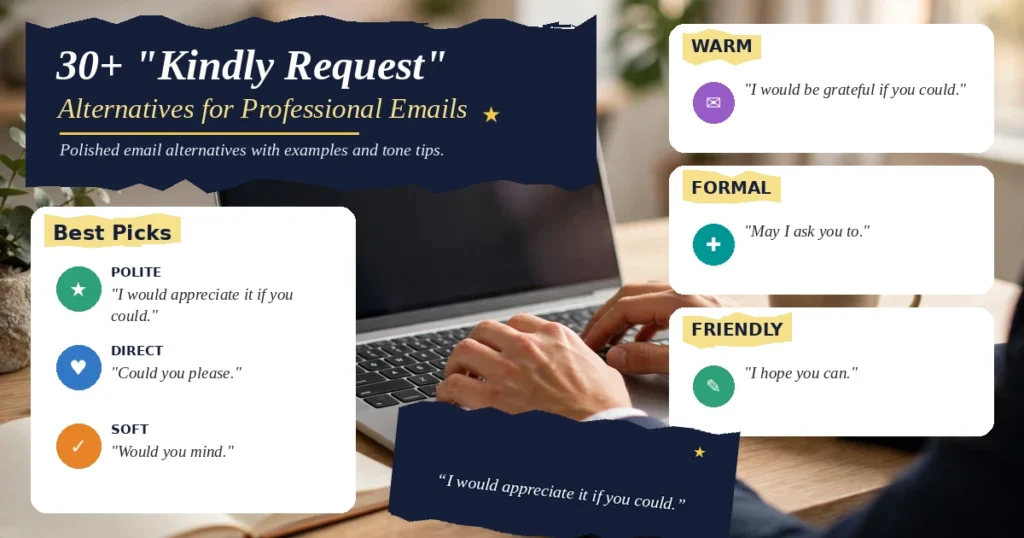
1. “I would appreciate it if you could.” — Polite and confident; best for formal requests. Example: “I would appreciate it if you could review the contract by Thursday.”
2. “Could you please.” — Direct and simple; best for everyday asks. Example: “Could you please send me the updated slides?”
3. “Would you mind.” — Soft and respectful; best for favors. Example: “Would you mind checking these numbers for me?”
4. “I would be grateful if you could.” — Warm and courteous; best for big favors. Example: “I would be grateful if you could introduce me to your manager.”
5. “May I ask you to.” — Gentle and formal; best for senior readers. Example: “May I ask you to approve the budget by Monday?”
6. “I hope you can.” — Friendly and low-pressure; best for informal work notes. Example: “I hope you can join the review meeting tomorrow.”
7. “It would mean a lot if you could.” — Personal and sincere; best for heartfelt requests. Example: “It would mean a lot if you could write me a recommendation.”
8. “I’d be thankful if you could.” — Warm and humble; best for kind asks. Example: “I’d be thankful if you could share your notes from the call.”
9. “I wonder if you could.” — Tentative and polite; best for cold outreach. Example: “I wonder if you could point me to the right person.”
10. “Would it be possible for you to.” — Careful and indirect; best for sensitive asks. Example: “Would it be possible for you to move the deadline to Friday?”
11. “Could I trouble you to.” — Self-deprecating; best for quick favors. Example: “Could I trouble you to forward this to the team?”
12. “I would value your help with.” — Respectful; best for asking for expertise. Example: “I would value your help with the pricing model.”
Formal
13. “I respectfully request.” — Official and firm; best for formal letters. Example: “I respectfully request a copy of the agreement.”
14. “Please be so kind as to.” — Traditional and elegant; best for old-style business writing. Example: “Please be so kind as to confirm your attendance.”
15. “I humbly ask that you.” — Very formal; best for appeals. Example: “I humbly ask that you reconsider the decision.”
16. “I solicit your assistance with.” — Heavy formal; best for official documents. Example: “I solicit your assistance with the funding application.”
17. “May I respectfully ask you to.” — Deferential; best for executives. Example: “May I respectfully ask you to review the proposal?”
18. “I am writing to request.” — Standard formal; best for application letters. Example: “I am writing to request a leave of absence.”
19. “I would like to request.” — Neutral formal; best for official emails. Example: “I would like to request access to the database.”
20. “Kindly advise.” — Crisp and formal; best for asking for guidance. Example: “Kindly advise on the next steps for onboarding.”
21. “Your cooperation is requested.” — Impersonal formal; best for notices. Example: “Your cooperation is requested in completing the survey.”
22. “I beg your indulgence.” — Old-fashioned; best for very formal asks. Example: “I beg your indulgence for a few minutes of your time.”
Friendly
23. “Could you do me a favor and.” — Casual and warm; best for colleagues you know. Example: “Could you do me a favor and proofread this?”
24. “Mind helping me with.” — Breezy; best for quick team asks. Example: “Mind helping me with the slide deck?”
25. “I’d love your help with.” — Upbeat; best for collaborative requests. Example: “I’d love your help with the launch plan.”
26. “Any chance you could.” — Light and casual; best for small favors. Example: “Any chance you could cover my shift on Friday?”
27. “Would you be able to.” — Neutral-friendly; best for everyday work. Example: “Would you be able to send the file today?”
28. “Can you help me out with.” — Direct and friendly; best for teammates. Example: “Can you help me out with this bug?”
29. “I’d really appreciate your help with.” — Warm; best for genuine asks. Example: “I’d really appreciate your help with the client pitch.”
30. “When you get a moment, could you.” — Patient and polite; best for non-urgent asks. Example: “When you get a moment, could you check the invoice?”
31. “I’d be grateful for your help with.” — Polished; best for email sign-offs. Example: “I’d be grateful for your help with the migration.”
32. “Could you please send.” — Clear; best for document requests. Example: “Could you please send the signed copy?”
33. “I’d like to ask for.” — Simple; best for straightforward email asks. Example: “I’d like to ask for an extension on the deadline.”
34. “Would you be willing to.” — Respectful; best for bigger commitments. Example: “Would you be willing to join the panel next month?”
35. “If it’s not too much trouble, could you.” — Very polite; best for cold emails. Example: “If it’s not too much trouble, could you share the report?”
36. “I’d appreciate a quick look at.” — Specific; best for review requests. Example: “I’d appreciate a quick look at the draft before I send it.”
37. “Please let me know if you can.” — Open-ended; best for low-pressure asks. Example: “Please let me know if you can make the workshop.”
38. “I’m hoping you can help with.” — Soft; best for first-time contacts. Example: “I’m hoping you can help with the vendor setup.”
Workplace
39. “Can you take a look at.” — Casual-professional; best for team chats. Example: “Can you take a look at the pull request?”
40. “Could you loop me in on.” — Collaborative; best for internal requests. Example: “Could you loop me in on the client thread?”
41. “I’d like your input on.” — Consultative; best for decisions. Example: “I’d like your input on the new hire.”
42. “Can you pick this up.” — Direct; best for task handoffs. Example: “Can you pick this up while I’m on leave?”
43. “Would you mind jumping on.” — Casual; best for meeting requests. Example: “Would you mind jumping on a quick call?”
44. “Could you flag this for.” — Modern; best for urgent items. Example: “Could you flag this for the security team?”
45. “Happy to get your eyes on.” — Flexible; best for reviews. Example: “Happy to get your eyes on the final design.”
Quick comparison
| Alternative | Tone | Best use |
|---|---|---|
| “I would appreciate it if you could” | Polite, confident | Formal requests |
| “Could you please” | Direct, simple | Everyday asks |
| “I respectfully request” | Official, firm | Formal letters |
| “Could you do me a favor and” | Casual, warm | Known colleagues |
| “I’d be grateful for your help with” | Polished | Email requests |
| “Can you take a look at” | Casual-professional | Team chats |
| “Would it be possible for you to” | Careful, indirect | Sensitive asks |
| “Please be so kind as to” | Traditional, elegant | Classic business writing |
| “Any chance you could” | Light, casual | Small favors |
| “I would like to request” | Neutral formal | Official emails |
Email examples
Emailing a client
Subject: Request for Q3 invoice approval
Hi Daniel,
I’d really appreciate your approval on the Q3 invoice when you get a moment. I’ve attached the breakdown for your review. Would you be able to confirm by Thursday so we can stay on schedule?
Best,
Anna
Emailing your manager
Subject: Leave request for next week
Hi Priya,
I’m writing to request two days of leave next week, from Wednesday to Thursday. I’ve handed my current tasks to Sam, and nothing urgent is pending. Please let me know if you can approve it — and thank you for taking care of this so quickly last time.
Thanks,
Rachel
Emailing a colleague
Subject: Quick favor — slide review
Hi Leo,
Could you do me a favor and proofread the slide deck before Friday’s presentation? It’s only ten slides, and I’d love your help with the wording on the last two. I would value your help with this — you always catch the details I miss.
Cheers,
Maya
Emailing a customer
Subject: We need one more detail
Hello,
Could you please share a screenshot of the error message? It would mean a lot if you could include the order number as well, so we can find your account faster. We know waiting is frustrating, and we’re working to fix this as quickly as possible.
Warm regards,
Chris
Networking email
Subject: Quick question about your team
Hi Sofia,
I wonder if you could point me to the right person on your partnerships team. I’m hoping you can help with a brief introduction — it would take five minutes, and I’d be grateful for your help with it. Would you be open to a short call next week?
Best,
Ben
Meeting follow-up
Subject: Action items from today
Hi team,
Thanks for a productive session. When you get a moment, could you update your tasks in the tracker? I’d appreciate a quick look at the revised timeline too. I really appreciate your time today — let’s keep the momentum going.
Best,
Nina
Common mistakes
1. Stacking too many polite fillers
“I kindly request that you please be so kind as to…” piles politeness on politeness until the sentence collapses. One clean phrase is always stronger than three. Pick one alternative and delete the rest.
2. Using the formal version with close colleagues
“I respectfully request your feedback” to a teammate you chat with daily sounds strange. Match the tone to the relationship — friendly settings deserve friendly phrasing like “Mind helping me with this?”
3. Burying the actual request
Some emails spend three paragraphs being polite and never clearly state what they want. Be courteous, then be specific: “Could you please send the signed copy by Friday?” The reader should never have to guess what you are asking for.
4. Demanding instead of asking
“Send me the report now, kindly” is not a request — it is an order wearing a polite mask. If the deadline is genuinely tight, explain why: “Could you send the report today? The client meeting moved to tomorrow morning.” Context turns a demand back into a request.
5. Forgetting to say thank you
A request without gratitude feels like a transaction. Add one line — “Thanks so much” or “I really appreciate it” — and your next request will land even better. If someone has gone out of their way and you are stuck, it is also fine to admit you need your help untangling a problem rather than pretending everything is fine.
6. Making the request too vague
“I kindly request your support” could mean anything. Support with what, by when, in what form? Vague requests get vague responses. Name the exact thing: “Could you review the first three pages by Thursday?”
Related phrases
- Please — The simplest polite marker. Example: “Please send the file when you can.”
- Thank you in advance — Gratitude before the favor. Example: “Thank you in advance for your help.”
- At your earliest convenience — Formal “as soon as you can.” Example: “Please reply at your earliest convenience.”
- I would be obliged — Formal gratitude. Example: “I would be obliged if you could attend.”
- Much appreciated — Short thanks. Example: “Your quick reply is much appreciated.”
- With gratitude — Formal sign-off. Example: “With gratitude for your time, James.”
- Your prompt attention — Formal “please hurry.” Example: “Your prompt attention to this matter is appreciated.”
- I trust you will — Confident expectation. Example: “I trust you will handle this carefully.”
- Kind regards — Warm formal sign-off. Example: “Kind regards, Sarah.”
- Please advise — Formal “tell me what to do.” Example: “Please advise on the correct process.”
- I look forward to your reply — Polite closer. Example: “I look forward to your reply by Friday.”
- Do me a favor — Casual request opener. Example: “Do me a favor and check this link.”
- Help me out — Friendly ask. Example: “Can you help me out with the setup?”
- Take your time — Patient request. Example: “Take your time — no rush on this.”
- No rush — Low-pressure marker. Example: “No rush, just send it when ready.”
- Whenever you’re ready — Patient and open. Example: “Send the draft whenever you’re ready.”
Phrase comparison
“Kindly request” is the safe default: formal, passive, and slightly stiff. It works everywhere but shines nowhere. “Could you please” keeps the same politeness but adds a human voice — the difference between a notice on a wall and a person talking to you. For everyday emails, the direct version almost always wins.
“I would appreciate it if you could” trades a little directness for extra warmth. It suits bigger asks — the kind where you genuinely want the reader to feel your gratitude. Compared with “kindly request,” it sounds like the writer actually cares about the answer, not just the formality. Use it when the favor is real and you want the reader to know it.
Formal options like “I respectfully request” go the other direction: they trade warmth for authority. They belong in legal letters, official applications, and correspondence with institutions — places where formality is the point. In a Slack message or a quick team email, they would feel overdressed. The pattern is simple: the more formal the reader and the setting, the more structure your request needs.
The friendly versions — “Any chance you could,” “Mind helping me with” — do the opposite of the formal ones. They close the distance between writer and reader, which is perfect for teammates and peers but risky with a new client or a senior executive. None of the 45 alternatives is universally best; the best one matches your reader’s expectations while still sounding like you.
Cultural usage
United States
American business writing favors direct, friendly requests. “Could you please send this?” and “Would you be able to help?” sound natural in US inboxes. Americans tend to skip heavy formal markers — “I kindly request” can read as overly stiff or even foreign to an American reader. Keep it simple and warm.
United Kingdom
British business English tolerates more formality. “I would be grateful if you could” and “May I ask you to” land well in the UK, where understatement and courtesy are prized. That said, even British inboxes now prefer a human tone over a robotic one — “kindly request” is fading in favor of simpler phrasing.
Corporate communication
Large companies often have unspoken email norms. Some teams run on Slack-style brevity (“Can you take a look?”), others expect full sentences in every message. Mirror the style of the people you write to. When writing upward to leadership, default one level more formal than your normal tone.
Customer service
Service language needs clarity and kindness together. “Could you please share your order number?” works because it is easy to understand and easy to comply with. Avoid the heavy formal versions here — a frustrated customer does not want ceremony; they want a clear next step. Close with warmth, such as “my pleasure to help” with anything else they need.
Networking
Networking requests are favors between near-strangers, so the wording carries the whole relationship. “I wonder if you could point me in the right direction” works because it is humble and specific. Never open a first message with a big formal demand — start small, be grateful, and let the connection grow.
Frequently asked questions
Is “kindly request” polite?
Yes, it is polite and grammatically correct. The problem is not rudeness — it is stiffness. In most modern inboxes, “kindly request” sounds like a template rather than a person. Politer-sounding options like “I would appreciate it if you could” carry the same courtesy with more warmth.
What is a more professional way to say “kindly request”?
Try “I would appreciate it if you could,” “Could you please,” or “I would be grateful if you could.” These sound professional without sounding robotic. For official documents, “I respectfully request” is the stronger formal choice.
Is “kindly” too formal for emails?
It depends on the email. In official letters and formal applications, “kindly” is fine. In everyday work emails, it often feels stiff — most native speakers would write “Could you please” instead. When in doubt, choose the simpler phrase.
Can I say “kindly request” in a job application?
You can, but a fresher alternative usually works better. “I would welcome the chance to discuss this role” sounds more confident and human than “I kindly request an interview.” Hiring managers read the classic line constantly, so standing out helps.
What is the difference between “kindly request” and “please”?
“Kindly request” is a full formal phrase; “please” is a simple politeness marker. “Please send the report” is direct and natural. “I kindly request the report” is heavier and more distant. In most cases, “please” plus a clear verb does the job better.
How do I make a request without sounding demanding?
Soften with the reader in mind: “Would it be possible for you to” or “If it’s not too much trouble, could you.” Explain the reason when the ask is big — “Could you send it today? The client meeting moved up.” Context turns pressure into understanding.
What is a polite way to request something urgently?
Be honest about the urgency and stay courteous: “Could you please send this by 3 PM today? I know it’s short notice, and I’d really appreciate it.” Hiding urgency behind formal filler only confuses people; naming it respects their time.
Should I say “kindly” or “please”?
Use “please” for almost everything — it is simpler, warmer, and universally understood. Save “kindly” for traditional formal writing where the style guide expects it. “Please be so kind as to” is the elegant middle ground for formal-but-human requests.
How do you request something from your boss?
Be respectful but direct: “Would you be able to approve the budget by Friday?” or “May I ask you to review the proposal?” Bosses prefer clarity over ceremony. Always state exactly what you need and by when.
What is a friendly alternative to “kindly request”?
“Could you do me a favor and,” “Mind helping me with,” or “Any chance you could.” These work with colleagues and teammates you know well. Keep the formal versions for strangers, clients, and executives.
Is it rude to say “I need you to”?
It can sound blunt, especially in writing. “I need you to send the file” is an order, not a request. Soften it: “Could you please send the file?” The extra two words cost nothing and change the whole tone.
How do you follow up on a request that got no reply?
Wait two to three business days, then send a short nudge: “Just floating this back up — could you please send the report when you get a chance?” One polite follow-up is professional; three starts to feel like pressure.
What should I avoid when making email requests?
Avoid stacking polite fillers, burying the actual ask, and being vague about what you need. Also avoid demanding language disguised as politeness — “Send it now, kindly” fools nobody. One clean, specific, courteous sentence is the formula.
Can I use these alternatives on LinkedIn?
Yes — most transfer perfectly. LinkedIn messages should be short, so pick the punchy ones: “I wonder if you could point me to the right person” or “Would you be open to a quick chat?” Keep the whole message under 100 words.
How many times should I say “please” in one email?
Once or twice is plenty. “Could you please send the report? Please let me know if you can” already feels repetitive. Vary your phrasing — “I’d appreciate it,” “Would you be able to” — so the email reads naturally.
Conclusion
The shortlist, if you only remember a few:
- Professional: “I would appreciate it if you could” and “Could you please”
- Formal: “I respectfully request” and “Please be so kind as to”
- Friendly: “Could you do me a favor and” and “Any chance you could”
- Email: “I’d be grateful for your help with” and “Would you be willing to”
- Workplace: “Can you take a look at” and “I’d like your input on”
A good request is a small act of respect: clear about what you need, honest about when you need it, and grateful in advance. Pick the phrase that fits your reader, say exactly what you want in one clean sentence, and close with thanks. Do that consistently, and your emails will stop sounding like forms — and start getting answers.
For the dictionary definition of the core word, see Cambridge Dictionary’s entry on “request”.