Introduction
When good news lands on your desk, your first instinct is often to write the words “happy to announce.” It is a safe choice, and it works. But when you are searching for other ways to say happy to announce, you are probably trying to make your message feel fresher, warmer, or more professional. The right words set the tone for the news that follows, and a small change in phrasing can make your email or post stand out.
Think about how often people read that exact phrase. In a busy inbox, “I am happy to announce” blends into the background. A sharper opening line pulls the reader in and signals that something worth their attention is coming. If you are reaching out to someone with good news for the first time, a strong first line builds trust before you even share the details.
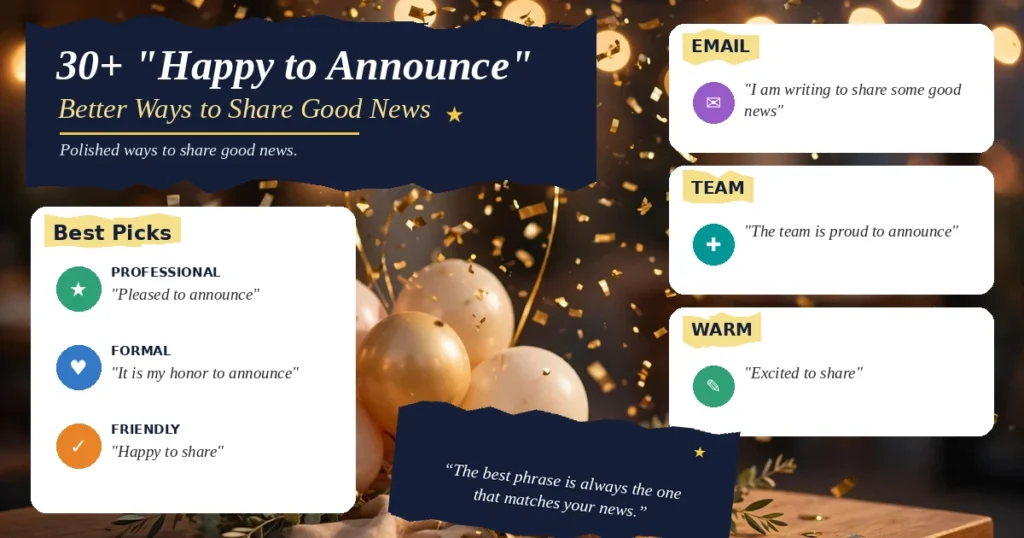
This guide gives you 30 alternatives to “happy to announce,” sorted into five tone groups: professional, formal, friendly, email, and workplace. You will also find meaning notes, usage tips, full email examples, common mistakes, cultural notes, and answers to 15 common questions. By the end, you will know exactly which phrase fits your audience and how to use it with confidence.
Meaning
“Happy to announce” means that the speaker feels glad to share news or information with others. It combines a positive feeling with a formal act of telling. People use it before news they believe the audience will welcome, such as a promotion, a product launch, a new hire, or an award.
The phrase “Happy to announce” means that the speaker feels glad to share news or information with others. It combines a positive feeling with a formal act of telling. People use it before news they believe the audience will welcome, such as a promotion, a product launch, a new hire, or an award.
Writers choose this phrase when they want to sound polite and upbeat without sounding too casual. It sits in the middle of the tone scale. It is warmer than “I wish to inform you” and more formal than “Guess what!” Because of this middle ground, it fits many situations, from company emails to social media posts. That flexibility is also why people overuse it, and why fresh alternatives can help your message land harder.
Professional usage
In professional settings, “happy to announce” appears most often in emails, press releases, LinkedIn posts, and internal company updates. Managers use it to share team changes, such as new roles, new members, or new projects. Marketing teams use it to reveal launches, partnerships, and milestones. Human resources teams use it to welcome new hires or celebrate internal promotions.
The phrase works well when the news affects a group. It signals that the speaker shares the group’s excitement and that the update is worth reading. For example, a team lead might write, “I am happy to announce that our project passed its final review.” The words “happy” and “announce” tell the team that this is a moment to celebrate together.
Professionals also use it to soften big changes. A company might write, “We are happy to announce a new office location,” when the move brings both excitement and questions. The warm opening makes the reader feel included rather than surprised. When the news is mixed or unclear, though, a warmer phrase can feel dishonest, so writers should match the tone to the real mood of the news.
In many workplaces, the phrase has become a habit. Writers type it without thinking, and readers skim past it without feeling anything. That is the main reason professionals look for alternatives. A fresh opening line earns back the reader’s attention, and it shows care. Choosing your words with care also strengthens your voice at work, because small word choices shape how colleagues see your judgment.
Alternatives
Here are 30 alternatives to “happy to announce,” sorted into five tone groups. Each entry includes a short note on tone and best use, plus one example sentence.
Professional
Use these in work emails, press releases, and public posts where a polished tone matters.
Pleased to announce
Tone: confident and standard professional use. Best for company updates and public statements.
Example: We are pleased to announce the opening of our new branch in Lahore.
Proud to announce
Tone: strong and confident, with a note of achievement. Best for milestones the team earned.
Example: I am proud to announce that our app passed one million downloads this week.
Excited to share
Tone: warm and energetic professional use. Best for launches and new initiatives.
Example: I am excited to share that we hired three new designers this month.
Delighted to share
Tone: warm and slightly refined. Best for invitations, partnerships, and good news with a personal touch.
Example: We are delighted to share that we partnered with a global shipping firm.
Thrilled to announce
Tone: high energy and celebratory. Best for major wins and big milestones.
Example: I am thrilled to announce that our team won the national design award.
Happy to share
Tone: light and natural. Best for casual professional updates and quick posts.
Example: I am happy to share that our new guide is now live on the website.
Formal
Use these in official letters, speeches, ceremonies, and messages to senior leaders.
Pleased to announce
Tone: confident and standard professional use. Best for company updates and public statements.
Example: We are pleased to announce the opening of our new branch in Lahore.
Proud to announce
Tone: strong and confident, with a note of achievement. Best for milestones the team earned.
Example: I am proud to announce that our app passed one million downloads this week.
Excited to share
Tone: warm and energetic professional use. Best for launches and new initiatives.
Example: I am excited to share that we hired three new designers this month.
Delighted to share
Tone: warm and slightly refined. Best for invitations, partnerships, and good news with a personal touch.
Example: We are delighted to share that we partnered with a global shipping firm.
Thrilled to announce
Tone: high energy and celebratory. Best for major wins and big milestones.
Example: I am thrilled to announce that our team won the national design award.
Happy to share
Tone: light and natural. Best for casual professional updates and quick posts.
Example: I am happy to share that our new guide is now live on the website.
It is with great pleasure that I announce
Tone: very formal and ceremonial. Best for speeches and official declarations.
Example: It is with great pleasure that I announce the winner of this year’s scholarship.
I am pleased to inform you
Tone: formal and direct. Best for official letters and policy updates.
Example: I am pleased to inform you that your application has been approved.
It is my honor to announce
Tone: respectful and formal. Best for awards, appointments, and public recognition.
Example: It is my honor to announce our new chief executive officer.
I am delighted to inform you
Tone: formal and formal. Best for invitations and formal good news letters.
Example: I am delighted to inform you that the board approved the new program.
It is with great pride that I share
Tone: formal and celebratory. Best for institutional milestones and achievements.
Example: It is with great pride that I share our school’s record exam results.
I am gratified to announce
Tone: formal and sincere. Best for announcements where hard work led to the result.
Example: I am gratified to announce that the charity drive passed its funding goal.
Friendly
Use these with friends, small teams, and communities where a warm tone fits.
Great news to share
Tone: casual and upbeat. Best for quick updates and social posts.
Example: Great news to share: our workshop dates are finally confirmed.
I have some exciting news
Tone: warm and personal. Best for direct messages and short emails to people you know.
Example: I have some exciting news about our holiday project this year.
I can’t wait to tell you
Tone: playful and full of energy. Best for friends and close colleagues.
Example: I can’t wait to tell you about the surprise we planned for the team.
I am over the moon to share
Tone: joyful and expressive. Best for personal celebrations shared at work.
Example: I am over the moon to share that my sister joined our company as an intern.
We have something special to share
Tone: warm and inviting. Best for group announcements to a close team.
Example: We have something special to share about our anniversary event.
Drumroll, please
Tone: fun and dramatic. Best for lighthearted team updates and social posts.
Example: Drumroll, please, we just signed our biggest client of the year.
Use these as opening lines for emails that carry good news.
I am writing to share some good news
Tone: clear and direct email style. Best for straightforward announcements.
Example: I am writing to share some good news about your recent order.
I wanted to let you know
Tone: natural and conversational. Best for personal email updates.
Example: I wanted to let you know that the meeting moved to Monday morning.
I have a quick announcement
Tone: brief and clear. Best for short emails where the reader is busy.
Example: I have a quick announcement about our new return policy.
Sharing some exciting news with you
Tone: warm and direct. Best for email updates to clients or partners.
Example: Sharing some exciting news with you, our new catalog is ready.
I am reaching out with great news
Tone: friendly and active. Best for cold or warm outreach emails.
Example: I am reaching out with great news about a discount for returning customers.
A quick update with good news
Tone: short and positive. Best for follow-up emails and status updates.
Example: A quick update with good news, the repairs finished ahead of schedule.
Workplace
Use these for team meetings, chats, memos, and internal updates.
The team is proud to announce
Tone: collective and confident. Best for group achievements and shared wins.
Example: The team is proud to announce that the new system is live today.
We are excited to roll out
Tone: energetic and active. Best for launches of tools, features, or programs.
Example: We are excited to roll out the new leave policy starting next month.
Big news from our department
Tone: casual and bold. Best for internal chats and team channels.
Example: Big news from our department, we hired two senior engineers.
We are thrilled to launch
Tone: high energy team voice. Best for product and campaign launches.
Example: We are thrilled to launch the summer training program today.
Let me be the first to tell you
Tone: personal and direct. Best for one-to-one workplace updates.
Example: Let me be the first to tell you, your promotion was approved today.
I am honored to share with the team
Tone: respectful and warm. Best for personal news shared with colleagues.
Example: I am honored to share with the team that I accepted the lead role.
Quick comparison
| Alternative | Tone | Best for | Energy level |
|---|---|---|---|
| Pleased to announce | Professional | Company updates | Medium |
| Proud to announce | Professional | Major wins | Very high |
| Excited to share | Professional | Launches | Medium |
| Delighted to share | Professional | Partnerships | Medium |
| Thrilled to announce | Professional | Major wins | Very high |
| Happy to share | Professional | Quick updates | Medium |
| It is with great pleasure that I announce | Formal | Speeches | Medium |
| I am pleased to inform you | Formal | Official letters | Low |
| It is my honor to announce | Formal | Awards | Medium |
| I am delighted to inform you | Formal | Formal invitations | Medium |
| It is with great pride that I share | Formal | Institutional wins | Medium |
| I am gratified to announce | Formal | Hard-earned results | Low |
| Great news to share | Friendly | Quick updates | Social posts |
| I have some exciting news | Friendly | Direct messages | Medium |
| I can’t wait to tell you | Friendly | Close colleagues | Very high |
| I am over the moon to share | Friendly | Personal news | Very high |
| We have something special to share | Friendly | Team updates | Medium |
| Drumroll, please | Friendly | Social posts | Very high |
| I am writing to share some good news | Direct announcements | Medium | |
| I wanted to let you know | Personal emails | Low | |
| I have a quick announcement | Busy readers | Low | |
| Sharing some exciting news with you | Client updates | Medium | |
| I am reaching out with great news | Outreach emails | Medium | |
| A quick update with good news | Follow-ups | Low | |
| The team is proud to announce | Workplace | Group wins | High |
| We are excited to roll out | Workplace | New tools | High |
| Big news from our department | Workplace | Internal chats | High |
| We are thrilled to launch | Workplace | Launches | Very high |
| Let me be the first to tell you | Workplace | One-to-one updates | Medium |
| I am honored to share with the team | Workplace | Personal news | High |
Email examples
Example 1: Product launch email to clients
Subject: Our new training course is here
Dear partners,
I am thrilled to announce the launch of our new online training course. The course covers 40 lessons, and it opens for enrollment on Monday. We built it based on your feedback, and we believe it will save your team hours every week. You can register from the link below, and seats are limited to the first 200 learners.
Thank you for your continued trust. We look forward to seeing you in class.
Best regards,
Sara
Example 2: Promotion email to the team
Subject: Please welcome our new team lead
Hi team,
Dear customers,
We are delighted to share that we partnered with a national courier service. From next week, all orders will ship faster, and tracking will update in real time. This change comes at no extra cost to you. If you had trouble with late deliveries before, please know that we need your help to report any remaining issues, so we can fix them fast.
Thank you for choosing us.
Warm regards,
Hina
Example 3: New hire email to the department
Subject: Meet our new designer
Hi team,
I am excited to share that Nadia joined our design team today. She brings five years of experience in mobile app design, and she will work on the new checkout flow. Her first day went smoothly, and she already has great ideas. Please stop by her desk to say hello.
Welcome, Nadia. We are glad to have you with us.
Thanks,
Danish
Example 4: Partnership email to customers
Subject: We partnered with a national courier
Dear customers,
We are delighted to share that we partnered with a national courier service. From next week, all orders will ship faster, and tracking will update in real time. This change comes at no extra cost to you. If you had trouble with late deliveries before, please know that we need your help to report any remaining issues, so we can fix them fast.
Thank you for choosing us.
Warm regards,
Hina
Example 5: Award email to the whole company
Subject: We won the industry award
Team,
It is with great pride that I share our latest win. We received the National Service Excellence Award for our customer support record. This award belongs to every person in this company, from the support desk to the delivery team. We will celebrate with a lunch event next Friday, and details will follow soon.
Please be patient while we finalize the venue. I know many of you have questions, and we will answer all of them before Friday. For now, take a moment to feel proud of what we built together. You can read more about polite requests if you want tips on asking teams to wait gracefully.
Congratulations to all,
The management
Common mistakes
Using the phrase for bad or mixed news. “Happy to announce” promises good news. Do not use it before layoffs, price increases, or policy cuts. Readers feel tricked when the tone does not match the content, and trust drops fast. Match the opening line to the real mood of the message.
Starting every update with the same line. If all your emails open with “happy to announce,” readers stop noticing the phrase, and the news loses its punch. Rotate your opening lines. Pick one that fits the specific news, not one you always use. A fresh line keeps the reader engaged from the first sentence.
Announcing before the details are ready. Writers sometimes announce news and then ask the reader to please be patient for the details. This creates frustration. Share the news only when you can answer basic questions: what, when, where, and who is affected. If the details are missing, wait.
Sounding robotic in personal emails. A formal opener like “I am pleased to inform you” can feel cold in a message to a close colleague. Save formal phrases for official settings. With people you know well, choose a warmer line that sounds like you. Readers can tell when a phrase does not fit the relationship.
Forgetting the call to action. Many writers share the news and stop. Tell the reader what to do next. Register by Friday, reply by Friday, or join the meeting on Monday. Good news still needs a clear next step, or the message loses its value.
Using too many exclamation marks. Excitement is good, but three exclamation marks make a professional email look messy. One is enough in most cases, and formal messages need none at all. Let the words carry the energy, not the punctuation.
Copying the phrase into every channel. The opener that works in a press release may fail in a team chat. “It is with great pleasure that I announce” sounds stiff in Slack. Match the phrase to the channel, not just the news. Short channels need short openers.
Announcing news that is not yours to share. Before you post, check who should share the news first. A manager may want to tell the team about a promotion before it appears in a group email. I need your help is a fine line for asking support, but it does not replace asking permission. Respect the chain of communication.
Related phrases
Several phrases live near “happy to announce” in meaning, and writers often mix them up. “Proud to present” works when you show something finished, like a report or a product, while “happy to announce” works when you share news. “Thrilled to share” carries more energy than “pleased to announce,” so use it when the excitement is real and high.
“Breaking news” belongs to journalism and urgent events, not to company updates. Using it for a routine launch makes the writer sound dramatic and out of touch. “We have exciting news” is close to “I have some exciting news,” but the group voice fits team channels better than personal emails. The voice should match the speaker.
Some writers pair an announcement with thanks. Lines like thank you for the clarification help when the news answers a question the reader asked. My pleasure to help works when the announcement solves a problem for someone. These small pairings keep the tone warm without changing the subject.
Phrase comparison
“Happy to announce” vs “Thrilled to share.” Both open with positive feeling, but “thrilled” runs hotter. Use “thrilled” for genuine celebration, like a major award or a record quarter. Use “happy to announce” for everyday good news, like a schedule change that benefits everyone. If you use “thrilled” too often, it loses power, so save it for real peaks.
“Pleased to announce” vs “Proud to announce.” “Pleased” sounds calm and measured, while “proud” claims ownership of the result. A manager who led the project can say “proud” to announce,” but a spokesperson sharing company news should say “pleased to announce.” The wrong choice makes the speaker sound either distant or boastful.
“Delighted to share” vs “Excited to share.” “Delighted” feels refined and slightly formal, while “excited” feels fresh and modern. “Delighted” fits invitations, partnerships, and letters to senior people. “Excited” fits launches, product news, and messages to younger audiences. Both work, but the audience decides.
“I am writing to share some good news” vs “I wanted to let you know.” The first line is direct and signals purpose right away. The second line is softer and sounds more like conversation. In a formal email to a client, use the first. In a message to a colleague you know well, use the second. Neither is better in general; the relationship decides.
“It is my honor to announce” vs “It is with great pleasure that I announce.” Both are formal, but “honor” carries respect for the occasion or the person, while “pleasure” carries the speaker’s own joy. Use “honor” for awards, appointments, and recognition. Use “pleasure” for celebrations and happy events. Mixing them up can make a serious moment feel light.
Cultural usage
In American workplaces, “happy to announce” and its alternatives appear often and openly. Teams celebrate wins in emails and posts, and direct positive language feels normal. American readers expect the good news early in the message, so the opening line carries weight. A bold opener like “We are thrilled to launch” fits this culture well.
In British workplaces, writers often prefer softer openers. “I am pleased to share” or “I am delighted to inform you” sound natural, while “thrilled” can feel too loud in formal settings. British business writing values understatement, so the energy of the phrase should stay one step below the actual excitement. What feels honest in New York may feel loud in London.
In South Asian workplaces, including Pakistan and India, “happy to announce” is extremely common in company emails and LinkedIn posts. Writers often pair it with respectful greetings and warm closings. Formal phrases like “It is my honor to announce” work well in messages to senior leaders. The culture values warmth, so even professional emails need a warm one. When you pick with care, your opening line does more than introduce the news. It sets the mood and earns the reader’s attention.
Start with one or two favorites from the list above, and use them in your next emails. Over time, you will build a natural habit of matching words to moments. If you ever want to check the exact meaning of the word, see the definition of “announce” for guidance. Good news deserves good words, so make every announcement count.