Introduction
If you are searching for other ways to say i am writing to inform you, you are probably tired of starting every professional email the same way. The phrase is correct, but it sounds stiff, old fashioned, and a little robotic. Many writers use it out of habit, even when a friendlier or shorter opener would serve them better.
Good news: you have dozens of strong replacements, and each one fits a different tone. A formal notice needs a formal opener. A quick team update needs something short and warm. This guide gives you 35 ready to use alternatives, grouped by tone, so you can pick the right one in seconds. You will also get real email examples, common mistakes to avoid, and answers to the questions people ask most about this phrase.
By the end, you will never stare at a blank email wondering how to start again. You will know exactly which phrase fits your reader, your company culture, and your purpose.
Meaning
“I am writing to inform you” is a formal way of saying that the purpose of your message is to share information. It tells the reader that news or facts will follow. People use it in business letters, official notices, and professional emails when they want to sound serious and clear.
The phrase has three parts. “I am writing” states the action. “To inform you” states the purpose. Together they signal that the message carries information the reader needs to know. Nothing is hidden and nothing is emotional. It is a neutral, factual opener.
However, the phrase is not the only way to deliver news. Depending on your relationship with the reader, you can sound warmer, shorter, or more modern. The meaning stays the same, but the tone changes. That is why learning alternatives matters. The right opener sets the mood for everything that follows.
Professional usage
This phrase belongs to the world of formal and semi formal writing. Managers use it to announce policy changes. Human resources teams use it in offer letters and warnings. Customer service teams use it to share updates about orders, accounts, and appointments. Government offices and schools use it in official notices.
In these settings, clarity matters more than style. A direct opener like “I am writing to inform you” leaves no doubt about the purpose of the message. It works well when the news is serious, such as a deadline change, a contract update, or a legal notice.
But in everyday workplace email, the phrase can feel too heavy. If you write to a colleague you talk to daily, a softer opener like “I wanted to let you know” fits better. If the message is casual, even “Quick update” does the job. The key is to match your opener to your audience. Senior leaders, clients, and official bodies usually expect formal language. Teammates and regular contacts welcome a friendlier tone.
Remember that tone carries meaning. A stiff opener can make simple news feel alarming. Before you write, ask yourself how you want the reader to feel when they read your first line. Then choose the alternative that creates that feeling.
Alternatives
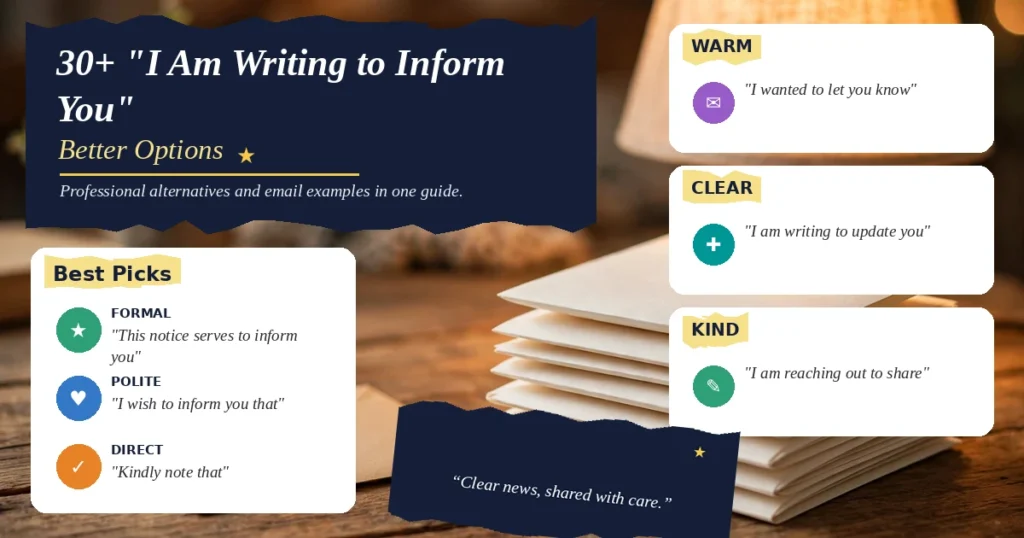
Here are 35 polished alternatives, grouped into five tone families. Each entry shows the phrase in bold, a short note on tone and best use, and a short example sentence. Mix and match them to fit your message.
Formal announcements.
These suit official notices, policy updates, and serious business communication.
This is to inform you that – Very formal, ideal for official notices and legal style letters. Example: This is to inform you that the office will close early on Friday.
I am writing to notify you – Strong and direct, works when the news needs a formal record. Example: I am writing to notify you of a change to your delivery schedule.
Please be advised that – Classic formal business English, common in contracts and official emails. Example: Please be advised that the deadline has moved to March 15.
This notice serves to inform you – Highly formal, best for written notices and compliance messages. Example: This notice serves to inform you of updated parking rules.
I wish to inform you that – Polite and formal, softer than a direct command. Example: I wish to inform you that your application was approved.
This email serves as formal notification – Clear and official, leaves a paper trail. Example: This email serves as formal notification of the meeting cancellation.
Kindly note that – Formal but courteous, common in international business English. Example: Kindly note that invoices must include the purchase order number.
Professional email openers.
These fit everyday workplace emails where you want to sound competent but human.
I wanted to let you know – Friendly and natural, the most popular modern replacement. Example: I wanted to let you know that the report is ready for review.
I am writing to update you – Clear and professional, signals news without sounding cold. Example: I am writing to update you on the project timeline.
I am reaching out to share – Warm and proactive, shows you are making the effort. You can pair it with phrases like I am reaching out to you when you want an even warmer opening line. Example: I am reaching out to share the new pricing details.
I would like to bring to your attention – Polite and formal, good for flagging issues. Example: I would like to bring to your attention a discrepancy in last month’s invoice.
This is a quick update regarding – Efficient and modern, tells the reader the message is short. Example: This is a quick update regarding tomorrow’s training session.
I am writing with news about – Neutral and flexible, works for good news and bad news. Example: I am writing with news about your recent application.
Allow me to share an update on – Courteous and professional, adds a touch of formality. Example: Allow me to share an update on the hiring process.
Short and direct.
These work for internal messages, team chats, and quick emails where brevity wins.
Quick update: – Casual and clear, perfect for teammates you know well. Example: Quick update: the client call moved to 3 pm.
FYI: – Very short for “for your information,” best for low stakes news. Example: FYI: the shared drive link has been updated.
Heads up: – Friendly warning style, great for advance notice. Example: Heads up: the system will be down for maintenance tonight.
Please note: – Short but still polite, works in instructions and reminders. Example: Please note: the new form is required from Monday.
Just a note to let you know – Light and conversational, keeps the tone relaxed. Example: Just a note to let you know the package arrived safely.
Sharing this for your awareness – Modern business phrasing, slightly formal but brief. Example: Sharing this for your awareness: the budget report is now live.
For your information: – The classic abbreviated form, neutral and safe. Example: For your information: the policy takes effect next quarter.
Warm and friendly.
Use these when you have a good relationship with the reader or want to soften news.
I wanted to share some news with you – Warm and personal, great for positive updates. Example: I wanted to share some news with you about the team’s success this quarter.
I have some news to share – Honest and open, builds curiosity in a gentle way. Example: I have some news to share about the upcoming office move.
I thought you should know – Considerate and respectful of the reader’s need to stay informed. Example: I thought you should know that your request was approved.
Just wanted to keep you in the loop – Casual and caring, perfect for ongoing projects. Example: Just wanted to keep you in the loop on the design changes.
I have an update I wanted to share – Friendly and direct, keeps things personal. Example: I have an update I wanted to share about your order status.
Writing to keep you posted – Relaxed and current, ideal for follow up messages. Example: Writing to keep you posted on the interview schedule.
I wanted to make sure you heard – Caring and thorough, shows attention to the reader. Example: I wanted to make sure you heard about the new holiday schedule.
Formal letters and official notices.
Reserve these for legal, HR, and high stakes official correspondence.
This letter is to inform you – Traditional and weighty, made for printed letters. Example: This letter is to inform you of the decision regarding your appeal.
We write to advise you – Institutional and formal, common from companies and agencies. Example: We write to advise you of changes to your account terms.
Please be informed that – Direct and official, leaves no room for confusion. Example: Please be informed that your access will expire on Friday.
You are hereby notified that – Legal strength language, use only for formal legal notices. Example: You are hereby notified that the hearing date has been set.
This is to advise you of – Formal advisory tone, common in banking and insurance. Example: This is to advise you of a scheduled system upgrade.
We wish to bring to your notice – Polite institutional phrasing, softer than a legal notice. Example: We wish to bring to your notice the updated safety guidelines.
Take notice that – Strong legal style, appropriate for official warnings. Example: Take notice that failure to respond may result in cancellation.
Quick comparison
Use this table to pick an alternative fast. Match the tone column to your reader and situation.
| Phrase | Tone | Best for | Formality |
|---|---|---|---|
| This is to inform you that | Official | Notices, legal letters | Very high |
| I am writing to notify you | Formal | Policy and schedule changes | High |
| Please be advised that | Formal | Contracts, deadlines | High |
| I wanted to let you know | Friendly | Everyday workplace email | Medium |
| I am writing to update you | Professional | Project and status updates | Medium |
| I am reaching out to share | Warm | Client and partner updates | Medium |
| Quick update: | Casual | Internal team messages | Low |
| FYI: | Casual | Low stakes FYI emails | Low |
| Heads up: | Friendly | Advance warnings | Low |
| I thought you should know | Warm | Considerate updates | Low to medium |
| This letter is to inform you | Official | Printed formal letters | Very high |
| You are hereby notified that | Legal | Legal and compliance notices | Very high |
Email examples
See how the alternatives work in real messages. Each example below is a complete short email you can adapt. Notice how the opener changes the feel of the whole message.
Example 1: Schedule change (professional)
Subject: Updated time for Thursday’s meeting
Hi team,
I am writing to update you on Thursday’s meeting. The start time has moved from 10 am to 11 am. The meeting link stays the same. Please confirm that the new time works for you.
Thanks,
Maria
Example 2: Policy update (formal)
Subject: New expense report policy, effective November 1
Dear staff,
This is to inform you that a new expense report policy takes effect on November 1. All receipts must now be submitted within 30 days. The finance team will hold a short briefing next week. Contact them if you have questions.
Best regards,
David Chen
Example 3: Good news for a client (warm)
Subject: Your application was approved
Hi Sarah,
I wanted to share some news with you. Your application was approved, and your account is now active. You can log in using the link below. If you need help getting started, just reply to this email. We are excited to have you on board.
Warm regards,
James
Example 4: Quick internal update (short and direct)
Subject: Office Wi-Fi fixed
Hi all,
Quick update: the office Wi-Fi is working again. If you still have connection issues, please restart your laptop and try again. Thanks for your patience while we fixed it.
Best,
Priya
Example 5: Advance warning (friendly)
Subject: System maintenance tonight
Hi team,
Heads up: our system will be down for maintenance tonight from 9 pm to 11 pm. Please save your work before 9 pm. Everything should be back to normal by midnight.
Thanks,
Tom
Example 6: Formal notice to a vendor (official)
Subject: Change to delivery terms
Dear Mr. Adams,
We write to advise you of a change to our delivery terms, effective January 1. All future orders will require a signed confirmation before shipping. Our procurement team will send the updated agreement this week.
Kind regards,
Lisa Morgan
Example 7: Order status update (professional)
Subject: Your order has shipped
Hi Daniel,
I wanted to let you know that your order shipped this morning. The tracking number is below. It should arrive within 5 business days. If anything looks wrong, reply to this message and we will sort it out right away.
Best,
Customer Care Team
Notice a pattern: the opener sets the tone, the middle delivers the facts, and the close gives a clear next step. When you deliver bad news, keep the language simple and honest, and you can add a gentle line such as I understand your frustration before explaining what happens next. When the reader waited a long time, a line asking them to please be patient can ease the tension.
Common mistakes
Even experienced writers make these errors with this phrase. Avoid them and your emails will sound more natural at once.
1. Using it in every email. If every message starts with “I am writing to inform you,” your writing sounds like a template. Vary your openers. Save the formal version for formal moments.
2. Using it with close colleagues. Writing “I am writing to inform you” to a teammate you chat with daily creates distance. Use “Quick update” or “I wanted to let you know” instead. Match the tone to the relationship.
3. Stacking it with other formal openers. Some writers combine phrases: “I am writing to inform you that I would like to bring to your attention…” This sounds heavy and confused. Pick one opener and move on to the point.
4. Hiding the news in long sentences. After the opener, some writers bury the actual news in a long, wordy paragraph. State the key fact in one clear sentence. Your reader should understand the news within five seconds.
5. Using it for casual news. Telling a friend “I am writing to inform you that I bought a new car” sounds strange. The phrase is for professional settings. In personal messages, just share the news directly.
6. Forgetting the call to action. Many emails end after the news with no next step. Tell the reader what to do: reply, confirm, click, or simply note the change. A clear action makes your email twice as useful.
7. Sounding cold when delivering bad news. Formal language can make bad news feel harsher. If you must share difficult news, keep the opener neutral but add a human sentence after it. For example, follow the news with thank you for the clarification when the reader helped you understand the issue, or promise a follow up so the reader feels heard.
Related phrases
These phrases often appear alongside “I am writing to inform you” in business writing. Learning them expands your toolkit.
I am pleased to inform you – Use this when the news is good. It adds warmth to the formal structure. Example: I am pleased to inform you that you have been selected.
I regret to inform you – Use this for bad news. It softens the blow with a polite expression of regret. Example: I regret to inform you that the position has been filled.
I am writing to confirm – Use this when you verify details rather than share new ones. Example: I am writing to confirm our meeting on Tuesday.
I am writing to request – Use this when you ask for something instead of sharing news. Example: I am writing to request an extension on the deadline.
Please be informed – A shorter formal variant, common in official memos. Example: Please be informed that the office will be closed on Monday.
Kindly be advised – A polite formal variant, popular in international business English. Example: Kindly be advised that the new rules apply from next month.
I wanted to follow up – Use this when you return to an earlier topic. It pairs well with update openers. Example: I wanted to follow up on the contract we discussed.
Each of these has its own set of alternatives too. For instance, if you often clarify points in email, it helps to study other ways to say “just to clarify” so your follow ups sound fresh every time.
Phrase comparison
Some openers look similar but serve different purposes. This table clears up the confusion.
| Phrase | Meaning | When to use it | Tone |
|---|---|---|---|
| I am writing to inform you | I have news to share | Sharing new information | Formal, neutral |
| I am pleased to inform you | I have good news | Announcing positive outcomes | Negative, kind |
| I regret to inform you | I have bad news | Rejections, cancellations | Formal, sympathetic |
| I am writing to confirm | I am verifying details | Confirming plans or facts | Formal, precise |
| I am writing to request | I am asking for something | Making a formal request | Formal, polite |
| I wanted to let you know | I have news to share | Everyday updates | Friendly, neutral |
| Please be advised that | Take note of this | Official instructions | Formal, direct |
Choose based on two things: what you are doing (sharing, confirming, or requesting) and how the reader should feel (neutral, happy, or prepared for bad news). Picking the wrong one sends the wrong signal. Never use “I am pleased to inform you” for bad news, and never use “I regret to inform you” for a promotion announcement.
Cultural usage
Business English changes across cultures, and this phrase is a good example. In British English, formal openers like “I am writing to inform you” and “Please be advised that” still appear often in official letters. British business culture values understatement, so the plain, factual tone fits well.
In American English, the trend is toward shorter, friendlier openers. “I wanted to let you know” and “Quick update” dominate everyday workplace email. Many American managers see “I am writing to inform you” as stiff or old fashioned, and they may rewrite it without thinking twice.
In international business English, especially in South Asia, the Middle East, and parts of Africa, formal openers remain standard and respected. Phrases like “Kindly note that” and “We wish to bring to your notice” are polite and expected. Using a casual opener with a senior official in these regions can seem disrespectful.
The lesson: know your reader. When you write to a global audience, aim for clear and polite rather than ultra casual. “I am writing to update you” works almost everywhere. When you write inside a casual startup culture, “Quick update” is fine. And when you write a legal or HR notice, stay formal no matter where your reader sits. Tone is a form of respect, and the right opener shows that you understand your audience.
If you want your messages to land well every time, it also helps to practice gratitude in your emails. A simple line like I appreciate it or my pleasure to help builds goodwill. At the end of the day, clear and kind communication wins in every culture.
Frequently asked questions
What does “I am writing to inform you” mean?
It means the purpose of your message is to share information. You use it to tell the reader that news or facts will follow. It is a formal, neutral way to open a business email or letter.
Is “I am writing to inform you” too formal for everyday email?
For most everyday workplace emails, yes. It can sound stiff when you write to colleagues you talk to often. Save it for official notices, and use “I wanted to let you know” or “Quick update” for routine messages.
What is a polite alternative to “I am writing to inform you”?
“I wanted to let you know” is polite, natural, and widely accepted. For more formal settings, “I wish to inform you that” or “Please be advised that” work well. The polite choice depends on your reader and the seriousness of the news.
Can I use “I am writing to inform you” in a cover letter?
You can, but stronger openers exist. Cover letters work better when you lead with value, such as “I am excited to apply for” or “With five years of experience in.” A generic formal opener wastes your first line.
How do I start an email without saying “I am writing to inform you”?
Pick an alternative that matches your tone. Try “I am writing to update you” for professional emails, “Quick update:” for internal notes, or “I wanted to share some news with you” for warmer messages. Then state the news in one clear sentence.
What is the difference between “inform” and “notify”?
“Inform” means to share information in a general way. “Notify” carries a stronger sense of official warning or formal record. Use “notify” for legal matters, deadlines, and compliance issues, and “inform” for general updates.
Is “Please be advised that” rude?
No, it is not rude, but it is very formal. Some readers find it cold or commanding. In friendly workplace cultures, softer options like “Please note” or “I wanted to let you know” land better. Know your audience before you use it.
How do I inform someone of bad news politely?
Use “I regret to inform you” as your opener, then state the news clearly and briefly. Add one empathetic sentence, such as an apology or a next step. Keep the language simple and honest, and avoid hiding the news in long paragraphs.
Can I say “I am writing to inform you” in a text message?
It is not wrong, but it sounds odd in a casual text. Text messages favor short, natural language like “Just wanted to let you know” or “Heads up.” Save the formal version for email and letters.
What should I write instead of “I am writing to inform you” in a formal letter?
Try “This letter is to inform you” for printed letters, or “We write to advise you” when you write on behalf of a company. Both carry the right weight for official correspondence. For legal notices, “You are hereby notified that” is the strongest option.
Is it okay to start an email with “FYI”?
Yes, for internal, low stakes messages. “FYI” tells the reader that no action is needed. Do not use it for important news, bad news, or messages to senior leaders and clients. In those cases, use a full sentence opener instead.
How long should the opening line of a business email be?
Aim for under 15 words. Short openers respect the reader’s time and get to the point fast. “I wanted to let you know that the report is ready” is clear. Long, stacked openers confuse the reader before the email even starts.
Should I use exclamation marks with these openers?
In formal writing, no. Exclamation marks can make serious news feel unserious. In warm, friendly updates, one exclamation mark is fine if the news is good. Never use more than one in a professional email.
What is a good subject line to pair with these openers?
Match the subject line to the news: “Updated meeting time,” “New policy effective November 1,” or “Your application status.” A clear subject line lets the reader prepare before they read your opener. Avoid vague subjects like “Update” or “Important.”
How do I inform a client about a delay professionally?
Open with “I am writing to update you” or “I wanted to let you know.” State the delay in one sentence, give the new timeline, and offer a next step. Honest, brief updates protect trust far better than long excuses.
Is it okay to start an email with “FYI”?
Yes, for internal, low stakes messages. “FYI” tells the reader that no action is needed. Do not use it for important news, bad news, or messages to senior leaders and clients. In those cases, use a full sentence opener instead.
Conclusion
You now have 35 strong alternatives to “I am writing to inform you,” plus real email examples, mistake fixes, and answers to the most common questions. The phrase itself is not wrong, but variety makes your writing sound more natural and more human. Choose a formal opener for official notices, a professional one for everyday email, and a warm one when the relationship matters.
Start small. Pick three favorites from the Alternatives section and use them this week. Notice how each one changes the feel of your message. Over time, choosing the right opener will become a habit, and your emails will sound confident in every situation.
To use these phrases with full confidence, it helps to know the exact meaning of the core word. You can check the dictionary entry for inform to see how it is used in real sentences. Master the opener, and the rest of the email gets easier.