Introduction
If you are searching for other ways to say after careful consideration, you are probably writing something important. Maybe it is a job email. Maybe it is a decision letter. You want to sound thoughtful and serious, but you do not want to repeat the same phrase again and again. This guide gives you 40 fresh alternatives.
The phrase “after careful consideration” is popular for a reason. It tells the reader that you took your time. You did not rush. You weighed the options before you decided. But when every business email uses the same words, they start to feel flat. A small change in wording can make your message feel more human and more honest.
In this article, you will find formal options, email-ready options, casual options, warm options, and short options. You will also see full email examples, common mistakes to avoid, and answers to the questions people ask most about this phrase. By the end, you will know exactly which alternative fits your situation. Let us begin with what the phrase really means and why it works so well in professional writing.
Meaning
“After careful consideration” means you thought about something deeply before making a choice. The word “careful” shows that you were not careless or hasty. The word “consideration” shows that you weighed different sides of a matter. Together, they signal respect for the decision and for the person reading your message.
People use this phrase in decisions that matter. A company uses it to reject a job candidate gently. A manager uses it before changing a policy. A freelancer uses it before declining a project. In each case, the phrase softens the news. It says, “I took this seriously, and my answer is thoughtful.”
The phrase also protects the speaker. When you say you considered something carefully, you show that your decision was fair. It becomes harder for the reader to argue that you were rushed or biased. That is why lawyers, managers, and hiring teams love it.
But the phrase has a weakness. Because it appears in so many rejection letters and cold emails, it can sound like a template. Some readers see it and think, “This is a form letter.” That is why learning good alternatives matters. A fresh phrase keeps the meaning but restores the sincerity. You still show that you thought deeply. You just say it in a way that feels real.
Professional usage
In professional settings, “after careful consideration” appears most often before bad news or hard decisions. Hiring managers write, “After careful consideration, we have decided to move forward with another candidate.” Vendors write, “After careful consideration, we cannot accept your proposal at this time.” The phrase prepares the reader for a “no.”
You can also use it before a “yes.” For example, “After careful consideration, we would like to offer you the role.” Here the phrase adds weight to good news. It tells the reader that the offer is serious and well-earned.
The phrase fits best in emails, formal letters, reports, and official announcements. It is common in HR writing, legal writing, and corporate communication. It sounds less natural in quick chats with coworkers or in casual conversations. In those settings, simpler phrases like “I thought about it” work better.
Timing matters too. Use these alternatives when the decision truly took time or care. If you rejected someone within five minutes, “after careful consideration” can sound false. Readers can sense when the words do not match the facts. Reserve the phrase, and its alternatives, for moments when real thought went into the choice.
One more tip for professionals. Pair the phrase with a clear next step. For example, “After careful consideration, we have decided to postpone the launch. We will review the timeline again in March.” The decision feels fair, and the reader knows what happens next. When I am reaching out to you with a difficult update, this pattern of care plus clarity builds trust instead of breaking it.
Alternatives
Here are 40 alternatives to “after careful consideration,” grouped by tone. Pick the group that matches your reader and your relationship with them.
Formal alternatives
Use these in legal letters, official notices, board decisions, and formal reports. They carry the most weight.
- After thorough review: Best for decisions based on documents, data, or files. It suggests a detailed check of the facts. Example: “After thorough review of your application, we have decided to offer you an interview.”
- Upon careful deliberation: Best for group decisions and official rulings. “Deliberation” implies a long, serious discussion. Example: “Upon careful deliberation, the committee approved the new budget.”
- Following extensive analysis: Best for data-driven decisions. It works well in reports and research settings. Example: “Following extensive analysis, we concluded that the old system should stay.”
- After due consideration: Best for legal and compliance writing. It sounds neutral and complete. Example: “After due consideration, the board accepted the resignation.”
- Upon mature reflection: Best for personal but formal letters. It adds a touch of dignity to hard news. Example: “Upon mature reflection, I have decided to decline the board seat.”
- Following a comprehensive evaluation: Best for vendor choices, audits, and performance reviews. It signals a full process. Example: “Following a comprehensive evaluation, we selected a new supplier.”
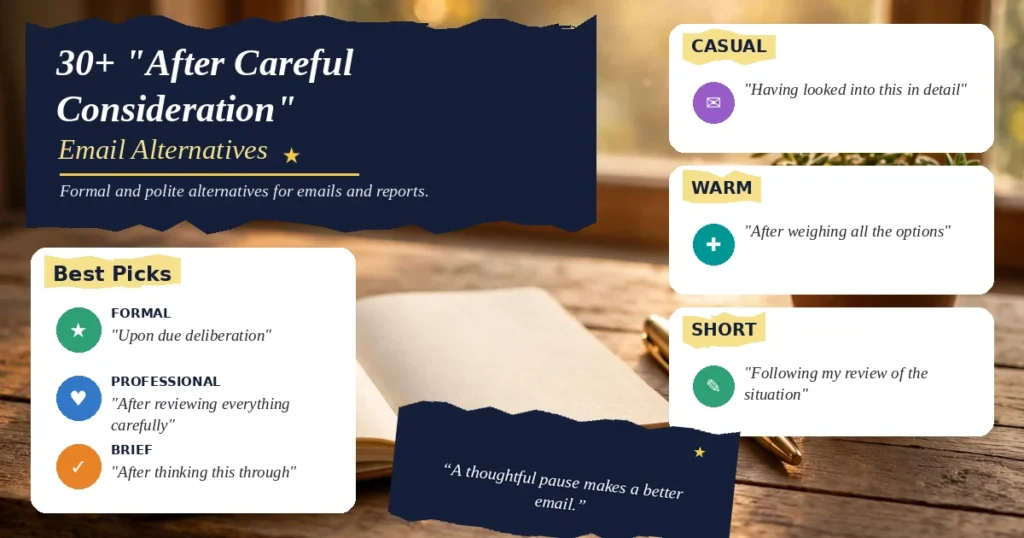
- After weighing all the options: Best when you want to show fairness. It tells the reader every choice got a fair look. Example: “After weighing all the options, we chose to keep the current plan.”
- Upon due deliberation: Best for official announcements. It is the most formal phrase on this list. Example: “Upon due deliberation, the association adopted the new rules.”
Professional email alternatives
These fit daily business email. They are polite and clear without sounding stiff.
- After reviewing everything carefully: Best for decisions that involved many details. It feels honest and human. Example: “After reviewing everything carefully, I think we should delay the launch.”
- Having looked into this in detail: Best when research was part of the process. It shows real effort. Example: “Having looked into this in detail, I believe a refund is the right call.”
- After thinking this through: Best for manager emails and team updates. It is direct and confident. Example: “After thinking this through, we will move the deadline to Friday.”
- Following my review of the situation: Best for first-person emails where you own the decision. It sounds responsible. Example: “Following my review of the situation, I have decided to approve the request.”
- After considering all the factors: Best for balanced decisions with pros and cons. It shows even-handedness. Example: “After considering all the factors, we will not renew the contract this year.”
- Having given this serious thought: Best for personal professional messages, like declining an offer kindly. It adds warmth to a firm answer. Example: “Having given this serious thought, I must pass on the project for now.”
- After a careful look at the numbers: Best for budget, pricing, and finance decisions. It grounds the choice in facts. Example: “After a careful look at the numbers, we need to cut the travel budget.”
- Upon further reflection: Best for follow-up emails where you changed or confirmed your view. It is short and natural. Example: “Upon further reflection, I agree with your original plan.”
Casual alternatives
Use these with coworkers you know well, in quick messages, or in friendly updates. They keep the meaning but drop the formality.
- After sleeping on it: Best for decisions made overnight. Everyone understands the feeling. Example: “After sleeping on it, I think your idea is better.”
- After thinking it over: Best for casual chats and friendly emails. It is the everyday version of the phrase. Example: “After thinking it over, I decided to take the new role.”
- Having thought long and hard: Best when the choice was truly difficult. It shows the struggle honestly. Example: “Having thought long and hard, I am going to pass on the move.”
- After chewing on it for a while: Best for very informal teams with a relaxed culture. It adds humor to a serious point. Example: “After chewing on it for a while, I finally get your point.”
- Once I had time to think: Best when a delay was the real reason for the decision taking long. It explains without apologizing. Example: “Once I had time to think, I realized the timing was wrong.”
- After mulling it over: Best for friendly, honest communication. It sounds natural and relaxed. Example: “After mulling it over, I think we should keep things simple.”
- Now that I have had a chance to think: Best for polite follow-ups after a first conversation. It bridges the gap between talks. Example: “Now that I have had a chance to think, I agree we should wait.”
- After giving it some real thought: Best for sincere but casual messages. It keeps the honesty of the original phrase. Example: “After giving it some real thought, I want to change my answer.”
Warm alternatives
These keep the thoughtfulness but add kindness. Use them when the reader deserves extra care, such as a rejected candidate you respect.
- After giving your proposal the attention it deserves: Best for rejections that must stay kind. It honors the other person’s effort. Example: “After giving your proposal the attention it deserves, we cannot move forward right now.”
- Having taken your feedback to heart: Best when someone shared opinions or complaints. It shows you listened. Example: “Having taken your feedback to heart, we changed the return policy.” When I appreciate it when clients speak up, and this phrase shows it back.
- After reflecting on what matters most: Best for value-based decisions. It adds a personal, human layer. Example: “After reflecting on what matters most, I chose to spend more time with my family.”
- With a great deal of thought: Best for graceful letters of refusal or resignation. It softens the message gently. Example: “With a great deal of thought, I have decided to step down from the role.”
- After considering your perspective fully: Best when you want the reader to feel heard before the answer. It builds goodwill. Example: “After considering your perspective fully, I still believe the current plan is best.”
- Having weighed this with care: Best for sensitive people-decisions, like team changes. It sounds kind and careful. Example: “Having weighed this with care, we decided to restructure the team.”
- After a thoughtful review of your case: Best for appeals, complaints, and HR matters. It respects the individual’s story. Example: “After a thoughtful review of your case, we approved your request.”
- With sincere deliberation: Best for messages that must feel personal. It is warm but still professional. Example: “With sincere deliberation, I accepted the offer to lead the project.”
Brief alternatives
Short options for tight emails, subject lines, and quick replies. They save space without losing meaning.
- After review: Best for fast, clear communication. It is the shortest honest option. Example: “After review, we approved the expense.”
- Upon review: Best for formal short notes and memos. It is crisp and clean. Example: “Upon review, the claim was accepted.”
- After due thought: Best when space is tight but tone still matters. Example: “After due thought, I must decline.”
- Post-review: Best for internal notes and status updates. It is modern and brief. Example: “Post-review, the team agreed to pause the campaign.”
- Following consideration: Best for short official statements. It keeps a formal edge. Example: “Following consideration, the motion was rejected.”
- After reflection: Best for personal short messages. It sounds calm and final. Example: “After reflection, I decided to stay.”
- Having considered the matter: Best for brief but complete sentences. Example: “Having considered the matter, we will proceed.”
- All things considered: Best for quick summaries of a decision. It wraps up the reasoning in three words. Example: “All things considered, the original plan is best.”
Quick comparison
Use this table to pick the right tone in seconds.
| Tone group | When to use it | Example phrase | Formality level |
|---|---|---|---|
| Formal | Legal letters, board decisions, official notices | After due consideration | Very high |
| Professional email | Daily business email with clients and managers | After reviewing everything carefully | High |
| Casual | Quick messages with coworkers you know | After thinking it over | Low |
| Warm | Kind rejections, sensitive people-decisions | Having taken your feedback to heart | Medium |
| Brief | Short notes, memos, status updates | After review | Medium |
If you are unsure which group fits, match the reader. A board member gets Formal. A client gets Professional email. A teammate gets Casual or Brief. When the news is hard, move one step warmer.
Email examples
Real emails show how these alternatives sound in action. Read each one and notice the tone.
Example 1: Job rejection (formal and warm)
Subject: Update on your application for the Marketing Lead role
Dear Ms. Rivera,
Thank you for your time in the interview process. After giving your application the attention it deserves, we have decided to move forward with another applicant. This was a close decision, and we were impressed by your portfolio.
We will keep your details on file for future roles. We wish you every success in your search.
Best regards,
Daniel
Example 2: Declining a vendor proposal (professional)
Subject: Re: Partnership proposal
Hello James,
Thank you for sending the proposal and for the clear presentation. After reviewing everything carefully, we have decided not to proceed at this time. The pricing model does not fit our current budget cycle.
Please keep in touch. We may revisit this next year. If you need help with anything on your end in the meantime, feel free to ask.
Kind regards,
Sarah
Example 3: Delaying a project (team email, casual-professional)
Subject: New timeline for the website redesign
Hi team,
After thinking this through, I believe we should push the launch by two weeks. The design still needs testing, and I would rather ship something solid than rush it.
New target date: November 14. I will share the updated plan tomorrow. Thank you for your hard work so far.
Best,
Mike
Example 4: Accepting an offer (positive news)
Subject: Re: Your offer
Dear Ms. Chen,
After weighing all the options, I am happy to accept the position of Senior Writer. Having given this serious thought, I am confident this is the right move for my career.
I look forward to starting on June 1. Please let me know the next steps.
Warm regards,
Alex
Example 5: Changing a company policy (formal announcement)
Subject: Update to our remote work policy
Team,
Following a comprehensive evaluation of last quarter’s results, we are updating the remote work policy. Starting next month, team leads may approve up to three remote days per week.
We made this change after considering all the factors, including productivity data and your feedback. Please be patient while we adjust the scheduling tools. If you have questions, reply to this email.
Thank you,
HR Team
Example 6: Quick internal reply (brief)
Hi Priya,
Post-review, we approved your expense report. The payment will go through on Friday.
Thanks,
Tom
Example 7: Follow-up after a first call (warm and polite)
Subject: Great speaking with you
Hello Mr. Adams,
Now that I have had a chance to think, I agree that starting with a trial month is the best approach. I am looking forward to your call on Thursday to discuss the details.
Best regards,
Nina
Common mistakes
Even good writers make these errors with this phrase family. Avoid all five.
Mistake 1: Using it when you decided in seconds. If you reply to a job application within an hour, “after careful consideration” sounds false. Match your words to the real timeline. For fast decisions, use “after review” or simply state the decision.
Mistake 2: Pairing it with vague reasons. “After careful consideration, we decided not to proceed” leaves the reader guessing. Add one clear reason. For example, “After careful consideration, we decided not to proceed because the timeline does not fit our launch date.”
Mistake 3: Using the formal version with close coworkers. Writing “Upon due deliberation, I will skip lunch” to a friend sounds silly. Save formal options for formal moments. With friends and close teammates, casual phrases fit better.
Mistake 4: Hiding behind the phrase. Some writers use “after careful consideration” to avoid explaining a choice. The phrase adds weight, but it cannot replace a reason. Always give the reader at least one honest sentence about why.
Mistake 5: Repeating the same alternative everywhere. If every rejection email says “after thorough review,” the phrase becomes the new template. Rotate your options. The 40 alternatives in this article give you plenty of room to vary your wording. And when I will let you know about a decision timeline, keep the follow-up as clear as the decision itself.
Related phrases
These phrases do not mean the same thing, but writers often need them in the same situations. Each one solves a nearby writing problem.
“Thank you for your patience”: Use it when the decision took longer than expected. It thanks the reader for waiting. Example: “Thank you for your patience while we reviewed all applications.”
“We have reached a decision”: Use it as a clean opening line before the news. It is neutral and direct. Example: “We have reached a decision regarding your proposal.”
“After much thought”: A softer cousin of the main phrase. It works when you want less formality. Example: “After much thought, I decided to accept.”
“It was not an easy decision”: Use it to show the choice was hard. It adds empathy before bad news. Example: “It was not an easy decision, but we must close the branch.”
“We took your feedback seriously”: Use it when the reader shared input. It proves you listened before deciding. Example: “We took your feedback seriously and changed the schedule.”
“On reflection”: A short, elegant phrase for personal writing. It fits essays and thoughtful emails. Example: “On reflection, the first plan was too risky.”
“In light of the facts”: Use it when evidence drove the choice. It sounds objective and calm. Example: “In light of the facts, we approved the budget increase.”
“After consulting with the team”: Use it when the decision was shared. It spreads responsibility fairly. Example: “After consulting with the team, we chose the new design.”
Each of these can pair with an alternative from the main list. For example, “After consulting with the team and giving the matter serious thought, we decided to proceed.” Layering two phrases adds depth without sounding repetitive.
Phrase comparison
“After careful consideration” has close cousins that sound similar but mean slightly different things. Picking the right one sharpens your message.
“After careful consideration” vs. “After some thought”: The first sounds formal and thorough. The second sounds casual and quick. Use the first for official decisions. Use the second for everyday choices.
“After careful consideration” vs. “After much deliberation”: Both are formal. “Deliberation” hints at a group discussion, like a jury or a board. Use it when more than one person decided. Use “consideration” when one person decided alone.
“After careful consideration” vs. “Upon reflection”: “Consideration” looks outward at the facts and options. “Reflection” looks inward at your own feelings and values. Use reflection for personal decisions. Use consideration for business ones.
“After careful consideration” vs. “After due diligence”: “Due diligence” means a formal investigation, often with legal or financial checks. It is stronger and more specific. Use it in contracts, mergers, and investments. For normal decisions, “consideration” is enough.
“After careful consideration” vs. “Having weighed the pros and cons”: The second phrase is more concrete. It tells the reader exactly what you did: listed advantages and disadvantages. Use it when you want to sound practical. Use “consideration” when you want to sound measured and formal.
“After careful consideration” vs. “All things considered”: The second is shorter and more conversational. It works well at the end of a discussion. The first works better at the start of an announcement. Choose based on where the sentence sits.
A simple rule: match the weight of the phrase to the weight of the decision. Big decisions earn big phrases. Small decisions earn small ones. At the end of the day, readers trust writers whose words fit the moment, just like they trust writers who close emails with a clear next step.
Cultural usage
This phrase travels well across cultures, but the tone rules change from place to place. A small awareness of these differences improves your global emails.
In the United States, “after careful consideration” is a standard part of business writing. Americans expect a direct decision after the phrase. Long explanations feel unnecessary. State the decision, give one reason, and move on.
In the United Kingdom, the phrase often comes with softer language around it. British writers may add phrases like “I am afraid” or “unfortunately.” For example, “I am afraid that, after careful consideration, we cannot proceed.” The extra softening matches British politeness norms.
In many Asian business cultures, indirect language matters even more. Writers may thank the reader several times before the decision appears. A phrase like thank you for the clarification often opens the email, and the decision arrives near the end. If you write to partners in Japan, Korea, or the Middle East, extra warmth around your alternative shows respect.
In German and Dutch business cultures, directness is a virtue. Readers there may prefer “After review, we decided” over long, warm phrases. Short alternatives from the Brief group often land best.
One universal rule holds everywhere. Never use this phrase to hide a decision you have not made yet. In every culture, readers notice when words promise thought that never happened. Say what you decided, say why in one line, and respect the reader’s time.
Frequently asked questions
What does “after careful consideration” mean in an email?
It means the writer thought deeply about the matter before deciding. It signals that the decision was fair and not rushed. Readers usually see it right before a yes or a no.
Is “after careful consideration” formal or informal?
It is formal. It fits business emails, official letters, and announcements. In casual chats with friends, it sounds too stiff. Use “after thinking it over” instead.
Can I use “after careful consideration” for good news?
Yes. It works before both good and bad news. For good news, it adds weight to the message. For example, “After careful consideration, we would like to offer you the position.”
What is a shorter way to say “after careful consideration”?
“After review” is the shortest honest option. “Upon review” is a close second with a slightly more formal feel. “All things considered” is short and conversational.
How do I say “after careful consideration” politely in a rejection email?
Add warmth around it. Try “Having given your application the attention it deserves” or “With a great deal of thought.” Then give one clear reason for the decision. Warmth plus honesty makes rejection easier to accept.
Is “after careful consideration” overused?
It is very common, especially in rejection letters. Because of that, some readers see it as a template phrase. Rotating through the 40 alternatives in this article keeps your writing fresh.
Can I use this phrase when I decided quickly?
You should not. The phrase promises real thought, so using it for a snap decision sounds false. Match your words to the facts. For fast decisions, use “after review” or state the choice directly.
What is the difference between “consideration” and “deliberation”?
“Consideration” means thinking about the options. “Deliberation” suggests a longer, deeper discussion, often with other people. “Deliberation” sounds slightly more formal and serious.
How do I start a sentence with one of these alternatives?
Place the phrase at the start, add a comma, then state the decision. For example, “After reviewing everything carefully, we approved the budget.” Keep the decision in the same sentence so the reader does not wait.
Should I explain my reasons after using the phrase?
Yes, give at least one clear reason. The phrase adds weight, but it cannot replace an explanation. One honest sentence about why is enough. Readers respect clarity.
Can I use these alternatives in a cover letter?
Yes, but choose carefully. A cover letter should sound confident, so phrases like “After weighing all the options, I am excited to apply” work well. Avoid the rejection-sounding ones. Focus on positive, forward-looking options.
Is “upon further reflection” the same as “after careful consideration”?
They are close, but not identical. “Upon further reflection” suggests you thought again after a first round of thinking. It fits follow-up emails. “After careful consideration” covers the whole thinking process from the start.
What tone should I use when declining with this phrase?
Stay warm, brief, and honest. Thank the reader, state the decision with your chosen alternative, and give one reason. Avoid long apologies. A short, kind message respects everyone’s time.
Can I use “after careful consideration” in academic writing?
Yes. It fits research papers, theses, and formal reports. For example, “After careful consideration of the data, we rejected the hypothesis.” In academic text, it signals a methodical process.
How many alternatives should I rotate in my emails?
Three or four favorites are enough for most people. Pick one formal, one professional email, one warm, and one brief option. Rotate them based on the reader and the news. Variety keeps your writing human.
Conclusion
You now have 40 other ways to say after careful consideration, plus email examples, tone guidance, and answers to the most common questions. The right phrase depends on your reader, your news, and your relationship with the person on the other side. Formal moments earn formal words. Kind news earns warm words. Quick updates earn brief ones.
The core lesson is simple. This phrase family promises one thing: real thought before a real decision. Keep that promise every time you use an alternative. Match the weight of your words to the weight of the choice, give one clear reason, and always close with a next step.
Start small. Pick three alternatives from this list and use them this week. Notice how your emails feel different when the wording fits the moment. Good writing is not about big words. It is about the right words. For a deeper look at the word itself, see consideration in the Cambridge Dictionary, and keep practicing until these phrases come naturally.