Introduction
If you are looking for other ways to say well noted in an email at work, you are probably tired of repeating the same short reply. “Well noted” is polite and clear, but when you use it in every message, it starts to sound automatic. Your reader may even wonder whether you actually read their email or simply sent a quick reflex reply. A small change in wording can fix that problem. The right phrase shows that you understood the message, that you respect the sender, and that you know what happens next.
Work emails move fast. Managers send updates, clients share instructions, and colleagues pass on deadlines. Each message deserves a reply that fits the situation. A short note to a close colleague does not need the same tone as a reply to a senior director or an important client. That is why having a range of alternatives matters. When you can pick a phrase that matches the tone, the relationship, and the action required, your emails sound more human and more professional at the same time.
This guide gives you 40 alternatives grouped by tone, so you can find the right one in seconds. You will also find full email examples, common mistakes to avoid, and tips for using these phrases across different cultures and workplaces. Whether you want a quick reply or a formal acknowledgement, you will find an option here that fits. If you often need to show understanding in a warmer way, learning other ways to say I understand can also help you vary your replies.
Meaning
“Well noted” is a short way of saying that you have read a message, understood it, and recorded the information in your mind. People use it in work emails to confirm receipt without writing a long reply. It tells the sender that their message did not disappear into an empty inbox. It also closes the loop, so the sender does not need to follow up and ask whether you saw their email.
The phrase comes from formal business language. In older office writing, people wrote “duly noted” or “noted with thanks” in letters and memos. Over time, “well noted” became a popular shortcut in emails, especially in workplaces in South Asia, the Middle East, and parts of Europe. Today it appears in offices all over the world, and most professionals understand it at once.
Still, the phrase has limits. On its own, it does not say what you will do next. It does not show warmth, and it does not confirm any specific detail. If a manager sends a long email with three instructions and you reply only with “well noted,” they may wonder which parts you understood. A stronger reply names the key point or adds a next step. For example, “Well noted, I will send the report by Friday” is much clearer than “well noted” alone. The alternatives in this guide help you add that clarity while keeping your reply short and polite.
Professional usage
At work, the way you acknowledge a message shapes how people see you. A careful reply builds trust. It shows that you pay attention, that you take instructions seriously, and that you respect other people’s time. A careless reply can do the opposite. A one-word answer to a detailed email can look dismissive, even when you do not mean it that way.
Use a short acknowledgement when the message needs no action and no discussion. For example, if your manager shares a meeting time or a policy update, a brief reply is enough. Use a longer, warmer reply when the message comes from a client, a senior leader, or someone who took time to explain something in detail. In those cases, thank the person and repeat the key point in your own words.
Tone matters as much as words. With a senior manager, choose formal language. With a close colleague, a friendly tone is fine. With a client, stay polite and professional, and avoid slang. Also match the length of your reply to the message you received. A two-line reply to a two-paragraph email looks unbalanced. A short sentence that repeats the main point usually fixes that problem.
One more rule helps in every workplace: never acknowledge a message you have not read. If you reply “noted” to an email that contains a question or a deadline, and then you miss that detail, the sender will lose trust in your replies. Read first, then choose your phrase. If you need more time before acting, say so honestly. A reply like “Noted, I will review this and reply by tomorrow” is far better than a fast reply that promises nothing. When a message also asks for patience while you work on it, you may find please be patient useful for phrasing that request politely.
Alternatives
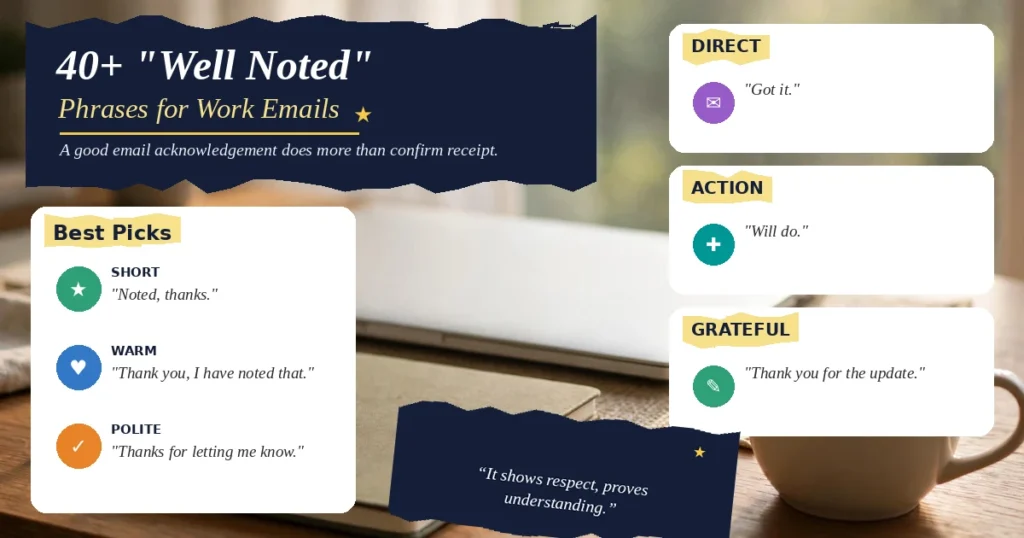
The 40 alternatives below fall into five tone groups. Each group fits a different kind of workplace situation. Pick the group first, then pick the phrase that fits your message. Each entry includes a short note on tone and best use, plus a one-line example you can adapt.
Short and direct.
Use these when you need a fast reply and no action is required. They work best with colleagues you already know well.
- Noted, thanks. — Short and polite. Best for quick updates from colleagues. Example: “Noted, thanks. I will check the schedule and confirm.”
- Got it. — Casual and direct. Best for internal chats and fast email threads. Example: “Got it. I will join the call at three.”
- Understood. — Clear and neutral. Best for instructions from a manager. Example: “Understood. I will follow the new process from Monday.”
- Message received. — Slightly formal. Best when you want to confirm delivery. Example: “Message received. I will review the document today.”
- Noted. — Very brief. Best for simple information with no action needed. Example: “Noted. I have saved the new deadline.”
- Acknowledged. — Formal and crisp. Best for official instructions. Example: “Acknowledged. I will proceed as instructed.”
- Copy that. — Informal and confident. Best for quick team coordination. Example: “Copy that. I will update the sheet now.”
- Will do. — Friendly and action-ready. Best when you accept a small task. Example: “Will do. I will send the file before lunch.”
Warm and polite.
Use these when you want to sound grateful and human. They work well with clients, senior colleagues, and anyone who helped you.
- Thank you, I have noted that. — Warm and complete. Best for client emails. Example: “Thank you, I have noted that. I will adjust the plan accordingly.”
- Thanks for letting me know. — Friendly and natural. Best for updates from any colleague. Example: “Thanks for letting me know. I will keep an eye on the timeline.”
- I appreciate you sharing this. — Warm and respectful. Best when someone shares useful information. Example: “I appreciate you sharing this. It helps me plan the week better.”
- Thank you for the update. — Polite and standard. Best for status updates. Example: “Thank you for the update. I will inform the rest of the team.”
- I have taken note of that. — Polite and slightly formal. Best for meeting follow-ups. Example: “I have taken note of that. I will include it in the minutes.”
- Thanks, I understand completely. — Reassuring and warm. Best when someone explains a concern. Example: “Thanks, I understand completely. I will be more careful next time.”
- I am grateful for the heads-up. — Friendly and appreciative. Best for early warnings about problems. Example: “I am grateful for the heads-up. I will fix the issue today.”
- Thank you, I will keep that in mind. — Gentle and thoughtful. Best for advice or reminders. Example: “Thank you, I will keep that in mind for the next presentation.”
Formal and professional.
Use these with senior leaders, clients, and official correspondence. They sound serious without sounding cold.
- Duly noted. — Classic formal phrase. Best for official instructions. Example: “Duly noted. I will act on your guidance.”
- Your message has been noted. — Formal and clear. Best for client or management emails. Example: “Your message has been noted. We will proceed as requested.”
- I confirm receipt of your message. — Very formal. Best for legal or official matters. Example: “I confirm receipt of your message. I will respond in detail soon.”
- This has been recorded. — Formal and factual. Best when you log information. Example: “This has been recorded. The team will use the updated figures.”
- I acknowledge your message. — Formal and respectful. Best for senior management. Example: “I acknowledge your message. I will review the proposal this week.”
- Your instructions are noted. — Formal and obedient in tone. Best for direct orders. Example: “Your instructions are noted. I will complete the task by Friday.”
- I have noted the details. — Professional and precise. Best for detailed briefs. Example: “I have noted the details. I will prepare the summary for you.”
- Thank you for bringing this to my attention. — Formal and courteous. Best for complaints or important issues. Example: “Thank you for bringing this to my attention. I will look into it right away.”
Action-focused.
Use these when the message requires a next step. They tell the sender exactly what you will do, which removes doubt.
- Noted, and I will act on it. — Clear and responsible. Best for tasks with clear actions. Example: “Noted, and I will act on it before the end of the day.”
- Understood, I will follow up. — Professional and active. Best for ongoing matters. Example: “Understood, I will follow up with the supplier tomorrow.”
- Got it, I will take care of it. — Confident and friendly. Best for tasks you own fully. Example: “Got it, I will take care of it and update you soon.”
- Noted, I will update the team. — Team-oriented. Best when others need the information. Example: “Noted, I will update the team in our morning meeting.”
- I will proceed as suggested. — Formal and cooperative. Best for approved plans. Example: “I will proceed as suggested and share the results with you.”
- Understood, I will make the change. — Direct and useful. Best for corrections or edits. Example: “Understood, I will make the change in the document today.”
- Noted, I will confirm once done. — Reassuring. Best for tasks that need a closing update. Example: “Noted, I will confirm once done so you can close the ticket.”
- Thanks, I will handle this today. — Prompt and polite. Best for urgent small tasks. Example: “Thanks, I will handle this today and send you the confirmation.”
Friendly and conversational.
Use these with colleagues you know well and in relaxed office cultures. They keep the tone light while still showing that you understood.
- Got it, thanks a lot. — Warm and casual. Best for friendly teams. Example: “Got it, thanks a lot. I will get started right away.”
- Perfect, noted. — Upbeat and short. Best for simple confirmations. Example: “Perfect, noted. I will add it to my list.”
- Sounds good, noted. — Relaxed and agreeable. Best for informal approvals. Example: “Sounds good, noted. Let us go with that plan.”
- You got it. — Very casual and friendly. Best for peers, not senior leaders. Example: “You got it. I will send the slides by four.”
- Thanks, all clear now. — Friendly and confident. Best after a helpful explanation. Example: “Thanks, all clear now. I know what to do next.”
- Noted, appreciate it. — Short and warm. Best for quick helpful messages. Example: “Noted, appreciate it. I will keep you posted.”
- All good, I have got it. — Relaxed and reassuring. Best for informal teams. Example: “All good, I have got it. No need to resend the file.”
- Thanks for the note. — Simple and friendly. Best for short informational emails. Example: “Thanks for the note. I will remember the new timing.”
Quick comparison
Choosing the right phrase becomes easier when you compare the groups side by side. Short and direct phrases save time, but they can feel cold if the message is sensitive. Warm and polite phrases build relationships, but they may feel too long for a fast-moving thread. Formal phrases show respect to senior leaders, yet they can sound stiff between close colleagues. Action-focused phrases are the safest choice when a task is involved, because they remove all doubt about what happens next. Friendly phrases keep the mood light, but you should avoid them with clients or senior managers you do not know well.
| Tone group | Best for | Reply length | Avoid with |
|---|---|---|---|
| Short and direct | Quick internal updates | Very short | Sensitive complaints |
| Warm and polite | Clients and helpful colleagues | Medium | Fast-moving group threads |
| Formal and professional | Senior leaders and official mail | Medium | Close friends at work |
| Action-focused | Any message needing a task | Short to medium | Messages needing no action |
| Friendly and conversational | Relaxed teams and peers | Short | New clients and senior leaders |
A simple rule covers most cases. If the email needs action, add the action to your reply. If the email is sensitive, add warmth. If the email is official, add formality. When in doubt, choose a warm and polite phrase, because it rarely offends anyone and it always sounds human.
Email examples
The examples below show how these phrases work inside complete emails. Notice how each reply repeats the key point or states a next step. That small detail turns a plain acknowledgement into a useful reply.
Example 1: Reply to a manager about a deadline
Subject: Re: Report deadline
Dear Ms. Khan,
Thank you, I have noted that. I will submit the monthly report by Friday afternoon, and I will share the summary with the team once it is ready.
Best regards,
Ali
Example 2: Reply to a client about a change request
Subject: Re: Website update
Dear Mr. Smith,
Your message has been noted. We will update the homepage banner as requested and send you a preview link by tomorrow morning.
Kind regards,
Sara
Example 3: Quick reply to a colleague about a meeting
Subject: Re: Team meeting
Hi Ayesha,
Got it, thanks a lot. I will join the meeting at eleven and bring the sales figures with me.
Thanks,
Omar
Example 4: Reply when you need more time
Subject: Re: Budget approval
Dear Ms. Lee,
Noted, and I will act on it. I need to check two figures with the finance team first, so I will send my full reply by Wednesday.
Best regards,
Fatima
Example 5: Reply to a senior leader about a policy update
Subject: Re: New travel policy
Dear Director Ahmed,
Duly noted. I will follow the new travel policy for all future bookings and share the update with my team members.
Respectfully,
Hassan
Example 6: Reply to a team update that needs no action
Subject: Re: Office closure
Hi team,
Thanks for letting me know. I have updated my calendar, and I will work from home on that day.
Best,
Nadia
If you often reply to messages that ask you to wait for a result, learning how to say I appreciate it with warmth can make those replies feel more personal too.
Common mistakes
Even a short acknowledgement can go wrong. These are the most common mistakes people make with “well noted” and similar phrases, and how to fix each one.
Replying with only two words to a long email. When someone writes a detailed message and you answer with “well noted,” they may feel ignored. Fix it by repeating the main point in one sentence. For example, write “Well noted, I will send the updated file by Thursday” instead of just “well noted.”
Using “well noted” for bad news. If a client reports a problem, replying “well noted” can sound cold and uncaring. A problem needs empathy first. Write something like “Thank you for letting me know. I understand the issue, and I will fix it today.” For messages that carry frustration, a warmer acknowledgement such as I understand your frustration shows far more care than a flat “noted.”
Acknowledging without reading. Some people reply fast to clear their inbox, then miss a question or a deadline hidden in the email. Always read the full message before you reply. If the email is long, scan it twice for dates, names, and questions.
Using slang with senior leaders. Phrases like “copy that” or “you got it” may sound rude to a director or a new client. Save casual phrases for peers and relaxed teams. When you are unsure about the right level of formality, choose a neutral phrase like “Understood” or “Thank you, I have noted that.”
Forgetting the next step. An acknowledgement that says nothing about the future leaves the sender guessing. If any action is needed, name it. Even a short addition like “I will confirm once done” gives the sender peace of mind.
Overusing the same phrase. If every reply you send says “well noted,” your emails start to look copied and pasted. Rotate through the alternatives in this guide. Variety shows that you actually read each message and thought about your reply.
Related phrases
“Well noted” belongs to a family of acknowledgement phrases. Knowing the nearby phrases helps you pick the most exact one for each situation. “Noted with thanks” adds gratitude to a plain acknowledgement, and it suits client emails well. “Duly noted” sounds more formal and official, and it fits instructions from senior leaders. “Understood” stresses comprehension rather than recording, so it works well when someone explains a rule or a process. “Got it” is the casual cousin of the group, and it fits fast chats between colleagues.
Other useful phrases include “I will take care of it,” which promises action, and “I will keep that in mind,” which suits advice and reminders. “Thanks for the heads-up” works when someone warns you about a problem early. “I will look into it” fits complaints and issues that need investigation. Each of these phrases overlaps with “well noted,” but each one carries a slightly different shade of meaning. The more of them you know, the more precise your replies become.
You can also combine acknowledgement with gratitude or an offer of help. For example, “Thank you for the update. If you need anything from my side, please let me know” covers both acknowledgement and support. When a colleague thanks you for your own help, a polite reply such as my pleasure to help keeps the exchange warm and professional. Building a small set of reliable phrases like these makes daily email writing faster and less stressful.
Phrase comparison
Some alternatives look similar but behave differently in real emails. This section compares the closest pairs so you can choose with confidence.
“Well noted” versus “duly noted”: both are formal, but “duly noted” sounds more official and slightly old-fashioned. Use “well noted” in normal office emails and “duly noted” when the matter is formal, such as a board instruction or a legal notice. Neither phrase shows warmth, so add a thank-you when the message deserves one.
“Noted” versus “understood”: “noted” says you recorded the information, while “understood” says you grasped its meaning. If a manager explains a new rule, “understood” fits better. If a colleague shares a date or a figure, “noted” fits better. When both apply, you can combine them: “Understood and noted.”
“Got it” versus “will do”: “got it” only confirms understanding, while “will do” also promises action. If someone gives you a task, “will do” is stronger. If someone shares information with no task attached, “got it” is enough. Using “will do” for a message that needs no action can confuse the sender, because they may wait for a result that never comes.
“Thank you for the update” versus “thanks for letting me know”: both are warm and polite, but the first suits formal updates and the second suits casual news. A project status report calls for “thank you for the update.” A colleague telling you about a room change calls for “thanks for letting me know.” The difference is small, but matching the phrase to the message shows attention to detail.
Finally, compare short replies with full replies. A short reply like “Noted, thanks” saves time and suits routine messages. A full reply like “Thank you, I have noted that. I will update the report and send it by Friday” suits important messages. The extra sentence costs you ten seconds, but it can save the sender a follow-up email and a day of waiting.
Cultural usage
Email tone varies across cultures, and “well noted” is a good example of that variation. In Pakistan, India, and the Gulf countries, “well noted” is extremely common in office emails. Managers and employees use it daily, and nobody finds it strange. In the United States and the United Kingdom, the phrase is understood but less common. American professionals more often write “got it,” “sounds good,” or “thanks for the update.” British professionals often write “noted, thanks” or “understood.”
This difference matters when you email people in other countries. If you write “well noted” to an American client, they will understand you, but the phrase may feel slightly formal to them. If you write “got it” to a senior manager in a formal Asian workplace, it may feel too casual. The safest approach is to match the tone of the person who emailed you. If their email is formal, reply formally. If their email is relaxed, you can relax a little too.
Formality also varies by industry. Banks, law firms, and government offices expect formal acknowledgements. Tech startups and creative agencies accept casual ones. When you join a new company, watch how your colleagues reply to emails for a week. Their habits will tell you what the local standard is. Adapting to that standard shows cultural awareness, and it helps you build trust faster with new teams and clients.
Frequently asked questions
Is “well noted” polite in a work email?
Yes, “well noted” is polite and widely accepted in work emails. It confirms that you read and understood the message. It can sound a little stiff on its own, so adding a thank-you or a next step makes it warmer and clearer.
What is the most professional alternative to “well noted”?
“Duly noted” and “your message has been noted” are among the most professional options. They suit senior leaders, clients, and official correspondence. For a balance of professionalism and warmth, “thank you, I have noted that” is an excellent choice.
Can I say “well noted” to my boss?
Yes, you can say “well noted” to your boss, especially in workplaces where the phrase is common. To show extra respect, use a fuller version such as “Well noted, thank you. I will complete the task by Friday.” Avoid very casual phrases like “you got it” with senior leaders unless your office culture is relaxed.
Is “noted” rude in an email?
“Noted” alone is not rude, but it can feel blunt if the message is long or emotional. A single word gives the sender nothing to work with. Adding a thank-you or a short detail, such as “Noted, thanks. I will check the dates,” removes any risk of sounding rude.
What should I reply instead of “well noted” to a client?
To a client, use a warm and complete reply such as “Thank you, I have noted that. We will proceed as requested and update you soon.” Clients value clarity and courtesy, so name the action you will take and give a time frame when you can.
Is “well noted” correct grammar?
Yes, “well noted” is grammatically correct as a short form. It is an elliptical phrase, which means it drops words that the reader can infer, such as “your message is.” In full sentences, you would write “Your message is well noted” or “I have noted your message well.”
How do I reply “well noted” in a formal email?
In a formal email, write a full sentence with a greeting and a closing. For example: “Dear Mr. Ahmed, your message has been noted. I will review the attached report and reply with my comments by Monday. Kind regards, Sara.” This structure looks professional and complete.
What is a short reply for “well noted” in a team chat?
In a team chat, short replies like “Got it,” “Noted, thanks,” or “Copy that” work well. Team chats move fast, so brevity is welcome. Save longer replies for emails that need a record or involve clients.
Should I say “well noted” or “well received”?
Use “well noted” when you want to confirm understanding and recording of information. Use “well received” when you want to confirm that you received a document, parcel, or file. For an email with an attachment, “well received” fits. For an email with instructions, “well noted” fits better.
Can “well noted” sound sarcastic?
It can, if the context is tense or the reply is too short for the situation. Replying “well noted” to a complaint or a long explanation can feel dismissive. In sensitive situations, use an empathetic reply that names the issue and promises action instead of a bare acknowledgement.
How do I acknowledge an email without sounding robotic?
Add one personal detail to your reply. Repeat the key point, name the next step, or thank the sender for something specific. For example, “Thanks for the detailed update. I have noted the new dates and will adjust my plan today” sounds human because it proves you read the message.
Is it okay to reply “well noted” to a thank-you email?
It is better to reply with gratitude rather than acknowledgement. If someone thanks you, answer with “You are welcome” or “My pleasure.” Replying “well noted” to a thank-you message can feel odd, because there is nothing to note. Match your reply to the purpose of their message.
What does “well noted, thanks” mean?
“Well noted, thanks” means you have read the message, understood it, and you are grateful to the sender. It is slightly warmer than “well noted” alone. It works well for everyday office updates and messages from colleagues at any level.
How can I vary my email acknowledgements?
Keep a small list of five or six favourite phrases from different tone groups and rotate them. Match the phrase to the sender, the message, and the action required. Variety, plus one specific detail from the email, keeps your replies fresh and genuine.
Do native English speakers use “well noted”?
Native speakers understand it, but they use it less often than “got it,” “noted, thanks,” or “understood.” It is more common in international business English and in South Asian and Gulf workplaces. If you email native speakers regularly, mixing in phrases like “thanks for the update” will make your English sound more natural to them.
Conclusion
A good email acknowledgement does more than confirm receipt. It shows respect, proves understanding, and tells the sender what happens next. “Well noted” does the job, but it is only one tool in a much larger set. With the 40 alternatives in this guide, you can match your reply to the sender, the situation, and the tone of your workplace. Short phrases suit fast threads, warm phrases suit clients and helpers, formal phrases suit senior leaders, and action-focused phrases suit any message that needs a result.
Start small. Pick five phrases from different tone groups and use them for one week. Notice which ones feel natural and which ones earn better responses from your colleagues. Over time, choosing the right acknowledgement will become automatic, and your emails will sound more confident and more human. If you need to thank someone for taking time to help you, learning other ways to say thank you for taking care of this can add warmth to those replies as well.
For the exact meaning and usage of the word at the heart of this phrase, see the Cambridge Dictionary entry for noted. Keep practising these alternatives, and your work emails will become clearer, warmer, and more professional with every reply.