Introduction
When someone shares a sharp observation that changes how you see a problem, a plain “thanks” can feel too small. That is why so many people search for other ways to say thank you for your insight. The right words show that you truly listened, that you value the other person’s thinking, and that you plan to use what they shared. A thoughtful thank-you also builds trust at work, because people repeat the behavior they feel appreciated for.
You can use these phrases in emails, meetings, chats, and feedback sessions. A short note after a mentor explains a tricky idea can strengthen the whole relationship. A warm line to a client after a useful call can set the tone for the next project. The key is to match your words to the moment. A formal note suits a senior leader, while a relaxed line suits a close teammate.
This guide gives you 40 ready-to-use alternatives, grouped by tone, plus email examples and common mistakes to avoid. You will learn when the original phrase works best, when a fresh version sounds better, and how to pick words that feel natural rather than stiff. By the end, you will never stare at a blank reply box again, unsure how to thank someone for a valuable idea.
Meaning
The phrase “thank you for your insight” means that you appreciate someone’s clear, deep understanding of a topic. An insight is not just a fact or an opinion. It is a fresh way of seeing a situation, often based on experience, careful thought, or close observation. When you thank someone for their insight, you praise both their knowledge and their judgment.
People use this phrase when a colleague explains why a project failed, when a manager points out a risk nobody else noticed, or when a client describes what their customers truly want. The words carry respect. They tell the other person that their view added real value, not just noise.
The phrase also works as a polite bridge in a conversation. It lets you accept feedback without arguing, and it keeps the door open for more honest discussion. For example, after a tough review meeting, saying “thank you for your insight” shows maturity. It says you can hear hard truths and still stay professional.
Still, the phrase can sound overused if you repeat it in every reply. Readers may start to skim past it, and the praise loses power. That is why a varied set of alternatives matters. When you choose words that fit the exact idea you received, your gratitude feels personal and sincere, not copied from a template.
Professional usage
In professional writing, “thank you for your insight” fits best after someone gives advice, analysis, or feedback that shapes a decision. Use it in a follow-up email after a strategy meeting, in a reply to a detailed report, or in a message to a mentor who helped you solve a problem. It works well with senior leaders, clients, and experts, because it sounds respectful without sounding stiff.
Keep the tone measured. Pair the thank-you with one specific detail from what the person said, so your message does not read like a generic reply. For instance, write “Thank you for your insight into our pricing problem. Your point about smaller packages changed our plan.” The detail proves that you listened, and it gives the other person a reason to keep helping you.
Avoid the phrase when the comment was simple or routine. If a teammate only confirmed a meeting time, a big word like “insight” sounds out of place. Save it for moments when someone truly helped you think better. Also avoid stacking too many praise phrases in one message, because that can sound like flattery. One sincere line, followed by a clear next step, beats a long string of compliments.
Timing matters too. Send your thank-you soon after the conversation, while the idea is still fresh. A quick same-day note feels warm and alert. A message that arrives weeks later can still work, but it should mention the result, such as “Your insight helped us win the client, and I wanted you to know.” That kind of follow-up turns a polite phrase into a real relationship builder.
If you want a softer opening before your thank-you, you can learn how to reach out with warmth and clarity in your first line. A kind opening makes the gratitude that follows feel even more natural.
Alternatives
The 40 phrases below fall into five tone groups, with eight phrases in each group. Pick the group that matches your relationship with the reader, then pick the phrase that fits the exact idea you received.
Formal and professional
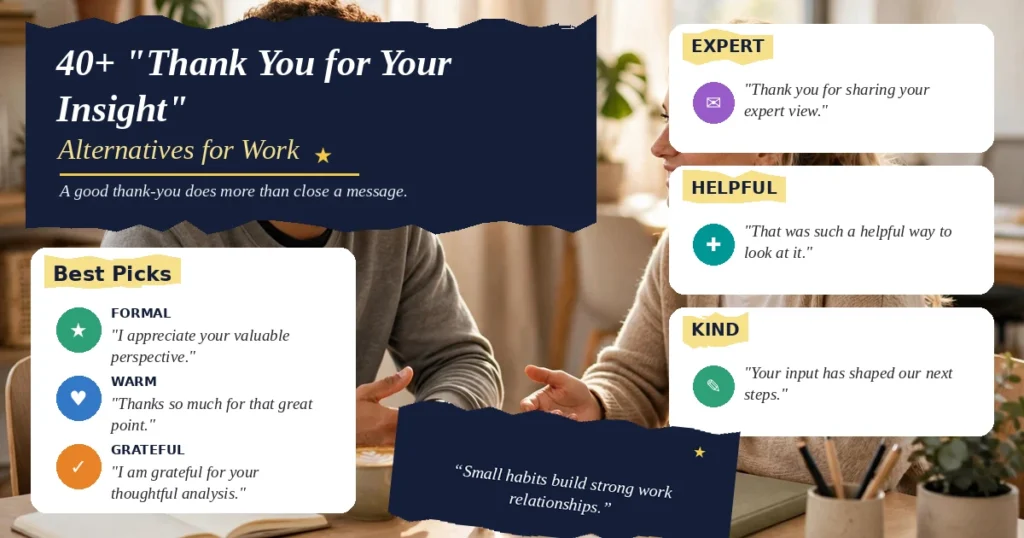
- I appreciate your valuable perspective. Best for senior leaders and formal emails. Example: “I appreciate your valuable perspective on the budget review.”
- Thank you for sharing your expert view. Best when an expert gives technical advice. Example: “Thank you for sharing your expert view on the new system.”
- I am grateful for your thoughtful analysis. Best after a detailed report or review. Example: “I am grateful for your thoughtful analysis of the survey results.”
- Your guidance means a great deal to me. Best for mentors and senior advisors. Example: “Your guidance means a great deal to me as I plan this project.”
- Thank you for your careful assessment. Best after a risk review or audit. Example: “Thank you for your careful assessment of the contract terms.”
- I value your professional judgment. Best for decision makers you respect. Example: “I value your professional judgment on this hiring choice.”
- Thank you for shedding light on this matter. Best for formal client messages. Example: “Thank you for shedding light on this matter before we signed.”
- Your input has shaped our next steps. Best when advice changes a plan. Example: “Your input has shaped our next steps for the launch.”
Warm and friendly
- Thanks so much for that great point. Best for close teammates and kind managers. Example: “Thanks so much for that great point about our customers.”
- I really appreciate how clearly you explained that. Best after a helpful explanation. Example: “I really appreciate how clearly you explained that process to me.”
- That was such a helpful way to look at it. Best for casual work chats. Example: “That was such a helpful way to look at the sales problem.”
- Thank you for opening my eyes to that. Best when an idea truly surprises you. Example: “Thank you for opening my eyes to that pricing issue.”
- I love the way you framed that idea. Best for creative teammates. Example: “I love the way you framed that idea for the campaign.”
- You always help me see the bigger picture. Best for a trusted colleague. Example: “You always help me see the bigger picture in these meetings.”
- Thanks for helping me think this through. Best after a long discussion. Example: “Thanks for helping me think this through before the deadline.”
- Your words gave me a lot to think about. Best for a warm closing line. Example: “Your words gave me a lot to think about, and I am grateful.”
Short and casual
- Great insight, thank you. Best for quick chat messages. Example: “Great insight, thank you. I will update the plan today.”
- Thanks for the fresh angle. Best for short replies at work. Example: “Thanks for the fresh angle on the product page.”
- That helps a lot, thanks. Best for fast-moving team chats. Example: “That helps a lot, thanks. I see the issue now.”
- Appreciate the clarity. Best for brief, polite replies. Example: “Appreciate the clarity on the timeline.”
- Good catch, thank you. Best when someone spots a problem. Example: “Good catch, thank you. I fixed the error right away.”
- Thanks for the heads-up on that. Best when advice prevents a mistake. Example: “Thanks for the heads-up on that client concern.”
- Noted with thanks. Best for very short formal notes. Example: “Noted with thanks. I will share this with the team.”
- Thanks, that makes sense now. Best after a confusing topic becomes clear. Example: “Thanks, that makes sense now. I will follow your plan.”
Thoughtful and detailed
- Your observation changed how I see this problem. Best when an idea shifts your view. Example: “Your observation changed how I see this problem, and I will act on it.”
- Thank you for connecting the dots for me. Best after a complex explanation. Example: “Thank you for connecting the dots for me in that report.”
- I had not considered that angle before. Best for honest, humble replies. Example: “I had not considered that angle before, and it makes a big difference.”
- Your breakdown made a tough topic much clearer. Best after a detailed walkthrough. Example: “Your breakdown made a tough topic much clearer for the whole team.”
- Thank you for pointing out what I missed. Best when feedback reveals a blind spot. Example: “Thank you for pointing out what I missed in the draft.”
- That perspective will improve our final result. Best when advice improves quality. Example: “That perspective will improve our final result, so thank you.”
- I appreciate the depth of your thinking here. Best for deep strategy talks. Example: “I appreciate the depth of your thinking here on market trends.”
- Your example made the whole idea click for me. Best after a vivid example. Example: “Your example made the whole idea click for me at last.”
For leaders, mentors, and clients
- Thank you for your wise counsel. Best for respected mentors. Example: “Thank you for your wise counsel during this tough quarter.”
- I am thankful for your steady guidance. Best for long-term mentors. Example: “I am thankful for your steady guidance on my career path.”
- Your experience shines through in that advice. Best for senior experts. Example: “Your experience shines through in that advice, and I trust it fully.”
- Thank you for trusting me with your view. Best for clients who share honest feedback. Example: “Thank you for trusting me with your view on our service.”
- I will carry your advice into our next plan. Best when you act on a leader’s idea. Example: “I will carry your advice into our next plan for the team.”
- Thank you for leading me to a better answer. Best after coaching or mentoring. Example: “Thank you for leading me to a better answer on staffing.”
- Your feedback will guide our team well. Best for client or board feedback. Example: “Your feedback will guide our team well in the next phase.”
- I am grateful to learn from your experience. Best for a closing line to a mentor. Example: “I am grateful to learn from your experience, now and in the future.”
Quick comparison
Use this table to pick a phrase fast. Match the formality level to your reader, and match the situation to the kind of help you received.
| Phrase | Formality | Best situation |
|---|---|---|
| I appreciate your valuable perspective | High | Senior leaders and formal emails |
| Thank you for sharing your expert view | High | Technical or expert advice |
| Thanks so much for that great point | Medium | Close teammates and kind managers |
| That was such a helpful way to look at it | Medium | Casual work chats |
| Great insight, thank you | Low | Quick chat messages |
| Thanks for the fresh angle | Low | Short replies at work |
| Your observation changed how I see this problem | Medium | Ideas that shift your view |
| Thank you for your wise counsel | High | Mentors and respected leaders |
A short phrase works best in chats, where long sentences slow the conversation down. A longer phrase works best in emails to clients and leaders, where a fuller sentence shows care. When you feel unsure, choose the middle level. A medium phrase rarely sounds wrong, while a phrase that is too formal can feel cold and a phrase that is too casual can feel careless.
Email examples
Example 1: After a strategy meeting
Subject: Thank you for today
Hi Sarah,
Thank you for your insight into our customer drop-off problem. Your point about the checkout page gave our team a clear place to start. We will test a shorter form this week, and I will share the results with you.
Best regards,
Alex
Example 2: After a mentor call
Subject: Grateful for your guidance
Hi Mr. Khan,
I am grateful for your thoughtful analysis of my career plan. Your advice about building one strong skill before chasing new roles changed how I will spend the next six months. Thank you for giving me such honest and practical help.
Warm regards,
Maria
Example 3: After client feedback
Subject: Thank you for your feedback
Hi James,
Thank you for trusting me with your view on our service. Your comments about response times were fair, and we have already changed our support rota. I appreciate your patience while we put the fix in place, and you can read more about how to ask someone to wait politely if you need a kind way to update your own clients.
Kind regards,
Priya
Example 4: After a peer helps you
Subject: Quick thanks
Hi Dana,
Thanks so much for that great point in today’s meeting. Your idea about splitting the report into two parts will save us hours each week. I have already shared it with the team.
Thanks again,
Tom
Example 5: After a tough review
Subject: Thank you
Hi Lee,
Thank you for pointing out what I missed in the draft. Your careful reading saved us from a costly error, and I have corrected the figures. I value your honest feedback, even when the news is hard to hear.
Best,
Nina
Example 6: After a training session
Subject: Thank you for the session
Hi Team,
Your breakdown made a tough topic much clearer for all of us. The examples you used helped the new staff grasp the system in one sitting. Thank you for giving your time and your experience so freely.
Best wishes,
Omar
Common mistakes
One common mistake is to thank someone without naming what helped you. A bare “thanks for your insight” at the end of a long email can feel like an automatic sign-off. Fix it by adding one short detail, such as “Your point about delivery times helped us fix the schedule.” The detail turns a flat phrase into real praise.
Another mistake is to use the phrase for praise that does not fit. If someone only shared a link or confirmed a date, calling it an insight sounds odd and may confuse the reader. Save the word for real thinking, such as analysis, advice, or a fresh angle. For simpler thanks, a plain “thank you” works better, and you can find warm ways to say thank you for a clear explanation when the help was about clarity rather than deep insight.
A third mistake is to overdo the praise. Three or four compliment lines in a row can sound like flattery, especially to a senior leader. Readers may wonder what you want from them instead of feeling appreciated. Keep your praise to one or two lines, then move on to the next step or the result.
A fourth mistake is to copy the same phrase into every message. When a manager sees “thank you for your insight” five times in one week, the words lose meaning. Rotate your phrases, and match each one to the moment. Variety shows that you thought about the person, not just the template.
A fifth mistake is to forget the follow-up. If you thank someone for advice and then never act on it, the thank-you feels empty. When you can, tell the person what you did with their idea, even in one short line. That closing loop builds trust faster than any single phrase.
Related phrases
Many phrases sit close to “thank you for your insight,” and each one fits a slightly different moment. “Thank you for your feedback” fits best when someone reviews your work or rates a service. “Thank you for your advice” fits best when someone tells you what to do next. “Thank you for your perspective” fits best when someone shares a personal view rather than hard analysis.
“Thanks for sharing” is softer and more casual, and it works well in group chats and social posts. “I appreciate your help” covers practical support, such as fixing a file or covering a shift. “Thank you for your time” praises the hours someone gave you, not the quality of their ideas. Choose the phrase that names the exact gift you received, because that precision makes your thanks feel honest.
If someone calmed a tense moment or showed patience with your team, you might thank them for understanding a difficult situation instead, since that phrase names empathy rather than insight. Learning these small differences helps you sound natural in every work message, not just in thank-you notes.
Phrase comparison
“Thank you for your insight” and “thank you for your feedback” often appear in the same emails, but they praise different things. Insight praises deep thinking and fresh understanding. Feedback praises a response to your work, such as a review, a rating, or a list of fixes. Use “insight” when someone teaches you something new, and use “feedback” when someone judges work you already did.
“Thanks for your input” is broader and lighter. It covers any comment, idea, or suggestion, even a short one. It suits group meetings where many people speak, because it thanks the whole group without singling out one deep idea. “Thank you for your wisdom” is heavier and more personal, and it suits mentors and elders. Use it rarely, or it can sound dramatic in a normal office email.
“I appreciate it” is the shortest and most casual option. It works well with close teammates, but it can feel thin after a long, thoughtful message from a client. When in doubt, add one detail to a short phrase, such as “I appreciate it, especially your point about staffing.” That single detail lifts a casual phrase to a professional level.
Tone also shifts with the verb you choose. “I am grateful” sounds warmer than “I appreciate,” while “I value” sounds more formal than both. Pick the verb that matches your relationship. A warm verb suits a mentor you know well, while a formal verb suits a new client you want to impress.
Cultural usage
In American and British workplaces, “thank you for your insight” sounds polite and professional, and people use it often in emails and meetings. In American offices, a short and direct thank-you feels normal, while British offices often add a softener such as “really” or “so much” to warm the tone. Both styles work, so pick the one that matches your own voice.
In many South Asian workplaces, including Pakistan and India, thanking a senior person carries extra weight. A respectful phrase plus a title, such as “Thank you for your insight, sir” or “Thank you for your guidance, ma’am,” sounds natural in formal settings. Among close colleagues, a warmer and simpler line feels better than a stiff formal one. The goal stays the same everywhere: show respect without sounding distant.
In some East Asian work cultures, direct praise can feel awkward, so a modest reply works well. A line like “Your view helped me learn a great deal” thanks the person while keeping the focus on your own learning. In Middle Eastern work cultures, warm and generous thanks are common, and a longer message with good wishes feels polite. When you write to someone from another culture, keep your words simple, sincere, and free of slang, so nothing gets lost in translation.
Across all cultures, one rule holds true. Specific praise beats generic praise. A short line that names the idea, the result, or the next step will travel well in any office, in any country, and in any language.
Frequently asked questions
What does thank you for your insight mean?
It means you appreciate someone’s deep and clear understanding of a topic. An insight is a fresh way of seeing a problem, often based on experience or careful thought. When you use this phrase, you praise both the person’s knowledge and their judgment. It tells them their view added real value to your thinking.
Is thank you for your insight formal or casual?
The phrase sits on the formal side, so it fits emails to leaders, clients, and experts. You can soften it for closer colleagues by saying “thanks for the great insight” instead. In very casual chats, a short line like “great point, thanks” feels more natural. Match the formality to your reader, and the phrase will always sound right.
Can I say thank you for your insight to my boss?
Yes, it is a safe and respectful choice for a boss, especially after advice or feedback. Pair it with one detail, such as “Your point about the budget helped me fix the plan.” That detail shows that you listened and that you take the advice seriously. Avoid using it after routine messages, where it may sound too grand.
What is a short alternative to thank you for your insight?
“Great insight, thank you” is the shortest strong option, and it works well in chats. “Thanks for the fresh angle” is another short choice for quick replies. “Appreciate the clarity” fits when the help made a topic clearer. Keep short phrases for fast conversations, and save longer phrases for emails.
How do I thank someone for insight in an email?
Open with a warm greeting, then thank the person in the first two lines. Add one specific detail about what helped you, and close with a next step or a result. For example, write “Thank you for your insight into our pricing. We will test your idea this week.” This shape feels polite, clear, and easy to reply to.
What should I say instead of thank you for your insight?
Try “I appreciate your valuable perspective” for formal emails, or “Thanks so much for that great point” for close teammates. For mentors, “Thank you for your wise counsel” sounds respectful and warm. For chats, “That helps a lot, thanks” keeps things light. Pick the phrase that names the exact help you received.
Is it rude to say just thanks after someone shares insight?
A bare “thanks” is not rude, but it can feel thin after a long and thoughtful message. The person gave you time and careful thinking, so one extra line costs little and means a lot. Add a short detail, such as “Thanks, your point about hiring helped me decide.” That small effort turns a flat reply into a warm one.
Can I use thank you for your insight in a meeting?
Yes, it works well spoken aloud, especially after a strong comment in a discussion. Say it with a calm tone and a short nod to the idea, such as “Thank you for your insight on delivery times.” Spoken praise also encourages others to share honest views. Keep it brief so the meeting can move forward.
How do I thank a client for their insight?
Thank the client early in your reply, and name the idea they shared. Then explain what you will do with it, such as fixing a problem or testing a new plan. A line like “Thank you for trusting me with your view” also works well, because it honors their honesty. If you want more warm client phrases, you can learn how to thank someone for taking care of a task for follow-up messages too.
What is the difference between insight and feedback?
Insight means a deep and fresh understanding of a topic, while feedback means a response to work you already did. You thank someone for insight when they teach you something new. You thank someone for feedback when they review your draft, your product, or your service. The two words overlap, but insight praises thinking and feedback praises review.
Can I say thank you for your insights in plural?
Yes, “thank you for your insights” works when someone shared more than one idea. Use the singular “insight” when one main idea stood out, and the plural when several points helped you. Both forms sound natural in emails and meetings. Choose the form that matches how much the person actually shared.
How do I reply when someone thanks me for my insight?
A warm reply keeps the conversation open, so try “You are welcome, and I am glad it helped.” You can also add a next step, such as “Let me know how the test goes.” If the person is a client, a line like “It is always my pleasure to help” sounds polite and professional. Keep your reply short, warm, and free of self-praise.
Should I use thank you for your insight with strangers?
Yes, it is polite enough for strangers, such as experts, speakers, and new contacts. A formal phrase suits a first message, because it shows respect without assuming closeness. Pair it with a clear detail so the stranger knows you truly read their message. Avoid overly warm phrases with strangers, since those can feel too familiar.
What tone should I use when thanking a mentor?
Use a warm and respectful tone, with words like “grateful” and “guidance.” Mentors give time and experience freely, so a sincere line means more than a flashy one. You can write “I am grateful to learn from your experience” as a closing line. A short note about how you used their advice will please a mentor more than a long list of compliments.
How often can I use thank you for your insight?
Use it only when someone truly shares a fresh idea, an analysis, or useful advice. If you use it every day, the words lose power and start to sound automatic. Rotate your phrases, and save this one for moments that deserve it. A phrase used with care always sounds more sincere than a phrase used by habit.
Conclusion
A good thank-you does more than close a message. It tells the other person that their thinking mattered, that you listened with care, and that you will carry their idea forward. The 40 alternatives in this guide give you a fresh line for every situation, from a quick team chat to a formal client email. Pick the phrase that fits your reader, add one specific detail, and follow up with a clear next step.
Small habits build strong work relationships over time. When you thank people well, they share honest views more often, and your whole team makes better decisions. Start with one phrase from this guide in your next reply, and notice how the conversation changes. If you want to check the exact meaning of the word behind this phrase, see the Cambridge definition of insight for a clear and simple explanation.
Thank you for reading, and may your next thank-you note feel as thoughtful as the insight that inspired it.